The Dye Plants of the Druids Myth Meaning & Symbolism
A myth where a Druid's sacrifice to the earth goddess imbues plants with sacred hues, weaving the colors of the Otherworld into the fabric of mortal life.
The Tale of The Dye Plants of the Druids
Listen, and let [the mist](/myths/the-mist “Myth from Celtic culture.”/) of memory gather. In the time before the [stone circles](/myths/stone-circles “Myth from Celtic culture.”/) were old, when [the world](/myths/the-world “Myth from Tarot culture.”/) was a tapestry of green shadow and whispered song, the people of the tribes wore the grey of undyed wool and the brown of earth. Their world was one of substance, but not of spectrum. [The sky](/myths/the-sky “Myth from Persian culture.”/) held its blue, the forest its endless green, and the sunset its fire, but these hues were locked away, belonging to the [Sídhe](/myths/sdhe “Myth from Celtic / Irish culture.”/) alone. Mortal cloth was a dull echo of the vibrant soul of the land.
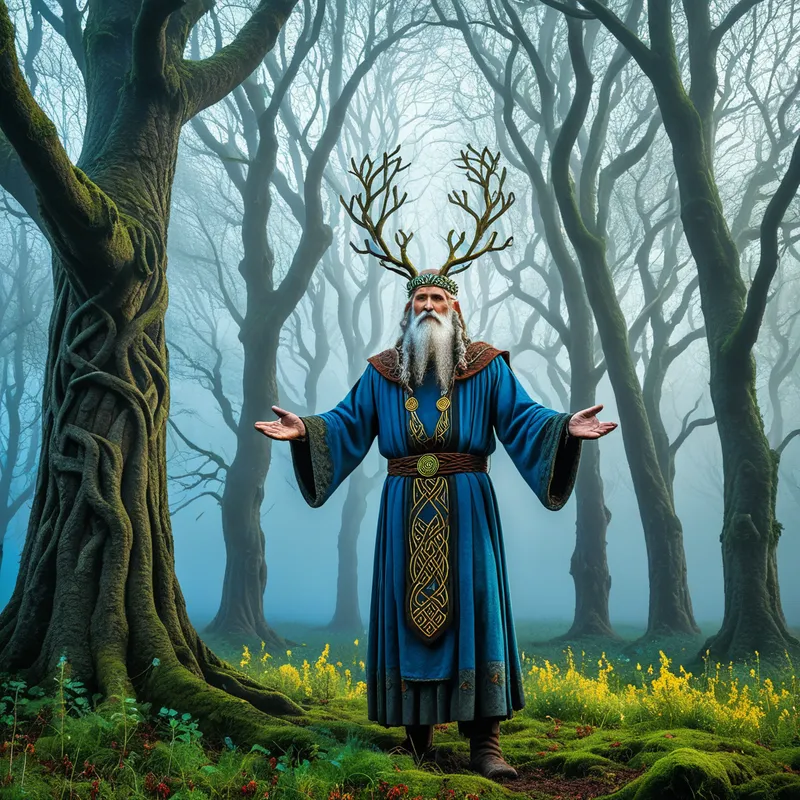
Among the Druids of a great oak grove was one named Fionnchú. He was a keeper of [ogham](/myths/ogham “Myth from Celtic culture.”/) and a listener to [the wind](/myths/the-wind “Myth from Various culture.”/) in the leaves, but his heart ached with a singular longing. He had seen, in the liminal space between waking and trance, the Danu’s own cloak. It was not a single color, but a living weave of impossible shades: a blue deeper than a midwinter night yet brighter than a summer lake, a yellow that held the warmth of the [honeycomb](/myths/honeycomb “Myth from Natural culture.”/) and the sharpness of the sun, a red that pulsed with the vitality of blood and the serenity of the rowan berry.
“Great Mother,” Fionnchú prayed, his forehead pressed to the root of the eldest oak. “Your children walk in a world of form, yet we are blind to the full garment of your beauty. We see the shape of the leaf, but not its secret laughter. We see the berry, but not its inner fire. Grant us, if you will, a thread of your cloak’s majesty, that we might honor you in our own weaving.”
The grove fell silent. No bird sang. Then, a voice, not in the ear but in the bone, spoke from [the earth](/myths/the-earth “Myth from Hindu culture.”/) itself. “The hue is the breath of the spirit. To take a color is to know the cost of its life. What is given must be returned. Will you pay the price for a glimpse of the spectrum?”
Fionnchú did not hesitate. “I will.”
“Then seek the three children of the in-between: the one that dreams in the chalky hill, the one that flames in the forgotten field, the one that sleeps in the blood-red earth. To wake them, you must give not [water](/myths/water “Myth from Chinese culture.”/), but memory. Not sun, but sacrifice. Pour into their roots the story of your people—their joys, their sorrows, their battles, and their peace. Pour your own breath into the soil. The color you receive will be the echo of what you give.”
And so Fionnchú began his silent vigil. He found the first plant, the woad, with its dusty, grey-green leaves on a windswept slope. For days and nights, he sat with it, singing into the earth the tales of warriors and the vast, lonely blue of [the sea](/myths/the-sea “Myth from Greek culture.”/) they crossed. He breathed his own longing for the infinite into the chalky soil until his lips were cracked and his voice a whisper. And from the heart of the plant, a profound, celestial blue began to whisper back.
He journeyed on, weak but determined, to a sun-baked meadow and found the second, the weld. To this one, he poured stories of harvest, of golden grain, of bees drunk on summer light, and of the joyful, fleeting warmth of [the hearth](/myths/the-hearth “Myth from Norse culture.”/)-fire. He gave it the memory of laughter. The plant responded, its stalks flushing with a luminous, vibrant yellow that seemed to hold captured sunlight.
Lastly, in a shaded, fertile hollow, he found the madder sleeping. Here, he offered the deepest sacrifice. He sang of love and loss, of the blood split in birth and in battle, of the enduring pulse of kinship that binds a tribe. He poured into the dark earth his own vitality, his strength ebbing as if from a wound. From the tangled roots, a rich, enduring crimson welled up, the color of heart’s blood and enduring life.
Fionnchú returned to his people carrying not the plants, but the secret. He was gaunt, his own vitality seemingly transferred into the knowledge he bore. He showed them how to coax these sacred hues from the leaves, the stalks, the roots. And as the first length of wool was plunged into the vat, transforming from dull grey to blazing blue, a collective gasp arose. It was not merely dye on cloth. It was a piece of the Sídhe made tangible. The Druid smiled, his task complete, and faded into the legend of the grove, having traded his own mortal vigor to clothe his people in the living colors of the world’s soul.
Cultural Origins & Context
This myth, like much of the deep Celtic mythological corpus, survives not in a single canonical text, but in the fragments of folklore, bardic tradition, and later medieval Irish and Welsh manuscripts that recorded older oral cycles. The “Celtic” world was not a monolith but a tapestry of related tribes across Europe, united by linguistic and broad religious similarities. Theirs was an animistic worldview, where spirit imbued every rock, stream, and plant.
The story of the dye plants would have functioned as a aetiological myth, explaining the profound, almost magical technology of vegetable dyeing. For the Celts, color was not decorative; it was potent. The famed Celtic love of vivid adornment—in woven tartans, enamelled jewellery, and body paint (like woad)—was a sacred act. It was a way of aligning the individual and the tribe with the powers of the natural and supernatural worlds. The Druid, as the intermediary between the human tribe and the otherworldly forces, was the logical protagonist for such a revelation. The myth sanctified the dyer’s craft, elevating it from chore to ritual, and embedded the values of reciprocity and sacred exchange into a fundamental cultural practice.
Symbolic Architecture
At its core, this is a myth of mediated [revelation](/symbols/revelation “Symbol: A sudden, profound disclosure of truth or insight, often through artistic or musical means, that transforms understanding.”/). The full [spectrum](/symbols/spectrum “Symbol: A continuum of possibilities, representing diversity, transition, and the full range of existence from one extreme to another.”/) of existence (the [goddess](/symbols/goddess “Symbol: The goddess symbolizes feminine power, divinity, and the nurturing aspects of life, embodying creation and wisdom.”/)‘s [cloak](/symbols/cloak “Symbol: A garment that conceals identity, protects from elements, or signifies authority and transformation in dreams.”/)) is too much for mortal [perception](/symbols/perception “Symbol: The process of becoming aware of something through the senses. In dreams, it often represents how one interprets reality or internal states.”/). The [Druid](/symbols/druid “Symbol: Druids are ancient spiritual leaders in Celtic mythology, associated with nature, wisdom, and magic.”/) acts as a [transformer](/symbols/transformer “Symbol: A symbol of profound change, adaptability, and the ability to shift between different states, forms, or functions.”/), a [human](/symbols/human “Symbol: The symbol of a human represents individuality, complexity of emotions, and social relationships.”/) [vessel](/symbols/vessel “Symbol: A container or structure that holds, transports, or protects something essential, representing the self, emotions, or life journey.”/) who can negotiate for a translated, embodied form of that divine totality.
The sacred is not found by taking, but by undergoing a trade with the soul of the world.
The three plants—woad (blue), weld (yellow), madder (red)—represent a primal [triad](/symbols/triad “Symbol: A grouping of three representing spiritual unity, divine completeness, and cosmic balance across many traditions.”/), a foundational chromatic cosmology. Blue is the color of the transcendent: the sky, the sea, the spiritual longing. Yellow is the color of the immanent: the sun, vitality, [consciousness](/symbols/consciousness “Symbol: Consciousness represents the state of awareness and perception, encompassing thoughts, feelings, and experiences.”/), and harvested wisdom. Red is the color of the embodied: [blood](/symbols/blood “Symbol: Blood often symbolizes life force, vitality, and deep emotional connections, but it can also evoke themes of sacrifice, trauma, and mortality.”/), [passion](/symbols/passion “Symbol: Intense emotional or physical desire, often linked to love, creativity, or purpose. Represents life force and deep engagement.”/), kinship, and the raw stuff of [life](/symbols/life “Symbol: The symbol of ‘Life’ represents a journey of growth, interconnectedness, and existential meaning, encompassing both the joys and challenges that define human experience.”/) and [death](/symbols/death “Symbol: Symbolizes transformation, endings, and new beginnings; often associated with fear of the unknown.”/). Together, they form a complete [picture](/symbols/picture “Symbol: A picture in a dream often symbolizes one’s perceptions, memories, or the desire to capture and preserve moments in time.”/) of experience. The Druid’s sequential sacrifice—of longing, of joy, of vitality—mirrors the process of investing one’s entire being into the act of creation. The color that emerges is not arbitrary; it is the alchemical result of the specific psychic and emotional [energy](/symbols/energy “Symbol: Energy symbolizes vitality, motivation, and the drive that fuels actions and ambitions.”/) offered.
The central [transaction](/symbols/transaction “Symbol: An exchange of value, energy, or information between parties, representing balance, reciprocity, and the flow of resources in life.”/)—[story](/symbols/story “Symbol: The symbol of ‘Story’ represents the narrative woven through our lives, embodying experiences, lessons, and emotions that shape our identities.”/) and [breath](/symbols/breath “Symbol: Breath symbolizes life, vitality, and the connection between the physical and spiritual realms.”/) for color—is the myth’s master [symbol](/symbols/symbol “Symbol: A symbol can represent an idea, concept, or belief, serving as a powerful tool for communication and understanding.”/). It states that true value, true [beauty](/symbols/beauty “Symbol: This symbol embodies aesthetics, harmony, and the appreciation of life’s finer qualities.”/), is born only from a reciprocal exchange where something of profound inner substance is willingly given.
The Dreamer’s Resonance
When this myth stirs in the modern unconscious, it often manifests in dreams of searching for or working with color. A dreamer might find themselves in a grey, monochromatic landscape, desperately seeking a source of pigment. They may dream of trying to mix paints but finding the colors muddy or inert, or of a prized, vividly colored object fading to drabness.
Somatically, this can correlate with feelings of creative sterility, emotional flatness, or a sense that one’s life lacks “color” or meaning. The psychological process at work is one of depletion through outward giving without sacred reciprocity. The dreamer may be in a role—caregiver, professional, artist—where they are constantly “pouring their story into the soil” for others, but have forgotten the ritual, the sacred intent, that should transform that sacrifice into a vibrant, returned hue. The dream is a call from the psychic [underworld](/myths/underworld “Myth from Greek culture.”/) to examine the exchanges of one’s energy. It asks: What vital part of yourself are you giving away, and what living color is being born from that offering? Or is your inner world becoming the grey, undyed wool?
Alchemical Translation
For the individual on the path of individuation, this myth models the process of psychic transmutation with exquisite precision. Our undeveloped [psyche](/myths/psyche “Myth from Greek culture.”/) is the “dull wool”—full of potential but lacking integration and conscious vibrancy.
The Druid’s journey is [the ego](/myths/the-ego “Myth from Jungian culture.”/)‘s journey into the unconscious (the earth, the goddess) to retrieve the lost or dormant qualities (the colors). The first step is the recognition of longing—the Fionnchú-like ache for a more authentic, spiritually resonant existence. The subsequent sacrifices are not acts of martyrdom, but of conscious investment.
Individuation is the art of dyeing the soul with the pigments of experience, willingly paid for.
To develop the “blue” of spiritual depth (woad), one must invest one’s contemplative longing and acknowledge the vast, often lonely, spaces within. To cultivate the “yellow” of conscious warmth and clarity (weld), one must consciously integrate one’s joys, successes, and light-filled memories into the fabric of identity. To embody the “red” of passionate, grounded life (madder), one must courageously engage with one’s wounds, desires, and the messy, vital blood-pulse of relationship and instinct.
The final, crucial stage is the return and the application of the knowledge. The myth does not end with the Druid hoarding the colors; it ends with him teaching the people how to create them. The alchemical goal is not a private enlightenment, but the ability to weave these transformed aspects into the daily “cloth” of one’s life, creating a personal existence that is a conscious, vibrant reflection of the soul’s full spectrum. The cost is the naive ego’s singular vitality; the reward is the richly dyed, complex tapestry of [the Self](/myths/the-self “Myth from Jungian culture.”/).
Associated Symbols
Explore related symbols from the CaleaDream lexicon: