The Duat Myth Meaning & Symbolism
The perilous underworld journey of the soul, guided by Ra and judged by Osiris, to achieve eternal life through truth and integration.
The Tale of The Duat
Listen. [The world](/myths/the-world “Myth from Tarot culture.”/) you know is but the day. Now, hear the story of the night.
As the last crimson sliver of the sun vanishes behind the western mountains, a profound silence descends. This is not an end, but a turning. Deep within the secret earth, a great door of shadow grinds open. This is the mouth of the Duat.
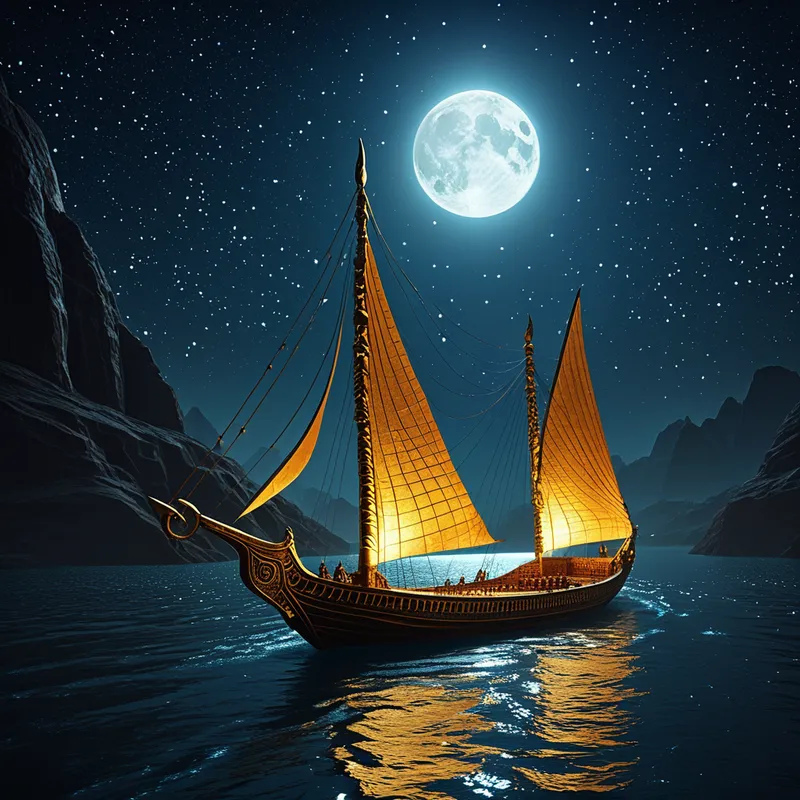
Upon a river of black [water](/myths/water “Myth from Chinese culture.”/), a barque of beaten gold glides silently. It is the Mesektet, the night-barque. Within it stands the weary sun god, Ra, now in his ancient, ram-headed form. His light, which by day scorches [the desert](/myths/the-desert “Myth from Biblical culture.”/), is here a contained, defiant flame, pushing back the utter blackness that presses in from the banks. He is not alone. A council of gods rows and guards: Heka whispers spells to bind the darkness, [Sekhmet](/myths/sekhmet “Myth from Egyptian culture.”/) bares her teeth at the shapeless things that writhe in the deep.
For this is a journey through the corpse of the world. [The river](/myths/the-river “Myth from Buddhist culture.”/) winds through twelve cavernous regions, each a kingdom of its own dread. In the first hours, the shores are barren. Then, the whispers begin. Forms coalesce from the gloom: serpentine Apep, who seeks daily to devour the sun and unravel creation, rises from the murk, its coils threatening to crush the barque. Gods thrust spears of light into its hide, and the battle is thunderous and desperate, a struggle that must be won anew each night.
Beyond the serpent lie lands of fire and inverted lakes, fields of silent spirits who long for the breath of life. The barque passes gates of flame, each manned by a guardian whose name is a secret and whose face is a terror. To pass, Ra must speak their true names, the magic words that unlock [the way](/myths/the-way “Myth from Taoist culture.”/). The air grows thick with the scent of [lotus](/myths/lotus “Myth from Hindu culture.”/) and decay.
At the deepest hour, in the silent core of the night, the barque reaches the seventh region. Here, the waters grow still. Upon a throne of lapis lazuli sits [Osiris](/myths/osiris “Myth from Global/Universal culture.”/), the green-skinned lord, wrapped in white linen, crowned with the tall plumes of truth. He is both judge and the judged, the first to make this journey and live. Here, Ra’s light mingles with the cool, phosphorescent glow of [Osiris](/myths/osiris “Myth from Global/Universal culture.”/), a moment of profound union between the sun and the soul of [the earth](/myths/the-earth “Myth from Hindu culture.”/).
Revived by this meeting, the barque begins its ascent. The waters lighten. The final gates open onto a marsh of rebirth. The [scarab beetle](/myths/scarab-beetle “Myth from Egyptian culture.”/), [Khepri](/myths/khepri “Myth from Egyptian culture.”/), pushes the solar disk from the eastern horizon. Ra, now young and fierce once more, steps from the night-barque into the day-barque, and dawn breaks over the world. The Duat has been traversed. The sun is reborn. The world lives again.
Cultural Origins & Context
The myth of the Duat was not mere folklore; it was the central cosmological drama of Egyptian civilization, a divine template mirrored in the life of the Nile and the fate of every person. Its primary texts are the so-called “Books of the Netherworld”—the Amduat, the Book of Gates, the Book of Caverns—painted in exquisite detail on the walls of royal tombs in the Valley of the Kings. These were not books for the living to read, but maps and guides for the deceased [pharaoh](/myths/pharaoh “Myth from Egyptian culture.”/), who was identified with Ra and Osiris.
The myth was performed nightly in temple rituals, where priests enacted the sun god’s struggle to ensure cosmic order (Maat) over chaos (Isfet). For the common people, the myth was embedded in funerary practices. Coffin Texts and later, the Book of the Dead, contained the spells, passwords, and knowledge needed to navigate [the underworld](/myths/the-underworld “Myth from Greek culture.”/), avoid its pitfalls, and pass the final [judgement](/myths/judgement “Myth from Tarot culture.”/). The Duat was both a specific destination after death and a parallel, ever-present dimension that the sun—and by extension, the justified soul—had to engage with for renewal to be possible.
Symbolic Architecture
The Duat is the ultimate [landscape](/symbols/landscape “Symbol: Landscapes in dreams are powerful symbols representing the dreamer’s emotional state, personal journey, and the broader context of life situations.”/) of the [soul](/symbols/soul “Symbol: The soul represents the essence of a person, encompassing their spirit, identity, and connection to the universe.”/). It is not a place of [punishment](/symbols/punishment “Symbol: A dream symbol representing consequences for actions, often tied to guilt, societal rules, or internal moral conflicts.”/), but of process. Its [river](/symbols/river “Symbol: A river often symbolizes the flow of emotions, the passage of time, and life’s journey, reflecting transitions and movement in one’s life.”/) is the flow of [consciousness](/symbols/consciousness “Symbol: Consciousness represents the state of awareness and perception, encompassing thoughts, feelings, and experiences.”/) into the unconscious. The twelve regions correspond to the twelve [hours](/symbols/hours “Symbol: Hours symbolize the passage of time, representing urgency, deadlines, or the fleeting nature of experiences.”/) of [night](/symbols/night “Symbol: Night often symbolizes the unconscious, mystery, and the unknown, representing the realm of dreams and intuition.”/), symbolizing a complete cycle of [dissolution](/symbols/dissolution “Symbol: The process of breaking down, dispersing, or losing form, often representing transformation, release, or the end of a state of being.”/) and re-formation.
The Duat is the psychic womb where the light of identity is dissolved in order to be reconstituted, truer and more resilient than before.
Ra represents the conscious ego, the solar principle of will, [clarity](/symbols/clarity “Symbol: A state of mental transparency and sharp focus, often representing resolution of confusion or attainment of insight.”/), and [purpose](/symbols/purpose “Symbol: Purpose signifies direction, meaning, and intention in life, often reflecting personal ambitions and core values.”/). His nightly [journey](/symbols/journey “Symbol: A journey in dreams typically signifies adventure, growth, or a significant life transition.”/) is [the ego](/myths/the-ego “Myth from Jungian culture.”/)‘s necessary descent into the unknown [depths](/symbols/depths “Symbol: Represents the subconscious, hidden emotions, or foundational aspects of the self, often linked to primal fears or profound truths.”/) of the [psyche](/myths/psyche “Myth from Greek culture.”/). The monstrous guardians—Apep, the gatekeepers—are the personified shadows, resistances, and forgotten traumas that guard the thresholds of deeper self-[knowledge](/symbols/knowledge “Symbol: Knowledge symbolizes learning, understanding, and wisdom, embodying the acquisition of information and enlightenment.”/). To pass them, one must know their “true names”—a profound psychological [truth](/symbols/truth “Symbol: Truth represents authenticity, honesty, and the quest for knowledge beyond mere appearances.”/) meaning we must fully acknowledge and integrate these aspects, not simply fight them.
The union with Osiris in the depths is the critical [moment](/symbols/moment “Symbol: The symbol of a ‘moment’ embodies the significance of transient experiences that encapsulate emotional depth or pivotal transformations in life.”/). Osiris is the [archetype](/symbols/archetype “Symbol: A universal, primordial pattern or prototype in the collective unconscious that shapes human experience, behavior, and creative expression.”/) of the Self, the one who has been dismembered (fragmented) and reassembled (integrated). He is the psychic substrate, the [pattern](/symbols/pattern “Symbol: A ‘Pattern’ in dreams often signifies the underlying structure of experiences and thoughts, representing both order and the repetitiveness of life’s situations.”/) of wholeness that exists even in the state of “[death](/symbols/death “Symbol: Symbolizes transformation, endings, and new beginnings; often associated with fear of the unknown.”/)” or unconsciousness. When the ego (Ra) connects with [the Self](/myths/the-self “Myth from Jungian culture.”/) (Osiris), it is revitalized not by its own light alone, but by the deeper, organic wisdom of the whole psyche.
The Dreamer’s Resonance
When the architecture of the Duat appears in modern dreams, it signals a profound process of nocturnal initiation. The dreamer is not merely having an “[underworld](/myths/underworld “Myth from Greek culture.”/) dream”; they are on the Mesektet.
Dreams of traveling on a dark river or through a series of labyrinthine tunnels or chambers mirror the journey through the regions. Encountering strange, hybrid, or threatening creatures at gates or thresholds represents the confrontation with shadow content—repressed emotions, complexes, or unlived potentials—that block further progress. The somatic feeling is often one of weight, slow movement, and palpable dread or awe.
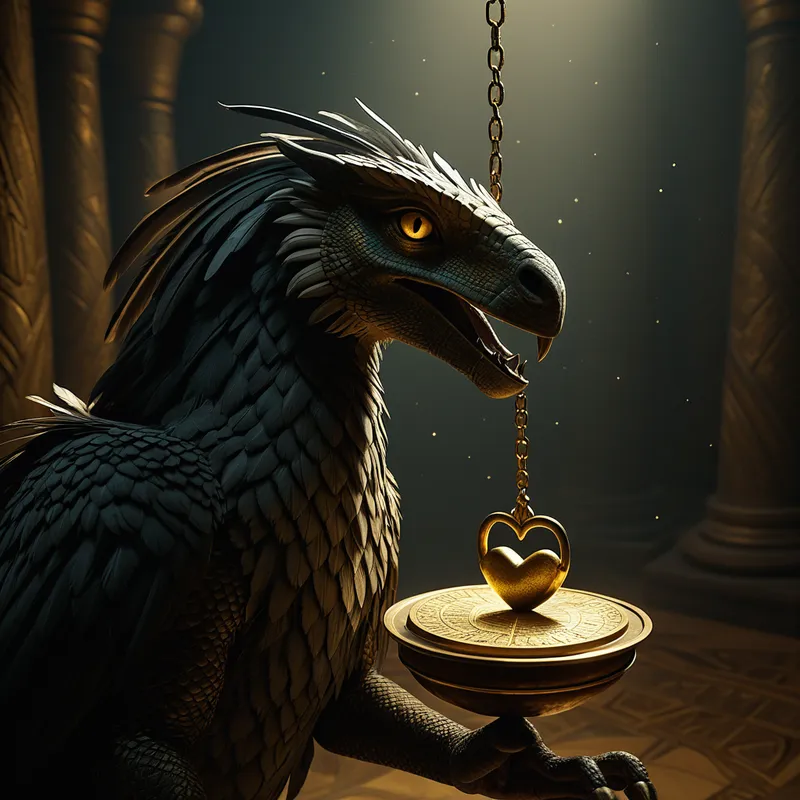
A dream of one’s heart being weighed is a direct resonance of the Judgement Hall. This indicates a deep, unconscious self-assessment where the integrity of one’s life actions (the heart) is being measured against one’s inner truth (the feather). The anxiety in such a dream is the fear of Ammit, the fear that parts of oneself will be found wanting and devoured, leading to psychic disintegration. Successfully navigating this dreamscape points to a soul undergoing a rigorous, transformative self-examination, essential for psychological growth.
Alchemical Translation
The alchemy of the Duat is a precise model for individuation. It maps the [nigredo](/myths/nigredo “Myth from Alchemical culture.”/), the blackening, the descent into [the prima materia](/myths/the-prima-materia “Myth from Alchemical culture.”/) of the soul.
The first step is the willingness to set—the ego’s consent to relinquish daytime control and descend. The battle with Apep is the struggle against the chaos that arises when old structures dissolve. The guided journey, with its divine council, signifies that while the descent is solitary, we are aided by inner archetypal resources (wisdom, protection, magic) if we can recognize them.
The judgement is not a verdict from an external god, but the soul’s own ruthless audit of its alignment with its deepest truth.
The critical alchemical operation is the conjunctio, [the sacred marriage](/myths/the-sacred-marriage “Myth from Various culture.”/) in the depths. This is the moment when the conscious attitude (Ra) is humbled and united with the guiding pattern of wholeness (Osiris). From this union comes the albedo, the whitening, and the final [rubedo](/myths/rubedo “Myth from Alchemical culture.”/), the reddening—symbolized by the triumphant sunrise. The reborn sun is not the old ego, but an ego-Self axis, a conscious personality now informed by and in service to the greater totality of the psyche.
For the modern individual, the Duat myth teaches that renewal is not found by staying in the light, but by courageously navigating the darkness within. Our crises, depressions, and periods of profound confusion are our personal hours of the night. The myth assures us that this journey has a structure, a purpose, and a dawn—if we have the courage to learn the names of our demons and the integrity to balance our heart against the feather of our own soul’s truth.
Associated Symbols
Explore related symbols from the CaleaDream lexicon: