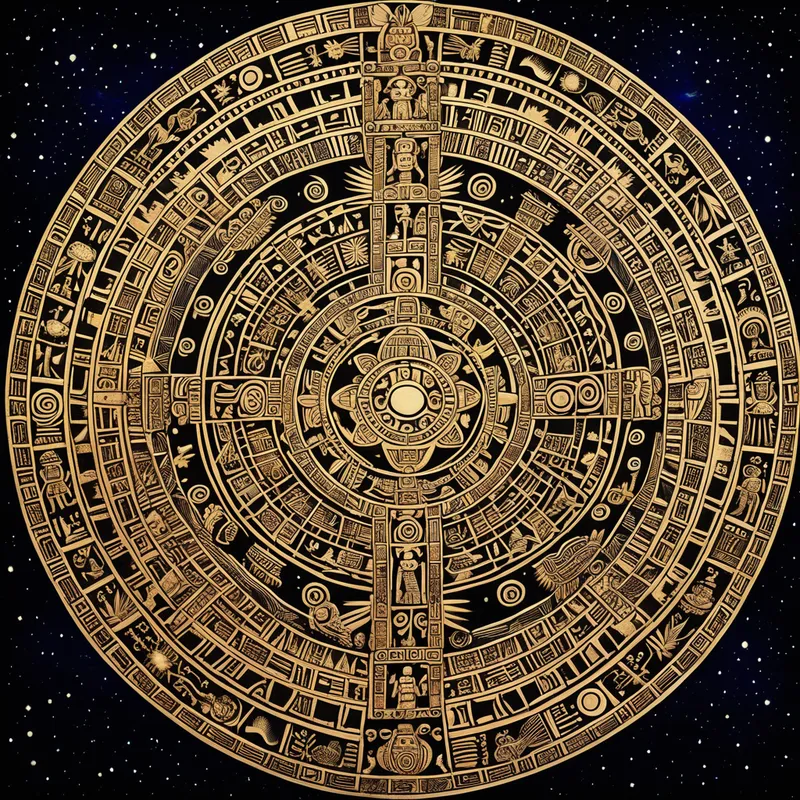
The Dresden Codex Venus Table Myth Meaning & Symbolism
A tale of celestial war, where the Morning Star's death and rebirth orchestrates the cosmic order, weaving fate from sacrifice and divine light.
The Tale of The Dresden Codex Venus Table
Listen. [The sky](/myths/the-sky “Myth from Persian culture.”/) is not empty. It is a battlefield, a parchment, a great beating heart. Before the first corn sprouted from the bones of [the earth](/myths/the-earth “Myth from Hindu culture.”/), the story was written in fire and shadow, in the relentless march of a single, brilliant wanderer: Kukulkan, the Feathered Serpent, but also Xux Ek, the Wasp Star, whose sting brings war.
In the deep, green silence of the First World, the lords of Xibalba grew jealous of the light. They hated the laughter of the Hero Twins, the prosperity brought by the Maize God. So they laid a trap not on earth, but in the heavens. They captured the light of dawn itself—[the Morning Star](/myths/the-morning-star “Myth from Astrological culture.”/). They dragged it down into the belly of [the world](/myths/the-world “Myth from Tarot culture.”/), into the endless night. For eight days, the sun rose into a silent, starless sky. The world held its breath. The rhythm was broken.
But a heart that stops must beat again. From the place of sacrifice, from the very court of the Death Gods, a struggle began. It was not a battle of strength, but of time, of perfect, patient mathematics. The spirit of the Morning Star, intertwined with the sacrificed Maize God, began a slow, inevitable ascent. It fought its way through the black waters, past [the star](/myths/the-star “Myth from Tarot culture.”/)-demons, its light a cold, piercing calculation.
On the ninth day, a sliver of impossible light cut the eastern horizon. Not the warm gold of the sun, but the sharp, silver promise of Xux Ek. It was a resurrection, but a changed one. This was no gentle [herald](/myths/herald “Myth from Greek culture.”/). This was a warrior reborn from [the underworld](/myths/the-underworld “Myth from Greek culture.”/), its light holding the memory of the dark. It climbed, a solitary beacon, for 263 days—a reign of piercing clarity and often, of omen. Then, as if remembering its debt to the dark, it turned and fled the sun, descending as the Evening Star for another season, a fading ember.
For 50 days, it vanished. The world waited. The priests watched the empty space where the star should be. This was the dangerous time, the heart of sky’s hidden breath. And then, once more, from the jaws of the [underworld](/myths/underworld “Myth from Greek culture.”/), it would burst forth. A cycle of 584 days. Death. Ascent. Reign. Descent. Sacrificial disappearance. Rebirth. Not once, but forever. A celestial heart, beating the world into existence, its pulse dictating the time of planting, the time of war, the very fabric of fate woven from its light and its long, dark sleep.
Cultural Origins & Context
This is not a myth told around a single fire, but one calculated on temple walls and painted in bark-paper books. The Dresden Codex, one of the few surviving pre-Columbian Maya books, contains its most precise articulation: the [Venus](/myths/venus “Myth from Alchemical culture.”/) Table. This was esoteric, priestly knowledge—astronomy as high liturgy. The myth was lived through rigorous observation. Astronomer-priests on pyramid-tops tracked the planet’s synodic cycle with breathtaking accuracy, correlating its phases with the Tzolk’in and Haab’ calendars.
Its societal function was profound and pragmatic. The reappearance of Venus as the Morning Star after its inferior conjunction was a time of supreme portent. It was associated with Chaac and renewal, but also with the warlike aspect of Kukulkan. Historical records suggest military campaigns were timed to its heliacal risings, harnessing the star’s perceived power. The myth thus governed the cycle of life (planting guided by the Maize God association) and death (war guided by the star’s martial aspect), embedding the cosmic drama into the very rhythm of kingdom and cornfield.
Symbolic Architecture
At its core, the Venus [Table](/symbols/table “Symbol: Tables in dreams often symbolize stability, social interactions, and a platform for discussions, negotiations, or decisions in our waking life.”/) myth is a grand [symbol](/symbols/symbol “Symbol: A symbol can represent an idea, concept, or belief, serving as a powerful tool for communication and understanding.”/) of the necessary, cyclical interplay between order and [chaos](/symbols/chaos “Symbol: In Arts & Music, chaos represents raw creative potential, uncontrolled expression, and the breakdown of order to forge new artistic forms.”/), light and darkness, [consciousness](/symbols/consciousness “Symbol: Consciousness represents the state of awareness and perception, encompassing thoughts, feelings, and experiences.”/) and the unconscious.
The light that guides must first be swallowed by the dark. The pattern that saves is born from a sacrifice to the formless.
Venus, especially as the Morning Star, represents emergent consciousness—the “aha” [moment](/symbols/moment “Symbol: The symbol of a ‘moment’ embodies the significance of transient experiences that encapsulate emotional depth or pivotal transformations in life.”/), the [dawn](/symbols/dawn “Symbol: The first light of day, symbolizing new beginnings, hope, and the transition from darkness to illumination.”/) of an [idea](/symbols/idea “Symbol: An ‘Idea’ represents a spark of creativity, innovation, or realization, often emerging as a solution to a problem or a new outlook on life.”/), the heroic ego asserting itself. But this consciousness is not born in a vacuum. It is forged in the Xibalba of the personal and [collective unconscious](/symbols/collective-unconscious “Symbol: The Collective Unconscious refers to the part of the unconscious mind shared among beings of the same species, embodying universal experiences and archetypes.”/). The eight days of darkness signify the inevitable [dissolution](/symbols/dissolution “Symbol: The process of breaking down, dispersing, or losing form, often representing transformation, release, or the end of a state of being.”/) of old structures, the “dark [night](/symbols/night “Symbol: Night often symbolizes the unconscious, mystery, and the unknown, representing the realm of dreams and intuition.”/) of the [soul](/symbols/soul “Symbol: The soul represents the essence of a person, encompassing their spirit, identity, and connection to the universe.”/)” that precedes [insight](/symbols/insight “Symbol: A sudden, deep understanding of a complex situation or truth, often arriving unexpectedly and illuminating hidden connections.”/). The [planet](/symbols/planet “Symbol: A planet symbolizes vastness, exploration, and the interconnectedness of life. It represents our place in the universe and the broader context of existence.”/)‘s dual [identity](/symbols/identity “Symbol: Identity represents the sense of self, encompassing personal beliefs, cultural background, and social roles.”/)—[life](/symbols/life “Symbol: The symbol of ‘Life’ represents a journey of growth, interconnectedness, and existential meaning, encompassing both the joys and challenges that define human experience.”/)-giver/Maize God and [destroyer](/symbols/destroyer “Symbol: A figure or force representing radical change through dismantling existing structures, often evoking fear and awe.”/)/[Wasp](/symbols/wasp “Symbol: A symbol of aggression, protection, and hidden threats, often representing anger, social conflict, or defensive instincts.”/) Star—encapsulates the dual potential of any awakened power: it can cultivate or it can conquer.
The 584-day cycle is a master symbol of individuation. It is not a [linear](/symbols/linear “Symbol: Represents order, predictability, and a direct, step-by-step progression. It symbolizes a clear path from cause to effect.”/) [path](/symbols/path “Symbol: The ‘path’ symbolizes a journey, choices, and the direction one’s life is taking, often representing individual growth and exploration.”/) to a [static](/symbols/static “Symbol: Static represents interference, disruption, and the breakdown of clear communication or signal, often evoking feelings of frustration and disconnection.”/) goal, but a recursive spiral. Each “return” of the Morning Star is a new level of [integration](/symbols/integration “Symbol: The process of unifying disparate parts of the self or experience into a cohesive whole, often representing psychological wholeness or resolution of internal conflict.”/), having carried a [piece](/symbols/piece “Symbol: A ‘piece’ in dreams often symbolizes a fragment of the self or a situation that requires integration, reflection, or understanding.”/) of the [underworld](/symbols/underworld “Symbol: A symbolic journey into the unconscious, representing exploration of hidden aspects of self, transformation, or confronting repressed material.”/) back into the light. The invisible [period](/symbols/period “Symbol: Periods in dreams can symbolize cyclical patterns, renewal, and the associated emotions of loss or change throughout life.”/) of inferior [conjunction](/symbols/conjunction “Symbol: In arts and music, a conjunction represents the harmonious or dissonant merging of separate elements to create a new, unified whole.”/) is perhaps the most potent symbol: the fruitful void, the necessary return to the primal soup where transformation occurs out of [sight](/symbols/sight “Symbol: Sight symbolizes perception, awareness, and insight, representing both physical and inner vision.”/), before a new [structure](/symbols/structure “Symbol: Structure in dreams often symbolizes stability, organization, and the framework of one’s life, reflecting how one perceives their environment and personal life.”/) can manifest.
The Dreamer’s Resonance
When this myth stirs in the modern dreamer, it often manifests as dreams of precise, repeating cycles interrupted by sudden voids. One might dream of a brilliantly lit path that abruptly ends at a cliff, of a clock whose hands move in perfect five-pointed stars, or of a guiding light that transforms into a stinging insect.
Somnatically, this can correlate with feelings of cardiac arrhythmia—a sense of the inner rhythm being off—or with sudden, piercing insights (the “sting” of the Wasp Star) that arrive during periods of depression or stagnation (the descent into the underworld). Psychologically, the dreamer is navigating a process of integration through chronology. The unconscious is presenting the [psyche](/myths/psyche “Myth from Greek culture.”/)‘s own timing, its necessary periods of activity (the 263-day reign) and incubation (the 50-day disappearance). To dream of this myth is to encounter [the Self](/myths/the-self “Myth from Jungian culture.”/) not as a static image, but as a dynamic, celestial timetable. The conflict arises when [the ego](/myths/the-ego “Myth from Jungian culture.”/) attempts to live in perpetual “Morning Star” brilliance, refusing the essential, vanishing phase of renewal.
Alchemical Translation
The alchemical journey mirrored here is the opus contra naturam—the work against nature’s entropy—which is, paradoxically, a collaboration with nature’s deepest laws. The Venus cycle models the stages of psychic transmutation for the individual seeking wholeness.
First, the Descent (Calcinatio/[Nigredo](/myths/nigredo “Myth from Alchemical culture.”/)): The conscious attitude (the shining star) is pulled into the underworld of shadow, complex, and unresolved pain. This is the sacrificial death of the Maize God. The ego is stripped bare.
Second, the Ascent (Sublimatio): From the dissolution, a new conscious principle begins to crystallize. This is the hard-won insight, the “warrior” knowledge born of suffering. It is sharp, clear, and often disruptive (the reign of the Morning Star).
Third, the Return (Coagulatio): This new consciousness must descend again, to be applied to earthly life, relationships, and the body. It becomes the Evening Star—softer, more reflective, integrating its light with the approaching dark.
Finally, the Concealment ([Solutio](/myths/solutio “Myth from Alchemical culture.”/)): The most critical phase. All achieved structure must dissolve back into the unconscious waters to be reconfigured. This is the invisible conjunction, the “secret work.” The individual must endure a period of not-knowing, of apparent regression, where the work is handed over to the deeper Self.
The individuated Self is not a fixed state of enlightenment, but the living capacity to endure the complete, sacred cycle—to be brilliant, to fade, to vanish, and to be reborn according to a wisdom deeper than the mind’s own light.
The [triumph](/myths/triumph “Myth from Roman culture.”/) of the myth is not in avoiding the dark, but in making the dark meaningful, in weaving it into an eternal, predictable, and beautiful pattern. The Dresden Codex Venus Table is, ultimately, a map for the soul’s navigation of time itself, teaching that our deepest order is born from a respectful, rhythmic dialogue with chaos.
Associated Symbols
Explore related symbols from the CaleaDream lexicon: