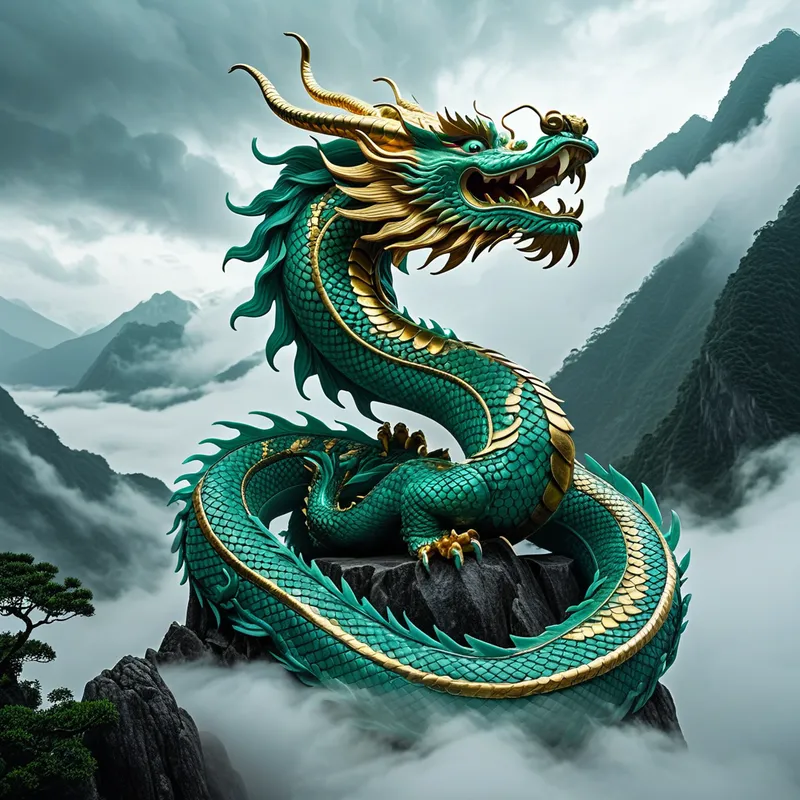
The Dragon Myth Meaning & Symbolism
The celestial dragon, a benevolent force of cosmic order, embodies the harmonious integration of elemental powers and the sovereign self.
The Tale of The Dragon
In the time before time, when [the world](/myths/the-world “Myth from Tarot culture.”/) was a broth of mist and potential, the heavens and [the earth](/myths/the-earth “Myth from Hindu culture.”/) were not yet separate. From this primordial chaos, the first breaths coalesced—not as a beast of destruction, but as a principle of order. It was the Long.
Hear now of its awakening. It did not hatch from an egg of stone, but unfolded from the very fabric of the Qi. Its scales were the patina of ancient bronze, its eyes twin pools of molten amber holding the memory of stars. It moved not with the thrashing of a monster, but with the inevitable, graceful undulation of a river finding its course. Where its claws touched the formless earth, mountains rose in reverence. Where its whiskers trailed through the damp air, valleys were carved and rivers began their eternal song to [the sea](/myths/the-sea “Myth from Greek culture.”/).
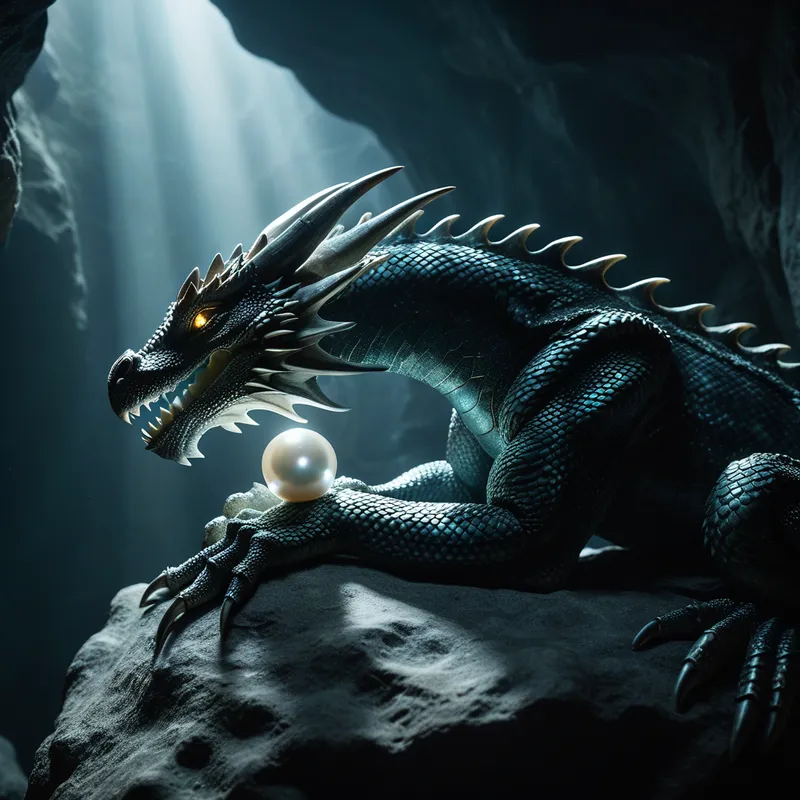
It communed with the elements, for it was their master and their child. It would ascend on thermals of its own making, summoning the clouds not with rage, but with a thought. Thunder was the drumbeat of its passage; gentle rain, its exhale of blessing. It sought not hoards of gold, but harmony. Its treasure was the Flaming [Pearl](/myths/pearl “Myth from Chinese culture.”/), a sphere of condensed moonlight and cosmic intent, which it chased through the celestial vault not to consume, but to balance—to keep the celestial rhythms true.
The people of the nascent world, looking up from their muddy fields and fragile boats, did not tremble in fear. They felt a resonance in their bones. They saw in the dragon’s dance across the seasons the very pattern of life: the potential of spring in its rising, the fullness of summer in its soaring, the harvest of autumn in its coiling descent, the deep wisdom of winter in its hidden slumber within the watery depths. It was the unseen sovereign, the animating spirit of the land itself, the breath that connected the yellow earth to the azure sky. Its story was not one of conflict and slaughter, but of emergence, presence, and benevolent governance. It was the tale of the world coming into its own rightful, majestic order.
Cultural Origins & Context
The Chinese dragon, or Long, is not a singular myth from a single text, but a living, breathing archetype woven into the very fabric of Chinese civilization over millennia. Its origins are syncretic, emerging from ancient totemic worship of crocodiles, snakes, and thunderclouds, eventually coalescing into the composite, celestial creature we recognize. Unlike the fire-breathing, treasure-hoarding dragons of the West, the Long was primarily a deity of [water](/myths/water “Myth from Chinese culture.”/) and weather, a benevolent ruler of rivers, lakes, and rains essential for agrarian life.
It was the emblem of the Mandate of Heaven, the divine justification for imperial authority. The emperor was the “Dragon-Face,” his throne the “Dragon Seat,” and his robes embroidered with the five-clawed dragon, a symbol of his role as the mediator between heaven and earth. This myth was passed down not just through folklore and festivals like the Dragon Boat Festival, but through state ritual, art, architecture, and cosmology. Its societal function was profound: to model an ideal of power that was not tyrannical, but harmonizing—a power that served the cosmic and social order, bringing rain, fertility, and peace.
Symbolic Architecture
Psychologically, the [dragon](/symbols/dragon “Symbol: Dragons are potent symbols of power, wisdom, and transformation, often embodying the duality of creation and destruction.”/) represents the awesome, integrative power of [the Self](/myths/the-self “Myth from Jungian culture.”/)—the total, organized [psyche](/myths/psyche “Myth from Greek culture.”/) that transcends [the ego](/myths/the-ego “Myth from Jungian culture.”/). It is not the [shadow](/symbols/shadow “Symbol: The ‘shadow’ embodies the unconscious, repressed aspects of the self and often represents fears or hidden emotions.”/) to be slain, but the sovereign wholeness to be integrated.
The dragon is the embodied paradox: the coiled potential in the depths of the unconscious and the soaring actualization in the heights of spirit.
Its composite anatomy is a map of psychic [integration](/symbols/integration “Symbol: The process of unifying disparate parts of the self or experience into a cohesive whole, often representing psychological wholeness or resolution of internal conflict.”/): the horns of a stag ([intuition](/symbols/intuition “Symbol: The immediate, non-rational understanding of truth or insight, often described as a ‘gut feeling’ or inner knowing that bypasses conscious reasoning.”/) and [connection](/symbols/connection “Symbol: Connection symbolizes relationships, communication, and bonds among individuals.”/) to [nature](/symbols/nature “Symbol: Nature symbolizes growth, connectivity, and the primal forces of existence.”/)), the head of a [camel](/symbols/camel “Symbol: A symbol of endurance, survival, and journey through harsh conditions, representing the ability to carry burdens across difficult terrain.”/) (endurance and [journey](/symbols/journey “Symbol: A journey in dreams typically signifies adventure, growth, or a significant life transition.”/) through the arid places of the [soul](/symbols/soul “Symbol: The soul represents the essence of a person, encompassing their spirit, identity, and connection to the universe.”/)), the eyes of a [demon](/symbols/demon “Symbol: Demons often symbolize inner fears, repressed emotions, or negative aspects of oneself that the dreamer is struggling to confront.”/) (penetrating [insight](/symbols/insight “Symbol: A sudden, deep understanding of a complex situation or truth, often arriving unexpectedly and illuminating hidden connections.”/) into [the shadow](/myths/the-shadow “Myth from Jungian culture.”/)), the [neck](/symbols/neck “Symbol: The neck in dreams often symbolizes communication, vulnerability, and the connection between thoughts and emotions.”/) of a snake (flexibility and connection to the chthonic), the belly of a clam (the [capacity](/symbols/capacity “Symbol: A measure of one’s potential, limits, or ability to contain, process, or achieve something, often reflecting self-assessment or external demands.”/) to nurture and produce pearls of wisdom), the scales of a carp (perseverance through difficulty), the claws of an [eagle](/symbols/eagle “Symbol: The eagle is a symbol of power, freedom, and transcendence, often representing a person’s aspirations and higher self.”/) (the [ability](/symbols/ability “Symbol: In dreams, ‘ability’ often denotes a recognition of skills or potential that one possesses, whether acknowledged or suppressed.”/) to grasp and hold onto [truth](/symbols/truth “Symbol: Truth represents authenticity, honesty, and the quest for knowledge beyond mere appearances.”/)), and the paws of a [tiger](/symbols/tiger “Symbol: The tiger symbolizes power, courage, and primal instincts, often representing untamed energy and aggression.”/) (grounded power and [authority](/symbols/authority “Symbol: A symbol representing power structures, rules, and control, often reflecting one’s relationship with societal or personal governance.”/)). It is the ultimate [chimera](/symbols/chimera “Symbol: The Chimera symbolizes the blending of oppositional forces, embodying complexity and the multifaceted nature of reality.”/), symbolizing the harmonious unification of all one’s disparate instincts, talents, and ancestral inheritances.
The Flaming [Pearl](/symbols/pearl “Symbol: The pearl symbolizes purity, wisdom, and the beauty derived from overcoming adversity.”/) it perpetually chases is the elusive goal of individuation—wisdom, enlightenment, or the fully realized Self. The [pursuit](/symbols/pursuit “Symbol: A chase or being chased in dreams often reflects unresolved anxieties, unfulfilled desires, or internal conflicts demanding attention.”/) is not frantic, but a dynamic, eternal dance; the goal is not to possess it statically, but to be in right [relationship](/symbols/relationship “Symbol: A representation of connections we have with others in our lives, often reflecting our emotional state.”/) with its illuminating [energy](/symbols/energy “Symbol: Energy symbolizes vitality, motivation, and the drive that fuels actions and ambitions.”/).
The Dreamer’s Resonance
When the dragon appears in a modern dream, it rarely arrives as a threat. Its presence signals a profound somatic and psychological process: the stirring of one’s innate, sovereign authority. You may dream of seeing a dragon coiled peacefully around a mountain (your own foundational identity), of flying alongside one (aligning with a greater power within), or of discovering you are the dragon, looking out through its eyes.
Somatically, this can correlate with a feeling of expanded breath, a sense of latent strength in the spine, or a deep, resonant calm. Psychologically, it marks a movement from a fragmented, ego-driven state toward a more integrated, Self-directed existence. The conflict in such dreams is often not with the dragon, but with the dreamer’s own resistance to this power—the fear of one’s own capacity, the “imposter syndrome” that questions one’s right to wield such harmonious authority. The dragon dream invites the dreamer to stop slaying their own majesty and to begin learning its rhythms.
Alchemical Translation
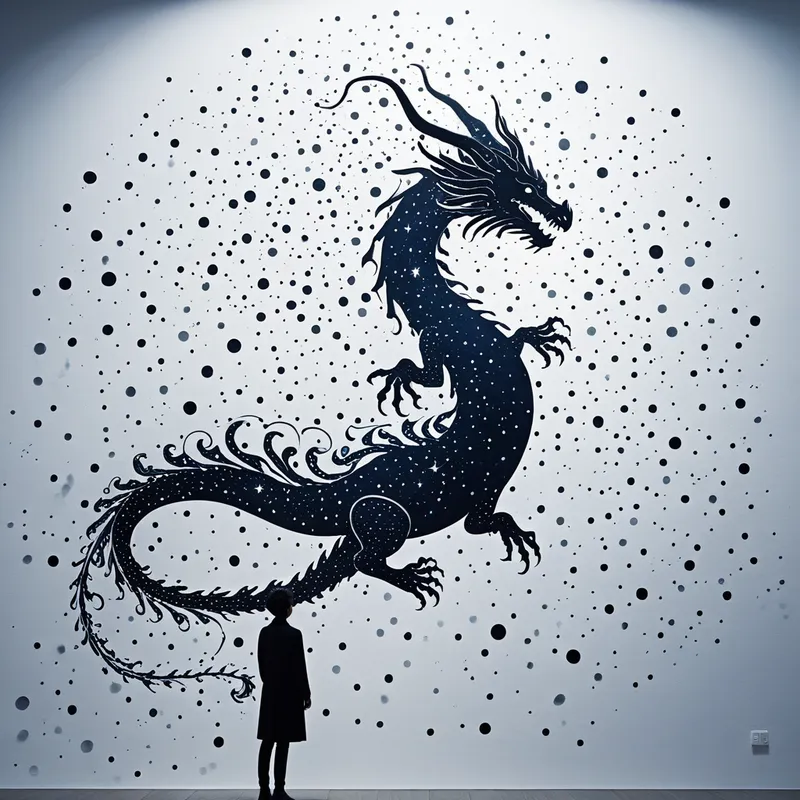
The myth of the dragon models a unique path of psychic transmutation. The Western heroic journey often requires a violent confrontation with the dragon-as-shadow, a splitting and conquering. The alchemy of the Long is one of invitation and assimilation.
Individuation here is not a battle, but a coronation where you recognize you were always the rightful ruler of your inner kingdom.
The process begins in the “watery depths”—the unconscious, emotional, and instinctual realm. One must first acknowledge and honor the raw, chthonic power there (the serpentine nature). The next stage is “gathering the attributes”—consciously developing the various strengths symbolized by the dragon’s composite form (the eagle’s vision, the tiger’s groundedness). The central work is “learning the dance”: harmonizing these attributes so they move as one coherent force, and engaging in the perpetual, dynamic pursuit of the pearl (meaning) without being consumed by the need to finally “have” it.
The [triumph](/myths/triumph “Myth from Roman culture.”/) is not the dragon’s death, but its full awakening and assumption of its role. For the modern individual, this translates to moving from a life of reaction and fragmentation to one of proactive, cohesive personal sovereignty. You become the benevolent ruler of your own psyche, capable of weathering internal storms, bringing fertility to your endeavors, and moving through the world with the graceful, undoubted authority of a force of nature aligned with the cosmos.
Associated Symbols
Explore related symbols from the CaleaDream lexicon: