The Donkey of Bethlehem Myth Meaning & Symbolism
A humble donkey carries the divine burden to Bethlehem, becoming a sacred vessel in the silent, transformative night of incarnation.
The Tale of The Donkey of Bethlehem
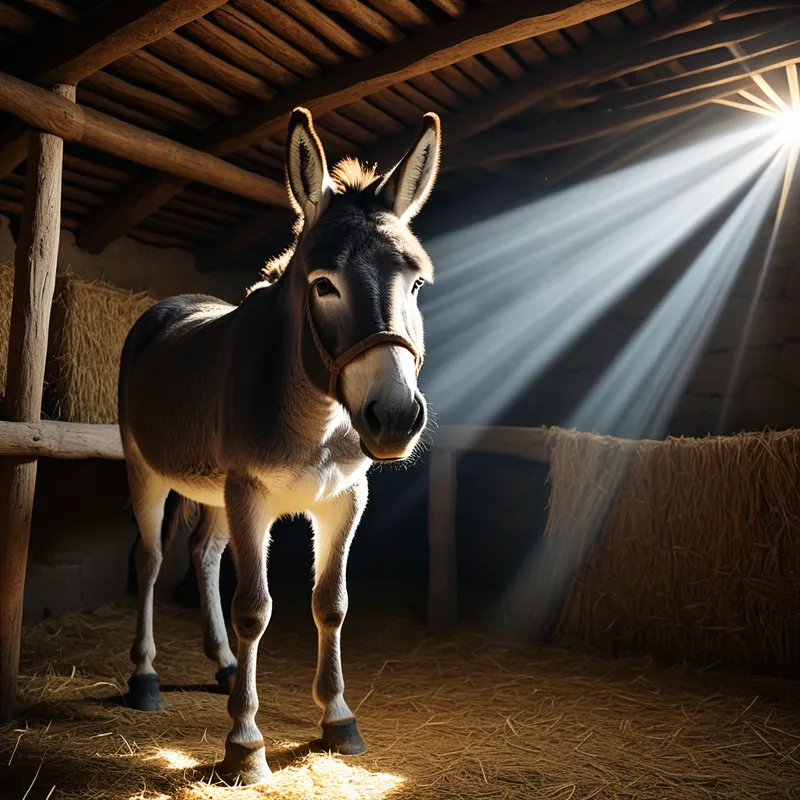
Listen. In the deep, dreaming hours of the world, when empires dozed and stars leaned close to whisper, there was a beast of burden. It was not a creature of legend, not a winged horse or a lion with a mane of fire. It was a donkey, gray and dusty, its coat the color of the road, its eyes pools of ancient patience. It knew the weight of grain sacks and water jars, the sting of the switch, the dust of a thousand forgotten journeys.
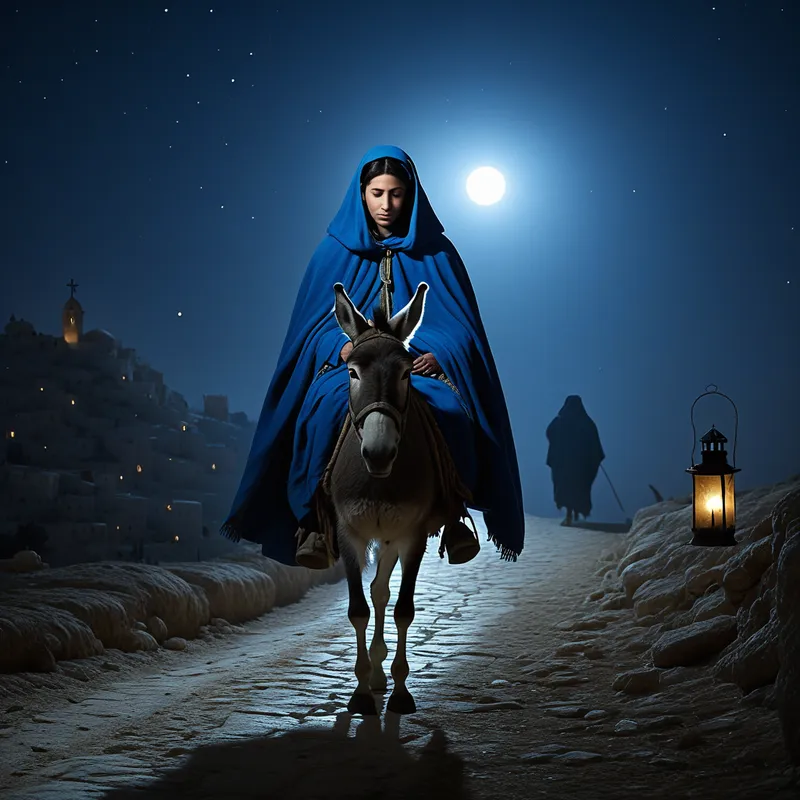
But on this night, the air was different. The very silence hummed. A man named Joseph, his face etched with worry and determination, laid hands upon its back. And with him came a woman, Mary, her form heavy with a child that was not of earth alone. Her touch was not that of a master, but of one who shares a burden. As she settled upon the donkey’s back, a strange warmth bloomed where she sat, not the heat of labor, but a gentle, radiant certainty that seeped into its weary bones.
The road to Bethlehem was a scar upon the hills, hard and unyielding. The donkey placed one careful hoof after another, feeling the precious, trembling balance of the woman it carried. The night pressed in, cold and vast, but above, a single star burned with a fierce, pinpoint clarity, casting long, dramatic shadows. They passed sleeping fields, dark groves of olive trees that seemed to watch, and heard only the crunch of stone underfoot and the soft, rhythmic breath of its passenger.
Arrival brought no rest. The town was a hive of frantic energy, every door shut, every voice raised in refusal. The donkey stood, a patient island in the human storm, bearing its quiet cargo while Joseph pleaded. Finally, they were turned not to an inn, but to the cave behind it, a place of animals and earth. The air was thick with the smell of hay, dung, and damp stone. Here, in this lowest of places, the donkey knelt. It was an instinct, a bending of the knee to make the descent easier for Mary. In that act of humble service, it made of its own back a stepping stone from the world of roads to the world of mystery.
And then, the burden shifted. Not in weight, but in essence. As Mary labored and the cave filled with a sound both utterly human and profoundly other—the cry of a newborn—the donkey stood witness. It saw the child laid in the feeding trough, the manger from which it itself had eaten. In that moment, the beast of burden understood, not with a human mind, but with the whole of its creature-being, that it had carried not just a woman, but a threshold. It had borne the vessel of the divine into the heart of the mundane. Its service was complete. It stood in the warm, golden light of lanterns and starlight, no longer just a donkey, but the first throne, the silent guardian of the incarnation, its patient breath mingling with the holy air.
Cultural Origins & Context
The Donkey of Bethlehem is a figure of apocryphal and folk tradition, a beloved embellishment upon the sparse narrative of the Gospels of Matthew and Luke. While the canonical texts mention no animal by the manger, the human imagination, from a very early period, could not conceive of the scene without them. The donkey, alongside the ox, found its place in the Nativity through texts like the Protoevangelium of James and, more powerfully, through the sermons of early church fathers like St. Augustine and the vision of the prophet Isaiah, who stated “The ox knows its owner, and the donkey its master’s crib” (Isaiah 1:3).
This myth was passed down not from pulpits alone, but through crèches, Christmas pageants, carols, and the oral storytelling of families. Its societal function was multifaceted: it softened the starkness of the divine mystery, making it relatable and tangible. It emphasized the humility of Christ’s birth by placing the God-child in the care of the lowliest of creatures. The donkey became an accessible entry point, especially for children and the common folk, a non-threatening, patient presence in a story of cosmic significance. It modeled a silent, steadfast faithfulness that required no theology to understand, only a heart that recognizes service and love.
Symbolic Architecture
The donkey is the archetype of the humble servant, the embodied principle of bearing. Its symbolism is a profound paradox: strength expressed through submission, dignity found in lowliness, and sacredness revealed through utility.
The divine does not arrive on a chariot of lightning but on the back of that which is accustomed to bearing the world’s weight. The sacred is carried by the seemingly ordinary.
Psychologically, the donkey represents the ego in its most necessary and purified form: not as the grandiose ruler of the psyche, but as the faithful beast of burden for the Self. It is that part of us that shows up, endures the long road, and performs the mundane tasks without fanfare, making space for something new and transformative to be born within our inner stable. The journey symbolizes the necessary movement—often arduous and undertaken under duress (the census)—that precedes any psychological birth. We are compelled by life’s circumstances to travel to an unknown destination within ourselves.
The manger, the feeding trough, is the ultimate symbol of alchemical transmutation. The container for common sustenance becomes the cradle for the divine. This speaks to the psychological truth that our most basic, “animal” instincts and needs—our hunger, our vulnerability, our physicality—are not obstacles to the spiritual life but its very vessel. The divine child, the nascent Self, is born precisely among and from our creatureliness, not in spite of it.
The Dreamer’s Resonance
When the myth of the Bethlehem Donkey stirs in the modern unconscious, it often manifests in dreams of carrying, journeying, or humble service. You may dream of patiently bearing a heavy, precious, or fragile load for someone else. You may find yourself guiding or being an animal through a dark landscape. The setting is frequently one of quiet perseverance—a long walk, a menial task performed with intense focus.
Somatically, this can correlate with a feeling of weight in the shoulders or back, a grounding sense of fatigue that is not entirely unpleasant, or a patient, rhythmic pacing in one’s energy. Psychologically, this dream pattern suggests the dreamer is in a phase of necessary, humble containment. It is the ego’s process of making itself a stable vessel for a new potential emerging from the deeper Self. The conflict is not against a monster, but against impatience, grandiosity, and the desire for recognition. The dream asks: Can you bear the burden of becoming without knowing the destination? Can you serve a process whose glory you will not own? This is the psyche preparing its manger, clearing out the old hay of egoic ambition to make a humble, fit place for what wants to be born.

Alchemical Translation
The alchemy modeled by the donkey is the transmutation of burden into purpose. In the individuation process, we all carry burdens—childhood wounds, societal expectations, personal failures, the sheer weight of consciousness. Initially, we experience these as meaningless suffering, the “grain sacks” of a life we did not choose.
The myth instructs us that the first step is not to cast off the burden, but to allow it to be sanctified by a higher purpose. When Mary mounts the donkey, the nature of its load changes. The individuating ego must ask: What if my anxiety, my sensitivity, my past struggles are not just random weights, but are the very structure upon which a new, more integrated consciousness is meant to ride? The journey to Bethlehem is the conscious acceptance of this question, the commitment to carry it forward even through the “night” of uncertainty and the “closed doors” of rejection.
The stable is not an accident of poverty; it is the only chamber capable of housing an event that unites heaven and earth. Our limitations are the architecture of our transformation.
The final, glorious transmutation occurs at the manger. The beast of burden, by its steadfast presence, becomes a witness to and participant in the coniunctio, the sacred marriage of spirit and matter. Its humble service alchemizes into sacred guardianship. For the modern individual, this translates to the moment when one realizes that their lifelong struggles—their patient endurance, their humble service to family, craft, or inner truth—were not for nothing. They were the necessary, faithful journey that allowed the birth of a genuine, grounded Self. The ego, like the donkey, does not become the Christ-child; it remains the donkey. But it is now a donkey that has carried God, and in that service, finds its eternal, unshakeable dignity. Its burden has become its grace.
Associated Symbols
Explore related symbols from the CaleaDream lexicon: