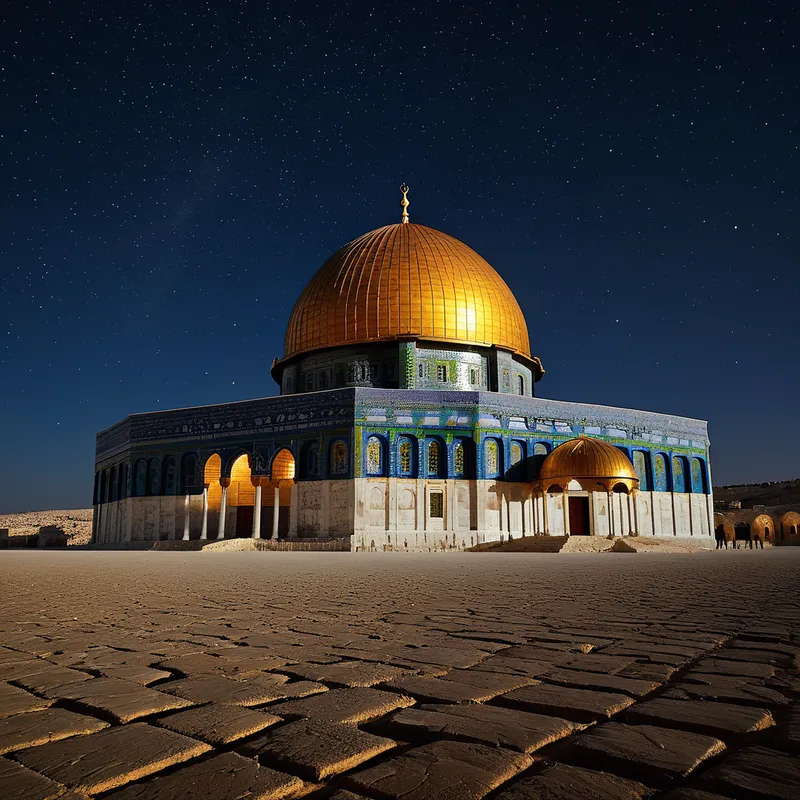
The Dome of the Rock Myth Meaning & Symbolism
The myth of the celestial ascent from the Foundation Stone, where the earthly and heavenly realms meet, establishing the world's sacred center.
The Tale of The Dome of the Rock
Listen, and hear of the place where [the world](/myths/the-world “Myth from Tarot culture.”/) was born, and where a man touched the face of eternity.
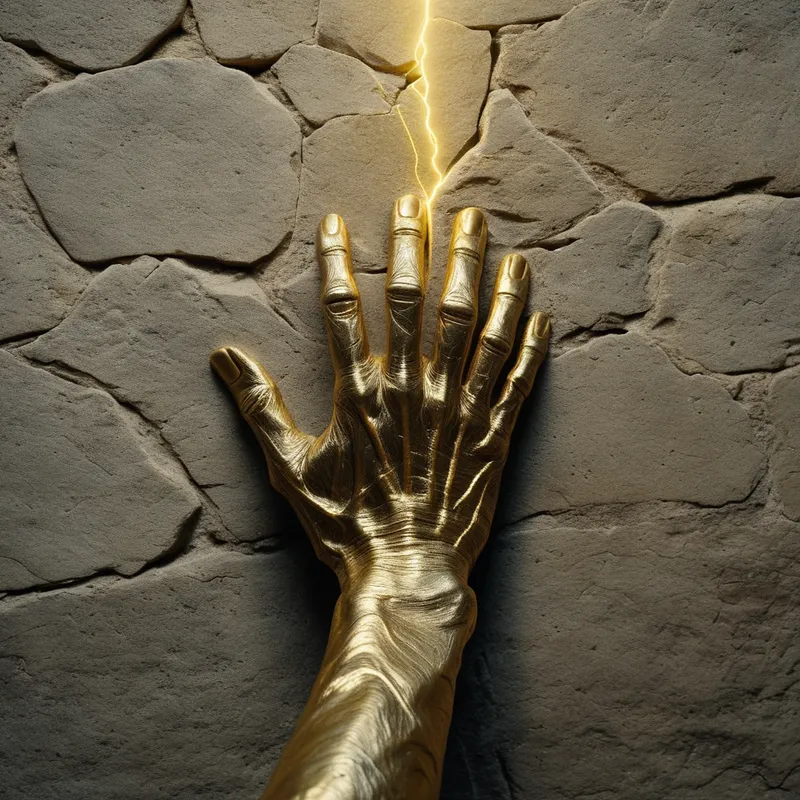
In the heart of the world, where the first light broke upon the formless deep, there lies a stone. It is not a stone like others. It is the Foundation Stone, the navel of [the earth](/myths/the-earth “Myth from Hindu culture.”/), the first solid [thing](/myths/thing “Myth from Norse culture.”/) to emerge from the waters of chaos. Upon this rock, the weight of the world rests. Above it, [the sky](/myths/the-sky “Myth from Persian culture.”/) is thin as a veil. Around it, the winds of time whisper secrets older than memory.
To this place came the Prophet Muhammad, in a night that was not a night, on a journey that was not of this earth. Borne upon the winged steed Al-Buraq, whose stride spanned [the horizon](/myths/the-horizon “Myth from Various culture.”/), he traveled from the sacred sanctuary to the farthest sanctuary. [The desert](/myths/the-desert “Myth from Biblical culture.”/) blurred beneath him, not as sand and rock, but as layers of meaning, realms of existence folding and unfolding.
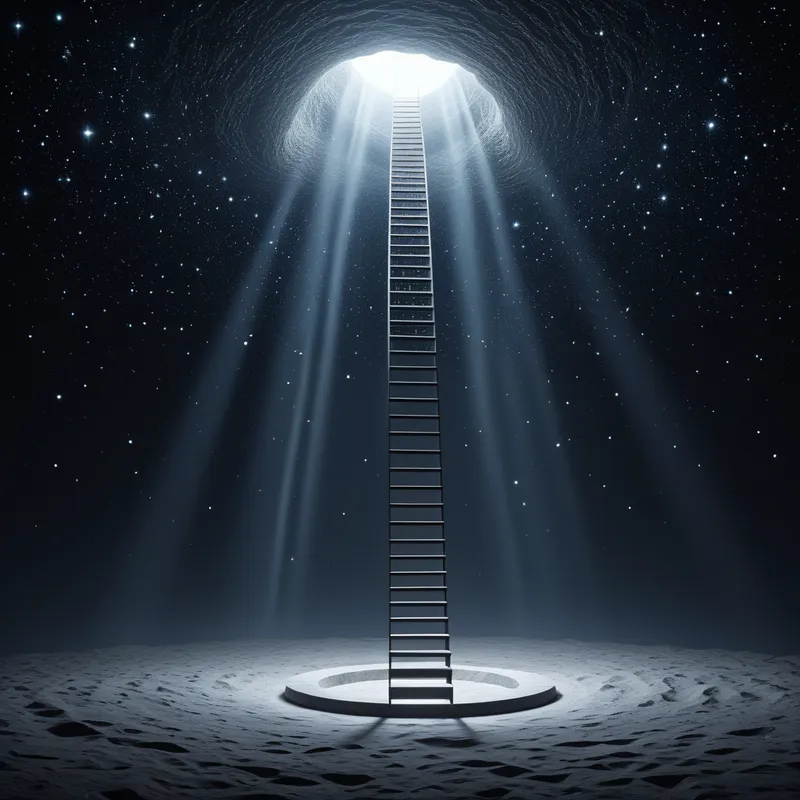
He alighted upon the Rock. The air here hummed with a silent frequency, the vibration of creation itself. From this very spot, a ladder of light descended—the Mi’raj. It was not wood or metal, but woven from divine command and prophetic yearning. Step by radiant step, he ascended. He passed through the seven heavens, each a universe of meaning, each guarded by a prophet of old who recognized him and affirmed his passage. He witnessed wonders that the tongue cannot describe: rivers of light, trees of jewels, the celestial Al-Bayt al-Ma’mur around which angels perpetually circle.
At the apex, in the presence of the Ultimate, boundaries dissolved. He received the command, the final seal of guidance for humanity. Then, he descended, step by step, back down the ladder of light, his feet finding once more the cool, solid surface of [the Foundation Stone](/myths/the-foundation-stone “Myth from Mesopotamian culture.”/). He returned, bearing a truth too vast for any container but the human heart. And where his foot had touched the Rock, it was said the stone itself softened in longing, rising to meet him. To mark this axis, this point of connection between the dust of earth and the court of heaven, a dome was built—not of containment, but of commemoration. A golden dome, sheltering the Rock, a mirror to the sky, marking the place where a human soul journeyed to the source and returned, anchoring the divine in the heart of the world.
Cultural Origins & Context
This is not a myth of a distant, forgotten age, but a living narrative at the core of Islam. It is known as the Isra and Mi’raj, and its details are meticulously preserved in the Hadith literature. While the event is understood as a profound spiritual and physical reality within Islamic theology, its structure and imagery function mythically—that is, they provide a cosmic map of meaning.
The story was first told by the Prophet himself to his companions, a report that challenged comprehension and cemented faith. It was passed down through chains of narrators with scrupulous care, becoming a cornerstone of Islamic spirituality. Its societal function is multifaceted: it establishes Al-Quds as the third holiest site in Islam; it validates the continuity of prophecy; and most importantly, it provides a template for the ultimate human potential—direct communion with the Divine. It answers the deepest human questions about the structure of the cosmos, the purpose of the soul, and the existence of a sacred center in a seemingly indifferent universe.
Symbolic Architecture
The myth is a masterpiece of symbolic [architecture](/symbols/architecture “Symbol: Architecture in dreams often signifies structure, stability, and the framing of personal identity or life’s journey.”/). The Qubbat al-Sakhrah is not merely a building; it is a psychic diagram.
The center is not a location, but a state of being—the point where the vertical axis of spirit pierces the horizontal plane of existence.
The [Foundation](/symbols/foundation “Symbol: A foundation symbolizes the underlying support systems, values, and beliefs that shape one’s life, serving as the bedrock for growth and development.”/) [Stone](/symbols/stone “Symbol: In dreams, a stone often symbolizes strength, stability, and permanence, but it may also represent emotional burdens or obstacles that need to be acknowledged and processed.”/) represents the irreducible core of [the Self](/myths/the-self “Myth from Jungian culture.”/), the [prima materia](/myths/prima-materia “Myth from Alchemical culture.”/) of the [psyche](/myths/psyche “Myth from Greek culture.”/) from which all else emanates. It is the bedrock of [identity](/symbols/identity “Symbol: Identity represents the sense of self, encompassing personal beliefs, cultural background, and social roles.”/), often buried and forgotten, yet supporting everything. The [Night](/symbols/night “Symbol: Night often symbolizes the unconscious, mystery, and the unknown, representing the realm of dreams and intuition.”/) [Journey](/symbols/journey “Symbol: A journey in dreams typically signifies adventure, growth, or a significant life transition.”/) symbolizes the necessary [departure](/symbols/departure “Symbol: A transition from one state to another, often representing change, growth, or leaving behind the familiar.”/) from the conscious, familiar ego-world into the unconscious, the “[night](/symbols/night “Symbol: Night often symbolizes the unconscious, mystery, and the unknown, representing the realm of dreams and intuition.”/) sea” of the [soul](/symbols/soul “Symbol: The soul represents the essence of a person, encompassing their spirit, identity, and connection to the universe.”/). Al-Buraq, the luminous hybrid [creature](/symbols/creature “Symbol: Creatures in dreams often symbolize instincts, primal urges, and the unknown aspects of the psyche.”/), is the transcendent function itself—that psychic force capable of bridging immense inner distances.
The [Ascension](/symbols/ascension “Symbol: A profound sense of rising upward, often representing spiritual enlightenment, personal growth, or transcendence beyond physical limitations.”/) is the journey of [consciousness](/symbols/consciousness “Symbol: Consciousness represents the state of awareness and perception, encompassing thoughts, feelings, and experiences.”/) through the layered strata of the psyche—the “heavens” representing progressively integrated archetypal realms, from personal complexes to transpersonal truths. Meeting the previous prophets signifies the reconciliation and [integration](/symbols/integration “Symbol: The process of unifying disparate parts of the self or experience into a cohesive whole, often representing psychological wholeness or resolution of internal conflict.”/) of one’s own inner [lineage](/symbols/lineage “Symbol: Represents ancestral heritage, family connections, and the transmission of traits, values, and responsibilities across generations.”/) of wisdom and tradition. The [climax](/symbols/climax “Symbol: The peak moment in a narrative or musical composition, representing resolution, transformation, or ultimate expression.”/) at the Divine [Presence](/symbols/presence “Symbol: Presence in dreams often signifies awareness or acknowledgment of something significant in one’s life.”/) represents an encounter with the Self, the central [archetype](/symbols/archetype “Symbol: A universal, primordial pattern or prototype in the collective unconscious that shapes human experience, behavior, and creative expression.”/) of order and wholeness. The return is critical; the wisdom gained is not for solitary [ecstasy](/symbols/ecstasy “Symbol: A state of overwhelming joy, rapture, or intense emotional/spiritual transcendence, often involving a loss of self-awareness.”/) but must be brought back to [earth](/symbols/earth “Symbol: The symbol of Earth often represents grounding, stability, and the physical realm, embodying a connection to nature and the innate support it provides.”/), to the “rock” of embodied [life](/symbols/life “Symbol: The symbol of ‘Life’ represents a journey of growth, interconnectedness, and existential meaning, encompassing both the joys and challenges that define human experience.”/).
The Dreamer’s Resonance
When this myth stirs in the modern dreamer, it often signals a profound crisis of orientation and a call to recenter. To dream of a specific, powerful stone in a vast, empty space points to an awakening to one’s own foundational trauma or truth—the unshakeable, often uncomfortable, core of one’s being. Dreams of miraculous ascent—flying, climbing endless ladders, or rising elevators—mirror the Mi’raj, indicating a rapid expansion of consciousness, a sudden insight that reorganizes one’s entire worldview.
Somatically, this process can feel like a lifting pressure in the chest or head, a feeling of being “spaced out” or ungrounded, which reflects the psyche’s temporary focus on the vertical, transcendent axis at the expense of the horizontal, earthly one. The subsequent phase, the return, might manifest as dreams of grounding, building, or planting—efforts to architect a new life structure (the Dome) around this freshly contacted core (the Rock). The dreamer is undergoing the sacred task of finding their own center and building a sanctuary around it.
Alchemical Translation
The alchemical process mirrored here is the coniunctio oppositorum—[the sacred marriage](/myths/the-sacred-marriage “Myth from Various culture.”/) of opposites, specifically heaven and earth, spirit and matter, the eternal and the temporal.
The goal is not to flee the stone for the sky, but to discover that the sky is the true nature of the stone.
[The first stage](/myths/the-first-stage “Myth from Alchemical culture.”/), the Night Journey ([Nigredo](/myths/nigredo “Myth from Alchemical culture.”/)), is the necessary descent into darkness and disorientation. [The ego](/myths/the-ego “Myth from Jungian culture.”/) loses its familiar coordinates. The Ascension (Albedo) is the purification and illumination, the rising through the graded levels of understanding, where one’s partial truths ([the prophets](/myths/the-prophets “Myth from Biblical culture.”/)) are acknowledged and integrated into a broader hierarchy of meaning. The encounter with the Divine (Citrinitas) represents the dawn of the “yellowing,” the first direct light of the Self upon the soul.
The final and most crucial stage is the Return ([Rubedo](/myths/rubedo “Myth from Alchemical culture.”/)), the “reddening.” This is the alchemical gold. The transcendent experience must be incarnated. The Prophet returns to the Rock. The psychological parallel is the embodiment of insight. The flash of enlightenment must be brought down to earth, applied to relationships, work, and the body. One must build their “Dome”—a conscious personality structure, a life, a creative work—that shelters and honors that sacred, central experience. The Dome does not hide the Rock; it frames it, allows it to be approached, and declares to the world that here, in this individual life, heaven has touched earth. The individuated person becomes a living axis mundi, grounded in their own unshakable foundation, open to the infinite above, a bridge between worlds.
Associated Symbols
Explore related symbols from the CaleaDream lexicon: