The Dolorous Stroke Myth Meaning & Symbolism
A sacred king is wounded in the groin by a holy spear, rendering him and his kingdom infertile, awaiting a question that can heal the wasteland.
The Tale of The Dolorous Stroke
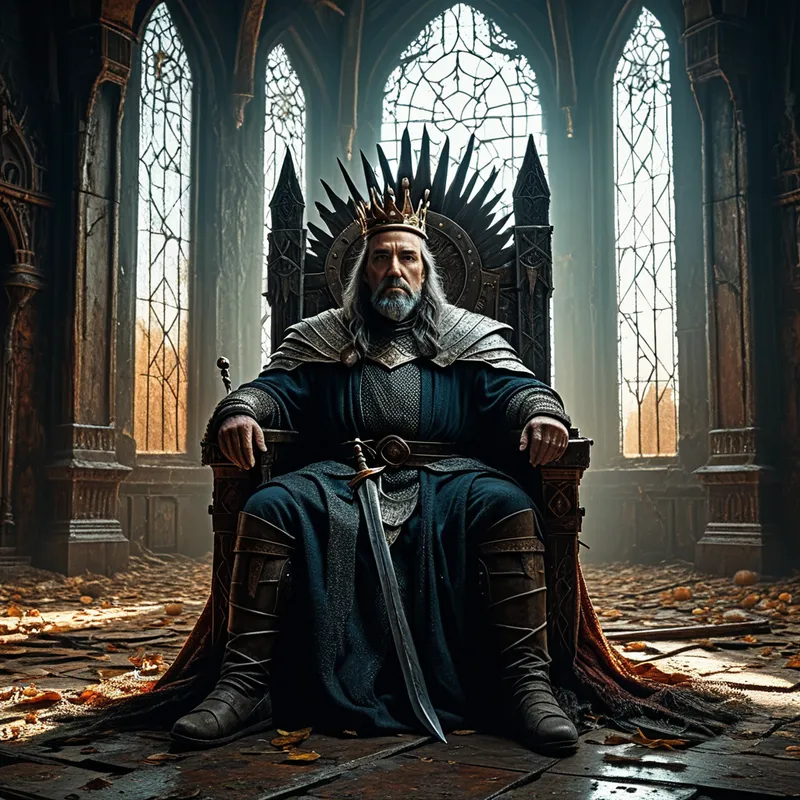
Listen, and hear the tale that begins in silence, in the hollow heart of a castle that was once a song. This is the story of the Fisher King, whom men also called the Maimed King, and of the blow that shattered the world.
His realm was Logres, and it was not always a wasteland. Once, its rivers ran silver with fish, its orchards bent low with fruit, and the laughter of children echoed in its green valleys. At its heart stood the Castle of the Grail, a place of such subtle radiance that it seemed woven from dawn-light and prayer. Here, the King presided, a guardian of mysteries. He was a man of two natures: a warrior who had known the clash of steel, and a contemplative soul who spent his days fishing in the castle’s quiet moat, a symbol of his quest for the deep, hidden truths of the spirit.
But a shadow walked with him, a brother or a cousin, a knight named Balin le Sauvage, or in older whispers, a figure known only as the Knight of the Sorrowful Countenance. This knight, driven by a fate as sharp as any blade, came to the Grail Castle. He was welcomed, for hospitality was sacred. In the great hall, a feast unfolded, but it was a feast of visions. A procession passed: a maiden bearing a Grail that shone with a light that fed the soul; a youth holding a sword of broken light; and finally, a page carrying the Lance of Longinus. From its iron tip, a single, perfect drop of blood welled and fell, hissing, into a silver cup borne by another.
A sacred silence held the hall. But the visiting knight, his heart a turmoil of pride and unasked questions, saw not a mystery to be witnessed, but a challenge to be met. Perhaps he sought to seize the Lance, to claim its power. Perhaps he misread a sign, thinking the King an enemy. The tales vary. What is sung in every version is the sound—a sigh of metal through air, a wet, final thunk—and the King’s cry, not of anger, but of profound, cosmic dismay.
The Dolorous Stroke was struck. The holy spear, the very instrument of divine sacrifice, was plunged into the King’s thigh, or his groin. It was not a wound that promised death, but one that denied life. The bleeding would not cease. The King’s strength did not fail, but his vitality did. He was suspended in a state of living decay, unable to die, unable to heal, unable to rise from his litter.
And as his blood seeped into the earth of Logres, the land itself mirrored his wound. The rivers shrank to bitter trickles. The trees shed their leaves in perpetual autumn. The soil grew hard and grey, yielding only thorns. The cows went dry, the women barren. The laughter fled. The Grail Castle, once a beacon, became a hidden, sorrowful place, adrift in a sea of desolation, waiting. The King, fishing in his moat for a sustenance that never came, could only ask of any traveler who stumbled upon his castle: “What ails thee?” For his own pain was now the pain of the world, and the answer to that question was the only key to a lock forged by a single, terrible mistake.
Cultural Origins & Context
The myth of the Dolorous Stroke is the dark, beating heart of the later Grail Romances, most profoundly articulated in the work of Chrétien de Troyes and later expanded in the cyclical Vulgate Cycle. It is a myth that evolved in the crucible of the 12th and 13th centuries, a time when the chivalric ideals of Arthur’s court were being interrogated through the lens of Christian mysticism and Celtic otherworld lore.
The story was not told around common campfires, but in the courts of nobility, by poets who were themselves often clerics or deeply influenced by theological concepts. Its function was multifaceted: it was a gripping adventure, a moral lesson on the catastrophic effects of impetuous action and spiritual ignorance, and a sophisticated allegory. The wounded King and his blighted land served as a powerful metaphor for a perceived spiritual malaise—a world (or a soul) out of alignment with the divine, suffering from a foundational trauma. The myth placed the responsibility for healing this cosmic wound squarely on the shoulders of the individual knight, transforming the quest for glory into a quest for compassionate understanding, a shift from conquering to questioning.
Symbolic Architecture
At its core, the Dolorous Stroke represents a primordial trauma that severs the connection between the sovereign self and the fertile ground of its own being. The King is the archetypal ruling principle, the ego in its highest function as steward of the inner kingdom. His wound in the thigh or groin is no accident; it is a strike at the seat of generative power, of passion, of lifeforce itself.
The wound is where the sacred becomes pathological. The Lance of divine sacrifice, misused, becomes the instrument of a curse.
The resulting “wasteland” is the psychological state of depression, alienation, and creative sterility. Life continues, but it is a hollow simulation. The Grail, representing the soul’s deepest nourishment and connection to the transcendent, remains present but inaccessible, because the conscious mind (the knight) is either too violent or too passive to engage with it correctly. The myth posits that a profound sickness of the spirit does not merely affect the individual; it radiates outward, poisoning one’s relationships, work, and very perception of the world. The kingdom is the king’s extended body.
The Dreamer’s Resonance
When this myth stirs in the modern unconscious, it often manifests not as a medieval tableau, but through potent contemporary symbols. To dream of a Dolorous Stroke is to dream of a foundational injury. The dreamer may find themselves in a house (the psyche) that is structurally sound but eerily empty, with a persistent leak they cannot locate or stop. They may be tasked with caring for a sick parent or child (the wounded inner king/queen) whose illness is mysterious and draining. They may be holding a tool—a pen, a scalpel, a controller—that suddenly malfunctions and causes an unintended, lasting harm.
The somatic experience is one of chronic, low-grade exhaustion and disconnection. There is a feeling of being “stuck in a rut,” of life happening around the dreamer but not to or through them. The dream is the psyche’s diagnosis: the core of your being is wounded, and until you address it, your external world will reflect that barrenness. The healing question the Fisher King awaits is the dreamer’s own nascent, often fearful, inquiry into the nature of their pain: “Whom does the Grail serve?”

Alchemical Translation
The process modeled here is the alchemy of acceptance and compassionate inquiry as the precursors to healing. The knight who finally heals the King—Perceval or Galahad—does so not by finding a magic herb, but by asking a simple, empathetic question: “What ails you?” or “Whom does the Grail serve?”
The healing is not in the answer, but in the quality of the asking. It is the shift from a consciousness that seeks to exploit or fix, to one that witnesses and serves.
For the modern individual, the “Dolorous Stroke” is often a past trauma, a betrayal, a failure, or a choice that severed our connection to our own vitality. Our inner kingdom lies fallow. The alchemical work begins with the nigredo, the blackening: we must first acknowledge the wasteland within, the persistent ache, the creative block. We must, like the Fisher King, cease trying to escape our litter and instead fully inhabit our wound.
The next stage is the question. This is the active, searching function of consciousness. It is therapy, journaling, art, or sincere dialogue—any process that formulates the heartfelt inquiry into the nature of our suffering. This question, asked with compassion for the self, is the lance that draws out the poison. It makes the Grail—the symbol of our deepest meaning and wholeness—visible and active again. The land does not heal because the wound vanishes, but because the relationship to the wound transforms. The flowing blood becomes the watering river; the king’s pain, once a private curse, becomes the shared story that restores the world. The individuated self is not the one who was never wounded, but the one who learned to ask the healing question of its own deepest sorrow.
Associated Symbols
Explore related symbols from the CaleaDream lexicon: