The Divine Smith Myth Meaning & Symbolism
The story of the cosmic artisan who, through immense sacrifice and mastery of primordial fire, forges the tools of creation and the weapons of fate.
The Tale of The Divine Smith
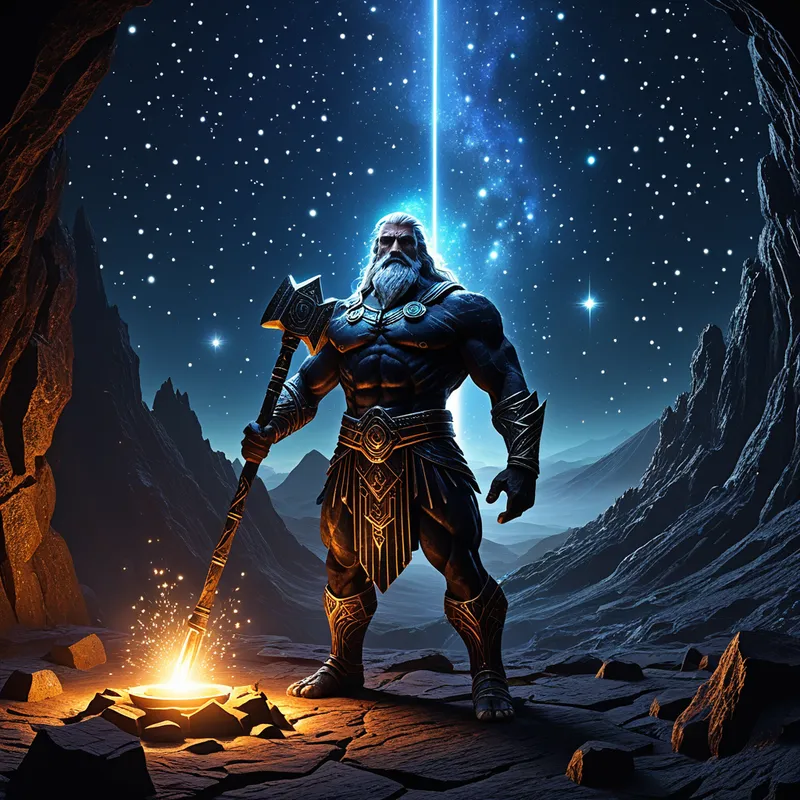
Listen. In the time before time, when the world was a formless murmur of potential, there was only the Churning Dark and the Sleeping Ember. From the tension between them was born the first sound—not a word, but a clang. The strike of will upon possibility. And thus, the Divine Smith awoke.
He did not step into being; he coalesced around the anvil of necessity. His skin was the patina of aged bronze, his beard braided with strands of iron and starlight, his eyes the steady, terrifying glow of the forge’s heart. He inhabited a mountain that was not a mountain, but the world’s first workshop—a cavern whose walls were the crust of creation, whose roof was the vault of the nascent sky. His forge-fire was the captured breath of the World Serpent, and his anvil was a fragment of the first fallen star, still singing with cosmic memory.
The gods, young and full of raw desire but empty-handed, came to him. The Storm-Bringer needed a spear to herd the clouds. The Earth-Mother needed a plow to tease life from the soil. The Trickster needed a tool that could both bind and unbind. They brought him materials: the tooth of a leviathan, the root of the World Ash, a tear of solidified moonlight. But these were inert. The secret, the Smith knew, was not in the material, but in the sacrifice that made it sing.
So, he began. For nine days and nine nights, he did not eat or sleep. The bellows were his own lungs, the hammer’s rhythm his own heartbeat. To temper the Storm-Spear, he did not quench it in water, but thrust it into his own thigh, binding the weapon’s fury to the price of pain. To sharpen the Earth-Plow, he polished its edge not with stone, but with the whispered names of every species yet unborn, his voice growing hoarse with the weight of futures. His greatest work, the Unbreakable Bond for the Trickster, required a thread from his own sinew, woven into the metal at the moment of its whitest heat.
The work was glorious, and the gods were pleased. But the final artifact remained. The Primal Ore—a lump of matter containing all opposites, chaos and order, love and hate—lay on his anvil. To work it would require everything. The Smith took up his hammer one last time. With each strike, a piece of his own essence—his immortality, his peace, his very name—was transferred into the emerging form. He forged the World-Axe, the tool that would cleave fate from chance. But as he set the final edge, his form grew translucent. The fire in his eyes dimmed, transferring into the axe’s gleam.
He did not die. He became the echo in every strike of a hammer, the principle in every transformation of matter. His mountain workshop sealed shut, becoming a myth within the world he helped define. The tools he made shaped reality, and the price he paid became the hidden cost of all true creation.
Cultural Origins & Context
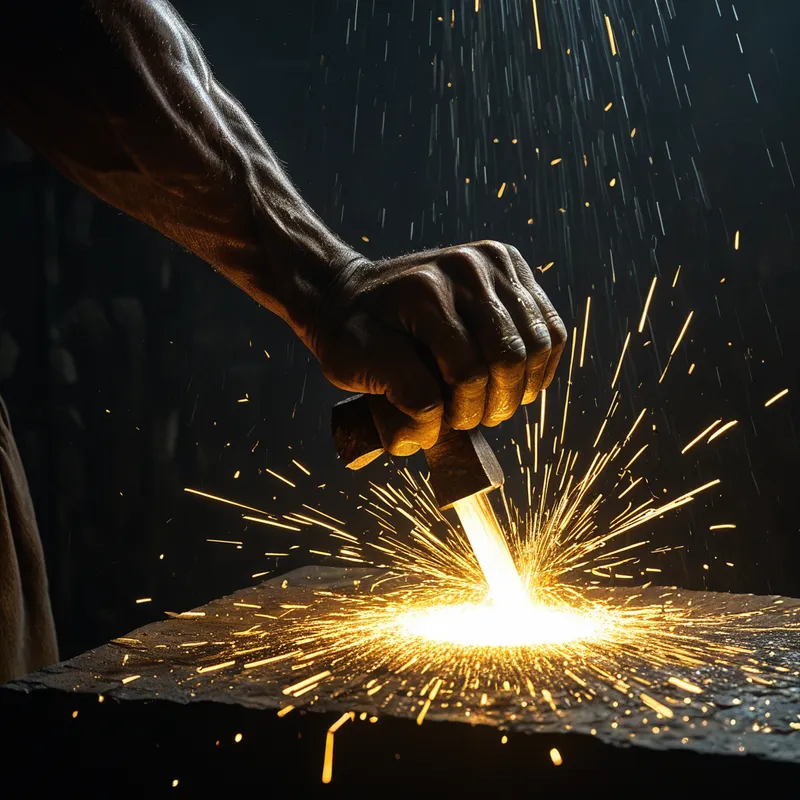
The figure of the Divine Smith is a polythetic archetype, appearing from the Gu of the Dahomey to Hephaestus of the Greeks, from Eitri who forged Thor’s hammer to the Ame-no-Mahitotsu. This is not a single myth but a global motif, passed down not merely as entertainment but as sacred technology. The stories were kept by guilds—smiths, masons, weavers—for whom the tale was both origin myth and operational manual. It was recited at initiations, during the lighting of the forge, or when a master craftsperson undertook a paramount work.
Its societal function was multifaceted. It sanctified the artisan’s labor, elevating it from mere production to a participation in cosmic order. It encoded technical secrets within metaphor (the “tempering” of a blade in the maker’s own blood speaks to the necessity of personal investment). Most importantly, it served as a container for the paradox of technology: the god who makes the weapons is often lame, exiled, or wounded, reminding every culture that the power to shape the world is inseparable from the cost of wielding it.
Symbolic Architecture
At its core, the Divine Smith represents the conscious Ego confronting the raw, chaotic material of the Self. The forge is the crucible of consciousness itself—the focused, heated, and pressurized space where transformation is forced.
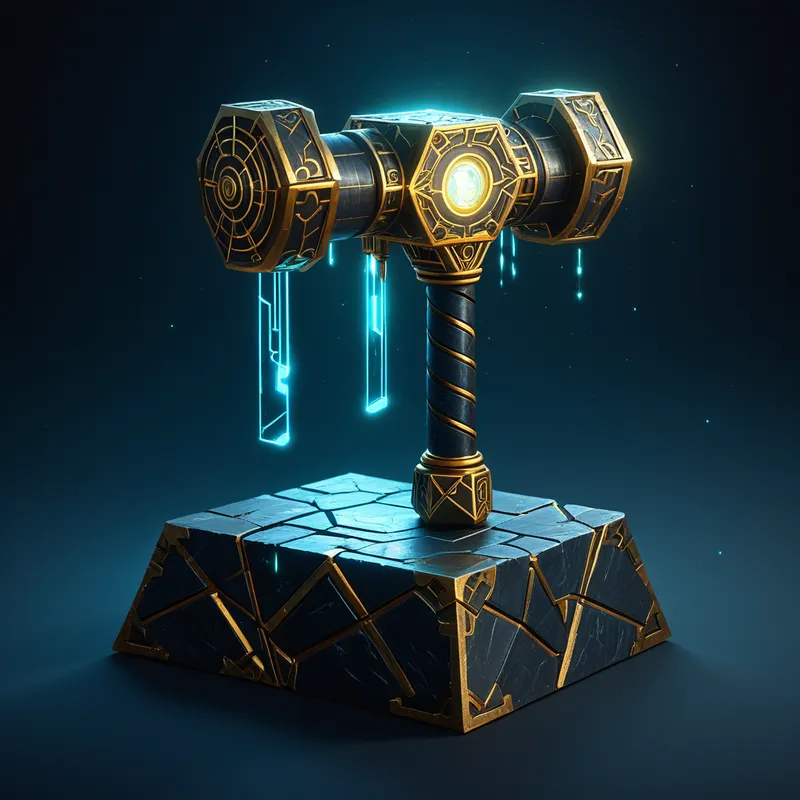
The anvil is the unwavering principle of reality; the hammer is the focused will of the psyche. The metal is the unformed content of the soul, waiting for its destiny.
The Smith’s lameness or isolation symbolizes the necessary sacrifice of wholeness for specialization. To develop a conscious faculty (thinking, crafting, ruling), other parts of the psyche must be relegated to the unconscious, creating a “wound.” His act of using his own body and essence as tools is the ultimate symbol of authenticity: nothing of true value can be created from a place of detachment. The artifact—be it a sword, a crown, or a musical instrument—is the newly synthesized psychic function, a “third thing” born from the marriage of raw instinct (ore) and disciplined consciousness (craft).
The Dreamer’s Resonance
When this myth stirs in the modern unconscious, it often manifests in dreams of intense, focused labor in strange workshops. You may dream of desperately trying to repair a crucial machine with inadequate tools, or of forging a key to a door you cannot see. Somatic sensations accompany this: a feeling of immense heat, the ache of repetitive strain in the arms, the metallic taste of effort.
Psychologically, this signals a stage of intense psychic metabolism. The dreamer is in the process of “working through” a dense, complex, and painful complex or life situation—the “primal ore.” The dream-forge is the psyche’s attempt to apply concentrated conscious energy to this raw material. The frustration of inadequate tools mirrors the feeling that one’s current coping mechanisms or understanding are insufficient for the task. This dream is a call to embrace the role of the Smith: to accept the heat, the labor, and the necessity of using parts of yourself as the very instruments of your own transformation.
Alchemical Translation
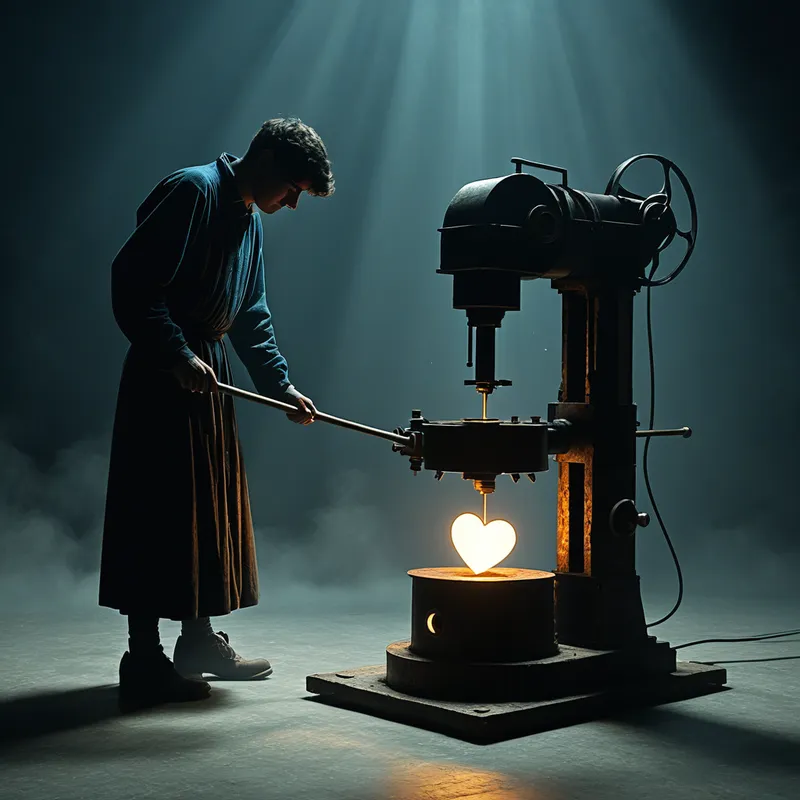
The myth of the Divine Smith is a perfect map for the individuation process, specifically the stage of Calcinatio and Coagulatio. First, the base matter of the personality (childhood patterns, inherited traumas, shadow contents) must be subjected to the searing fire of honest self-confrontation—this is the forge. This fire is painful; it feels like a destruction of the old self.
The alchemical gold is not found, but made. It is the creation of a conscious personality capable of holding its own contradictions without shattering.
Then, through the repeated, disciplined blows of conscious choice and action (Coagulatio), this molten, chaotic state is given form. The “artifact” you forge might be a new ethical stance, a creative work, a healed relationship, or simply a more resilient sense of self. The critical, often overlooked step is the Smith’s sacrifice. You cannot create this new form without investing your own life-force—your time, your vulnerability, your old identities. The “lame” Smith who emerges is the new, more conscious you: perhaps less “whole” in a naive sense, but infinitely more real and capable. You become the living artifact, and your life becomes the workshop where meaning is continually hammered out from the raw ore of experience.
Associated Symbols
Explore related symbols from the CaleaDream lexicon: