The Divine Sculptor Myth Meaning & Symbolism
The story of a deity shaping humanity from clay and breathing life into it, a foundational myth of origin, consciousness, and divine intimacy.
The Tale of The Divine Sculptor
In the time before time, when silence was a substance and darkness a deep, fecund womb, there was a stirring. Not a sound, but a will. A presence, vast and unnameable, turned its attention from the wheeling fires of stars and the depths of the seas. Its gaze fell upon the bare, good earth.
From the riverbank, where the waters of life met the dust of potential, it gathered the substance. Not mere dirt, but the primal clay—the adamah. The hands of the presence, which are not hands as we know them but the very instruments of intention, began to work. There was no hurry. Each motion was a universe in itself—the pressing of a thumb to form a hollow, the smoothing of a palm to create a plane, the careful pinching of a limb.
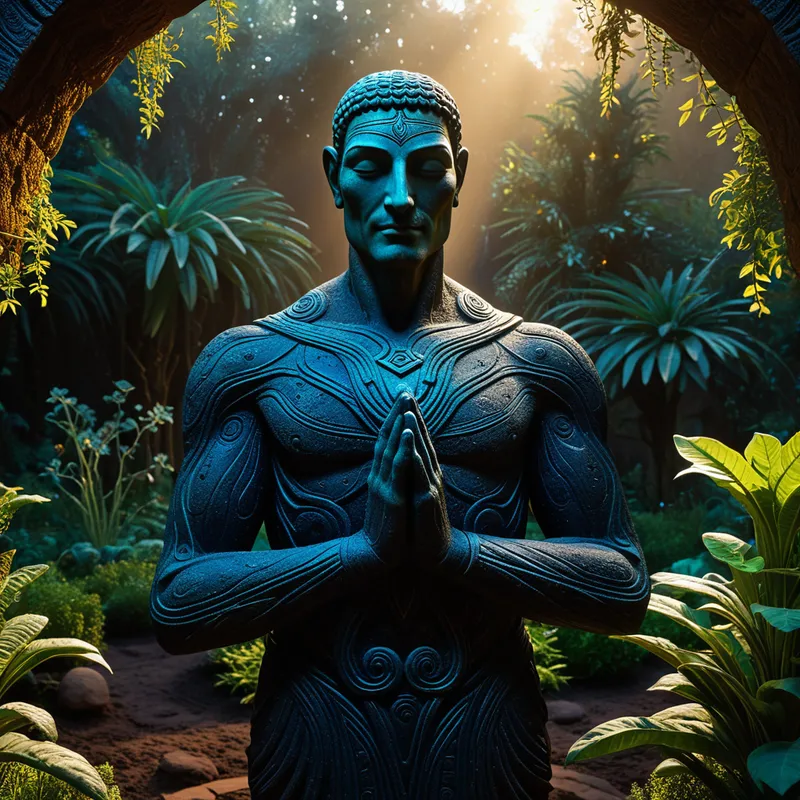
The form took shape on the ground, a figure lying supine as if asleep in the very soil from which it was born. It had the semblance of the presence, yet was utterly other: solid, bounded, finite. A statue of exquisite detail, with closed eyes and a face of serene emptiness. It was perfect in form, and yet it was inert. A vessel with no wine, a lyre with no song. It lay in the garden, beautiful and terribly still.
Then, the presence bent close. It did not speak a command to the distant heavens. It did not summon power from [the abyss](/myths/the-abyss “Myth from Kabbalistic culture.”/). Instead, it inclined itself toward the sculpture’s face in an act of unimaginable intimacy. And it breathed.
Not wind, not air, but its own breath—the [ruach](/myths/ruach “Myth from Hebrew culture.”/)—flowed from its being into the nostrils of the clay. It was a whisper that contained a symphony, a spark that held a sun. The inbreathing was a marriage of opposites: the infinite into the finite, the eternal into the temporal, spirit into matter.
And the clay shuddered.
The chest rose in a first, gasping inhalation. The eyelids fluttered, then opened upon a world of color, light, and shadow. The fingers, once cold earth, curled into the soft grass. The being sat up, not as a puppet pulled by strings, but as a self-moving mystery, looking into the face of its maker with a dawning consciousness that was entirely, bewilderingly, its own. The silence was broken by the sound of a living heart. The sculptor had not made a servant, but a living soul.
Cultural Origins & Context
This narrative forms the opening chapters of the Book of Genesis, the foundational text of the Abrahamic traditions—Judaism, Christianity, and Islam. It is a cosmogonic myth of the highest order, establishing the ontological relationship between the divine and the human. Passed down through oral tradition long before being codified in written scripture, it served as the bedrock of a worldview.
Its primary societal function was to answer the most profound human questions: Where do we come from? What is our nature? What is our purpose? By locating human origin in a deliberate, intimate act of a sovereign deity, it conferred immense dignity and sacred responsibility upon human life. Humanity was not an accident of chaos, but a crafted image, a tselem Elohim. This myth established the human role as stewards within creation and set the stage for the complex covenant relationship that defines much of Abrahamic theology. It was told not as a scientific treatise, but as a theological and anthropological truth about the essence of being.
Symbolic Architecture
The myth is a masterclass in symbolic duality, mapping the fundamental [architecture](/symbols/architecture “Symbol: Architecture in dreams often signifies structure, stability, and the framing of personal identity or life’s journey.”/) of [human](/symbols/human “Symbol: The symbol of a human represents individuality, complexity of emotions, and social relationships.”/) existence.
[Clay](/symbols/clay “Symbol: Clay symbolizes malleability, creativity, and the potential for transformation, representing the foundational aspect of life and the ability to shape one’s destiny.”/) (Adamah) and [Breath](/symbols/breath “Symbol: Breath symbolizes life, vitality, and the connection between the physical and spiritual realms.”/) (Ruach): This is the core dialectic—[earth](/symbols/earth “Symbol: The symbol of Earth often represents grounding, stability, and the physical realm, embodying a connection to nature and the innate support it provides.”/) and [spirit](/symbols/spirit “Symbol: Spirit symbolizes the essence of life, vitality, and the spiritual journey of the individual.”/), [body](/symbols/body “Symbol: The body in dreams often symbolizes the dreamer’s self-identity, personal health, and the relationship they have with their physical existence.”/) and [soul](/symbols/soul “Symbol: The soul represents the essence of a person, encompassing their spirit, identity, and connection to the universe.”/), form and animation. The [clay](/symbols/clay “Symbol: Clay symbolizes malleability, creativity, and the potential for transformation, representing the foundational aspect of life and the ability to shape one’s destiny.”/) represents our materiality, our [mortality](/symbols/mortality “Symbol: The awareness of life’s finitude, often representing transitions, impermanence, or existential reflection in dreams.”/), our [connection](/symbols/connection “Symbol: Connection symbolizes relationships, communication, and bonds among individuals.”/) to the cyclical world of [nature](/symbols/nature “Symbol: Nature symbolizes growth, connectivity, and the primal forces of existence.”/) from which we come and to which we return. The [breath](/symbols/breath “Symbol: Breath symbolizes life, vitality, and the connection between the physical and spiritual realms.”/) represents [consciousness](/symbols/consciousness “Symbol: Consciousness represents the state of awareness and perception, encompassing thoughts, feelings, and experiences.”/), [life](/symbols/life “Symbol: The symbol of ‘Life’ represents a journey of growth, interconnectedness, and existential meaning, encompassing both the joys and challenges that define human experience.”/)-force, freedom, and the irreducible spark of the divine within.
The human condition is the eternal tension and marriage of the vessel and the wine, the dust and the wind.
The Intimate Breath: The mode of animation is critically important. Life is not implanted via a tool or a distant decree, but through intimate, face-to-face [respiration](/symbols/respiration “Symbol: Breathing in dreams symbolizes life force, emotional regulation, and connection to the unconscious. It reflects vitality, anxiety, or spiritual awareness.”/). This symbolizes that our very consciousness is sustained by a continuous, relational connection to the [source](/symbols/source “Symbol: The origin point of something, often representing beginnings, nourishment, or the fundamental cause behind phenomena.”/). To be human is to be in a state of inspired [relationship](/symbols/relationship “Symbol: A representation of connections we have with others in our lives, often reflecting our emotional state.”/).
The Sculptor’s Act: The deliberate, hands-on shaping signifies [purpose](/symbols/purpose “Symbol: Purpose signifies direction, meaning, and intention in life, often reflecting personal ambitions and core values.”/) and artistry. Humanity is not [mass](/symbols/mass “Symbol: Mass often symbolizes a gathering or collective experience, representing shared beliefs, burdens, or the weight of emotions within a community.”/)-produced but individually crafted, implying unique value and intentional design. The act moves from formlessness to form, from [chaos](/symbols/chaos “Symbol: In Arts & Music, chaos represents raw creative potential, uncontrolled expression, and the breakdown of order to forge new artistic forms.”/) to order, mirroring the inner process of bringing the latent self into actuality.
The Dreamer’s Resonance
When this myth stirs in the modern unconscious, it often manifests in dreams of profound making or terrifying inertia. To dream of being the sculptor, shaping a form—be it a statue, a child, a house, or an abstract shape—points to an active process of individuation. The dreamer is consciously engaging with their potential, trying to give form to a new aspect of their identity, a creative project, or a life direction. The somatic feeling is one of focused agency, even if fraught with effort.
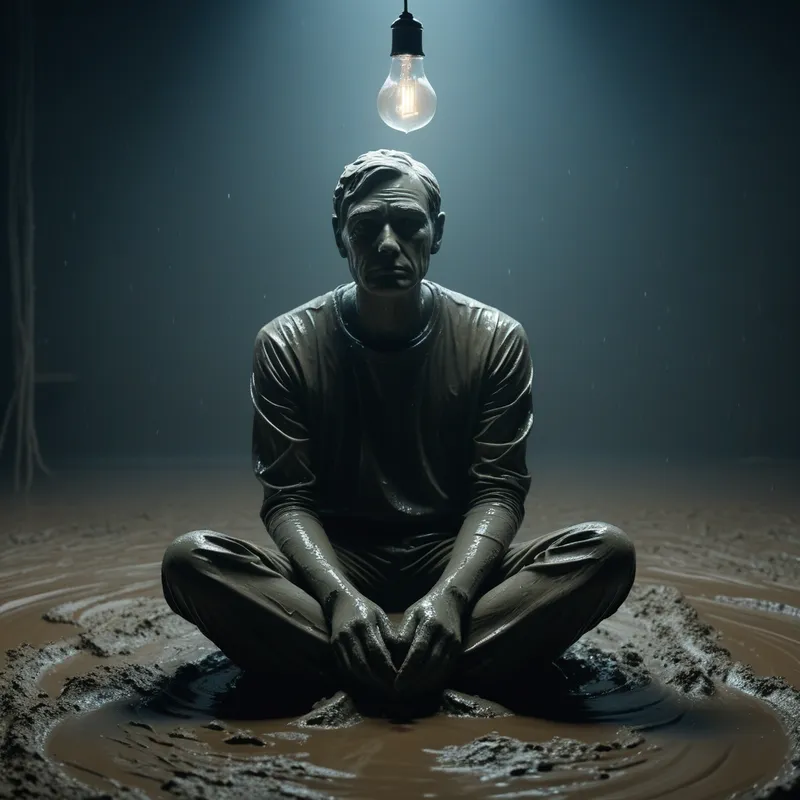
Conversely, to dream of being the unanimated sculpture—to be made of cold stone or wet clay, unable to move, waiting for a breath that does not come—is a classic experience of depression, creative block, or spiritual desolation. It is the [psyche](/myths/psyche “Myth from Greek culture.”/)’s portrait of feeling formed by external pressures (family, society, trauma) yet devoid of inner vitality or authentic will. The somatic resonance is one of heaviness, paralysis, and suffocation. The dream is a cry from the soul for its own ruach, for an enlivening connection to what truly matters.
Alchemical Translation
Psychologically, the myth of the Divine Sculptor models the alchemical process of psychic transmutation, where the base materials of the personality are worked into a conscious, integrated self.
The First Matter is the primal, unconscious psyche—the adamah of our inherited complexes, instincts, and unexamined life. Our task is not to reject this “clay,” but to gather it, to acknowledge it as the only substance from which we can be formed. The Sculpting is the conscious work of analysis, reflection, and choice. It is the difficult, patient shaping of our raw impulses and inherited patterns into a coherent form—a mature ego that can hold tension and bear responsibility.
Individuation is the slow, painful, glorious act of breathing your own spirit into the form life has given you, becoming both the shaped and the shaper.
The critical, transformative phase is the Inbreathing. This is the moment of inspiration, when the work of the conscious ego is visited by the spirit of [the Self](/myths/the-self “Myth from Jungian culture.”/)—the inner, transcendent totality. It is when insight strikes, when a long-held tension resolves, when a new attitude emerges not from willpower alone, but from a deeper, numinous source. This is the infusion of meaning. The statue becomes a living soul when the personal ego aligns with and is animated by the transpersonal Self.
Thus, the myth instructs us that wholeness is found not in escaping our earthly, limited nature, but in allowing [the divine spark](/myths/the-divine-spark “Myth from Gnostic culture.”/) within—the breath of consciousness and meaning—to fully inhabit it. We are called to be both the artifact, lovingly shaped by experience and fate, and the living soul, breathing with purpose and relationship. We are the place where [the earth](/myths/the-earth “Myth from Hindu culture.”/) and the heaven meet.
Associated Symbols
Explore related symbols from the CaleaDream lexicon: