The Divine Child (Puer Aeternu Myth Meaning & Symbolism
The archetypal story of a divine, eternal youth, embodying boundless potential and the promise of renewal, yet threatened by forces of stagnation and shadow.
The Tale of The Divine Child (Puer Aeternu)
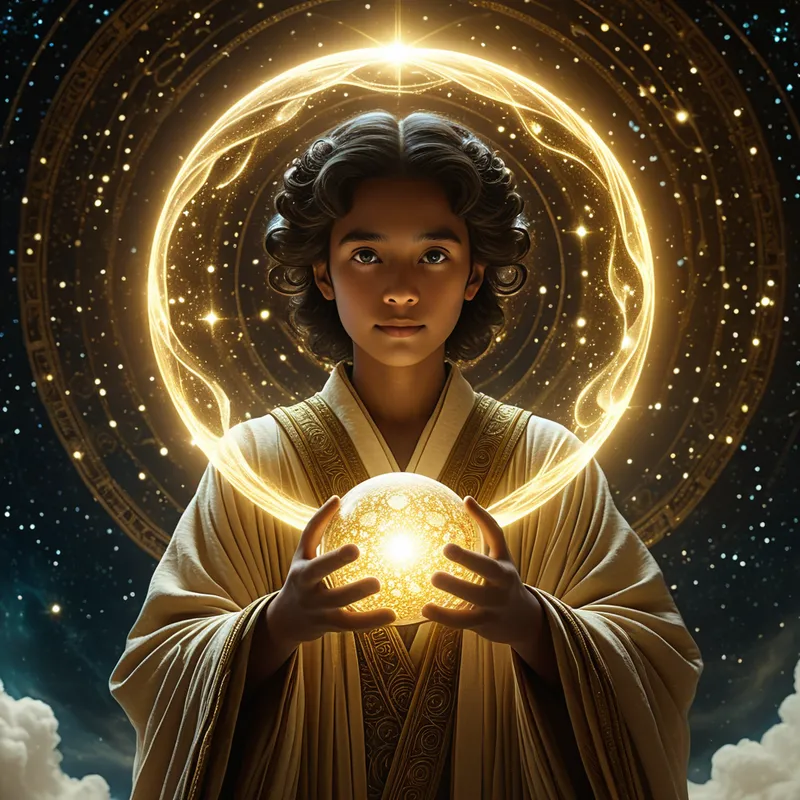
Before time was counted, in the breath between the first light and the solidity of stone, there existed a promise. Not a god of thunder or a goddess of the harvest, but a whisper of what could be—a figure of dawn-light given form. This was the Puer Aeternus, the Divine Child.
He was found not in a palace, but in the most improbable of cradles: a lotus bloom on the primordial waters, a basket of reeds in the bullrushes, a humble manger under a strange star, a basket left at the foot of the Yggdrasil. His face held the softness of the new moon and the piercing clarity of a winter star. He did not speak in words, but in the language of budding flowers and the silent growth of roots. He was potential incarnate, the future itself, swaddled in the present.
But the world of the manifest is a jealous place. A shadow stirs in the deep, a ruler grown old and brittle in his power, a titan who has consumed all novelty and now hungers for the one thing he cannot possess: beginning again. This Senex, the Old King, hears the prophecy—that this child will one day renew the world, which means the old order must pass. In his fear, he issues the decree that echoes through all such tales: Find the child. Destroy it.
Thus begins the desperate flight. The child is hidden in the wilderness, entrusted to humble shepherds or gentle animals, concealed by the veil of the mundane. The Senex’s soldiers, clad in the rust of dogma and the armor of control, scour the land. They represent the crushing weight of the established, the fear of the new, the desire to freeze time itself. The conflict is not of swords, but of essences: the fluid, playful, ever-becoming spirit of the Child against the rigid, static, and ultimately dying spirit of the Old.
The rising action is a symphony of near-discoveries and miraculous protections. A river parts into gentle pools. A thicket of thorns blossoms into a protective bower. Stars dim to hide his light. The child does not fight; he evades, his very nature a rebuttal to the Senex’s logic of domination. The climax arrives not in a battle, but in a confrontation of gazes. The Senex, in his towering citadel of stone, finally beholds the child, who has been brought before him not as a prisoner, but as a silent witness. In the Child’s eyes, the Old King does not see a threat, but a reflection—the ghost of his own lost wonder, the memory of his own divine spark, now ossified into throne and scepter. The decree dies on his lips, not from defeat, but from a devastating, silent recognition.
The resolution is not the child’s coronation, but his disappearance. His work is not to rule, but to seed. Having reminded the world of its capacity for innocence and new beginning, he fades from the common sight. He becomes the morning breeze that carries a new idea, the unexpected laugh that breaks a cycle of despair, the first green shoot on scorched earth. He is not gone; he is translated, becoming the eternal potential within the heart of things, waiting to be born anew in any moment of true courage or creativity.
Cultural Origins & Context
The pattern of the Divine Child is not the property of any single culture, but a psychic imprint found across the human experience. We see it in the infant Zeus hidden in a cave on Crete, in the baby Moses in his basket of bulrushes, in the child Jesus sought by Herod, in the Once and Future King pulled from the stone. It appears in the filius philosophorum and in countless folk tales of changelings and fairy children.
This myth was not merely told for entertainment; it was a vital societal narrative. It was recited during rites of passage, at the birth of a royal heir, or at the dawn of a new year. Its function was profound: to affirm the possibility of renewal against the entropy of time, to offer hope that the future could be fundamentally different from—and better than—the past. It served as a collective reminder that the established order, no matter how powerful, is temporary, and that the seeds of its transformation are already present, often in the most vulnerable and unexpected forms.
Symbolic Architecture
Psychologically, the Divine Child represents the nascent, unintegrated Self—the core of our unique potential and authenticity before it is shaped (or misshapen) by the demands of the world, the family, and the internalized collective consciousness. It is the spark of genius, the unjaded perspective, the capacity for wonder and spontaneous joy.
The Divine Child is the psychic antidote to cynicism; it is the part of us that still believes the world can be made new.
The Senex symbolizes the opposite pole: the inner critic, the rigid patterns, the accumulated baggage of “how things have always been,” the fear of the unknown that seeks to strangle new growth in its crib. The myth dramatizes the eternal internal tension between our longing for safety and control (the Senex) and our yearning for growth, novelty, and authentic expression (the Puer).
The flight and hiding signify the necessary protection this vulnerable, nascent self requires. It must often develop in secret, in the “wilderness” of the unconscious, away from the harsh, critical gaze of our own internalized authority figures or a hostile environment. The Child’s eventual confrontation with the Senex is not about destruction, but about recognition and integration. The old order must see and acknowledge the new potential for any real transformation to occur.
The Dreamer’s Resonance
When this myth activates in modern dreams, it often signals a crucial moment of psychic pregnancy. Dreaming of a radiant, special, or threatened child indicates that a new potential, a fresh start, or a long-buried aspect of the dreamer’s own creativity is seeking birth. This could be a new project, a life transition, a recovering sense of play, or the emergence of a more authentic identity.
Somatically, this process may feel like a fluttering anxiety in the solar plexus—the excitement of possibility mixed with the fear of exposure. Psychologically, it is the process of nurturing something immensely valuable yet fragile. Conversely, dreaming of pursuing or losing such a child may point to the dreamer’s own inner Senex actively suppressing this new life out of fear, practicality, or self-doubt. The dream is the psyche’s way of staging this archetypal drama, asking the dreamer: Will you protect this new beginning, or will you allow the old fears to silence it?

Alchemical Translation
The alchemical journey mirrored in this myth is the Magnum Opus, specifically the stage of albedo—the whitening, where the primal matter is purified into a state of lunar receptivity and potential. The Divine Child is the lapis albus, the precious product of this arduous inner work.
For the modern individual, the myth models the process of individuation by illustrating that wholeness does not come from eradicating our youthful, creative spirit in favor of rigid adulthood, nor from refusing to grow up in a perpetual state of adolescent potential. The triumph is in the sacred marriage, the conjunctio oppositorum, of the Puer and the Senex.
The goal is not for the Child to slay the King, but for the King to be renewed by the Child’s spirit, and for the Child to be given wise form by the King’s experience.
The alchemical translation is this: we must first recognize and protect our inner Divine Child—our unique spark, our “what if,” our joy. We must hide it from the inner critic long enough for it to gain strength. Then, we must consciously bring it before that same critical, aging authority within us. Not for a fight, but for a dialogue. The mature individual is one in whom the wisdom of experience (Senex) provides structure and grounding for the boundless inspiration and renewing energy of the eternal youth (Puer). The result is not an eternal child, but an adult infused with the creative spirit of the child—a true Senex who has made peace with the Puer Aeternus within. This is the birth of the integrated Self, where potential finds its purpose, and wonder walks hand-in-hand with wisdom.
Associated Symbols
Explore related symbols from the CaleaDream lexicon: