The Divided Line Myth Meaning & Symbolism
A philosopher's journey through the realms of shadow, substance, and pure form, guided by the vision of a line that divides all reality.
The Tale of The Divided Line
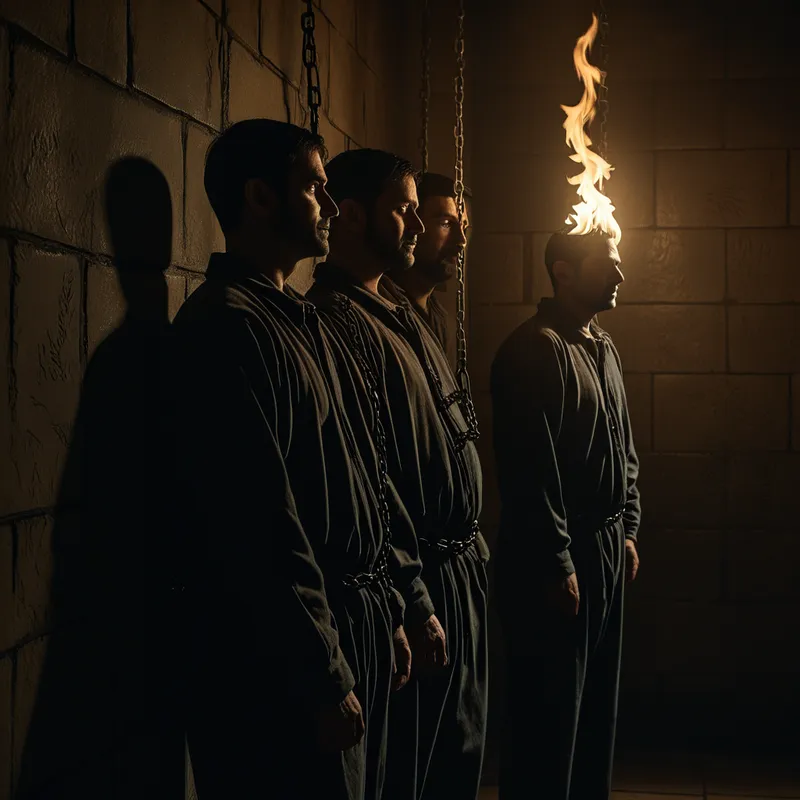
Listen, and let your mind’s eye see. Not in the sun-baked agora, nor in the marble halls of power, but in a place of hushed voices and shifting dust. In a chamber deep beneath the earth, a fire crackles. Its light dances upon a rough stone wall, and before that wall sit figures, bound from childhood. Neck and leg, fastened so they cannot turn their heads. They see only the wall, and upon it, the play of shadows—shapes of men and beasts, of vessels and trees, cast by puppeteers who walk behind them, bearing forms before the fire.
This is all they have ever known. The whisper of the puppeteers, the crackle of the flame, the dance of the dark on the stone. They name these shadows “reality.” They honor the clever shadow, fear the fierce one, desire the beautiful one. Their world is a world of echoes, and they are content, for they know no other song.
But imagine… imagine one is loosened. Dragged, protesting, up from the seat of familiar darkness. Made to turn and face the fire itself. The light is agony. The puppeteers and their carved puppets are a blur of confusing substance. “Which is more real,” a voice asks, “the shadow you worshipped, or the object that casts it?” The freed one is bewildered, pained. The old certainties are lies. The solid world is a tumult of flame and moving forms.
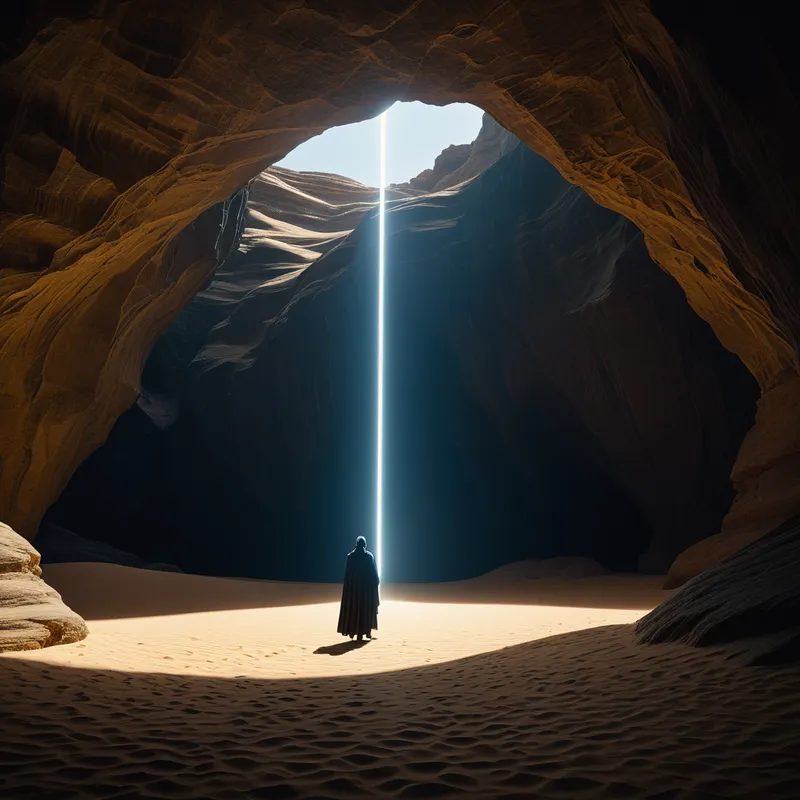
Then, he is dragged further, up a steep and difficult passage, out of the cave entirely, into the overwhelming world. The light of the sun is a violence. He is blind. He can see nothing but phantoms of brilliance. Slowly, painfully, his eyes adjust. He sees reflections first—in water, in polished bronze. Then the things themselves: the trees, the stones, the living animals. He comes to understand that these, not the puppets below, are the true originals. And finally, lifting his aching gaze, he beholds the source of all: the sun itself. Not the shape of it, but its power—the cause of the seasons, the guardian of all life, the very author of visibility and truth.
His heart swells with a terrible, glorious understanding. He pities his former companions. He must return. Descending into the familiar dark, his eyes are now useless. He stumbles. He tries to tell them of the sun, of the true forms, of the vast deception of their shadow-play. They laugh at his blindness. They think his journey has ruined him. They resolve, if they could, to kill anyone who would try to free them and lead them up.
And the one who has seen knows this: the path from shadow to sun is a line, drawn by the mind’s own striving. It is a division not of earth, but of soul. It begins in the cave of eikasia, passes through the firelight of pistis, ascends to the daylight of dianoia, and culminates in the blinding vision of noesis. This is the tale. Not of a hero who slays a beast, but of a soul that turns around.
Cultural Origins & Context
This is not a myth of Olympus, sung by bards. It is a philosophical allegory, a “likely story” crafted by Plato in the middle period of his work, most famously in the Republic. Its context is the Socratic project: to define justice, both in the city and in the individual soul. The Divided Line, and its companion parable of the Cave, serves as the epistemological and metaphysical foundation for that entire endeavor.
It was passed down not around campfires, but in the Academy, through dialectical conversation and written scrolls. Its societal function was radical: to provide a map for the education of the philosopher-kings, the rulers who could perceive the Form of the Good, the sun of the intelligible world. It was a tool for cultural critique, implicitly judging Athenian democracy as a cave of competing shadows, and for personal transformation, offering a rigorous path out of opinion (doxa) and into knowledge (episteme).
Symbolic Architecture
The myth is a perfect symbolic architecture for the structure of reality and consciousness. The Line itself is the axis of being.
The journey from shadow to sun is not a travel through space, but a revolution within the soul—a turning of the entire apparatus of perception from what is generated to what generates.
The lowest segment, the world of shadows and reflections, symbolizes the realm of imagination and uncritical acceptance of images—our fantasies, prejudices, and the seductive illusions of art and rhetoric. The next segment, the physical objects and the fire that illuminates them, represents the world of belief in the tangible, the realm of science and practical affairs, yet still trapped in the cave of the senses.
The upper half of the Line begins the ascent to the intelligible. The third segment corresponds to the realm of mathematical and logical reasoning (dianoia), where we use hypotheses and models (like the puppets) to understand eternal truths. The pinnacle, the fourth segment, is the realm of the Forms and the Form of the Good. This is pure, direct intellectual intuition (noesis), where the soul grasps first principles without the aid of sensory images or even logical steps.
Psychologically, the hero is the intellect itself, the nous. The conflict is between the passive, comfort-seeking part of the psyche that accepts given appearances, and the active, erotic, philosophical part that yearns for the source. The painful ascent is the necessary suffering of disillusionment, of having one’s cherished beliefs shattered by a greater truth.
The Dreamer’s Resonance
When this myth stirs in the modern dreamer, it rarely appears as a literal cave. It manifests as a profound somatic and psychological process of disorientation and reorientation.
You may dream of being in a familiar room that suddenly reveals a hidden door or a corridor you never noticed. You enter, and the geometry becomes impossible—walls shift, perspectives invert. This is the somatic signal of the psyche beginning its turn. You might dream of staring at a photograph or a screen, only to have the image pixelate, dissolve, and reform as a three-dimensional object you can walk around. This is the transition from eikasia to pistis.
The most potent resonance is the dream of blinding light. A light so intense it is painful, that washes out all detail, that forces you to look away. Upon waking, you feel a strange cognitive ache, a sense that you were on the verge of understanding something monumental but were not yet ready to bear it. This is the soul’s encounter with the Form of the Good, the psychological sun. The dream is the psyche’s attempt to integrate a truth too vast for waking consciousness, often preceding a significant shift in one’s fundamental worldview or values.
Alchemical Translation
The alchemical process mirrored here is the opus magnum of individuation: the transmutation of leaden, unconscious identification with shadows into the golden, conscious apprehension of the Self’s archetypal ground.
The Cave is the prima materia, the confused mass of personal and collective unconscious content. The fire is the heat of affect, of complex-driven emotions that cast dramatic shadows on the walls of our ego.
The first turning toward the fire is the beginning of shadow work—facing the “puppeteers” of our complexes, the personal and ancestral patterns that manipulate our reactions. To see the puppets is to achieve a degree of objectivity about our inner dynamics.
The arduous ascent represents the engagement with the anima/animus (the guide to the deeper unconscious) and the integration of archetypal patterns, moving from personal psychology to transpersonal understanding. The world outside the cave is the realm of the archetypes themselves, the Platonic Forms seen through a psychological lens—eternal patterns of behavior and meaning.
Finally, gazing at the sun is the perilous encounter with the Self. It is blinding because it transcends the ego completely. The return to the cave is the critical, often thankless, task of bringing this realization back into one’s life and community—the “redemption of the mundane.” The philosopher who has seen the Good must live in the world of shadows without despair, offering not dogma, but the example of a turned soul. The myth thus models the complete cycle: descent, suffering, illumination, and return—the very pattern of a life made whole.
Associated Symbols
Explore related symbols from the CaleaDream lexicon: