The Distillation Process Myth Meaning & Symbolism
A myth of the spirit's descent into matter and its fiery, repeated purification to separate the eternal from the transient.
The Tale of The Distillation Process
Listen. In the time before time, when [the world](/myths/the-world “Myth from Tarot culture.”/) was a broth of potential, there existed not a god of fire or [water](/myths/water “Myth from Chinese culture.”/), but a spirit of the process itself. Its name, whispered in the heat of the furnace and the sigh of the cooling coil, was the Distiller.
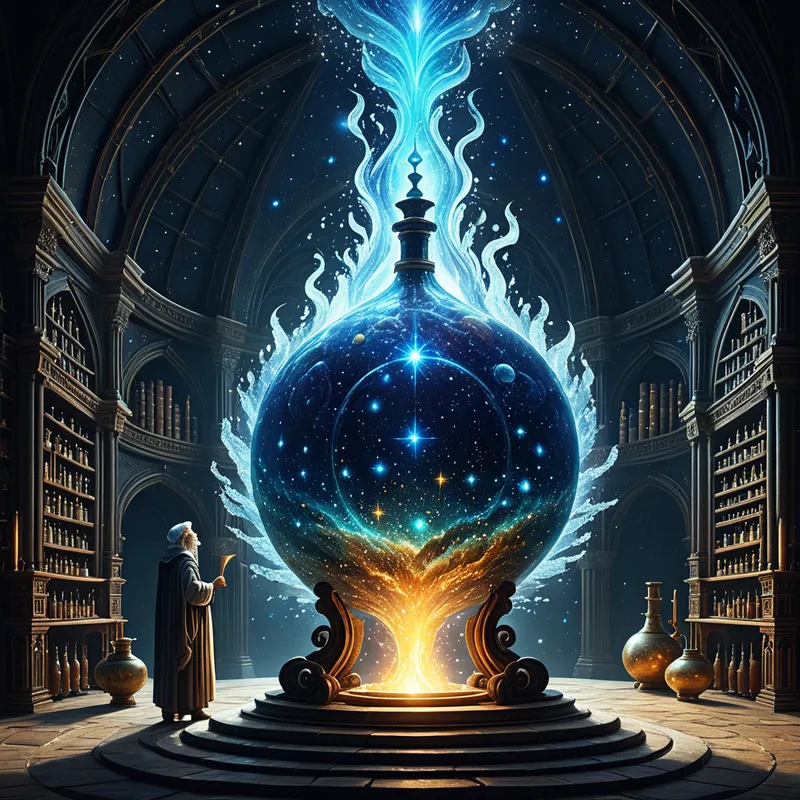
The Distiller dwelt in a chamber that was neither a cave nor a temple, but [the womb](/myths/the-womb “Myth from Various culture.”/) of the world. Its walls were the dark, fertile earth; its ceiling, the vault of the night sky pierced by a single shaft of cold, clear moonlight. In the center of this chamber stood its sole instrument: the Alembic. This was no mere vessel of clay or glass. It was forged from a single tear of the cosmos, crystalline and eternal, waiting.
The Distiller’s task was eternal, and its material was the [Prima Materia](/myths/prima-materia “Myth from Alchemical culture.”/)—the raw, weeping stuff of existence that seeped from the walls. It was a substance of profound contradiction: it shimmered with the promise of stars yet smelled of damp soil and forgotten things. It contained everything and nothing, all potential trapped in formless murk.
With hands that were both gentle and relentless, the Distiller gathered this weeping chaos. It did not judge the mess. It sang to it, a low hum that vibrated in the bones of [the earth](/myths/the-earth “Myth from Hindu culture.”/), as it poured the murky elixir into the belly of [the Alembic](/myths/the-alembic “Myth from Alchemical culture.”/). Then, with a breath that was not air but pure intention, the Distiller called forth the Fire of Separation.
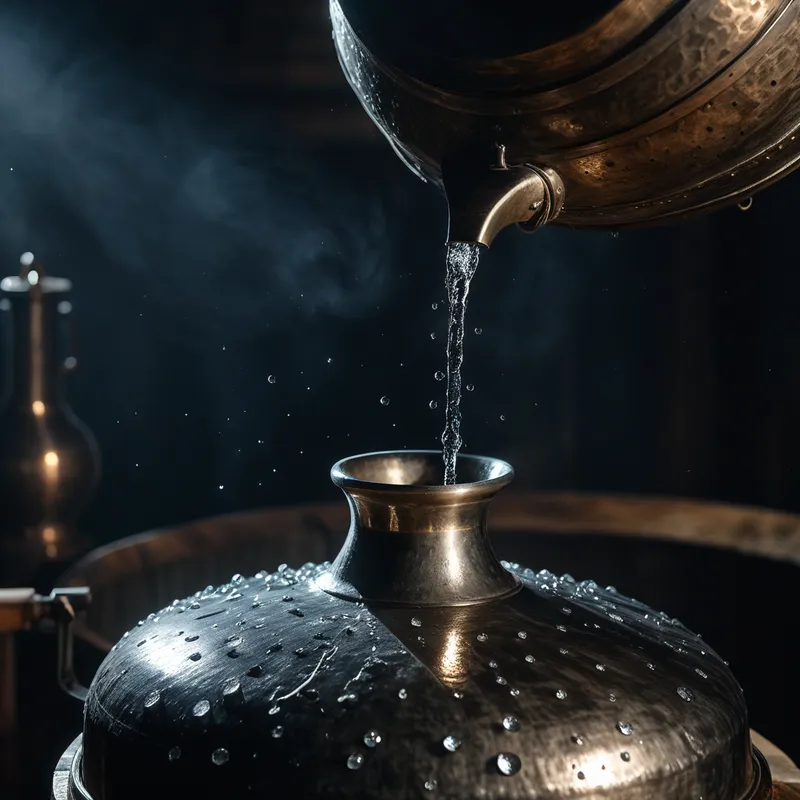
The fire did not roar; it whispered. It was a blue-white flame, cool to the touch yet of unimaginable potency. It licked the base of [the vessel](/myths/the-vessel “Myth from Alchemical culture.”/), and [the Prima Materia](/myths/the-prima-materia “Myth from Alchemical culture.”/) began to stir. Not with a boil, but with a great, reluctant sigh. From its depths arose vapors—thick, dark, and heavy with the scent of regret, of fear, of all that was dense and clinging. This was the Caput Mortuum, the “Dead Head.” It condensed in the cool upper curves of the Alembic and dripped away, a bitter, black rain rejected into a vessel of shadow.
But the process was not complete. The fire persisted. The whisper became a hymn. And from the remaining substance, now lighter, a new vapor arose. This one was silver, mercurial, quick as thought. It carried the scent of rain on stone and the sound of a lute string snapping. This was the [Spiritus](/myths/spiritus “Myth from Alchemical culture.”/). It danced in the coil, elusive, promising intelligence but not yet wisdom. It, too, was gathered aside.
The chamber grew still. The fire burned now with a focused, solar intensity. All that remained in the heart of the Alembic was a tiny, concentrated essence, glowing with a soft, internal radiance. Then, the final ascent. A vapor unlike any other rose—not as a cloud, but as a beam of condensed light, fragrant with ozone and the silence at the heart of a rose. It traveled the path its siblings had forged, but where they had condensed, it crystallized.
In the receiving vessel, a single, perfect droplet formed. It was not water, nor metal, nor light alone, but all these in essence. It was the [Quintessence](/myths/quintessence “Myth from Alchemical culture.”/). It held the memory of the chaos but none of its bondage. It was the truth extracted from the lie, the signal distilled from the noise.
The Distiller beheld the droplet, its task for that cycle complete. It did not celebrate, for the Prima Materia still wept from the walls. It simply began again, the eternal cycle of dissolution and coagulation, separation and union. The myth does not end; it breathes in the space between the fire and the coil, forever.
Cultural Origins & Context
The myth of the Distillation Process was never a single story told around a fire. It was the underlying narrative of the alchemical art itself, encoded in laboratory manuals, cryptic emblems, and the oral tradition of adepts. It emerged from the Hellenistic world of Alexandria, was preserved and elaborated by Islamic scholars like Jabir ibn Hayyan, and flowed into the medieval and Renaissance workshops of Europe.
Its primary “tellers” were the practitioners—the monks, physicians, and natural philosophers who spent their lives bent over furnaces. They did not speak of the Distiller as a deity to be worshipped, but as a principle to be understood and embodied. The myth was passed down through the very act of performing the distillation: the careful heating, the watchful waiting for the “divisions” to appear, the reverence for the different “waters” or “spirits” that emerged. It was a sacred technology, a physical allegory for a spiritual reality. Societally, it functioned as a map of transformation, offering a hopeful, structured cosmology in a world often experienced as chaotic and corrupt. It promised that through diligent, repeated work (Opus), even the basest matter—and by extension, the basest human nature—could be redeemed and perfected.
Symbolic Architecture
At its core, the myth is a master [symbol](/symbols/symbol “Symbol: A symbol can represent an idea, concept, or belief, serving as a powerful tool for communication and understanding.”/) of discernment. The Alembic represents the contained [psyche](/myths/psyche “Myth from Greek culture.”/), the [crucible](/symbols/crucible “Symbol: A vessel for intense transformation through heat and pressure, symbolizing spiritual purification, testing, and alchemical change.”/) of conscious experience. The chaotic Prima Materia is the undifferentiated content of [the self](/myths/the-self “Myth from Jungian culture.”/)—our bundled memories, instincts, talents, and traumas, all in a confused [mass](/symbols/mass “Symbol: Mass often symbolizes a gathering or collective experience, representing shared beliefs, burdens, or the weight of emotions within a community.”/).
The fire is not punishment, but the fierce light of attention. It is the heat of introspection, the courage to look within.
The sequential [separation](/symbols/separation “Symbol: A spiritual or mythic division between realms, states of being, or consciousness, often marking a transition or loss of connection.”/) of the Caput Mortuum, the Spiritus, and finally the [Quintessence](/symbols/quintessence “Symbol: The fifth element or pure essence beyond earth, air, fire, and water, representing perfection, the divine, and the fundamental nature of reality.”/) is not about rejecting parts of the self, but about differentiating them. The Caput Mortuum symbolizes the literal, heavy, identified aspects we must let go of—rigid identities, outgrown narratives, and psychic inertia. The Spiritus represents the airy intellect and the restless [soul](/symbols/soul “Symbol: The soul represents the essence of a person, encompassing their spirit, identity, and connection to the universe.”/), valuable but incomplete, prone to [inflation](/symbols/inflation “Symbol: A dream symbol representing feelings of diminishing value, loss of control, or expansion beyond sustainable limits in one’s life or psyche.”/) and [distraction](/symbols/distraction “Symbol: A state of diverted attention from a primary focus, often representing avoidance, fragmentation, or competing priorities in consciousness.”/). The [Quintessence](/symbols/quintessence “Symbol: The fifth element or pure essence beyond earth, air, fire, and water, representing perfection, the divine, and the fundamental nature of reality.”/) is the indwelling Self, the core of authentic being that remains when all that is non-essential has been acknowledged and separated out. The Distiller, then, is the archetypal function of [consciousness](/symbols/consciousness “Symbol: Consciousness represents the state of awareness and perception, encompassing thoughts, feelings, and experiences.”/) itself, the inner [observer](/symbols/observer “Symbol: An observer represents contemplation, self-awareness, and the act of witnessing one’s experiences.”/) and operator that patiently conducts this work of psychic purification.
The Dreamer’s Resonance
When this myth stirs in the modern unconscious, it often manifests in dreams of purification, sorting, and essential extraction. A dreamer may find themselves in a laboratory, cleaning a cluttered house room by room, or, most poignantly, experiencing a fever or illness where they feel a “burning away” of something old.
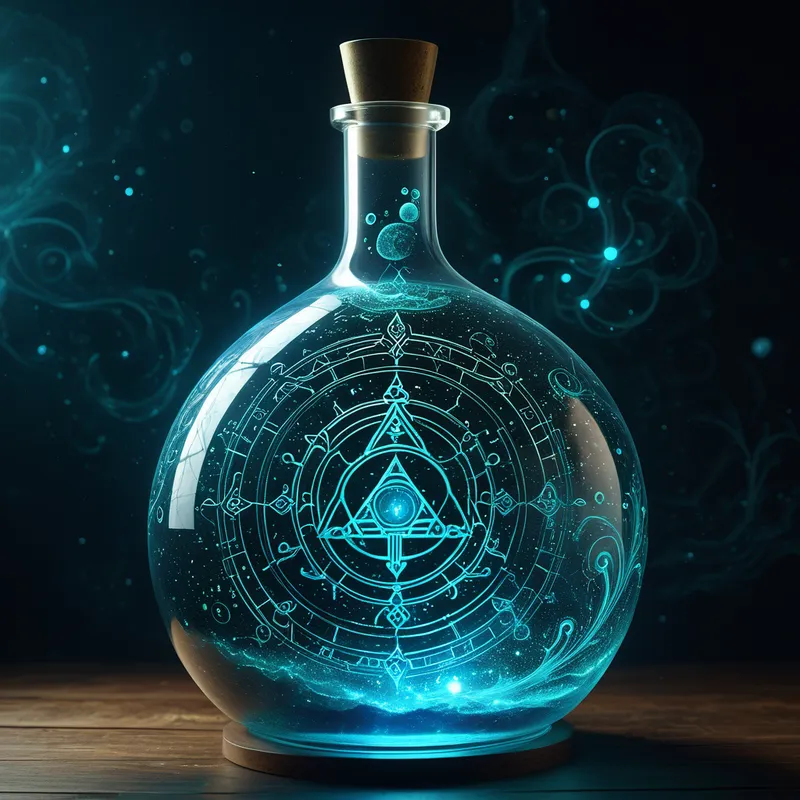
Somatically, this can feel like a period of intense emotional or physical sensitivity, as if one’s boundaries have become as thin as the glass of the Alembic. There is a sense of being “in process,” of volatility. The psychological process is one of acute discernment. The dream-ego is undergoing a natural, often involuntary, distillation. Confused feelings begin to separate into distinct layers: here is my grief (Caput Mortuum), here is my intellectual anxiety about that grief (Spiritus). The dream is the psyche’s way of enacting the myth, of applying the Fire of Separation to a complex emotional compound, seeking the clear truth (Quintessence) at its heart. It is a sign the psyche is working to resolve an undifferentiated state, moving from confusion toward clarity, even if the immediate experience is one of heat and pressure.

Alchemical Translation
For the individual, the Distillation Process is the core model of psychic transmutation, the heart of the individuation journey. It translates the myth into a disciplined practice of inner work.
The first step is the gathering of the Prima Materia—this is the act of turning inward to confront the raw, unprocessed material of one’s life: [the shadow](/myths/the-shadow “Myth from Jungian culture.”/), the complexes, the unlived potential. One must “fill the vessel” with honest self-appraisal.
The work is repetition. One does not distill once and become pure. The myth is eternal because the self is never static; new Prima Materia is always generated by life.
Then, the application of the fire. In psychological terms, this is sustained, non-judgmental awareness. It is the heat of holding a contradiction, a pain, or a desire in consciousness without immediately acting on it or repressing it. As the fire is applied, separations occur. In therapy or journaling, this is when a glob of “depression” differentiates into specific grief, anger, and fatigue. The “Dead Head” is consciously acknowledged and released—these are the habits, beliefs, and identifications we consciously choose to put down. The “Spirit” is recognized for what it is—helpful insight, but not the final goal.
The arrival of the Quintessence is never a dramatic, final achievement. It is the quiet moment of essence. It is the clear, simple feeling that arises after the emotional storm has been sorted. It is the core value, the authentic need, or the fundamental truth that was buried under layers of reaction and conditioning. To embody the Distiller is to become the patient, enduring operator of one’s own consciousness, understanding that the goal is not a static state of perfection, but the ongoing, sacred process of separating the eternal from the transient within oneself. It is the art of becoming, drop by precious drop, more essentially who you are.
Associated Symbols
Explore related symbols from the CaleaDream lexicon: