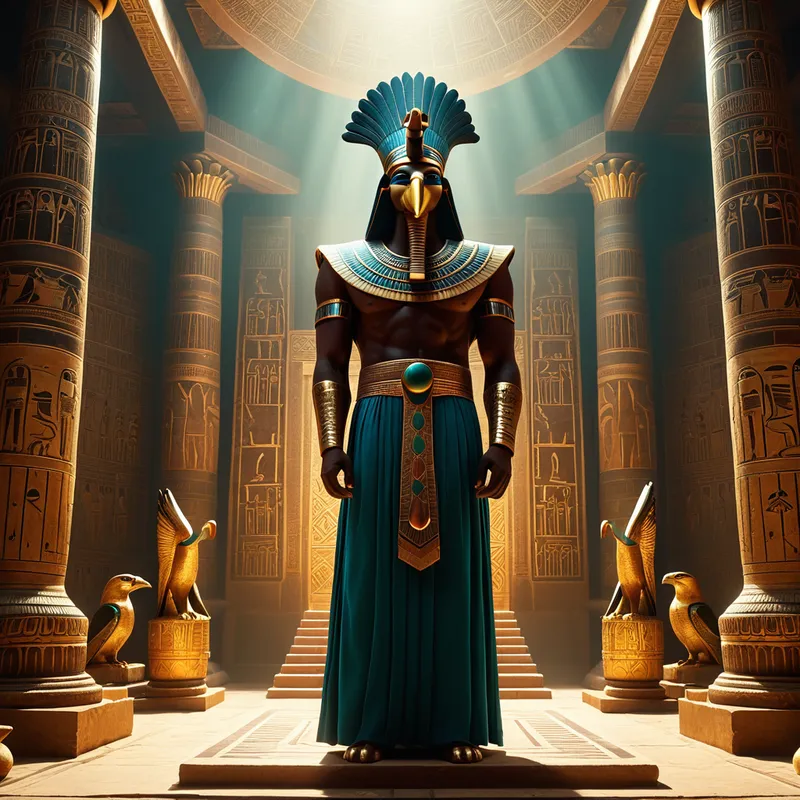
The Dispute of Horus and Set ( Myth Meaning & Symbolism
A divine trial for Egypt's throne pits the rightful heir, Horus, against his chaotic uncle, Set, in a saga of justice, betrayal, and ultimate reconciliation.
The Tale of The Dispute of Horus and Set
The air in the Great Ennead was thick with the scent of lotus and the weight of eternity. The sun-baked silence of the hall was broken only by the murmur of the celestial Nile flowing through the Field of Reeds. A dispute had festered for eighty years, a wound in the fabric of Ma’at itself. On one side stood Horus, the Avenger, his falcon eyes sharp with the grief of a son who never knew his father. He was the living seed of Osiris, rightful heir to the Two Lands. Opposite him coiled Set, the Red One, whose form was a mystery of aardvark and hound, his voice the crack of thunder in the barren hills. He was the brother who had slain Osiris, who claimed the throne by strength and chaos.
The gods were divided, their voices a storm of indecision. Ra, the ancient one, favored Set’s raw power. But Isis, Horus’s mother, wove spells of protection and argument with the patience of the river. The trial became a saga of treachery and cunning. Set challenged Horus to a contest, to race in stone ships upon the Nile. Horus, clever, built his boat of pinewood and painted it to look like stone. Set, in true stone, sank like a rock. Enraged, Set transformed into a hippopotamus and shattered Horus’s boat. In the struggle, Horus lost an eye—a celestial orb carved from the moon itself.
But the most infamous blow was struck in darkness. Set, seeking to dominate his nephew utterly, committed an act of violation. Yet from this desecration, Horus’s cunning mother Isis worked her deepest magic. She caught Horus’s seed and spread it upon Set’s favorite lettuce in his garden. When Set ate, he became pregnant with the seed of his rival, a humiliation that shouted his defeat to the council.
The final judgment came not from the bickering gods, but from the silenced. A letter was sent to Neith, the ancient goddess of the deep. Her reply was swift and final: give the office to Horus. Still, Set raged. A final test was decreed. They would each journey into the belly of the other, transformed into hippopotami, and see who could endure longest. Isis, fearing for her son, hurled a copper harpoon into the watery fray. It struck Horus first. She withdrew it and cast again, this time piercing Set. He cried out, “What, sister? Do you not know your own brother?” In a moment of pity, Isis released him. Horus, in a fury of betrayal at his mother’s mercy, leapt from the water and struck off her head. The hall froze in horror.
Ra commanded Thoth to restore Isis with a cow’s head, a temporary form. The cycle of violence seemed endless. At last, the council appealed to Osiris himself, in his kingdom of the dead. From the Duat, Osiris’s voice echoed, cold and inevitable as the tomb: “Why is my son Horus still deprived of his father’s office?” He reminded them that all gods, and all men, would one day come to his silent realm. His justice was the final justice. Cowed by this truth, even Ra assented. Horus was crowned Lord of the Two Lands. But the story does not end in simple victory. Set was not destroyed. He was bound, made to bear the sun barque of Ra through the perilous night, his chaotic strength harnessed to a cosmic purpose. The Eye of Horus, lost and restored by Thoth, became the symbol of wholeness, a sacred offering.

Cultural Origins & Context
This myth is not a single story but a vast, living narrative woven into the very political and cosmological fabric of ancient Egypt. Its primary sources are fragmented across funerary texts like the Book of the Dead, temple inscriptions, and later Greek retellings such as Plutarch’s On Isis and Osiris. It was not merely entertainment; it was a divine charter for kingship. Every Pharaoh was the living Horus, and upon his death, he became Osiris. The myth legitimized the royal succession, framing it as a restoration of cosmic order (Ma’at) over chaos (Isfet).
The telling of this dispute would have resonated in the halls of power and in the rituals of the temple. It explained the necessity of a strong, just ruler (Horus) while acknowledging the ever-present, destructive forces of drought, storm, and foreign invasion (Set). The myth’s complexity—its lack of a purely “evil” villain and its shocking, ambiguous episodes—reflects a sophisticated understanding of the universe as a dynamic balance between opposing, yet necessary, forces.
Symbolic Architecture
At its heart, the dispute is the psyche’s foundational drama. Horus represents the principle of conscious order, legitimate inheritance, and the forward-looking ego destined to rule the daylight world of society and structure. Set is not mere evil, but the necessary, raw force of the unconscious: instinct, passion, brute strength, and the disruptive energy that challenges stagnant order.
The throne is not won by destroying chaos, but by compelling it into service. The true enemy is not the shadow, but the refusal to engage it.
The mutilation—the loss of the Eye and the sexual violation—symbolizes the inevitable wounding incurred in this struggle for consciousness. The restored Wedjat Eye is not the original, innocent eye. It is a reconstituted wholeness, wiser and more resilient for having been shattered and made whole by Thoth, the archetypal mediator. The shocking violence between Horus and Isis reveals the painful cost of individuation: the nascent ego (Horus) must sometimes rebel against the very source of its protection (the mother complex) to claim its full authority.
The Dreamer’s Resonance
When this myth stirs in the modern dreamer, it announces a profound internal trial. To dream of a fierce, protracted legal battle or an endless competition against a shadowy, relentless opponent is to feel the Horus-Set dispute alive within. Somatic sensations may include a pressure behind the eyes (the Horus eye), a feeling of being violated or undermined in one’s core authority, or a raw, untamed anger (the Set energy) that feels both destructive and potent.
Psychologically, the dreamer is in the council of the gods, where parts of the self argue for order and parts for disruption. The dream may present impossible contests or paradoxical betrayals, mirroring the myth’s bizarre tests. This is the psyche working to adjudicate a deep-seated conflict between what one feels is rightfully theirs (inheritance, potential, a “throne”) and the internalized chaotic forces that sabotage, challenge, or seem to illegitimately hold that power. The process is not about winning, but about enduring the trial until a deeper, more authoritative voice (the Osiris within) can settle the claim.
Alchemical Translation
The alchemy of this myth is the transmutation of a binary conflict into a paradoxical unity. The goal is not the hero’s pure victory, but the integration that follows the divine verdict. The modern individual’s journey of individuation follows this precise pattern. First, one must identify the Horus claim: “What is my rightful inheritance? My authentic voice, my purpose?” Then, one must confront the Set force: the inner saboteur, the explosive temper, the addictive pattern, the chaotic life circumstances that seem to usurp that throne.
The crown of the Self is a double crown. One part is forged in the bright gold of conscious achievement, the other in the dark iron of acknowledged shadow.
The arduous, often humiliating trials are the necessary engagements with this shadow. We lose our “eye”—our clarity, our innocence. We may feel violated or humbled. The alchemical fire is the eighty-year dispute itself, the sustained tension of the conflict. The conjunctio, or sacred marriage, is the final, startling resolution: Set, the adversary, is given a vital role bearing the sun. The chaotic energy is redeemed, harnessed to propel the very journey of consciousness (Ra’s barque) through the darkness. The individual who completes this process does not become a flawless Horus. They become a ruler who has integrated their Set, a consciousness powered by its reconciled opposites, wearing the double crown of a unified psyche. The offering of the Wedjat Eye is then made: the wholeness gained is offered back to the gods, to life itself, no longer as a demand, but as a sacred gift.
Associated Symbols
Explore related symbols from the CaleaDream lexicon: