The Dioscuri (Castor and Pollu Myth Meaning & Symbolism
The myth of twin brothers, one mortal and one divine, whose bond transcends death, creating a constellation of inseparable light and shadow.
The Tale of The Dioscuri (Castor and Pollux)
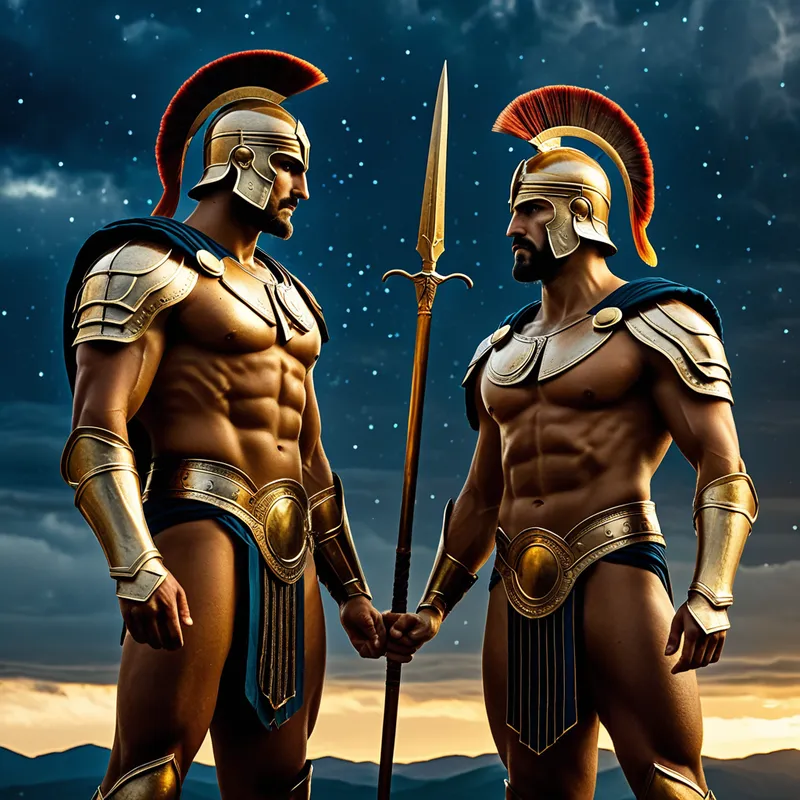
Hear now a tale woven from starlight and dust, of two hearts that beat as one and the price paid to keep that rhythm alive. In the age when gods walked [the earth](/myths/the-earth “Myth from Hindu culture.”/) in the guise of men, there was born to Leda, Queen of Sparta, a pair of sons. But their origin was a mystery sung by [the wind](/myths/the-wind “Myth from Various culture.”/): one, Castor, was born of mortal seed, his father the king. The other, Polydeuces (whom the Romans called Pollux), was born of divine lightning, his father the great Zeus himself. From the same egg they hatched, yet one was bound to [the earth](/myths/the-earth “Myth from Hindu culture.”/), the other to the heavens.
They grew as two halves of a single soul. Castor, the mortal, was a master of horses, his hands knowing the tremor of a stallion’s flank as a bard knows his lyre. Pollux, [the immortal](/myths/the-immortal “Myth from Taoist culture.”/), was a peerless boxer, his fists like falling stars. Together, they sailed with [Jason](/myths/jason “Myth from Greek culture.”/) on [the Argo](/myths/the-argo “Myth from Greek culture.”/), their strength a bulwark against storm and monster. They were the Dioscuri, the youthful gods, protectors of sailors who saw their flickering light dance on the mastheads in stormy seas.
But [the shadow](/myths/the-shadow “Myth from Jungian culture.”/) finds all light. Their bond was tested not by a foreign army, but by kin. In a quarrel over stolen cattle with their cousins, Idas and Lynceus, fate’s cruel blade fell. Lynceus, with his preternatural sight, struck Castor down. A mortal wound for a mortal man. Pollux, hearing his brother’s cry—a sound that tore [the world](/myths/the-world “Myth from Tarot culture.”/) in two—found Castor bleeding his life into the Spartan soil.
Here, the universe held its breath. Pollux, the immortal, knelt in the dust. He cradled his dying twin, and the unbearable truth crashed upon him: he was condemned to an eternity of suns without his shadow, a song without its harmony. He would walk the halls of Olympus forever, alone. This was not a gift, but a curse.
So Pollux, son of Zeus, looked up to the fathomless sky and made a prayer that was also a defiance. “Father!” he cried, his voice raw with a grief that shook the roots of mountains. “Take this from me. Take this immortality. I will not have it. Let me follow him into the dark, or bring him up into the light. But do not leave us parted.”
The silence that followed was deeper than any tomb. Then, the voice of the Thunderer echoed, not in anger, but in solemn recognition of a love that challenged cosmic law. He offered a choice no god had ever conceived: they could alternate their existence. One day, Pollux would descend to the murky realm of [Hades](/myths/hades “Myth from Greek culture.”/) to be with Castor; the next, Castor would ascend to Olympus to be with Pollux. An eternal oscillation between heaven and earth, light and shadow, joy and grief.
And so, they were not lost to the world. Zeus, in his final tribute, set their intertwined spirits in the vault of the night. There they blaze as the constellation Gemini, two stars forever close, a beacon of brotherhood that refuses the finality of the grave. They are the light that appears on the storm-tossed wave, the sudden calm, the hope that no bond truly dies.
Cultural Origins & Context
The myth of the Dioscuri is not a singular story but a living tradition that flowed from the Indo-European heartland into the specific soil of Greece and Rome. They are thought to derive from ancient Proto-Indo-European divine twin myths, figures representing the fundamental duality of existence: day and night, life and death, mortal and immortal. In Greece, they were fervently worshipped not as distant Olympians, but as immediate, accessible saviors. They were the protectors of sailors, their phenomenon of St. Elmo’s Fire seen as their physical presence, guiding vessels through peril.
In Sparta, a society built on martial brotherhood, they were model warriors and the epitome of philia (brotherly love). Their cult was deeply embedded in the social fabric; Spartan kings would make sacrifices to them before battle, and their images were carried into war. In Rome, they were revered as Castor and Pollux, central figures in the Roman state religion after their legendary intervention at the Battle of Lake Regillus, where they appeared to secure a Roman victory. Their temple in [the Roman Forum](/myths/the-roman-forum “Myth from Roman culture.”/) stood as a testament to their role as guardians of the state and its people. The myth was passed down through epic poetry, like the Cypria, and local cult practices, functioning as a societal anchor—a divine explanation for loyalty, sacrifice, and the hope for divine aid in moments of extreme crisis.
Symbolic Architecture
At its core, the myth of the Dioscuri is a profound map of the [psyche](/myths/psyche “Myth from Greek culture.”/)’s inherent duality. They are not opposites at war, but complementary halves of a whole.
The true self is not a singularity, but a constellation of intertwined opposites.
Castor represents the mortal, earthly, and temporal [aspect](/symbols/aspect “Symbol: A distinct feature, quality, or perspective of something, often representing a partial view of a larger whole.”/) of being—the [body](/symbols/body “Symbol: The body in dreams often symbolizes the dreamer’s self-identity, personal health, and the relationship they have with their physical existence.”/), [the ego](/myths/the-ego “Myth from Jungian culture.”/), the part of us that is born, grows, and will decay. He is our humanity with all its fragility and groundedness. Pollux represents the immortal, celestial, and eternal aspect—the [spirit](/symbols/spirit “Symbol: Spirit symbolizes the essence of life, vitality, and the spiritual journey of the individual.”/), [the Self](/myths/the-self “Myth from Jungian culture.”/), the fragment of the divine or the unconscious that feels boundless and timeless. Their inseparable bond symbolizes the essential, though often conflicted, [marriage](/symbols/marriage “Symbol: Marriage symbolizes commitment, partnership, and the merging of two identities, often reflecting one’s feelings about relationships and social obligations.”/) between these two realms within an individual.
Their alternating [destiny](/symbols/destiny “Symbol: A predetermined course of events or ultimate purpose, often linked to spiritual forces or cosmic order, representing life’s inherent direction.”/) in [Hades](/symbols/hades “Symbol: Greek god of the underworld, representing death, the unconscious, and hidden aspects of existence.”/) and [Olympus](/symbols/olympus “Symbol: In Greek mythology, Mount Olympus is the divine home of the gods, representing ultimate power, perfection, and spiritual transcendence.”/) is the ultimate [symbol](/symbols/symbol “Symbol: A symbol can represent an idea, concept, or belief, serving as a powerful tool for communication and understanding.”/) of [integration](/symbols/integration “Symbol: The process of unifying disparate parts of the self or experience into a cohesive whole, often representing psychological wholeness or resolution of internal conflict.”/). It is not a [resolution](/symbols/resolution “Symbol: In arts and music, resolution refers to the movement from dissonance to consonance, creating a sense of completion, release, or finality in a composition.”/) that eradicates one side, but a dynamic [equilibrium](/symbols/equilibrium “Symbol: A state of balance, stability, or harmony between opposing forces, often representing inner peace or external order.”/). It models the necessity of acknowledging our [shadow](/symbols/shadow “Symbol: The ‘shadow’ embodies the unconscious, repressed aspects of the self and often represents fears or hidden emotions.”/) (the mortal, dying part) and our potential for transcendence (the divine part). The [constellation](/symbols/constellation “Symbol: Represents guidance, destiny, and the navigation through life, symbolizing the connections between experiences and paths.”/) Gemini becomes a celestial [mandala](/symbols/mandala “Symbol: A sacred geometric circle representing wholeness, the cosmos, and the journey toward spiritual integration.”/) for this completed self—a wholeness achieved not through the victory of one half over the other, but through their eternal and sacred [dialogue](/symbols/dialogue “Symbol: Conversation or exchange between characters, representing communication, relationships, and narrative flow in games and leisure activities.”/).
The Dreamer’s Resonance
When this myth stirs in the modern dreamscape, it often manifests as a profound somatic experience of division seeking union. A dreamer may find themselves with a twin, a double, or a mirror image that is both them and not-them. One may be injured, lost, or fading. The psychological process at work is the confrontation with a split in the psyche—perhaps between the professional and personal self, the logical mind and the emotional body, or the idealized [persona](/myths/persona “Myth from Greek culture.”/) and the rejected shadow.
The somatic sensation can be one of literal heartache, a pulling in the chest, or a feeling of being physically halved. The dream is the psyche’s attempt to heal this rupture. The death of Castor in the dream does not symbolize an end, but the critical wounding of an aspect of the self that demands attention. The dreamer, in the role of Pollux, is being presented with a non-negotiable choice: to acknowledge this wounded, mortal part and make a pact with it, or to live in a state of sterile, lonely “perfection.” The dream pushes towards the pact, towards the difficult, oscillating responsibility of caring for both parts of one’s nature.

Alchemical Translation
The alchemical journey of the Dioscuri is [the opus](/myths/the-opus “Myth from Alchemical culture.”/) of individuation—the process of becoming whole. It begins in the unio naturalis, the natural union of the twins in life, representing the initial, unconscious state of potential wholeness. The death of Castor is the [nigredo](/myths/nigredo “Myth from Alchemical culture.”/), the blackening, the necessary descent into darkness, despair, and the confrontation with mortality (of the ego, of an old identity).
The crucible of the soul is forged in the refusal to abandon any part of oneself.
Pollux’s refusal of solitary immortality is the pivotal moment of [rubedo](/myths/rubedo “Myth from Alchemical culture.”/), the reddening, a passionate, heartfelt commitment to the work of integration. It is the conscious, painful choice to stay connected to one’s suffering, humanity, and flaws. The resulting alternation between realms is the albedo and citrinitas—the whitening and yellowing—a state of purification and illumination where the opposites are not fused into a bland oneness, but are held in a dynamic, rotating tension.
For the modern individual, this myth does not counsel becoming “perfect” or purely “spiritual.” It instructs us to make the sacred pact with our own Castor—our vulnerable, temporal, imperfect human self. It asks us to agree to spend time in our personal Hades (our grief, shame, and limitations) as willingly as we aspire to our Olympus (our joy, creativity, and connection to the transcendent). The [triumph](/myths/triumph “Myth from Roman culture.”/) is the constellation—the creation of a stable, enduring pattern of being that encompasses both the light and the dark, granting others the guiding light of an authentic, fully inhabited life.
Associated Symbols
Explore related symbols from the CaleaDream lexicon: