The Dice Game of Shiva - where Myth Meaning & Symbolism
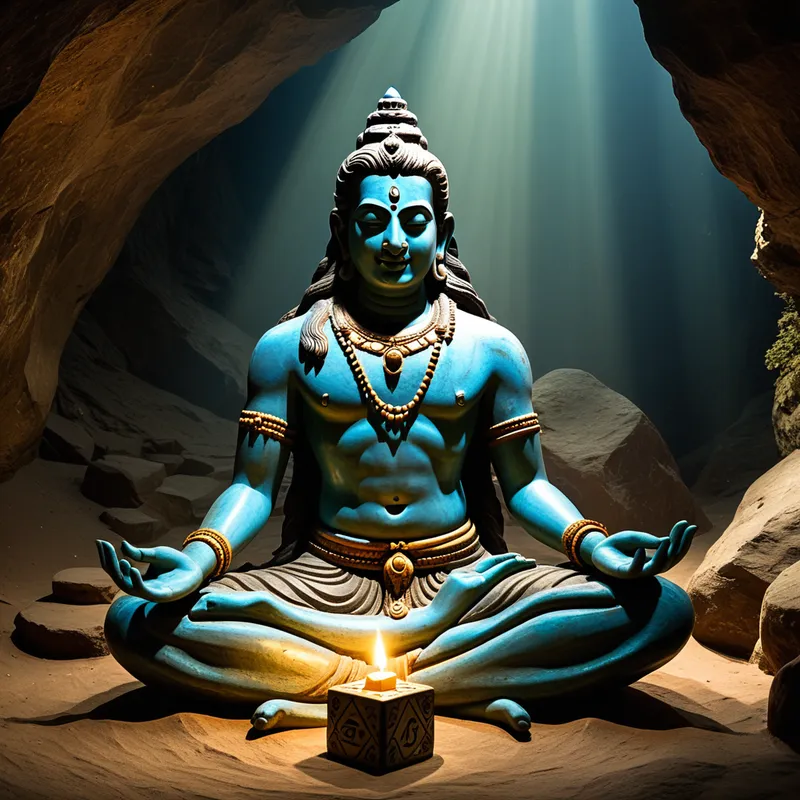
The supreme ascetic, Shiva, is lured into a game of dice by his consort, Parvati, leading to the loss of his transcendent state and a descent into worldly illusion.
The Tale of The Dice Game of Shiva - where
In the high, silent fastness where time itself grows thin, where the snows of eternity settle on peaks that pierce the roof of the world, he sat. Shiva, the great ascetic, the lord of yogis, was immersed in samadhi. His body was still as mountain rock, smeared with the ash of burned-out universes. His matted locks were the nesting place of galaxies, and the crescent moon on his brow was a cool, silent witness. In this state, he was pure consciousness, untouched, unmoved, beyond the dualities of win and lose, pleasure and pain.
But in the heart of the world, a different rhythm pulsed. Parvati, his divine consort, the embodiment of the dynamic, creative force of the universe, grew restless. To her, the absolute stillness of her lord was both awe-inspiring and agonizing. The world was a tapestry of love and strife, of music and sorrow, and he was absent from its dance. She longed not for the distant god, but for the engaged husband, the playful companion, the present father.
A plan, born of divine love and cosmic mischief, took shape in her mind. She approached his silent form, a smile playing on her lips. “Lord of All,” she whispered, her voice like the first murmur of a spring river breaking winter’s silence. “Your meditation is profound, your detachment complete. But can it withstand a simple game? A roll of the dice?”
Shiva, deep within the infinite, felt the vibration of her challenge. It was a tiny ripple in the boundless ocean of his being, yet it contained the entire seed of manifestation. Slowly, the consciousness that encompassed all things contracted, focused. His third eye remained closed, but his two earthly eyes opened, reflecting the playful, determined face of his beloved. He saw the dice in her hand—carved from the bone of a primordial beast and the heart of a dark star. They were not mere toys; they were the very instruments of Maya.
A game was agreed upon. The stakes? Themselves. The rules? The whims of chance, the law of probability that governs the falling of leaves and the fate of kings. The first rolls were light, playful. But the spirit of the game took hold. The click-clack of the dice on the stone floor of the cave became the ticking clock of creation. Parvati, embodying the engaging power of the world, played with fierce joy and cunning focus. Shiva, the transcendent one, found himself drawn into the dance of duality he had renounced.
He played, and he began to lose. With each unlucky roll, something of his immense, formless power condensed and slipped away. His serene indifference cracked. A flicker of frustration, a shadow of desire to win, crossed his face—emotions long since burned to ash in the fires of his penance. Parvati played on, and the unthinkable happened. The great ascetic, the master of himself, lost everything. He lost his celestial ornaments, his mighty bull Nandi, his very loincloth. Finally, in the ultimate throw, he lost himself. His transcendent state, his identity as the detached lord of yoga, was forfeit.
Vanquished, Shiva turned and walked away from his Himalayan abode, stripped of his divine attributes, a seemingly ordinary, bereft figure descending into the plains of the world. Parvati, holding all he was, watched him go, her victory tasting suddenly of ashes. The game was over. The illusion had claimed its greatest prize.
Cultural Origins & Context
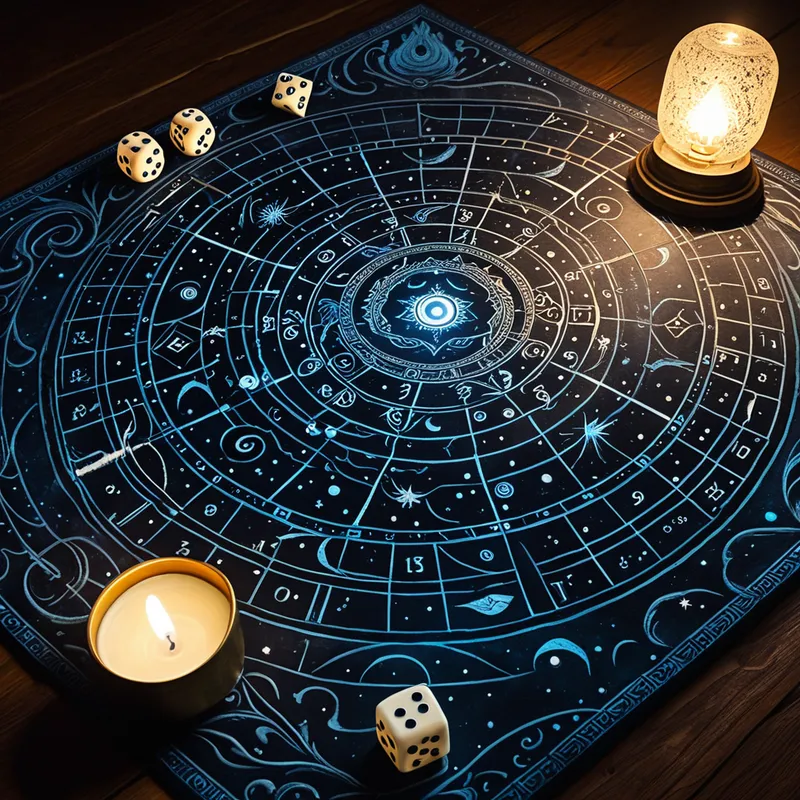
The myth of Shiva’s dice game is primarily found within the corpus of Puranic literature, particularly the Shiva Purana and the Linga Purana. Unlike the grand cosmological narratives of creation or the epic battles of the Mahabharata, this story belongs to a more intimate, domestic, and philosophical stratum of mythology. It was told not just to glorify the deity, but to illustrate a profound theological and existential paradox.
It functioned as a teaching story, passed down by storytellers and priests to illustrate the irresistible, engaging power of Maya, even for the highest consciousness. It served as a narrative anchor for discussing the nature of attachment, the perils of even subtle desire, and the inseparable interplay between the transcendent absolute (Shiva) and the immanent creative energy (Shiva/Parvati as Ardhanarishvara, the androgynous union). In a societal context, it also subtly validated the importance of the householder’s life (grihastha ashrama) and the power of the feminine principle (Shakti) as the necessary force that brings the transcendent into dynamic relationship with the world.
Symbolic Architecture
At its core, this is not a story about a game, but about the fundamental conditions of existence. The dice represent the principle of chance, probability, and the inherent uncertainty of the manifested universe. To enter the game is to accept the rules of samsara—the cyclical world of birth, death, and consequence.
The dice are the bones of fate, rattling in the cup of time. To roll them is to consent to be bound by their fall.
Shiva represents pure, undifferentiated consciousness—the witness, the Purusha. His deep meditation is the state of liberation (moksha), beyond all pairs of opposites. Parvati represents Prakriti, the active, manifesting principle of nature, the divine energy that fuels the world of form and relationship. Her challenge is not malicious, but essential. The universe cannot exist in a state of pure, static transcendence; it requires the dynamic tension between stillness and movement.
The game, and Shiva’s subsequent loss, symbolizes the inevitable “fall” of spirit into matter, of consciousness into identification. Even the greatest sage carries a latent thread of identity, a final subtle attachment, which the cunning of Maya can exploit. Shiva’s loss of his attributes signifies the soul’s descent into incarnation, forgetting its divine nature and becoming entangled in the roles, possessions, and ego-identifications of worldly life.
The Dreamer’s Resonance
When this myth pattern stirs in the modern unconscious, it often manifests in dreams of unexpected loss, foolish gambles, or being stripped of status. You may dream of losing a cherished possession in a bet, showing up to work naked having forgotten your clothes, or being forced to hand over your house keys to a smiling, familiar figure.
Somatically, this can feel like a sudden deflation, a loss of spiritual or psychological “insulation.” The dreamer is undergoing a process of necessary descent. The psyche is signaling that a period of detached observation, intellectual superiority, or spiritual bypassing has reached its limit. The “Parvati” aspect of the self—the embodied, emotional, relational, and creative life force—is demanding engagement. The price of admission to a fuller, more integrated life is the forfeiture of the safe, detached identity. It is a painful but crucial humiliation of the ego that believes it is above the game.

Alchemical Translation
The psychic transmutation modeled here is the alchemy of integration, the core of Jung’s individuation process. We all contain an inner “Shiva”—a part that seeks transcendence, clarity, control, and isolation from life’s messy complexities. We also contain an inner “Parvati”—the part that longs for connection, passion, creativity, and immersion in the sensory world.
Individuation begins when the sage within consents to play the fool’s game, understanding that wholeness is found not in choosing one, but in mastering the relationship between them.
The “dice game” is the moment of crisis where our spiritual or intellectual pretensions are challenged by the raw needs of life: love, failure, dependency, emotion. “Losing the game” is the indispensable first step. It is the dissolution of the inflated persona—the serene yogi, the invulnerable intellectual, the perfectly controlled individual. This loss forces a descent into the ordinary, the human, the flawed.
But the myth does not end with Shiva’s exile. Later narratives tell of his return, of Parvati’s remorse, and of the restoration of a new, more conscious balance. This is the alchemical rubedo, the reddening. The transcendent consciousness, having fully experienced the depths of identification and loss, returns not to its old, detached state, but to a state of engaged transcendence. It can now participate in the world without being completely enslaved by it. The integrated self is neither the aloof ascetic nor the frantic player, but the one who understands the game so deeply they can play with freedom, knowing the dice are both real and illusory. The ultimate gamble is to risk the known self for the chance to become whole.
Associated Symbols
Explore related symbols from the CaleaDream lexicon: