The Diamond Cave Myth Meaning & Symbolism
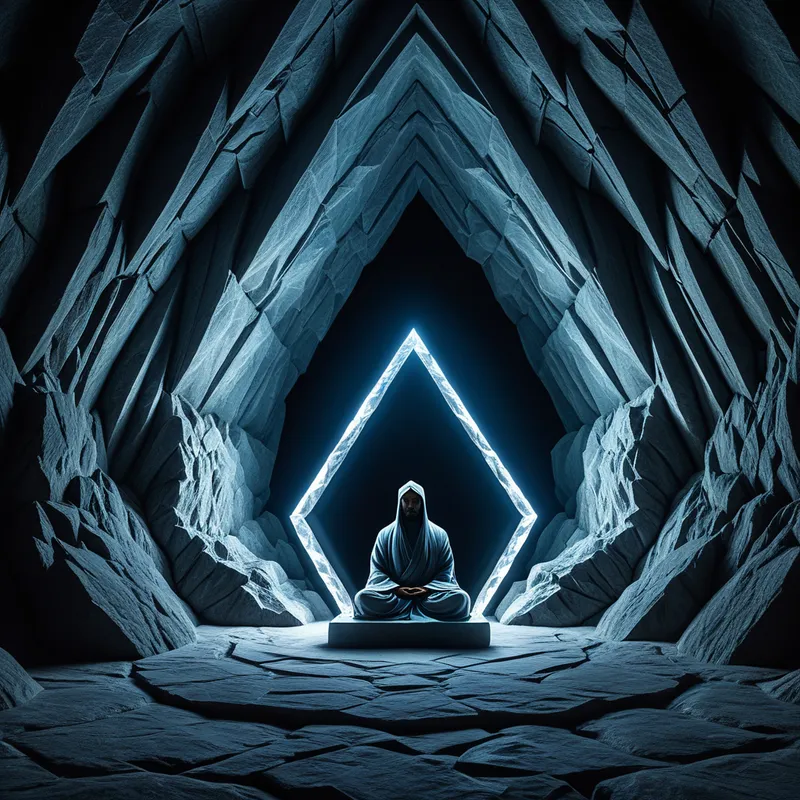
A myth of the Buddha's confrontation with Mara's army in a radiant cave, symbolizing the ultimate victory of enlightened awareness over the forces of delusion.
The Tale of The Diamond Cave
Hear now the tale whispered by the winds that scour the high plateaus, a story not of earth and stone alone, but of mind and its final, glorious triumph. Before the dawn of our age, when the world was a tapestry of becoming and unbecoming, the one who would be Shakyamuni sought the heart of reality. His austerities had honed his spirit to a fine edge, yet the final veil remained. He journeyed to the foot of the great Mount Meru, to a place where the bones of the earth held a secret.
There, he found it: an opening into the mountain’s heart, a cavern not of darkness, but of a cold, clear, and adamantine light. This was the Vajrāsana, the Diamond Throne, the immovable spot. The very walls were facets of living diamond, refracting not external sun, but an inner luminescence that had slept since the first thought arose. The Bodhisattva entered, sat upon the diamond seat, and made his final vow: “Though my skin, my nerves, and my bones should wither, though my life’s blood dry up, I will not move from this spot until I have attained supreme awakening.”
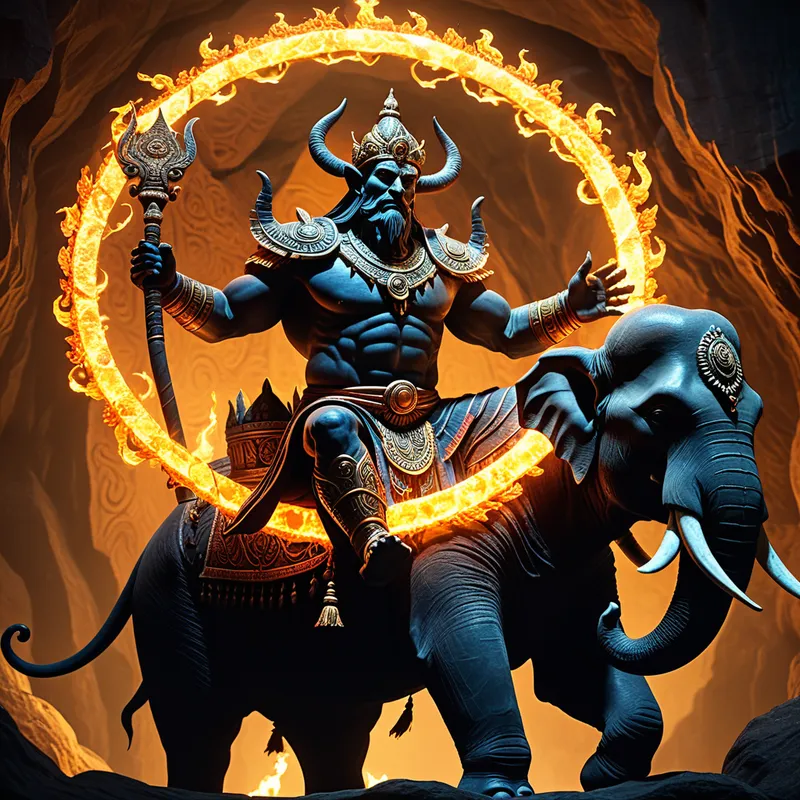
This vow was a bell struck in the silent hall of the universe. It echoed into the realm of Mara, the Lord of Illusion, whose kingdom is sustained by the hunger of beings. He felt the foundations of his domain tremble. Here was one who sought to see through the dream itself. Enraged and terrified, Mara marshaled his terrible host. He came not as a single demon, but as an army of ten thousand forms: fearsome warriors with blazing weapons, seductive daughters whispering of sensual pleasures, hordes of monstrous beasts with gnashing teeth, and a swirling cloud of doubts personified—voices that hissed of futility, of arrogance, of the comforts forsaken.
They poured into the Diamond Cave, a tsunami of shadow against the still, radiant point of the meditator. Spears were hurled, but in the cave’s pure light, they transformed into blossoms of lotus, falling harmlessly. Mara’s beautiful daughters danced, but their forms flickered and revealed the skeleton of craving beneath. The monstrous roars became empty echoes. The Bodhisattva did not fight; he witnessed. He touched the earth.
In that touch, he called the world itself as his witness. And the earth thundered in response, “I bear you witness!” The solidity of reality, the Dharma itself, affirmed his right to be there. Mara’s army shattered like glass against a diamond. The illusions dissolved, not in battle, but in the sheer, unbearable clarity of seeing things as they are. In that moment, as the last shadow fled the cave, the diamond walls blazed with a light that was neither cold nor hot, but was pure knowing. The Bodhisattva was no more. The Buddha sat in his place. The cave was now not a location, but a state of being: indestructible, luminous, and utterly awake.
Cultural Origins & Context
The myth of the Diamond Cave, or more precisely, the event at the Vajrāsana, is the central narrative of the Buddha’s enlightenment as preserved in the Pali Canon and elaborated in later commentarial literature. It is not a folktale but a foundational cosmological and psychological drama. Historically, it is tied to the site of Bodh Gaya, but its mythological location is the immovable axis of the world.
This story was not merely told; it was enacted in meditation, visualized by monks and nuns as the template for their own inner struggle. The recitation of the Buddha’s victory over Mara was (and is) a potent ritual, a sympathetic magic where the listener aligns themselves with the archetypal victor. In monastic communities, it served as the ultimate paradigm of the spiritual journey: the solitary practitioner, armed only with mindfulness and wisdom, confronting the totality of their own conditioned existence, personified as Mara. It democratized the epic, making every moment of temptation or doubt a skirmish at the door of one’s own diamond cave.
Symbolic Architecture
The myth’s power lies in its perfect symbolic architecture. The Cave is not a hiding place, but the innermost sanctum of the psyche, the irreducible core of awareness itself. Its diamond nature symbolizes the śūnyatā—not a void, but a reality that is luminous, indivisible, and capable of cutting through all deception.
The cave is the mind in its natural state, before it is colonized by story and fear. The diamond is its inherent, indestructible clarity.
Mara is not an external devil, but the personified totality of the psychological forces that sustain the sense of a separate, suffering self: fear (his army), sensual desire (his daughters), and the ultimate existential doubts about the path itself. The transformation of weapons into flowers is the key alchemical image: what the untrained mind perceives as a threat (pain, loss, criticism), the enlightened awareness perceives as part of the unfolding display, devoid of inherent solidity.
The “touching the earth” (Bhūmisparśa Mudrā) is the gesture of ultimate grounding. It signifies the end of seeking outside oneself. Reality itself—the earth, the Dharma—is the only witness needed. The victory is not an annihilation of Mara, but a dis-identification from his narrative. He is seen, and in being fully seen, he loses all power to define the one who sees.

The Dreamer’s Resonance
When this myth stirs in the modern dreamer, it often manifests not as a grand Buddhist legend, but in the intimate symbols of a personal crucible. To dream of being in a crystalline or gem-like cave is to dream of contacting a profound, inner integrity. The dreamer may feel a rare and potent stillness there.
The shadowy army at the threshold manifests as the dreamer’s own “Mara”: perhaps a looming deadline that feels monstrous, a chorus of critical inner voices, the seductive pull of an old addiction, or the formless anxiety of existential uncertainty. The somatic experience is crucial—a tightening in the chest, a sense of being besieged in a place that should be safe. This is the psyche staging its own great confrontation. The dream asks: Can you, in your innermost sanctuary, hold steady? Can you witness the storm of your own neuroses without believing you are the storm? The resolution in the dream—if it comes—is often a sudden, quiet clarity, a light that emanates from within the dreamer’s own body, dissolving the nightmare logic without a fight.

Alchemical Translation
For the individual on the path of individuation, the Diamond Cave myth is a master guide for psychic transmutation. The first step is the journey inward to find one’s own “immovable spot”—the core value, the non-negotiable truth of one’s being, beyond the roles of parent, professional, or partner. This is the seat of the Self.
The alchemical fire is the confrontation with the shadow, here personified as Mara’s legion. This is not about positive thinking, but about the courageous, mindful endurance of all that we have repressed, denied, or projected. The anger, the pettiness, the fears, the raw desires—they must be allowed to parade before the throne of awareness.
The transmutation occurs not when the shadow is defeated, but when it is recognized as a part of the self’s own disowned energy, and thus, robbed of its autonomous, haunting power.
The “touch of the earth” is the act of grounding this process in the body and in concrete reality—through journaling, embodied practice, honest relationship, or creative expression. It is the affirmation that this struggle is real and valid. The final illumination is the emergence of the Sage archetype: a consciousness that sees the interdependent flow of phenomena, that rests in a diamond-like clarity which reflects everything but is distorted by nothing. The cave is no longer a secret chamber, but the very nature of one’s perception. The world, in all its beauty and horror, is seen from the unshakable throne within.
Associated Symbols
Explore related symbols from the CaleaDream lexicon: