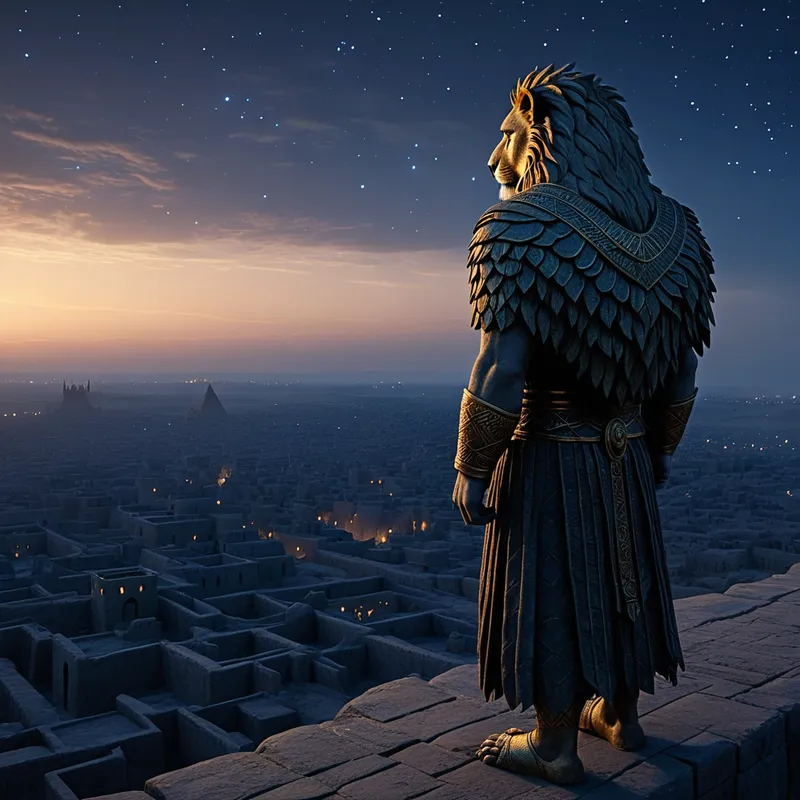
The dialogue between Gilgamesh Myth Meaning & Symbolism
A king, haunted by death, confronts his own soul in a desperate dialogue, seeking wisdom beyond the walls of his own power and grief.
The Tale of The dialogue between Gilgamesh
Hear now the lament of the king who had everything and found it to be dust.
In the sun-baked city of Uruk, whose walls were said to be raised by the gods themselves, ruled Gilgamesh. Two-thirds god, one-third man, he was a storm of a king—his strength shook the very foundations, his will bent the people to his tasks. He built, he conquered, he took. Yet in the silent chambers of his own heart, a hollow wind began to blow. He was mighty, but he was alone. Then came Enkidu, fashioned from clay and the breath of the wilderness. They clashed like titans and from that clash, a bond was forged stronger than bronze. They were two halves of one soul—the civilized king and the untamed spirit. Together, they slew the demon Humbaba and defied the gods.
But the gods demand balance. For their arrogance, they claimed Enkidu. A wasting sickness took him, not on a glorious battlefield, but on a pallet of reeds. Gilgamesh watched the light fade from his friend’s eyes, felt the warmth leave his hand. The storm-king was shattered. For the first time, Gilgamesh, who feared nothing, knew terror. The terror of the worm, the dust, the unending dark. If Enkidu, his mighty mirror, could be reduced to clay, then so too would he be.
He cast off his royal robes, clad himself in the skins of lions, and fled his own kingdom. His quest was no longer for glory, but for an answer. He sought Utnapishtim, the Faraway, the only mortal to have cheated death. His journey was a descent: through the Mount Mashu guarded by scorpion-beings, across the Waters of Death. He arrived, a ragged, desperate shadow of a king.
And here, in the garden at the world’s end, the dialogue began. Not with Utnapishtim at first, but within the silent, ravaged halls of his own being. Gilgamesh pleaded his case to the immortal one: “My friend who I loved has turned to clay. Shall I not lie down like him and never rise again?” He recited the saga of his grief, his journey, his fear. Utnapishtim listened, then offered not comfort, but the relentless truth of the flood story—a tale of divine caprice, not a recipe for immortality. He tested Gilgamesh with sleep, which the king failed. As a final consolation, he revealed the secret of a plant that restores youth, a thorny prize at the bottom of the sea.
Gilgamesh dove deep, retrieved it, and for a moment, hope bloomed anew. He would take it back to Uruk, share it with the elders, and begin life again. But on the journey home, stopping at a cool spring, a serpent, drawn by the plant’s scent, stole it away. Gilgamesh watched it slough its old skin and slip, renewed, into the water. He sat down on the shore and wept. His great hands, which had felled giants, were empty. All his striving, his dialogue with fate, had ended here, with the silent consumption of his hope by the coiled wisdom of the earth. He returned to Uruk, to the towering walls he had built. He showed them to the ferryman, Urshanabi, not as a tyrant’s boast, but as a witness. “Look at it now,” he said. The dialogue was over. The answer was in the work, in the city, in the memory etched not in eternal life, but in enduring stone.
Cultural Origins & Context
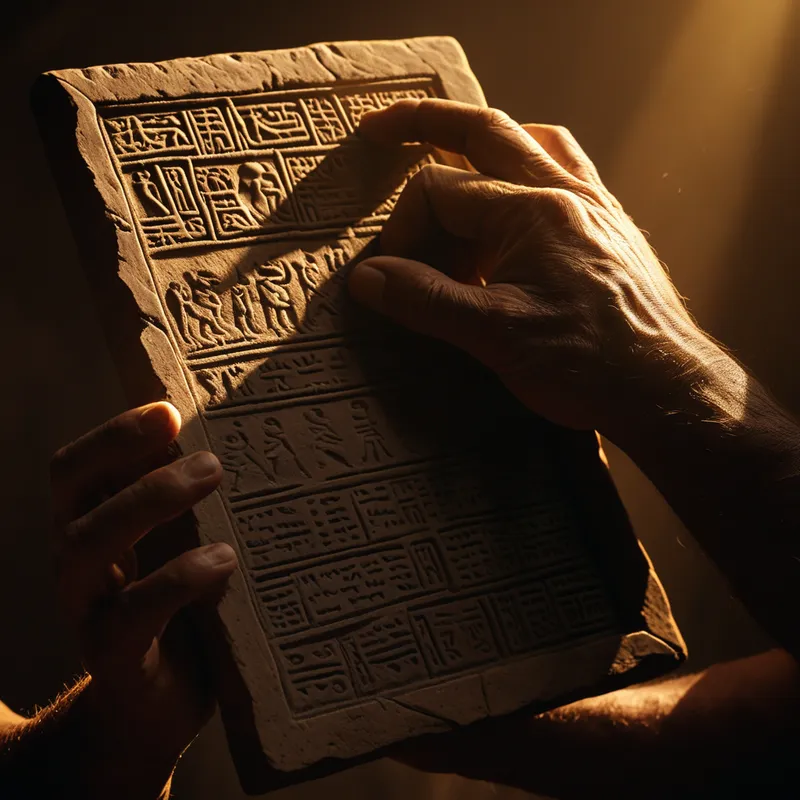
This core narrative is drawn from The Epic of Gilgamesh, a composite work of Sumerian and Akkadian poetry that is humanity’s oldest surviving major literary work. The tablets, inscribed in cuneiform, date back to the Third Dynasty of Ur (c. 2100 BCE). It was not a static bible but a living epic, recited by skilled scribes and perhaps performed in ritual or courtly contexts.
Its societal function was multifaceted. On one level, it was a foundational national myth for Mesopotamian city-states, explaining kingship, the relationship with the often-capricious gods, and the virtues of building civilization. On a deeper, more universal level, it served as a profound piece of existential literature. In a culture acutely aware of the fragility of life amidst floods, wars, and disease, the epic gave voice to the most human of terrors: mortality. It provided no easy solace, but it framed the question with a grandeur that made the asking itself a kind of answer. The “dialogue” was not just Gilgamesh’s; it was a culture’s dialogue with the limits of its own power and the meaning of its achievements.
Symbolic Architecture
The dialogue is not merely a conversation between characters, but a psychic drama externalized. Gilgamesh represents the conscious ego—the part of us that builds, achieves, and seeks to impose order on chaos. Enkidu is the instinctual, embodied anima or shadow-self, the connection to nature and raw feeling that the civilized ego has forgotten.
The death of Enkidu is not the death of a friend, but the catastrophic realization that the soul itself is mortal.
Gilgamesh’s subsequent flight is the ego’s desperate, linear quest for a “cure” for this consciousness—a literal immortality. Utnapishtim represents the Self, the transcendent, timeless center of the psyche that has integrated the flood of the unconscious. He does not give Gilgamesh what he wants because what he wants (endless egoic existence) is impossible. The serpent, a timeless symbol of transformation, cycles, and chthonic wisdom, performs the true alchemy. It takes the prize of becoming young again and embodies it. The serpent is the transformation; it does not possess it. Gilgamesh’s final act—showing the walls of Uruk—symbolizes the shift from seeking eternal life to creating enduring meaning. The work, the legacy, the shared story, becomes the true immortality.
The Dreamer’s Resonance
When this myth stirs in the modern dreamer, it often manifests not as a epic quest, but as a profound, unsettling dialogue in a liminal space. You may dream of sitting across from an older, wiser version of yourself, or a shadowy figure who is your opposite, in a room that feels both vast and suffocating. The conversation is urgent, but the words are muffled or the other self simply listens, its silence more terrifying than any rebuke.
This is the somatic signature of the ego confronting its own limits. The “death of Enkidu” in the psyche is often a major life transition: the end of a foundational relationship, a career failure, a health diagnosis, or simply the crushing weight of midlife awareness. The dream dialogue is the psyche’s attempt to process this grief and terror, to argue with fate. The feeling upon waking is often one of profound loneliness mixed with a strange, quiet urgency. The dream is initiating a necessary, if painful, conversation between the part of you that “does” and the part of you that simply “is,” and which knows it must die.

Alchemical Translation
The alchemy modeled here is the transmutation of the heroism of action into the heroism of acceptance. The initial state is leaden, heavy with the ego’s grandiosity and subsequent despair (Gilgamesh the tyrant, then Gilgamesh the mourner). The fire of the quest is the nigredo, the blackening—the journey through despair and the underworld of the psyche.
The stolen plant is not a failure, but the crucial dissolution. The ego’s prized solution must be taken by the unconscious for true change to occur.
The dialogue with Utnapishtim and the loss to the serpent constitute the albedo, the whitening—a washing in the waters of truth. The ego’s literal, goal-oriented solution is dissolved, revealing a more subtle truth. The final stage, the rubedo or reddening, is not a triumphant return with a trophy, but Gilgamesh’s return to Uruk. He sees his city not as a possession, but as a testament. The psychic energy that was fixated on conquering death is redirected into valuing the finite, mortal moment. The individual is not made immortal, but their perspective is irrevocably altered. The gold produced is not eternal life, but wisdom—the hard-won knowledge of one’s place in the great cycle. The individuated Self is the one who can stand before the walls of their own life, their own achievements and failures, and say, “Look at it now,” with something closer to peace than despair. The dialogue ends not with an answer, but with a deeper, more resonant relationship to the question.
Associated Symbols
Explore related symbols from the CaleaDream lexicon: