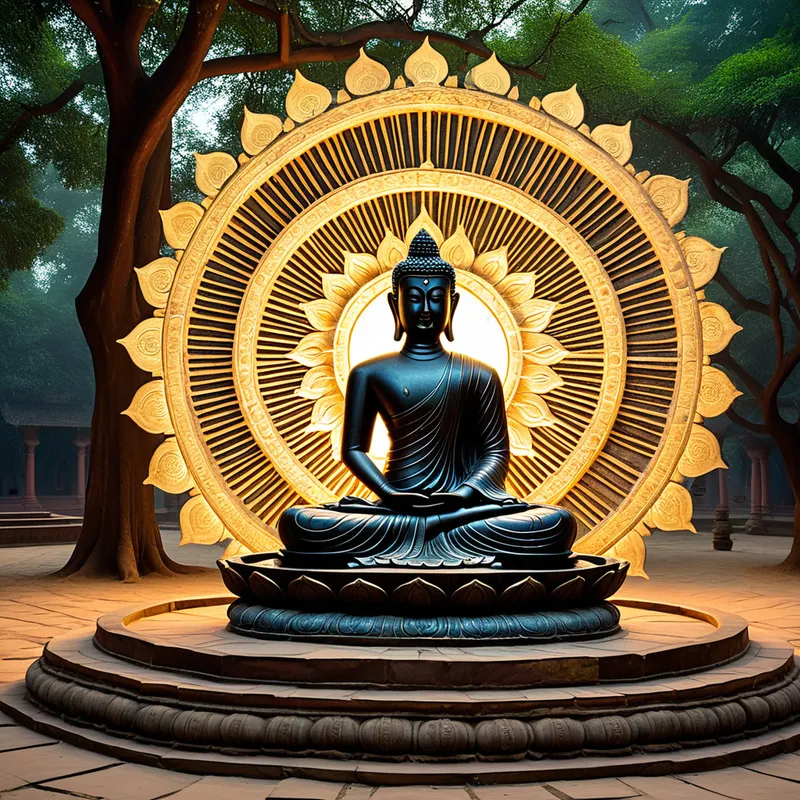
The Dharmachakra Myth Meaning & Symbolism
The Buddha's first teaching sets the Wheel of Dharma in motion, offering a path from suffering to liberation through profound insight.
The Tale of The Dharmachakra
The air in the Migadāya was still, heavy with the scent of damp earth and old leaves. For six years, the five ascetics had followed him, this prince who had traded silks for rags, palaces for forests. They had watched him starve his body, hold his breath until the world swam, sit unmoving under the fiercest sun. And they had watched him, finally, accept a simple bowl of milk-rice, breaking his fierce austerity. In their eyes, he had faltered. Betrayed the path. They turned their backs, a silent council of disappointment, and withdrew to this grove where deer moved like silent shadows.
He came to them there. Not as the emaciated seeker they remembered, but as one utterly changed. His step was not heavy with penance, but grounded, like a mountain come to walk. His eyes held not the fever of conquest, but the vast, cool clarity of a cloudless sky. He sat, folding his legs upon the earth, and the very deer drew closer, unafraid.
The ascetics, bound by old loyalty and new scorn, intended to offer no respect. Yet as his presence settled, a profound quiet descended, deeper than the silence they cultivated. It was a quiet that listened. He spoke, and his voice was the sound of a deep river finding its course.
“Monks,” he began, and the word was a recognition, not a title. “These two extremes are not to be followed by one who has gone forth. What two? The pursuit of sensual happiness in sensual pleasures, which is low, vulgar, the way of ordinary people, unworthy, unprofitable; and the pursuit of self-mortification, which is painful, unworthy, unprofitable.”
The words hung in the air, dismantling the very foundations of their striving. He spoke of a Majjhima Patipada, a path that ran like a razor’s edge between the indulgence he had left and the torment they still embraced. Then, with the precision of one describing the workings of a sublime and terrible engine, he set in motion the Cattāri Ariyasaccāni.
He gave name to the universal ache: Dukkha. He pointed to its source, the thirsty, grasping Taṇhā. He proclaimed with the certainty of one who has crossed over: “There is a cessation to this suffering.” And finally, he laid out the very path to that cessation: the Ariyo Aṭṭhaṅgiko Maggo.
As he spoke, it was as if he was not merely explaining, but assembling. From the raw material of truth, he fashioned a wheel. A wheel of law, of reality, of the way things are and the way to freedom from them. With his hands, he formed the Dharmachakra Mudra, fingers touching as if holding the very axis of this newly revealed cosmos. And in that moment, in the hearts of the five who listened, something long-stationary, frozen in the ice of dogma and effort, began to turn. The Wheel of Dharma, once still and latent in the nature of reality, was set in motion. The first revolution had begun. The deer, it is said, paused in their grazing to listen, for the sound of suffering’s end is sweet to all beings.
Cultural Origins & Context
This is not a myth of gods on Olympus, but a historical event elevated to mythic stature through its world-altering consequence. The sermon at Sarnath is the foundational act of the Buddhist community, the Sangha. It was first transmitted orally, memorized and recited by monks for centuries before being committed to palm-leaf manuscripts in the Pali Canon, specifically in the Dhammacakkappavattana Sutta.
Its primary societal function was and remains transmission and validation. It validates the Buddha’s enlightenment by demonstrating he had found something teachable—a practical doctrine (Dhamma) rather than an ineffable experience. It established the template for all future teaching: diagnostic (the Truths of suffering and cause), prognostic (the Truth of cessation), and prescriptive (the Truth of the path). For the monastic community, reciting this sutta was a reaffirmation of their raison d’être. For lay followers, it represented the accessible core of a vast philosophical system, a map offered by one who had returned from the territory of awakening.
Symbolic Architecture
The Dharmachakra is the supreme symbol of the Buddha’s teaching, but its symbolism is dynamic, not static. It is not a shield or a throne, but a mechanism.
The Wheel turns not to move from place to place, but to transform the ground upon which it stands.
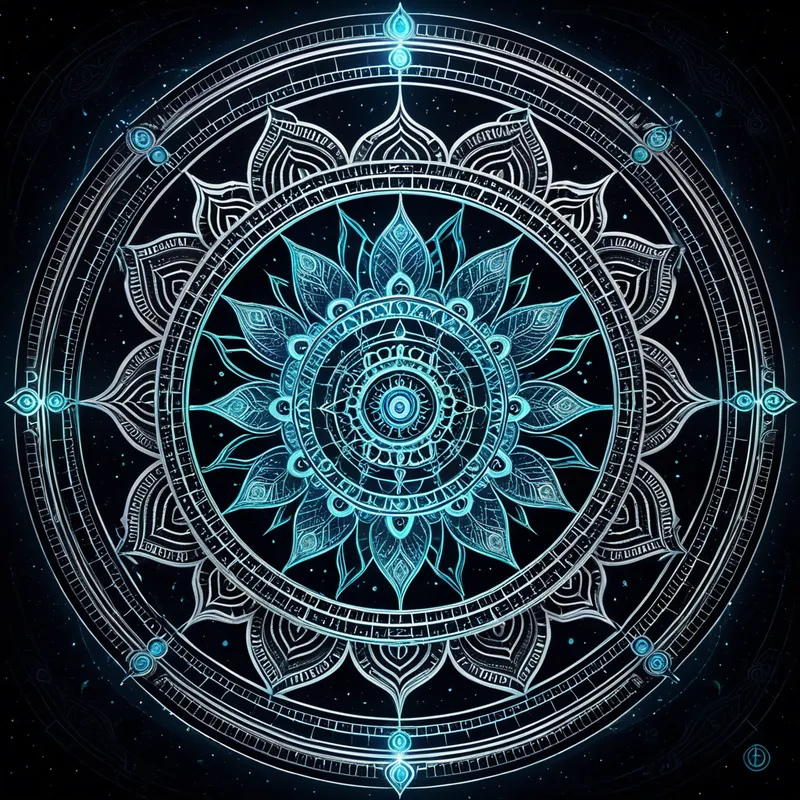
Its hub represents ethical discipline (Sīla), the unmoving center from which all else radiates. The spokes (typically eight, for the Eightfold Path) are the practical means, connecting the center to the rim. The rim represents the power of meditative concentration (Samādhi) that holds the entire structure together, enabling its motion. The three parts together symbolize the integrated training in wisdom, morality, and meditation.
Psychologically, the Wheel represents the self-validating system of liberating insight. It is the psyche’s own healing logic. The First Noble Truth is the courageous act of acknowledging suffering without denial—the initial, painful turn. The Second Truth is the insight into one’s own complicity in that suffering, the grasping ego. The Third is the revolutionary possibility of release, the “turn” toward health. The Fourth is the recursive application of the method, where each step on the path reinforces the others, creating a virtuous, upward spiral of understanding.
The Dreamer’s Resonance
To dream of a wheel is to dream of process, cycle, and mechanism. A dream of the Dharmachakra specifically signals a profound moment of psychic integration and the reception of inner guidance.
The somatic experience might be one of a deep, resonant hum or vibration, a feeling of something monumental beginning to move after being long stuck. The dreamer may see a wheel that is dusty and immobile, then watch as it begins to turn, shedding rust or overgrowth. This mirrors the psychological process of a core, life-governing insight—perhaps about a repetitive pattern of suffering (“my same old story”)—finally breaking into conscious awareness. The wheel’s turning is the moment the intellectual understanding becomes an embodied, operational truth.
Alternatively, dreaming of a broken or shattered wheel may indicate a crisis of meaning, where one’s guiding philosophy or life structure has failed. The unconscious is then presenting the archetype of the Wheel in its damaged state, calling for a return to the essential, integrative principles at its center.

Alchemical Translation
The alchemy here is not of lead to gold, but of confusion to clarity, of Samsara to Nirvana, using the mind itself as the crucible. The myth models individuation as a process of setting in motion one’s own ethical and psychological causality.
Individuation is the personal turning of the Wheel, taking universal truths and forging them into the unique instrument of one’s own liberation.
The first alchemical stage is Nigredo: the frank confrontation with Dukkha—the shadow, the pain, the neurosis. This is the “heat” of honest self-appraisal. The second is Albedo: the purification offered by the Middle Way and the Eightfold Path, washing away the extremes of inflation and abasement, of indulgence and harshness. The third is Rubedo: the reddening, the culmination, which is the living realization of the path. Here, the Wheel is no longer an external doctrine but the very pattern of one’s perception, speech, and action. The “three turnings” described in the sermon—the understanding of each Truth, the knowledge of what must be done regarding it, and the accomplishment of that task—become the recursive engine of psychological growth.
For the modern individual, the Dharmachakra myth invites us to become the mechanic of our own psyche. It asks: What is the suffering I have not fully acknowledged? What is the craving that fuels it? Is there a genuine belief in cessation, in the possibility of change? And am I willing to engage the integrated, daily practice—the “path”—that will turn insight into lived reality? The Wheel does not turn by wishful thinking. It turns by the applied pressure of right effort against the axle of right understanding. To set it in motion is to begin the most profound journey: from being a passive subject of one’s psychology to an active agent of its transformation.
Associated Symbols
Explore related symbols from the CaleaDream lexicon: