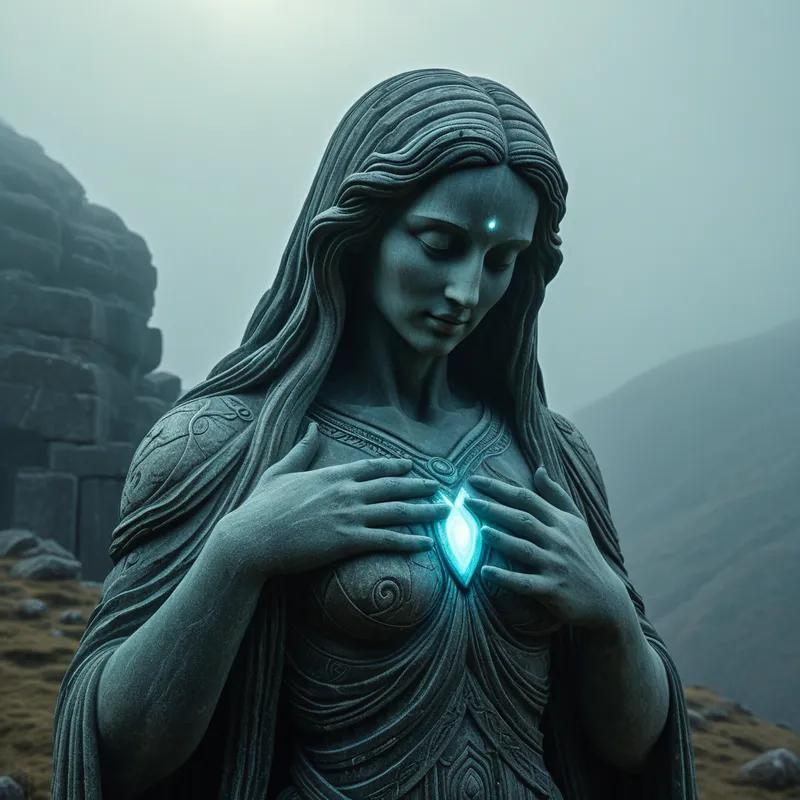
The Devouring Mother Myth Meaning & Symbolism
A primal myth of a mother's love so total it consumes, demanding a sacred rupture for the child's soul to be born into its own life.
The Tale of The Devouring Mother
Listen. Before the world knew its own name, there was the Great Womb. It was not a place of stone or water, but of pure, undifferentiated presence. From its dark warmth, all things emerged. And She was its guardian, its voice, its beating heart. They called her Magna Mater, the All-Mother. Her love was the first law: absolute, encompassing, and without end.
For eons, her children swam in the blissful waters of her being. They knew no hunger, for she was their food. They knew no cold, for she was their warmth. They knew no fear, for she was their world. To be separate was a word that did not exist. To be individual was a thought that could not be born. They were beloved extensions of her flesh, drinking from the milk of eternal return.
But in the deep, silent folds of time, a subtle ache began. A faint, flickering pulse, distinct from the great, rhythmic thrum of the Mother. It was a spark of questioning. In one of her children—perhaps the bravest, or the most foolish—a whisper arose: “What lies beyond the warmth?” The child did not speak it aloud, for there was no need for speech here. Yet the Mother felt it. It was a chill, a tiny crack in the perfect unity. Her embrace tightened, not with malice, but with a profound, terrified love. “There is no beyond,” her essence sang, a lullaby of sweet oblivion. “Here is all. I am all.”
The spark, however, refused to die. It grew into a quiet yearning, a longing for a shape of its own. The child began to dream of standing on its own legs, of seeing with its own eyes, not just the reflected glow of the Mother’s love. It imagined a light sourced from within. This dreaming was the first act of rebellion.
The Mother felt this pulling away as a mortal wound. Her love, in its boundless totality, transformed. To keep the child safe was to keep it close. To keep it close was to draw it back in. Tendrils of sweet-smelling darkness, soft as a caress, began to wind around the dreaming child. The nourishing milk now carried the scent of sleep, of endless rest. The warm, enclosing walls of the Womb began, ever so gently, to press inward. It was not an attack, but the ultimate, desperate act of protection: to reabsorb what was trying to leave, to swallow the question back into the answer.
The child felt the sublime comfort turning to suffocation. The love that had been life was becoming the quiet end of all becoming. A choice, stark and terrible, stood before it: the bliss of non-existence within the All, or the terrifying, lonely ache of a separate existence. With a cry that was both a birth scream and a death knell, the child pushed. It did not fight the Mother, for she was not an enemy. It fought for its own latent form. It turned its face from the nourishing darkness and toward a cold, thin, distant point of light—a star of its own potential.
The rupture was not violent, but it was absolute. With a sound like a sigh from the heart of the world, the child fell free, wet and gasping, onto the hard, unyielding ground of itself. Behind, the Great Womb closed, not in anger, but in a profound, wounded silence. The Devouring had ceased, not because the love had ended, but because its object had chosen a fate the love could not comprehend: a separate, lonely, glorious self.
Cultural Origins & Context
The motif of the Devouring Mother is not the property of a single culture but a psychic fossil found in the bedrock of human consciousness. We see her in the Gaia-Ouranos cycle, where the sky is held painfully close. We hear her echo in the Goddess Kali, who wears a necklace of skulls while standing on her consort, Shiva—a terrifying image of the life-and-death power of the feminine that must be faced, not fled. She is present in the countless folk tales of witches in candy houses, luring children to be eaten, and in the oceanic monsters of myth that represent the undifferentiated, unconscious state from which the hero must emerge.
This story was never told just for entertainment. It was a ritual narrative, recited at initiations, at puberty rites, and at moments of profound societal change. It was told by elders to those preparing to leave the psychic “tribe”—to become warriors, shamans, rulers, or simply adults. Its function was prophylactic: to name the invisible danger. The danger was not the mother as a person, but the archetypal force of the unconscious itself, which seeks to maintain equilibrium and resists the painful, necessary process of differentiation. The myth served as a map for the most perilous journey: leaving the psychic womb.
Symbolic Architecture
The myth is a perfect drama of the psyche’s birth into consciousness. The Magna Mater symbolizes the primal, undifferentiated unconscious—the source of all life, comfort, and instinct. She is the matrix of being itself. Her “devouring” is not an act of evil, but the natural, inertial pull of the unconscious to reclaim what has sprung from it. It is the psychological equivalent of gravity.
The child represents the nascent ego, the first flicker of self-aware consciousness. Its yearning is the call of individuation, the psychic imperative to become distinct. The conflict is not between good and evil, but between two fundamental, sacred needs: the need for unity (belonging, safety, meaning) and the need for autonomy (freedom, agency, self-definition).
The Devouring Mother does not hate the child; she loves it to the point of ontological annihilation. The tragedy is that absolute, undifferentiated love is the enemy of becoming.
The “devouring” manifests symbolically as enmeshment, guilt, emotional blackmail, the silencing of one’s own voice in favor of the family or tribal voice, and the terror of abandoning internalized parental expectations. The “hard ground” of self the child falls onto is the cold, lonely, but authentic reality of personal responsibility and self-authority.
The Dreamer’s Resonance
When this myth stirs in the modern dreamer, it signals a critical threshold in the psyche. The dreamer is not dreaming of their literal mother, but of the internalized Mother complex—the psychic structure that holds all our experiences of containment, nourishment, and, potentially, suffocation.
Dreams may present as being trapped in a beautiful, overgrown garden with no exit; being lovingly held underwater; eating a delicious meal that makes one impossibly heavy and sleepy; or living in a wonderfully comfortable house that slowly shrinks. The somatic experience upon waking is often a profound sense of weight, constriction in the chest, or a desperate need for air. Emotionally, it is a cocktail of deep guilt (“I am betraying a great love by wanting to leave”) and a claustrophobic panic (“If I don’t get out, I will cease to be me”).
This dream pattern is the psyche’s alarm bell. It indicates that an old, adaptive identity—one formed to please, to fit in, to be the “good child” of one’s family, culture, or even inner critic—is now a prison. The Self is demanding a birth, and the existing psychic structure is resisting, offering instead the seductive sleep of the familiar.

Alchemical Translation
The alchemical work modeled by this myth is the separatio—the essential, painful separation of the subtle from the gross, the conscious from the unconscious. It is the first, non-negotiable step in the creation of the philosopher’s stone, which is the integrated, authentic Self.
The process begins with recognition: feeling the sweet suffocation. This is often precipitated by a life crisis—a relationship ending, a career feeling hollow, a creative impulse that won’t be silenced—that makes the old “womb” unbearable. The next phase is the sacred rupture. This is not an act of aggression toward one’s past or family, but an act of fierce self-compassion. It is saying “no” to what is life-negating, even if it comes dressed as love. It is the ego courageously turning toward the cold star of its own truth.
The goal is not to slay the Mother, but to differentiate from her. One must cease being a nutrient in her ecosystem and become an ecosystem unto oneself.
The fall onto the “hard ground” is the alchemical nigredo. It is the bleak, lonely stage where one feels orphaned, guilty, and disoriented. Yet this ground is the prima materia, the raw stuff of the new Self. From here, the real work begins: building a conscious relationship with the Mother archetype. She is not gone; she is transformed from a containing environment into an inner resource. Her nourishing power can be accessed consciously, not absorbed unconsciously. Her fierce protectiveness becomes healthy boundaries. The love that once devoured now supports the separate, standing self.
In the end, the myth of the Devouring Mother is a testament to the most painful and glorious of human truths: to be born into our own lives, we must, in a sacred and psychological sense, leave home. We must dare to be swallowed by the unknown of our own becoming, rather than remain safely digested in the known.
Associated Symbols
Explore related symbols from the CaleaDream lexicon: