The Desert Fathers Myth Meaning & Symbolism
A story of radical seekers who fled civilization for the desert's silence, battling inner demons to find the divine spark within the soul's deepest solitude.
The Tale of The Desert Fathers
Listen. In the days when the world was turning from old gods to new, when stone temples gave way to hearts as altars, a great unrest stirred in the souls of men. It was not a call to build, but to unbuild. Not to gather, but to scatter.
From the bustling ports of Alexandria, the polished streets of Rome, the fertile fields of the Nile, they came. Not soldiers, but refugees of the spirit. They turned their backs on the clamor of the marketplace, the weight of family expectation, the soft prison of a comfortable life. Their compass pointed not north or south, but inward, and its needle led them to the only place vast enough and empty enough to hold the enormity of their quest: the desert.
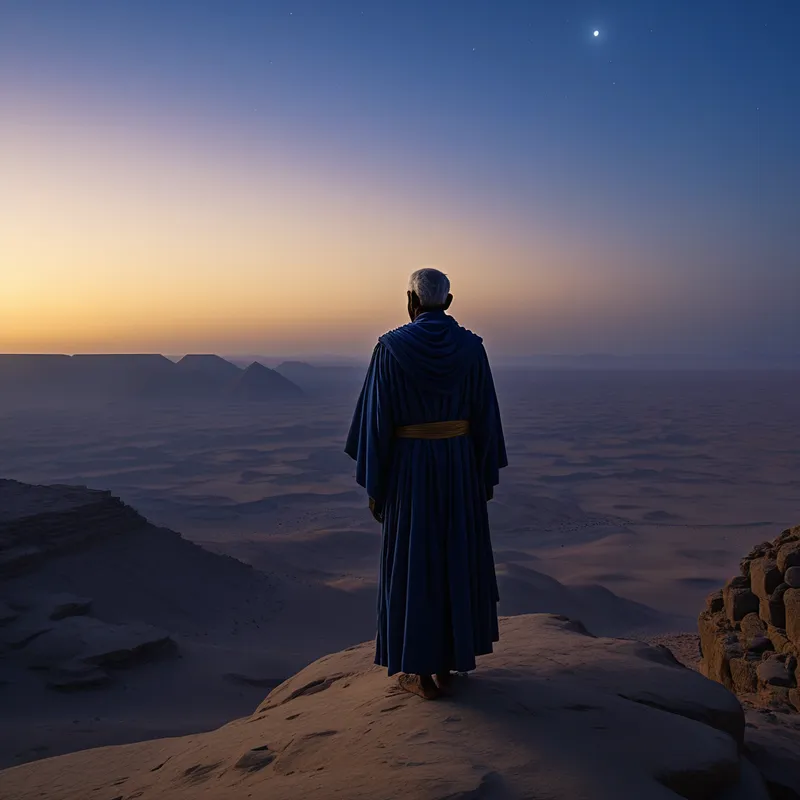
The Desert was not a barren wasteland, but a fierce and holy antagonist. It was a sea of scorching sand by day, a kingdom of biting cold by night. The sun was a hammer on the anvil of the sky. The wind sculpted dunes into the faces of forgotten giants. Here, in the cell, a man was left with nothing but the sound of his own breath and the echoing chambers of his mind.
The figures who emerged were not priests in fine vestments, but ascetics in rags. Antony the Great, who heard the gospel command to “sell all you have” and obeyed, fleeing to the inner mountain. Abba Poemen, the shepherd of souls who spoke few words, but each one carried the weight of a polished stone. Syncletica of Alexandria, who taught that “in the heart’s furnace, iron becomes steel.” They were the Abbas and Ammas, the fathers and mothers of the wilderness.
Their conflict was not with empires or beasts, but with the legion within. In the silence, every suppressed thought, every hidden vanity, every coiled fear unspooled itself and took form. These were the demons—apparitions of lust, specters of despair, phantoms of pride that whispered of the futility of their quest. A brother would be assailed by visions of lavish feasts as his stomach cramped with hunger. Another would be tormented by the haunting memory of a past wrong, a ghost that no penance could seem to lay to rest. The desert did not create these demons; it revealed them, stripping away the noise that had masked their constant chatter.
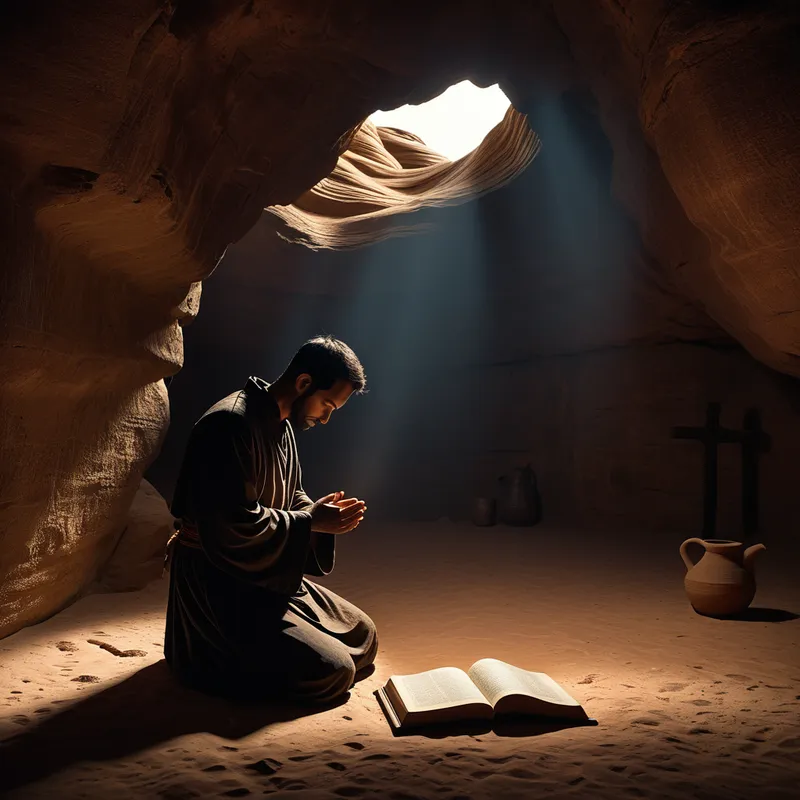
The rising action was the battle itself, fought not with sword and shield, but with the prayer of the heart, with manual labor, with brutal honesty, and with the saving grace of a rare, hard-won word from a elder. A young monk, ravaged by the demon of acedia—that noonday devil that makes the sun stand still and the cell feel like a tomb—would drag himself to the cell of an old man. He would not receive a complex sermon, but a simple command: “Go back to your cell. Your cell will teach you everything.”
The resolution was never a final victory, but a transformation of perception. After years of struggle, the seeker might find that the demon of anger, when faced fully, dissolved into a well of grief that, once wept, became a source of compassion. The haunting memory, when greeted not with flight but with mindful attention, lost its poisonous sting. The fierce, empty silence of the desert ceased to be a threat and became a presence—a palpable, listening stillness they called hesychia. In that stillness, they reported not visions of grandeur, but a simple, unshakeable certainty: the Kingdom of God was not a distant reward, but a hidden reality within the depths of the purified heart. The seeker and the Sought became, in the desert’s crucible, inseparable.
Cultural Origins & Context
This mythos emerged in the 3rd and 4th centuries AD, primarily in the deserts of Egypt, Palestine, and Syria. It was born at a critical juncture. Christianity had moved from persecuted sect to imperial religion. For some, this institutionalization felt like a loss of the radical, personal fervor of the early martyrs. The desert became the new arena for martyrdom—a “white martyrdom” of the will and the passions, rather than the blood.
The stories were not written as formal hagiographies at first. They were oral lore, passed from elder to disciple, collected in sayings (Apophthegmata Patrum) and poignant anecdotes. They served a vital societal function: they provided a radical alternative to the Roman civic ideal. Against the value of public life, family, and wealth, they posited the value of solitude, spiritual kinship, and holy poverty. They were the ultimate critics of culture, standing outside it to remind it of a transcendent priority. Their societal role was paradoxically to be of no obvious use, thereby becoming a psychic anchor for the civilization that marveled at them.
Symbolic Architecture
The myth is a masterful map of the psyche’s deepest terrain. The Desert is not a geographical location, but the archetypal realm of the Unconscious itself—vast, unknown, potentially hostile, yet holding the secret of life. To enter the desert is to consent to a journey into one’s own interior wilderness, away from the consensus reality of the “world” (the persona, the ego’s social identity).
The cell is the crucible of the self. The demon is the unintegrated complex. The abba is the inner voice of objective consciousness.
The cell symbolizes the bounded space of focused introspection—the therapy room, the meditation cushion, the journal page. It is where one is forced to stay with one’s own contents. The demons are the autonomous complexes of the psyche: trauma, addiction, narcissism, rage, and that most insidious, acedia, which we might call depression or existential ennui. The battle is the process of making the unconscious conscious, not by fighting these figures as external enemies, but by recognizing them as disowned parts of the self.
The Abba or Amma represents the archetype of the wise elder or the Self—the internal guiding principle that knows the way through the labyrinth. Their cryptic advice (“Go, sit in your cell”) is the psyche’s own wisdom: the solution is not in flight or analysis, but in abiding presence with the conflict itself.

The Dreamer’s Resonance
When this myth activates in the modern dreamer, it signals a profound call to interiority. One may dream of being alone in vast, empty landscapes—endless hallways, abandoned cities, or literal deserts. These are not nightmares of isolation, but initiatory dreams. The somatic feeling is often one of acute exposure and vulnerability, yet underpinned by a strange, solemn purpose.
To dream of a simple, sparse room (the cell) indicates a psyche creating a container for a difficult integration process. Dream figures of shadowy, taunting, or seductive entities (the demons) represent specific psychological content rising for acknowledgment—perhaps a buried grief, a denied ambition, or a compulsive pattern. The critical element is the dreamer’s stance: are they fleeing, or are they, like the Desert Father, turning to face the apparition? The dream may offer a guide—an unknown wise figure, an animal, or even a book (the abba), offering a simple, non-intellectual key. This dream pattern marks the soul’s attempt to find its own hesychia amidst the psychic noise of modern life.
Alchemical Translation
The alchemical process mirrored in the desert journey is nigredo—the blackening, the descent into the massa confusa of the unconscious. The ego, identified with the comforts and identities of the “world,” is dissolved in the fierce sun of self-awareness. The demons are the volatile elements that must be encountered and endured, not expelled.
The triumph of the desert is not the death of the demon, but the transformation of the demon’s energy into a faculty of perception.
The hermit’s labor—weaving baskets, plaiting ropes—is the opus, the small, repetitive work that grounds the transformative process in the body and in patience. The “Kingdom of God within” is the alchemical lapis, the Philosopher’s Stone—the realization of the indestructible, transcendent center of the personality, the Self. This is not achieved by adding something, but by subtracting everything that is not essential.
For the modern individual, the myth does not prescribe a literal flight to the wilderness. It prescribes a disciplined creation of interior space—digital detox, silent retreat, deep therapy, artistic practice—where the world’s chatter fades and the soul’s own contents can be heard. The conflict with the “demons” of anxiety, addiction, or meaninglessness is the sacred labor. The goal is hesychia: not emptiness, but a profound inner unity where the seeker discovers that what they sought was the very awareness with which they sought it. The desert, in the end, becomes a mirror, and in its vast silence, the soul meets its own eternal, reflecting depth.
Associated Symbols
Explore related symbols from the CaleaDream lexicon: