The Desert Myth Meaning & Symbolism
A journey through a vast, scorching wilderness where prophets and people face divine silence, inner demons, and the forging of a covenant.
The Tale of The Desert
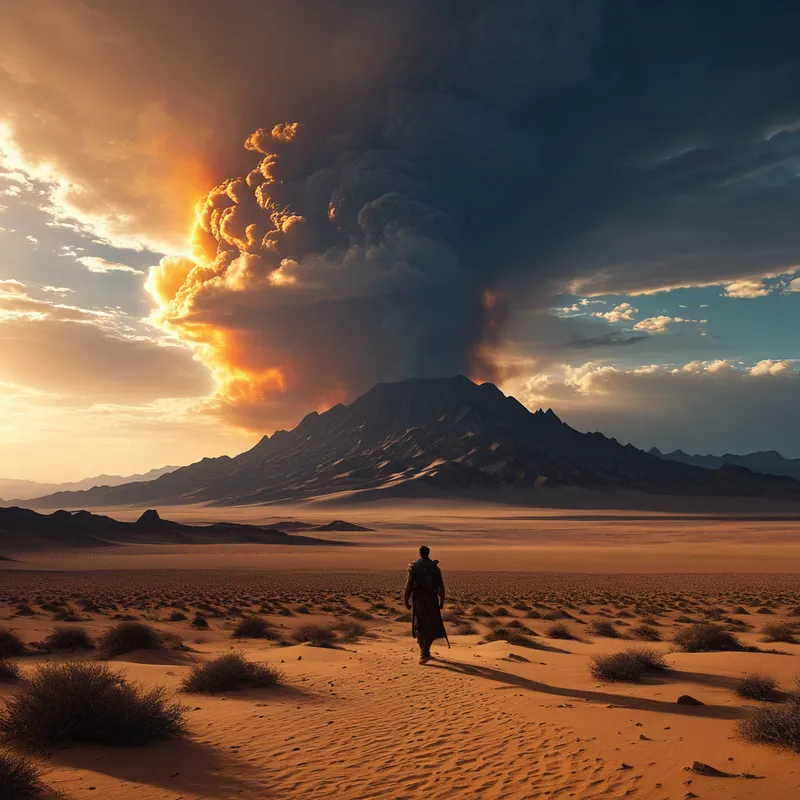
Hear now of the great and terrible wilderness, [the crucible](/myths/the-crucible “Myth from Alchemical culture.”/) of the spirit. It is a place of scorching wind and whispering sand, a sea of stone and dust where the sun is a tyrant and the night a cloak of freezing stars. This is not a land for men, but for scorpions and serpents, and for the voice that speaks in the silence between heartbeats.
Into this vastness, a people are driven. They are not travelers by choice, but fugitives, fleeing the lash of a [Pharaoh](/myths/pharaoh “Myth from Egyptian culture.”/) to walk into the jaw of the sun. Their guide is a man marked by fire, [Moses](/myths/moses “Myth from Biblical culture.”/), who speaks with a stammer yet carries a staff that drinks the power of gods. Before them rolls a pillar: by day, a column of cloud to veil the murderous sun; by night, a tower of fire to hold back the abyssal dark. It is their only sign in a trackless waste.
But the desert is patient, and hunger is a sharper master than any king. Thirst cracks their lips and doubt cracks their unity. They cry out, not for the future promise, but for the flesh-pots of their past bondage. The very ground seems to curse them, yielding only bitterness. In their anguish, they turn on their guide, their savior becoming a [scapegoat](/myths/scapegoat “Myth from Biblical culture.”/) for their despair.
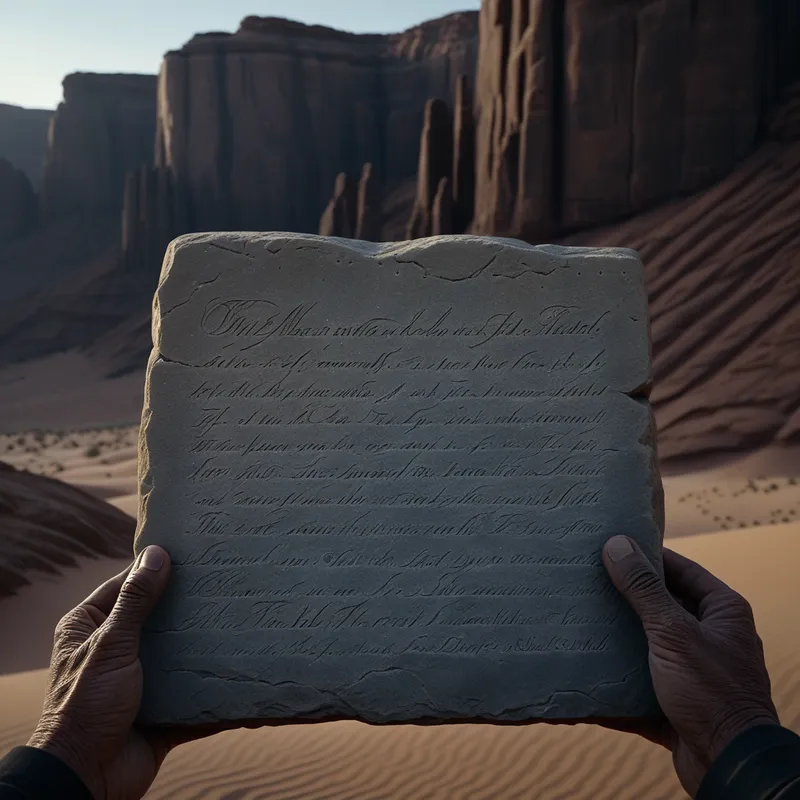
Then comes the testing. From the bare rock, struck by the prophet’s staff, [water](/myths/water “Myth from Chinese culture.”/) gushes. From the barren sky, a strange, flaky bread—[manna](/myths/manna “Myth from Biblical culture.”/)—frosts the ground each dawn, a daily gamble of trust. Yet the silence of the expanse breeds a deeper terror: the fear of abandonment. In this void, at a mountain shrouded in thunder and smoke, the covenant is forged. Laws are given, not on parchment, but on tablets of stone, hewn from the mountain’s heart. It is a marriage of a people to a principle, enacted in the very place where all other supports have fallen away.
For forty years—a generation—they wander. Their clothes do not wear out, their feet do not swell, but their spirits are sanded down, grain by grain. The old self, the slave-mind, must die in the sand before the new people can be born. The desert does not grant victory; it grants clarity. It strips away everything until only the essential question remains: in the absolute emptiness, what do you truly worship?
Cultural Origins & Context
The desert mythos is the foundational crucible of the Israelite identity as recorded in [the Torah](/myths/the-torah “Myth from Jewish culture.”/)—the first five books of the Hebrew Bible. It is not a single story but a sprawling, generational epic ([the Exodus](/myths/the-exodus “Myth from Abrahamic culture.”/), the Wanderings) compiled from oral traditions, priestly sources, and prophetic narratives over centuries. It was told and retold at Passover, the festival of liberation, ensuring each generation internalized that their origin as a free people was born not in a palace, but in a wilderness.
Its societal function was multifaceted. Historically, it explained a plausible period of tribal formation and migration. Theologically, it established the core relationship: a deity who liberates and disciplines, who makes a covenant in a place of no other refuge. Sociologically, it served as a perpetual warning and inspiration. The desert was a remembered state of total dependency, a model for how the community should rely on divine law rather than the false security of Egypt (empire) or Canaan (assimilation). [The prophets](/myths/the-prophets “Myth from Biblical culture.”/), like Elijah and [John the Baptist](/myths/john-the-baptist “Myth from Christian culture.”/), would later return to the desert as the place of pure, unadulterated encounter, away from the corruptions of settled society.
Symbolic Architecture
Psychologically, the Desert represents the necessary via negativa—the [path](/symbols/path “Symbol: The ‘path’ symbolizes a journey, choices, and the direction one’s life is taking, often representing individual growth and exploration.”/) of negation. It is the [landscape](/symbols/landscape “Symbol: Landscapes in dreams are powerful symbols representing the dreamer’s emotional state, personal journey, and the broader context of life situations.”/) of [the ego](/myths/the-ego “Myth from Jungian culture.”/)‘s impoverishment. All the crutches of the [persona](/symbols/persona “Symbol: The social mask or outward identity one presents to the world, often concealing the true self.”/)—social [status](/symbols/status “Symbol: Represents one’s social position, rank, or standing within a group, often tied to achievement, power, or recognition.”/), familiar routines, [material](/symbols/material “Symbol: Material signifies the tangible aspects of life, often representing physical resources, desires, and the physical world’s influence on our existence.”/) certainty—are burned away by the sun of circumstance or conscious [choice](/symbols/choice “Symbol: The concept of choice often embodies decision-making, freedom, and the multitude of paths available in life.”/). What remains is the [shadow](/symbols/shadow “Symbol: The ‘shadow’ embodies the unconscious, repressed aspects of the self and often represents fears or hidden emotions.”/), howling like [the wind](/myths/the-wind “Myth from Various culture.”/): the complaints, the [nostalgia](/symbols/nostalgia “Symbol: A bittersweet longing for past experiences, places, or relationships, blending memory with emotional resonance.”/) for bondage, the golden calves we [fashion](/symbols/fashion “Symbol: Fashion signifies personal expression, societal status, and cultural identity through clothing and styles.”/) from our leftover [jewelry](/symbols/jewelry “Symbol: Jewelry often symbolizes personal identity, social status, and emotional connections, reflecting how individuals curate their identities and express their values through adornments.”/).
The Desert is not God’s absence, but the theater where all other actors have left the stage, leaving only the fundamental dialogue between the Self and the soul.
The Manna symbolizes the paradoxical nourishment of the unknown. It cannot be hoarded; it must be gathered anew each day. This represents the grace of [insight](/symbols/insight “Symbol: A sudden, deep understanding of a complex situation or truth, often arriving unexpectedly and illuminating hidden connections.”/) or [energy](/symbols/energy “Symbol: Energy symbolizes vitality, motivation, and the drive that fuels actions and ambitions.”/) that comes only when we relinquish our need for permanent, ego-controlled [security](/symbols/security “Symbol: Security denotes safety, stability, and protection in one’s personal and emotional life.”/). The [Mount Sinai](/myths/mount-sinai “Myth from Biblical culture.”/) encounter—terrifying, overwhelming—symbolizes the shocking, non-negotiable intrusion of [the Self](/myths/the-self “Myth from Jungian culture.”/) (the transpersonal [psyche](/myths/psyche “Myth from Greek culture.”/)) into the settled, if miserable, camp of the conscious mind. [The Law](/symbols/the-law “Symbol: Represents external rules, societal order, moral boundaries, and the tension between personal freedom and collective structure.”/) (Decalogue) given there is not mere restriction, but the archetypal [structure](/symbols/structure “Symbol: Structure in dreams often symbolizes stability, organization, and the framework of one’s life, reflecting how one perceives their environment and personal life.”/) that makes a coherent [psyche](/myths/psyche “Myth from Greek culture.”/) (a “people”) possible out of chaotic desire.
The Dreamer’s Resonance
To dream of a desert is to dream of a psychic state of aridity, testing, or essential solitude. The somatic feeling is often one of exposure, parchedness, and vast, empty space. Psychologically, the dreamer is likely in a life transition where old identities, relationships, or projects have fallen away, and the new has not yet taken shape. It is a liminal space.
The specific elements matter. Dreaming of wandering lost suggests a search for meaning or direction in a time of confusion. Finding an oasis points to the emergence of a vital, nourishing insight from the unconscious. A blazing sun may represent a conscious attitude that is too harsh, scorching the softer, more intuitive parts of the self. A sandstorm often signifies overwhelming emotional or mental chaos that obscures clarity. The dream desert is where we meet our own “murmuring”—the internal complaints and resistances to the difficult but necessary journey of growth.
Alchemical Translation
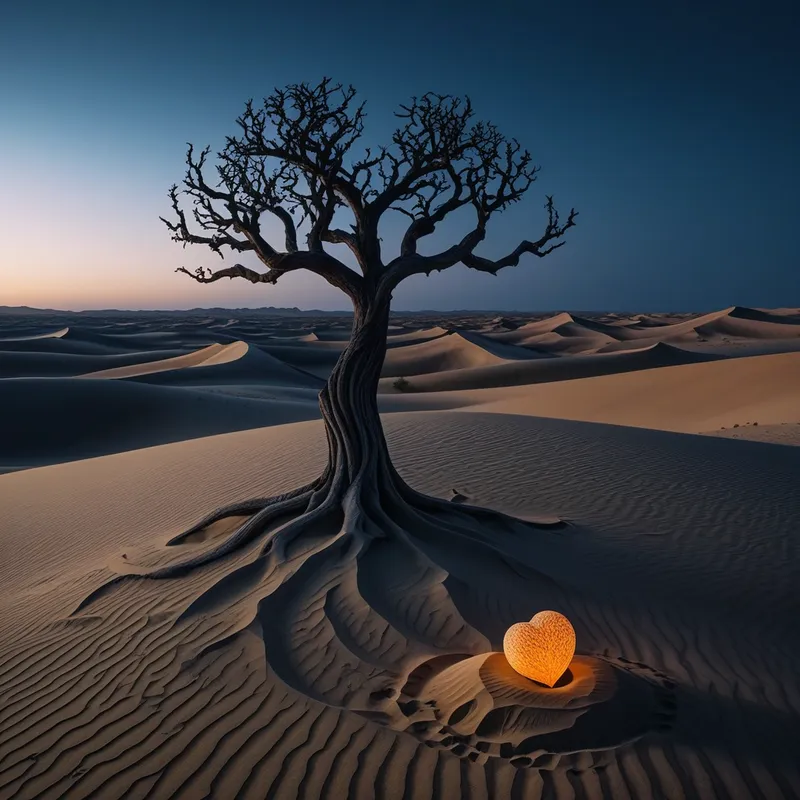
The alchemical process mirrored in the desert myth is the [nigredo](/myths/nigredo “Myth from Alchemical culture.”/)—the blackening, the initial stage of dissolution and putrefaction. The known “Egypt” (the familiar but oppressive conscious attitude) must be left behind. The soul enters the furnace of [the wilderness](/myths/the-wilderness “Myth from Biblical culture.”/) where everything is reduced to its essential components. This is a voluntary or involuntary psychic austerity.
The forty years in the wilderness are the incubation period required for the death of the old psychic regime. One does not think their way into a new self; one endures their way into it.
The miracle of [the manna](/myths/the-manna “Myth from Biblical culture.”/) is the alimentum—the subtle, divine sustenance that appears only when the ego gives up its frantic striving and planning. The striking of the rock for water is the moment when focused will (the staff) applied to the hardened structures of the psyche (the rock) releases the flow of emotion and vitality (water). Finally, reaching [the promised land](/myths/the-promised-land “Myth from Biblical culture.”/) is not the goal of individuation—which is a perpetual process—but the achievement of a new, more authentic and grounded level of consciousness, capable of engaging [the world](/myths/the-world “Myth from Tarot culture.”/) from a center forged in solitude. The desert teaches that the covenant, the lasting relationship with the Self, is always made in the place of our greatest vulnerability and emptiness.
Associated Symbols
Explore related symbols from the CaleaDream lexicon: