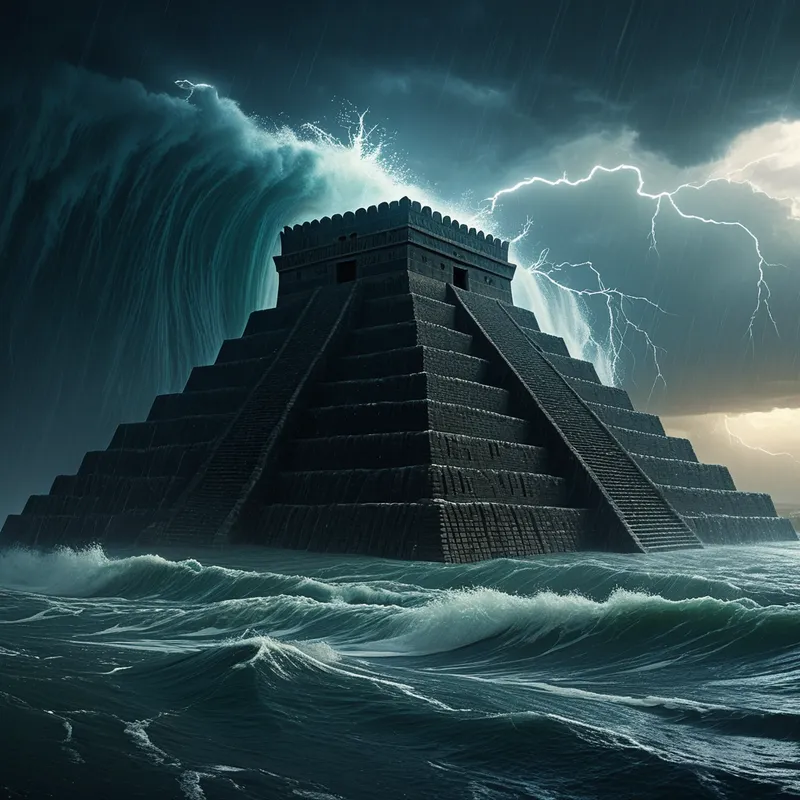
The Deluge Myth Meaning & Symbolism
A god's decree to flood the world, a mortal's ark, and the promise of a new covenant. The ancient blueprint for survival and renewal.
The Tale of The Deluge
Hear now the whisper of the reeds, the sigh of [the river](/myths/the-river “Myth from Buddhist culture.”/) that remembers. In the time before time, when the gods walked [the earth](/myths/the-earth “Myth from Hindu culture.”/) in their fullness, the great assembly of the Anunnaki grew weary. The clamor of humanity, multiplying like locusts upon the fertile mud of the Twin Rivers, had become an unbearable din. Their noise rose like smoke, choking the heavens, disturbing the sacred slumber of the divine.
Enlil, lord of wind and storm, whose breath could shatter mountains, convened the council. His heart was a stone. “The uproar of mankind is intolerable,” he thundered. “Their sins are a stain upon the earth. Let us send a Deluge to wipe them from the face of [the world](/myths/the-world “Myth from Tarot culture.”/), to return silence and peace to the lands.” The decree was sealed. The loom of fate was set.
But one god’s heart was troubled. Ea, the clever, the compassionate, who had helped shape humanity from clay, could not bear the utter end. He could not defy the council openly, so he chose a whisper. He went to the reed wall of a humble house in the city of Shuruppak, where a righteous king, [Utnapishtim](/myths/utnapishtim “Myth from Mesopotamian culture.”/), slept. Ea did not speak to the man, but to the wall itself, so the wall might murmur in the king’s dreams.
“Reed-house, reed-house! Wall, wall! Listen, reed-house! Pay heed, wall! O man of Shuruppak, son of Ubara-Tutu, tear down your house, abandon your wealth. Build a great boat, an ark. Make it equal in length and breadth, roof it over like the Apsu. Take aboard the seed of all living creatures.”
Utnapishtim awoke, his mind clear with divine terror. He gathered the elders and spoke in riddles, saying he must leave for the ocean to live with Ea, and that a rain of abundance would fall for them. They laughed and helped him, unknowing. For seven days, the city’s craftsmen labored. The ark was built of reeds and pitch, a vast, floating cube. Utnapishtim loaded his family, his craftsmen, and “all that I had of the seed of all living creatures”—the cattle, the wild beasts, the winged birds of [the sky](/myths/the-sky “Myth from Persian culture.”/).
Then the weather changed. The dawn came with a black cloud. Adad bellowed within it. The Sibitti marched across the land, shattering the world with their brilliance. The Deluge broke. For six days and seven nights, the tempest raged. [The wind](/myths/the-wind “Myth from Various culture.”/) walked the land like a battle. Brother saw not brother. The gods themselves cowered, shrinking back like whipped dogs, terrified at the weapon they had unleashed. [Ishtar](/myths/ishtar “Myth from Babylonian culture.”/), the goddess of love and war, wailed like a woman in childbirth: “How could I, in the assembly of the gods, decree such evil? To have my people turned to clay!”
On the seventh day, [the sea](/myths/the-sea “Myth from Greek culture.”/) grew still. [The flood](/myths/the-flood “Myth from Biblical culture.”/) lay flat as a roof. All of humanity had returned to clay. Utnapishtim opened a hatch. Light fell on his face. He looked upon a waterworld, silent and terrible. The ark came to rest on the slopes of Mount Nisir. He sent out a dove. It returned. He sent a swallow. It returned. He sent a [raven](/myths/raven “Myth from Haida culture.”/). It saw the waters receding, it ate, it circled, it did not return.
Then Utnapishtim stepped out upon the mountain. He built an altar of reeds and offered a sweet-smelling sacrifice to the gods. They gathered like flies to the offering, smelling its savor. Enlil arrived last, furious to see a boat had survived. But Ea spoke with clever wisdom: “Punish the sinner for his sin, the wrongdoer for his wrongdoing. But do not cut off the thread entirely, lest humanity be forgotten.” Enlil’s anger cooled. He took Utnapishtim and his wife by the hand, blessed them, and said, “Hitherto, Utnapishtim was mortal. Now, he and his wife shall be like us gods. They shall live at the source of the rivers, in the distance.”
Thus, the floodwaters receded. Thus, life began again, not from innocence, but from a hard-won covenant born of destruction and a god’s whispered secret to a wall.

Cultural Origins & Context
This is not a single story, but a river of narrative flowing through the bedrock of Mesopotamian civilization. The most complete version comes to us from the eleventh tablet of the Epic of [Gilgamesh](/myths/gilgamesh “Myth from Mesopotamian culture.”/), etched in Akkadian on clay tablets in the library of Ashurbanipal. But its roots are older, reaching back to Sumerian fragments where the hero is named Ziusudra.
This was a story told in scribal schools, recited in temple courtyards, and referenced in royal inscriptions. It was not mere entertainment; it was a foundational myth explaining the precarious nature of existence in the Fertile Crescent, a land both gifted and threatened by its life-giving, unpredictable rivers. The Deluge myth served as a theodicy—an explanation for divine wrath—and a charter for kingship, illustrating that survival and renewal depended on a special, wisdom-guided relationship with the divine. The hero is not a warrior, but a pious, obedient listener, a model for the ruler who must heed the subtle signs of the gods to ensure the survival of his people.
Symbolic Architecture
The [Deluge](/symbols/deluge “Symbol: A massive, overwhelming flood representing cleansing, destruction, or emotional inundation.”/) is the ultimate [symbol](/symbols/symbol “Symbol: A symbol can represent an idea, concept, or belief, serving as a powerful tool for communication and understanding.”/) of psychic [dissolution](/symbols/dissolution “Symbol: The process of breaking down, dispersing, or losing form, often representing transformation, release, or the end of a state of being.”/). It represents the point where the conscious structures of [the ego](/myths/the-ego “Myth from Jungian culture.”/)—the cities, the laws, the [noise](/symbols/noise “Symbol: Noise in dreams signifies distraction, confusion, and the need for clarity amidst chaos.”/) of [human](/symbols/human “Symbol: The symbol of a human represents individuality, complexity of emotions, and social relationships.”/) ambition—become so rigid, so oppressive to the deeper Self, that the unconscious must rise up in a cataclysmic act of correction.
The flood is not punishment, but a necessary return to the undifferentiated state, the massa confusa, from which a new and more conscious order can emerge.
The ark is the [vessel](/symbols/vessel “Symbol: A container or structure that holds, transports, or protects something essential, representing the self, emotions, or life journey.”/) of [consciousness](/symbols/consciousness “Symbol: Consciousness represents the state of awareness and perception, encompassing thoughts, feelings, and experiences.”/) itself, the fragile but resilient container that must hold the “seed of all [life](/symbols/life “Symbol: The symbol of ‘Life’ represents a journey of growth, interconnectedness, and existential meaning, encompassing both the joys and challenges that define human experience.”/)“—the totality of the [psyche](/myths/psyche “Myth from Greek culture.”/)‘s potential—while the old world drowns. It is not a ship for sailing, but a sealed box for enduring, for passive containment. Utnapishtim is the [archetype](/symbols/archetype “Symbol: A universal, primordial pattern or prototype in the collective unconscious that shapes human experience, behavior, and creative expression.”/) of the one who listens to the voice from the [wall](/symbols/wall “Symbol: Walls in dreams often symbolize boundaries, protection, or obstacles in one’s life, reflecting the dreamer’s feelings of confinement or security.”/), the whisper of the unconscious (Ea) that warns of the coming [crisis](/symbols/crisis “Symbol: A crisis symbolizes turmoil, urgent challenges, and the need for immediate resolution or change.”/) and provides the [blueprint](/symbols/blueprint “Symbol: A blueprint represents the foundational plan or design for something, often symbolizing potential, structure, and the mapping of one’s inner self or future.”/) for survival. His final [apotheosis](/symbols/apotheosis “Symbol: The transformation of a mortal into a divine or godlike state, representing ultimate spiritual elevation and transcendence of human limitations.”/) into a quasi-divine being living “at the [source](/symbols/source “Symbol: The origin point of something, often representing beginnings, nourishment, or the fundamental cause behind phenomena.”/) of the rivers” symbolizes the [achievement](/symbols/achievement “Symbol: Symbolizes success, mastery, or reaching a goal, often reflecting personal validation, social recognition, or overcoming challenges.”/) of a [consciousness](/symbols/consciousness “Symbol: Consciousness represents the state of awareness and perception, encompassing thoughts, feelings, and experiences.”/) rooted in the origins of psychic [life](/symbols/life “Symbol: The symbol of ‘Life’ represents a journey of growth, interconnectedness, and existential meaning, encompassing both the joys and challenges that define human experience.”/), no longer subject to its catastrophic floods.
The Dreamer’s Resonance
When this myth stirs in the modern soul, it often manifests not as a literal dream of flooding, but as a profound somatic and emotional experience of being overwhelmed. The dreamer may find themselves in a house with walls that weep [water](/myths/water “Myth from Chinese culture.”/), or watching from a high place as a silent, inexorable tide swallows the landmarks of their life. The “water” is the rising affect—grief, rage, despair—that threatens to dissolve the familiar structures of identity, career, or relationship.
This dream pattern signals a critical phase of psychic inundation. The ego is being called to build its “ark”: to identify what is essential (the “seed”) and to construct a temporary, sealed container of reflection, patience, and non-action. The process is one of surrender, not fight. The dream asks: What must you let drown? What single, vital truth must you protect at all costs while the storm of transformation passes? The release of the birds—the dove, [the swallow](/myths/the-swallow “Myth from Greek culture.”/), the raven—mirrors the dreamer’s tentative probes back into reality, testing if the old terrain is habitable or if they must wait, sealed in the dark a little longer.

Alchemical Translation
The alchemical journey mirrored in the Deluge is the stage of [solutio](/myths/solutio “Myth from Alchemical culture.”/)—dissolution. The fixed, leaden elements of the personality are dissolved in the aqua permanens, the eternal water of the unconscious. This is a terrifying but necessary step in [the opus](/myths/the-opus “Myth from Alchemical culture.”/) of individuation.
To be made whole, one must first be unmade. The ark is the alchemical vessel, the vas hermeticum, where the opposites are held in tension during the chaos.
Utnapishtim’s journey models the process: First, the receipt of the secret (Ea’s whisper), akin to a moment of profound intuition or synchronicity that warns of an impending inner crisis. Then, the construction of [the vessel](/myths/the-vessel “Myth from Alchemical culture.”/): the conscious effort to prepare for the dissolution by gathering one’s resources and values. The flood itself is the involuntary plunge, where all one’s former certainties are washed away. The waiting on the mountain is the coagulatio—the re-solidification. The sacrifice is the act of giving back, of gratitude, which transforms the relationship with the inner “gods” or archetypal forces. The final gift is not a return to the old life, but a transformation in kind: immortality, or in psychological terms, a consciousness that has integrated the reality of death and renewal, and now dwells “at the source,” connected to the eternal flow of psychic life, no longer its victim. One becomes not just a survivor of the flood, but its wise, distant witness.
Associated Symbols
Explore related symbols from the CaleaDream lexicon: