The Dark Night of the Soul Myth Meaning & Symbolism
A mystic's journey through profound spiritual desolation, where all light and comfort vanish, leading to a purifying union with the divine.
The Tale of The Dark Night of the Soul
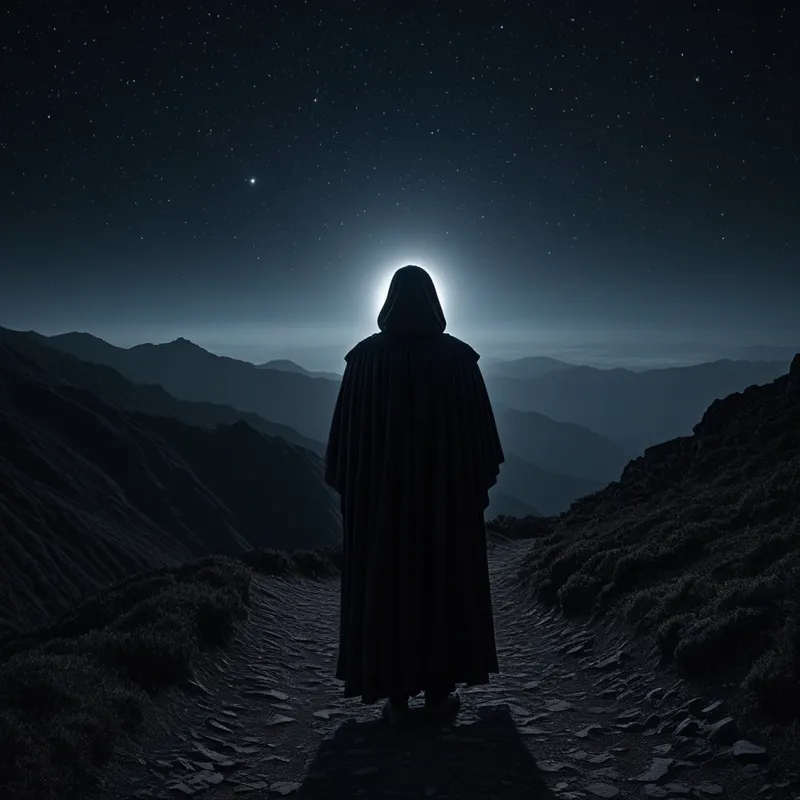
Listen, and I will tell you of a journey not across lands, but through the desolate country of [the self](/myths/the-self “Myth from Jungian culture.”/). It begins not with a call to adventure, but with a silencing. [The pilgrim](/myths/the-pilgrim “Myth from Christian culture.”/), once fervent, finds the well of prayer has run dry. The sweet consolations of the spirit, once like summer rain, have ceased. The familiar face of the Beloved has turned away, leaving not anger, but a void more terrifying than any wrath.
This is the onset of the Night. It is not the gentle dark of evening, but an absolute, starless midnight that descends upon the soul. The pilgrim walks a path they have trodden a thousand times in light, but now it is alien. The scriptures are dry leaves, offering no sustenance. The rituals are empty gestures, echoing in a vast hall of silence. Every memory of warmth becomes a thorn, every former insight a mockery. This is the Night of the Senses, where all that once pleased and comforted is stripped away, leaving the soul naked upon the mountain.
But this is only the first gate. Deeper lies the Night of the Spirit. Here, the very fortress of the self is besieged. The intellect, that proud tower, finds its foundations are sand. The will, that strong captain, loses all direction in the fog. The soul is plunged into a crucible where it is not refined, but seemingly annihilated. It feels itself abandoned, not just by God, but by its own essence. It is a living death, a profound poverty where one possesses nothing, not even the certainty of one’s own existence. The pilgrim does not struggle; they are carried by a current too deep for struggle, a passive purging by a love that feels like absolute negation.
And in the deepest hour of this Night, when the silence is complete and the darkness absolute, a strange alchemy occurs. The eyes accustomed only to blackness begin to perceive a different quality of light—not a light that shines upon things, but a light that is the substance of all things. The emptiness becomes a presence. [The void](/myths/the-void “Myth from Buddhist culture.”/) becomes a womb. The soul, now emptied of all its own constructs and comforts, finds it is not alone. It is filled with a knowing that is not knowledge, a union that is not fusion. The dawn that breaks is not of the sun, but of the Spirit. The pilgrim emerges, not triumphant, but humbled and transparent, a window through which the eternal light now shines, having passed through the necessary, terrible, and glorious Dark.
Cultural Origins & Context
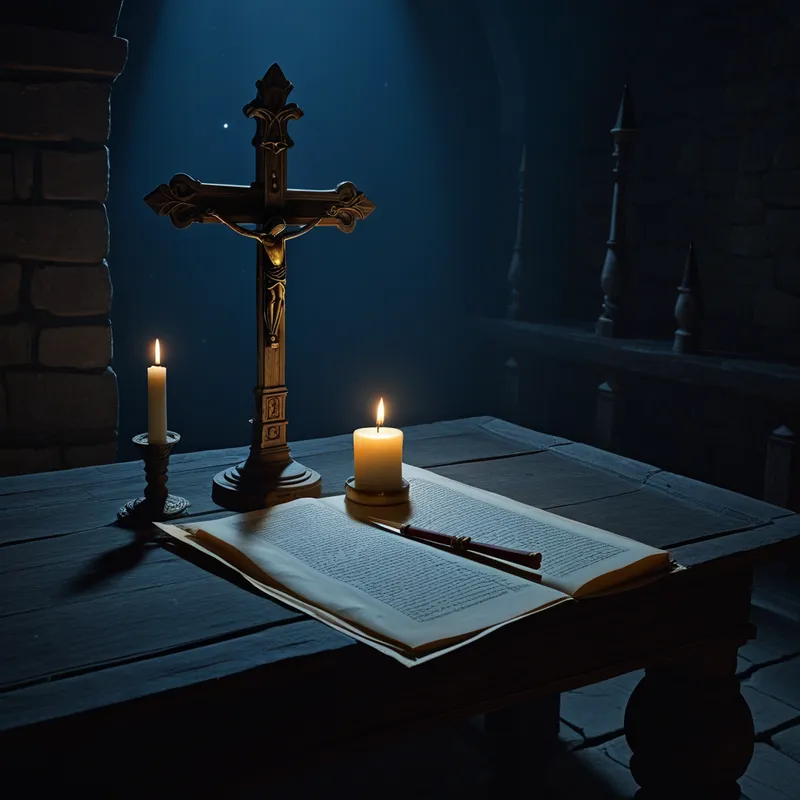
This is not a myth of antiquity, but of the interior landscape of 16th-century Spain. Its primary bard was San Juan de la Cruz (St. John of the Cross), who composed the seminal poem “Noche Oscura” and its accompanying commentaries while imprisoned in a Toledo monastery by his own religious order for attempting reform. The myth was born in confinement, written down in secret, and passed among a small circle of Discalced Carmelites, most notably Teresa of Ávila.
Its societal function was paradoxical. Within the rigid structures of Counter-Reformation Catholicism, it provided a map for the ultimate subversion: the direct, unmediated encounter of the soul with God, beyond the mediation of church, ritual, or even thought. It was a guide for the few, the “proficient,” who had moved beyond beginner’s piety into the terrifying wilderness of advanced contemplation. It legitimized a state of spiritual despair as not a failure or a sin, but a necessary, purgative stage on the path to divine union, offering a language for an experience that was otherwise ineffable and potentially heretical.
Symbolic Architecture
The myth’s power lies in its stark, universal [symbolism](/symbols/symbolism “Symbol: The use of symbols to represent ideas or qualities, often conveying deeper meanings beyond literal interpretation. In dreams, it’s the language of the unconscious.”/). The [Night](/symbols/night “Symbol: Night often symbolizes the unconscious, mystery, and the unknown, representing the realm of dreams and intuition.”/) is not evil, but the necessary [condition](/symbols/condition “Symbol: Condition reflects the state of being, often focusing on physical, emotional, or situational aspects of life.”/) for [revelation](/symbols/revelation “Symbol: A sudden, profound disclosure of truth or insight, often through artistic or musical means, that transforms understanding.”/). It represents the active withdrawal of all ego-centric supports—sensory pleasure, intellectual certainty, emotional consolation. It is the great unknowing.
The Dark Night is not God’s absence, but the overwhelming presence of a reality too vast for the small house of the self to contain. The house must be dismantled.
The Pilgrim/[Soul](/symbols/soul “Symbol: The soul represents the essence of a person, encompassing their spirit, identity, and connection to the universe.”/) is the heroic ego facing its own [dissolution](/symbols/dissolution “Symbol: The process of breaking down, dispersing, or losing form, often representing transformation, release, or the end of a state of being.”/). This is not the [hero](/symbols/hero “Symbol: A hero embodies strength, courage, and the ability to overcome significant challenges.”/) who slays dragons, but the hero who allows themselves to be slain, understanding that their constructed [identity](/symbols/identity “Symbol: Identity represents the sense of self, encompassing personal beliefs, cultural background, and social roles.”/) is the final [barrier](/symbols/barrier “Symbol: A barrier symbolizes obstacles, limitations, and boundaries that prevent progression in various aspects of life.”/). The Beloved (God) is both the initiator of the Night and its secret substance. The divine is portrayed as a [lover](/symbols/lover “Symbol: A lover in dreams often represents intimacy, connection, and the emotional aspects of relationships.”/) who, in ultimate intimacy, withdraws all tangible signs of affection to force the [soul](/symbols/soul “Symbol: The soul represents the essence of a person, encompassing their spirit, identity, and connection to the universe.”/) to love not the gifts, but the Giver alone.
The [ascent](/symbols/ascent “Symbol: Symbolizes upward movement, progress, spiritual elevation, or striving toward higher goals, often representing personal growth or transcendence.”/) of the [mountain](/symbols/mountain “Symbol: Mountains often symbolize challenges, aspirations, and the journey toward self-discovery and enlightenment.”/) in darkness symbolizes the [paradox](/symbols/paradox “Symbol: A contradictory yet true concept that challenges logic and perception, often representing unresolved tensions or profound truths.”/) of spiritual progress: advancement is measured not by gained [heights](/symbols/heights “Symbol: Represents ambition, fear, or spiritual elevation. Often symbolizes life challenges or a desire for perspective.”/), but by surrendered burdens. The [journey](/symbols/journey “Symbol: A journey in dreams typically signifies adventure, growth, or a significant life transition.”/) is one of subtraction, not addition.

The Dreamer’s Resonance
When this myth stirs in the modern dreamer, it rarely appears in religious garb. It manifests as the profound existential dream: dreams of being lost in a featureless landscape, of wandering through one’s own home and finding all the rooms empty or rearranged, of searching for a vital person or object that remains perpetually just out of reach. The somatic feeling upon waking is one of deep, unshakeable melancholy, emptiness, or anxiety—a “soul ache.”
Psychologically, this signals the [psyche](/myths/psyche “Myth from Greek culture.”/)’s engagement with its own shadow and its movement toward the Self. The conscious attitude—the [persona](/myths/persona “Myth from Greek culture.”/), the achieved identity, the life narrative one has constructed—has become too small. The unconscious rises up not to destroy, but to dismantle this outdated structure. The dreamer is in the grip of a necessary depression, a psychic purging where old values, attachments, and self-images are being incinerated to make way for a more authentic totality. It is [the ego](/myths/the-ego “Myth from Jungian culture.”/)’s winter.
Alchemical Translation
In the alchemy of individuation, the Dark Night maps perfectly onto the stage of [nigredo](/myths/nigredo “Myth from Alchemical culture.”/)—the blackening, the putrefaction. This is the essential first step where [the prima materia](/myths/the-prima-materia “Myth from Alchemical culture.”/) (the raw, unconscious psyche) is subjected to a metaphorical death. All that is inflated, false, or dependent on external validation must rot away.
The soul’s brilliance is forged in the absence of light, as carbon becomes diamond under immense, lightless pressure.
For the modern individual, this myth models the process of psychic transmutation when one’s life meaning collapses—through loss, crisis, burnout, or the simple, haunting question of “is this all there is?” The conscious mind interprets this as failure and despair. The myth re-frames it as the beginning of the only true journey: inward. The [triumph](/myths/triumph “Myth from Roman culture.”/) is not in “beating” the darkness, but in submitting to its transformative fire. One does not find the light by fleeing the dark, but by consenting to be fully within it, until one realizes the dark itself is a form of light too brilliant for the unaided eye. The ego is not destroyed, but humbled and relocated as a participant in a larger, more mysterious Self. The individual emerges from this alchemical crucible not “fixed,” but fundamentally reconstituted—lighter, more porous, and capable of a compassion rooted in having known the void that exists at the heart of all things, and the love that secretly fills it.
Associated Symbols
Explore related symbols from the CaleaDream lexicon: