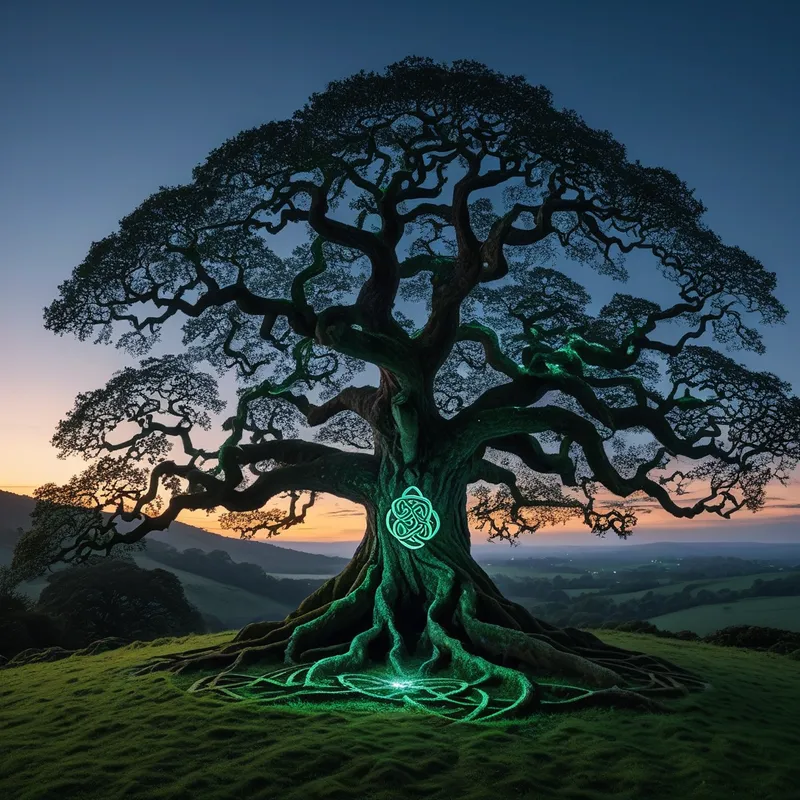
The Dara Knot Myth Meaning & Symbolism
A tale of a mortal's descent into the underworld, seeking the strength of the World Tree to heal a wounded land and their own fractured spirit.
The Tale of The Dara Knot
Listen. [The wind](/myths/the-wind “Myth from Various culture.”/) carries a memory older than stone. It whispers of a time when [the veil](/myths/the-veil “Myth from Various culture.”/) between the worlds was thin as morning mist, and the heart of the forest held a secret.
In the land of [Tír na nÓg](/myths/tr-na-ng “Myth from Celtic culture.”/), a shadow fell. Not a shadow of night, but of forgetting. The great Bile, the Oak that held [the sky](/myths/the-sky “Myth from Persian culture.”/) from [the earth](/myths/the-earth “Myth from Hindu culture.”/) and whose roots drank from the wells of wisdom, began to sicken. Its leaves, once coins of emerald light, turned brittle and fell in silent, constant rain. With its fading, a grey weariness seeped into the land. The rivers ran sluggish, the songs of the people grew thin, and a coldness settled in the bone, though the sun still shone.
Among the people was a woman named Dara. She felt the wasting in her own spirit—a hollow where courage once lived, a fracture in her will. While others lamented, Dara was visited by a dream. In it, she saw not the dying crown of the great Oak, but its roots, plunging deep into a darkness that was not empty, but full. A voice, like the creak of ancient timber and the rush of deep [water](/myths/water “Myth from Chinese culture.”/), spoke: “The strength you seek is not above, in the perishing light, but below, in the enduring dark. To heal the tree, you must become the knot that binds its despair to its hope.”
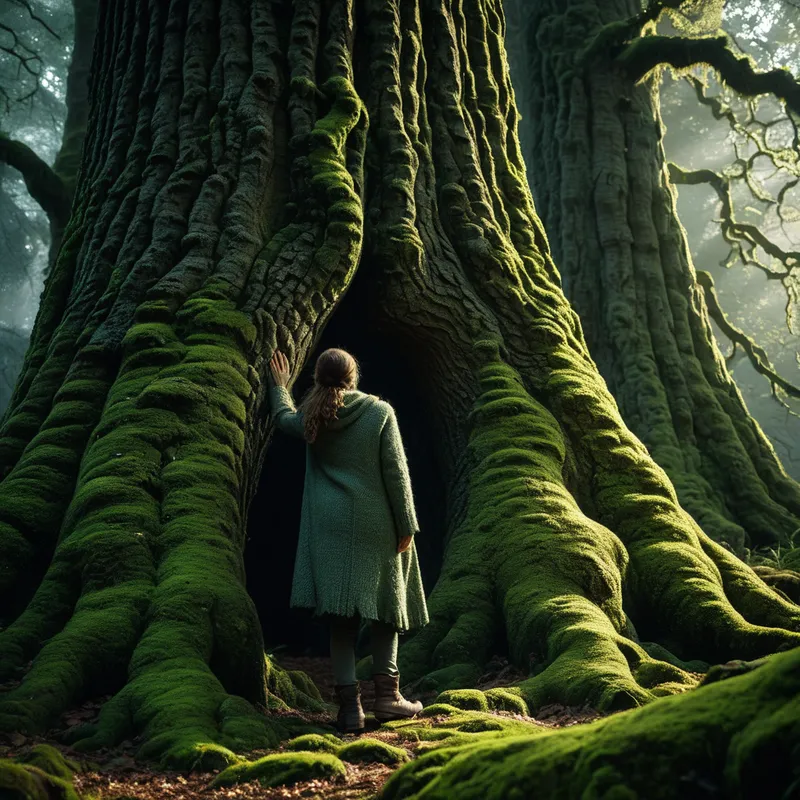
With only a cloak of determination and a vessel carved from [hawthorn](/myths/hawthorn “Myth from Celtic culture.”/), Dara left the fading world of light. She did not climb a mountain, but descended. She found the hidden mouth of a root-cave at the Oak’s base and entered the Anwnn. Here was no fiery hell, but a realm of immense, pressing quiet, of tangled roots like serpents, and pools that reflected nothing. She walked paths of compacted earth and memory, her breath the only sound.
Her test was not a monster to slay, but the weight of the tree’s own anguish. She felt the thirst of its deepest roots, the memory of every drought. She witnessed the scars of every lightning strike, not as wounds, but as stories etched in pain. [The shadow](/myths/the-shadow “Myth from Jungian culture.”/) sought to untether her, to whisper that the fracture was her true nature, that wholeness was a myth for the sun-touched world above. Her own hollow echo threatened to consume her.
In the deepest dark, where even root tendrils ceased, Dara found the Heart-Rock. From it sprang the primal taproot, and around it, the shadow was thickest. She had no sword, no spell. Instead, she placed her hands upon the cold stone and did not fight the shadow, but let it flow through her. She remembered the sun on her face, the taste of river water, the grip of her own two hands on a plow. She wove these memories not as a shield, but as a thread. She took the Oak’s memory of thirst and knotted it with her memory of drink. She took its scar of lightning and bound it to her memory of a hearth-fire’s warmth.
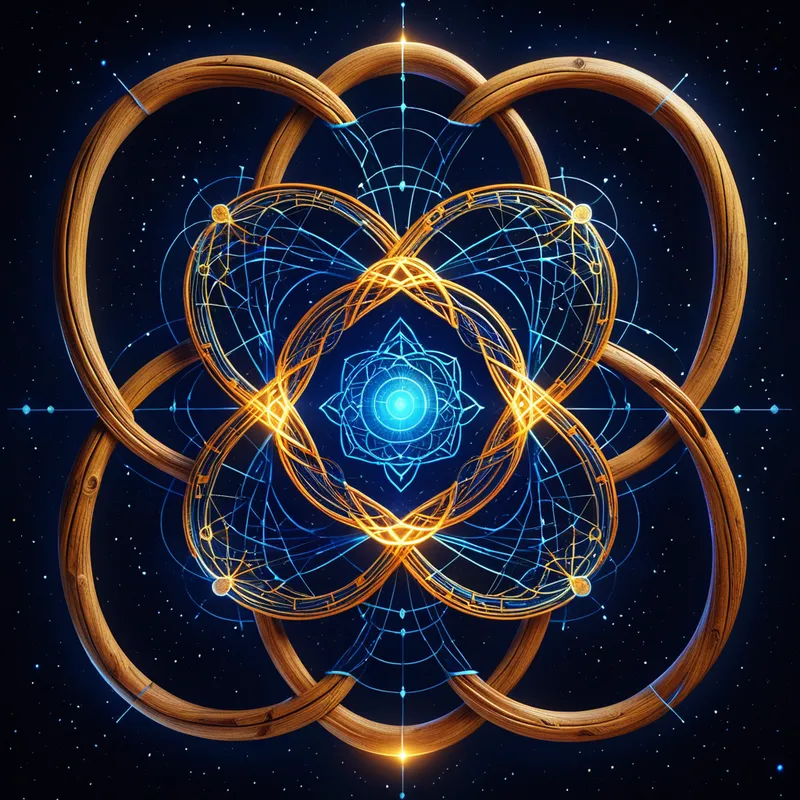
She did not conquer the dark; she conversed with it. She became the loom where the tree’s deep suffering and [the world](/myths/the-world “Myth from Tarot culture.”/)’s living joy were woven together. As she did, a pattern began to glow—not on the rock, but in the space between her spirit and the root. A knot of endless, interlaced lines, with no beginning and no end. The Dara Knot was born not from craft, but from covenant.
When the pattern was complete, a surge of vitality, dark and potent as the richest soil, rushed upward through the root. Dara followed it, emerging not as she was, but rooted. Above, the great Oak stood, not merely healed, but radiant, its bark patterned with the faint, eternal trace of the knot. And in the eyes of her people, and in her own steady hands, the same pattern was seen—a testament that true strength is forged in the embrace of the deep, unseen world.
Cultural Origins & Context
The tale of the Dara Knot, like the intricate pattern itself, is woven from several strands of Celtic tradition. It is not a singular myth from a specific manuscript like the Mabinogion, but a narrative reconstruction based on pervasive Celtic cosmological principles and the symbolic function of [knotwork](/myths/knotwork “Myth from Celtic culture.”/). The Celts held the oak tree as supremely sacred, the embodiment of durability, sovereignty, and mystical knowledge. [The druids](/myths/the-druids “Myth from Celtic culture.”/), the priestly scholar-class, performed rituals in oak groves and saw in the tree’s structure a map of the cosmos: roots in [the underworld](/myths/the-underworld “Myth from Greek culture.”/) (Anwnn), trunk in the mortal world, and branches in the upper world.
Knotwork, which flourished in the early Christian Insular art period but whose origins are undoubtedly pre-Christian, was far more than decoration. It was a visual language of the infinite, of interconnectedness, and of binding. A story like Dara’s would have been part of an oral tradition, told by bards and seanchaí by firelight. Its function was societal and psychological: to model a specific type of heroism. Not the hero who ventures out to conquer external foes, but the one who journeys in to reconcile internal and cosmic dichotomies—life and death, strength and vulnerability, the individual and the universal pattern.
Symbolic Architecture
At its core, the Dara [Knot](/symbols/knot “Symbol: A knot symbolizes connections, commitments, complications, and the binding or untying of relationships and situations.”/) myth is a profound [allegory](/symbols/allegory “Symbol: A narrative device where characters, events, or settings represent abstract ideas or moral qualities, conveying deeper meanings through symbolic storytelling.”/) for the [discovery](/symbols/discovery “Symbol: The act of finding something previously unknown, hidden, or lost, often representing personal growth, new opportunities, or hidden aspects of the self.”/) of inner [strength](/symbols/strength “Symbol: ‘Strength’ symbolizes resilience, courage, and the ability to overcome challenges.”/). The dying Oak represents a world, a [community](/symbols/community “Symbol: Community in dreams symbolizes connection, support, and the need for belonging.”/), or an individual [psyche](/myths/psyche “Myth from Greek culture.”/) in a state of dis-[integration](/symbols/integration “Symbol: The process of unifying disparate parts of the self or experience into a cohesive whole, often representing psychological wholeness or resolution of internal conflict.”/), where a vital [connection](/symbols/connection “Symbol: Connection symbolizes relationships, communication, and bonds among individuals.”/) to the foundational, nourishing [depths](/symbols/depths “Symbol: Represents the subconscious, hidden emotions, or foundational aspects of the self, often linked to primal fears or profound truths.”/) has been severed.
The journey to the root is the journey to the origin of one’s being, where personal history merges with ancestral and archetypal soil.
Dara, whose name aligns with the oak, is the [human](/symbols/human “Symbol: The symbol of a human represents individuality, complexity of emotions, and social relationships.”/) [soul](/symbols/soul “Symbol: The soul represents the essence of a person, encompassing their spirit, identity, and connection to the universe.”/) conscious of its own fracture. Her descent is the essential [movement](/symbols/movement “Symbol: Movement symbolizes change, progress, and the dynamics of personal growth, reflecting an individual’s desire or need to transform their circumstances.”/) of introspection, of [shadow](/symbols/shadow “Symbol: The ‘shadow’ embodies the unconscious, repressed aspects of the self and often represents fears or hidden emotions.”/)-work. The Anwnn is not a place of [punishment](/symbols/punishment “Symbol: A dream symbol representing consequences for actions, often tied to guilt, societal rules, or internal moral conflicts.”/), but of unformed potential and stored [trauma](/symbols/trauma “Symbol: A deeply distressing or disturbing experience that overwhelms the psyche, often manifesting in dreams as unresolved emotional wounds or psychological injury.”/)—the personal and [collective unconscious](/symbols/collective-unconscious “Symbol: The Collective Unconscious refers to the part of the unconscious mind shared among beings of the same species, embodying universal experiences and archetypes.”/). The “[shadow](/symbols/shadow “Symbol: The ‘shadow’ embodies the unconscious, repressed aspects of the self and often represents fears or hidden emotions.”/)” she encounters is the accumulated, unattended pain of the [tree](/symbols/tree “Symbol: In dreams, the tree often symbolizes growth, stability, and the interconnectedness of life.”/) ([the Self](/myths/the-self “Myth from Jungian culture.”/)) and her own latent weaknesses. Her [triumph](/myths/triumph “Myth from Roman culture.”/) is not an act of destruction, but of sacred binding. The knot she forms is the [symbol](/symbols/symbol “Symbol: A symbol can represent an idea, concept, or belief, serving as a powerful tool for communication and understanding.”/) of the integrated psyche, where opposites are held in [tension](/symbols/tension “Symbol: A state of mental or emotional strain, often manifesting physically as tightness, pressure, or unease, signaling unresolved conflict or anticipation.”/) without cancelling each other out. The [pattern](/symbols/pattern “Symbol: A ‘Pattern’ in dreams often signifies the underlying structure of experiences and thoughts, representing both order and the repetitiveness of life’s situations.”/) has no loose ends; every line of strength is interwoven with a line of [vulnerability](/symbols/vulnerability “Symbol: A state of emotional or physical exposure, often involving risk of harm, that reveals authentic self beneath protective layers.”/), creating a [resilience](/symbols/resilience “Symbol: The capacity to recover quickly from difficulties, adapt to change, and maintain strength through adversity.”/) that is flexible yet unbreakable.
The Dreamer’s Resonance
When the Dara Knot appears in modern dreams, it rarely manifests as a literal Celtic design. More often, the dreamer finds themselves in a [labyrinth](/myths/labyrinth “Myth from Various culture.”/) of roots or circuitry, feeling a compelling need to trace a path to a central, dark source. They may dream of a beloved tree that is sick, and feel a somatic imperative to place their hands upon it, experiencing a transfer of coldness or a surge of heat.
Psychologically, this signals a process of rooting during a period of existential or emotional drought. The psyche is initiating a descent to recover vital energy and meaning that has been lost to the conscious, “daylight” self. The dream may be accompanied by feelings of claustrophobia (the pressure of the roots) or profound calm (the embrace of the earth). To dream of successfully forming or discovering the knot indicates the unconscious synthesis of a new, more resilient structure of being—[the ego](/myths/the-ego “Myth from Jungian culture.”/) learning to draw strength not from willpower alone, but from its connection to the deeper, autonomous processes of the Self.
Alchemical Translation
The alchemical process mirrored in Dara’s journey is the [nigredo](/myths/nigredo “Myth from Alchemical culture.”/) leading to the albedo. The [nigredo](/myths/nigredo “Myth from Alchemical culture.”/) is the descent into the blackness, the confrontation with the raw, unprocessed material of the soul—the despair of the Oak, the fracture in Dara. This is the essential, often painful, first stage of individuation where one must acknowledge what is broken or in shadow.
The knot is the philosopher’s stone of the soul: not a singular prize, but the living pattern of relationship between all that one is and all that one has endured.
Dara’s act of weaving is the albedo. She does not discard the dark material but integrates it, washing it in the “waters of memory” (her lived experience) and uniting it with the “light” of conscious intention. The resulting knot is the symbol of the lapis, the integrated Self. For the modern individual, this translates to the hard, sacred work of psychological integration. It is the process of taking a core wound, a deep insecurity, or a period of depression, and not merely seeking to “cure” it, but to understand how it has shaped the unique, interlaced pattern of one’s strength. The goal is not to become invulnerable, but to become knotted—so deeply intertwined with the full spectrum of your experience that you cannot be unraveled by life’s tensions. You become, like the oak, both grounded and sky-reaching, drawing resilience from the very darkness you once feared.
Associated Symbols
Explore related symbols from the CaleaDream lexicon: