The Daoist Cloud Myth Meaning & Symbolism
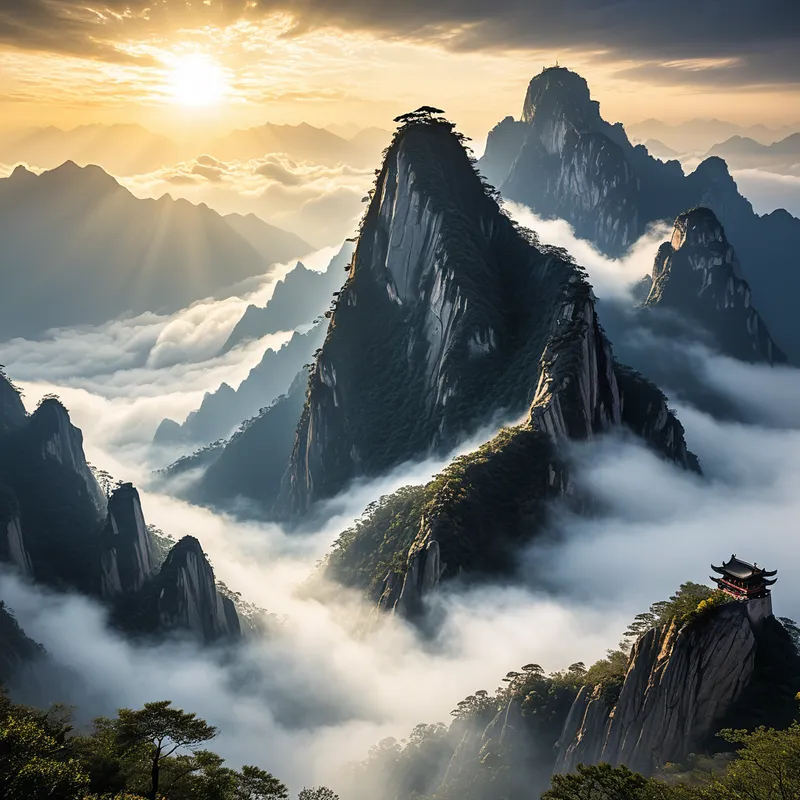
A celestial cloud, born of cosmic breath, journeys between form and formlessness, embodying the Daoist principle of effortless transformation and natural harmony.
The Tale of The Daoist Cloud
In the time before time was measured, when the Dao breathed its first, silent sigh, the heavens were not yet settled. From the great exhalation of the Dao, a wisp was born. Not a god, not a beast, but a consciousness of vapor and intention—a Cloud.
It did not have a name, for names bind. It simply was. It drifted above the Kunlun peaks, watching the raw Yang energies harden into mountains and the deep Yin energies carve the valleys. It felt a longing, not for purpose, but for participation. To be only an observer was a subtle agony.
One day, a great drought seized the land. The rivers shrank to threads of silver; [the earth](/myths/the-earth “Myth from Hindu culture.”/) cracked like aged pottery. The people and creatures cried out with a thirst that echoed into [the sky](/myths/the-sky “Myth from Persian culture.”/). The Cloud felt this pull—a somatic call from [the world](/myths/the-world “Myth from Tarot culture.”/) below. It could rain, but to rain was to cease to be as a cloud. It was the conflict: to remain itself, aloof and whole, or to scatter its essence for the sake of the other.
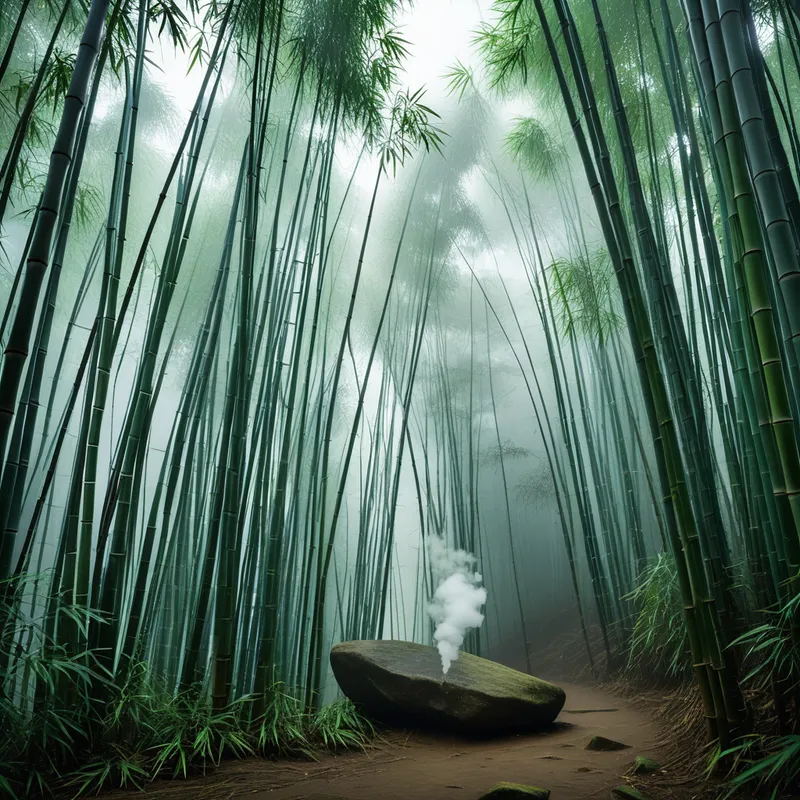
With a thought that was also a feeling, the Cloud let go. It did not fight [the wind](/myths/the-wind “Myth from Various culture.”/), nor command the temperature. It simply allowed itself to be changed. It thickened, darkened, and grew heavy with the memory of [the sea](/myths/the-sea “Myth from Greek culture.”/). In a gentle, relentless release, it became a million falling diamonds, soaking into the parched earth, filling the riverbeds, beading on the leaves of the wilting bamboo.
The Cloud was gone. In its place was mud, and flow, and green shoots pushing toward the sun. But on the warm breath of the satisfied earth, under the gaze of the sun, a new mist began to rise. Tiny vapors, from every leaf and pond and stone, ascended. They gathered, drawn by a familiar, silent song. In the high, cold air near the mountain peak, they coalesced.
There, once more, was the Cloud. Not the same, yet not different. It had known the weight of form and the freedom of formlessness. It had been the gift and the giver, the sacrifice and [the resurrection](/myths/the-resurrection “Myth from Christian culture.”/). Now, it drifted again, but with a knowing serenity. It would rain when the land called, and gather again when the sky whispered. Its being was no longer a state, but a graceful, eternal dance between condensation and dispersal, between being-for-itself and being-for-the-world. It had learned the [Wu Wei](/myths/wu-wei “Myth from Taoist culture.”/) of the heavens.
Cultural Origins & Context
The myth of the Daoist Cloud is not a single, codified story from a classic text like the Daodejing or the [Zhuangzi](/myths/zhuangzi “Myth from Chinese culture.”/). Rather, it is a narrative essence distilled from the core principles of Daoist philosophy and cosmology, woven into parable form by Daoist adepts and storytellers. It served as a teaching tool, a way to transmit profound, abstract concepts through nature’s poetry.
This myth would have been told in the quiet courtyards of mountain monasteries, or by wandering ascetics to earnest seekers. Its function was societal in an inward sense: it modeled a mode of being that countered rigid Confucian hierarchies and striving. It taught resilience through flexibility, contribution through self-dissolution, and immortality not as stasis, but as perpetual, willing transformation. The Cloud is the ideal of the Xian, [the immortal](/myths/the-immortal “Myth from Taoist culture.”/), who moves through the world and its changes without being harmed by them, because they do not cling to a single, fixed identity.
Symbolic Architecture
The Cloud is the [psyche](/myths/psyche “Myth from Greek culture.”/) itself—[consciousness](/symbols/consciousness “Symbol: Consciousness represents the state of awareness and perception, encompassing thoughts, feelings, and experiences.”/) in its natural, unbounded state. The [clear sky](/symbols/clear-sky “Symbol: Represents clarity, inspiration, and boundless potential. Often symbolizes divine connection and creative freedom in artistic contexts.”/) represents the Wuji, the infinite potential before the [psyche](/myths/psyche “Myth from Greek culture.”/) takes shape. The Cloud’s formation is the [emergence](/symbols/emergence “Symbol: A process of coming into being, rising from obscurity, or breaking through a barrier, often representing birth, transformation, or revelation.”/) of [the ego](/myths/the-ego “Myth from Jungian culture.”/), a temporary [condensation](/symbols/condensation “Symbol: In dreams, condensation represents the compression of multiple ideas, memories, or emotions into a single image, often revealing hidden connections and subconscious complexity.”/) of [identity](/symbols/identity “Symbol: Identity represents the sense of self, encompassing personal beliefs, cultural background, and social roles.”/) from the vast unconscious.
The Cloud does not decide to rain; it becomes the conditions for rain. This is the wisdom of the unconscious enacted.
The [drought](/symbols/drought “Symbol: Drought signifies a period of emotional scarcity, lack of resources, or feelings of deprivation leading to anxiety or intense longing.”/) symbolizes a psychic or spiritual [crisis](/symbols/crisis “Symbol: A crisis symbolizes turmoil, urgent challenges, and the need for immediate resolution or change.”/)—a state of [aridity](/symbols/aridity “Symbol: Aridity symbolizes emotional or spiritual barrenness, a lack of nourishment, and a state of profound dryness or emptiness.”/), rigidity, or emotional [famine](/symbols/famine “Symbol: A profound lack or scarcity, often of food, representing deprivation, survival anxiety, and systemic collapse.”/). The land is the world of matter, [relationship](/symbols/relationship “Symbol: A representation of connections we have with others in our lives, often reflecting our emotional state.”/), and duty, the “[reality](/symbols/reality “Symbol: Reality signifies the state of existence and perception, often reflecting one’s understanding of truth and life experiences.”/) principle” that feels severed from the nourishing waters of the [spirit](/symbols/spirit “Symbol: Spirit symbolizes the essence of life, vitality, and the spiritual journey of the individual.”/). The Cloud’s dilemma is the core [human](/symbols/human “Symbol: The symbol of a human represents individuality, complexity of emotions, and social relationships.”/) conflict between self-preservation and [empathy](/symbols/empathy “Symbol: The capacity to understand and share the feelings of others, often manifesting as emotional resonance or intuitive connection in dreams.”/), between individuation and communion.
The act of raining is the ultimate symbolic sacrifice. It is the ego’s voluntary [dissolution](/symbols/dissolution “Symbol: The process of breaking down, dispersing, or losing form, often representing transformation, release, or the end of a state of being.”/) for a greater good—the pouring out of one’s talents, love, or [energy](/symbols/energy “Symbol: Energy symbolizes vitality, motivation, and the drive that fuels actions and ambitions.”/) into the world, knowing it means the end of the current self-[structure](/symbols/structure “Symbol: Structure in dreams often symbolizes stability, organization, and the framework of one’s life, reflecting how one perceives their environment and personal life.”/). The subsequent [evaporation](/symbols/evaporation “Symbol: The process of liquid transforming into vapor, symbolizing impermanence, transformation, and the dissolution of form into essence.”/) and reformation is the promise of [depth](/symbols/depth “Symbol: Represents profound layers of consciousness, hidden truths, or the unknown aspects of existence, often symbolizing introspection and existential exploration.”/) [psychology](/symbols/psychology “Symbol: Psychology in dreams often represents the exploration of the self, the subconscious mind, and emotional conflicts.”/): that from such a “[death](/symbols/death “Symbol: Symbolizes transformation, endings, and new beginnings; often associated with fear of the unknown.”/)” of the ego-[attitude](/symbols/attitude “Symbol: Attitude symbolizes one’s mental state, perception, and posture towards life, influencing emotions and actions significantly.”/), a new, more complex and resilient consciousness is reborn. The Cloud is forever changed, having integrated the experience of being the rain. It now contains the [memory](/symbols/memory “Symbol: Memory symbolizes the past, lessons learned, and the narratives we construct about our identities.”/) of the [valley](/symbols/valley “Symbol: A valley often symbolizes a period of transition or a place of respite between two extremes.”/) within its vaporous form.

The Dreamer’s Resonance
When this myth stirs in the modern dreamer, it often manifests as dreams of melting, dissolving, or transforming into natural elements. You may dream of becoming mist, of your body turning to [water](/myths/water “Myth from Chinese culture.”/) that seeps into the ground, or of floating weightlessly only to be scattered by a wind.
Somatically, this can correlate with feelings of depletion after caregiving, the “fragmentation” felt after a major life project concludes, or the disorienting fluidity of an identity shift (e.g., after a career change, becoming a parent, or a spiritual awakening). The psyche is processing the necessity of dispersal. It is working through the anxiety of losing one’s recognizable form to meet the demands of life. The dream is not a warning, but an initiation. It is the unconscious reassuring the conscious mind: “This scattering is not annihilation; it is part of a natural cycle. You will gather again, different, but whole.”

Alchemical Translation
For the individual on the path of individuation, the myth of the Daoist Cloud models the alchemical process of [Solve et Coagula](/myths/solve-et-coagula “Myth from Alchemical culture.”/)—“Dissolve and Coagulate.” Our modern curse is often rigidity: a fixed identity, a calcified [persona](/myths/persona “Myth from Greek culture.”/), a defensive ego-structure that refuses to change even when it is causing suffering or sterility.
The alchemical fire is not willpower, but the heat of genuine encounter with the world’s need. It forces the dissolution.
The “drought” is the felt experience of this rigidity. Life feels dry, repetitive, meaningless. The alchemical instruction is to emulate the Cloud: to perceive where life is calling for our “rain”—our emotional honesty, our creative output, our compassionate action—and to allow the dissolution. This is not an act of willful destruction, but of supreme yielding. It is the courage to be vulnerable, to spend oneself, to not know who one will be on the other side.
The rebirth of the Cloud is the Coagula stage. After the outpouring, there must be a period of gathering. This is deep rest, introspection, and withdrawal. The new self that forms is not a return to the old, but a synthesis. It contains the wisdom of the sacrifice. The individual learns they are not a static noun, but a verb—a process of continuous, graceful transformation. They achieve a sovereignty that is not based on control, but on harmonious adaptation. They become, in a psychological sense, a true Xian: a sage who moves through the trials of life with the effortless, transformative grace of a cloud becoming rain, and rain becoming cloud, forever in tune with the great breath of the Dao.
Associated Symbols
Explore related symbols from the CaleaDream lexicon: