The Danaids Myth Meaning & Symbolism
Forty-nine sisters, forced into marriage, murder their husbands and are condemned to eternally carry water in a leaking vessel.
The Tale of The Danaids
Hear now the story of the [water](/myths/water “Myth from Chinese culture.”/)-bearers, a tale of salt and blood, of thirst unquenched beneath a pitiless sun. It begins not in the sunlit world, but in the shadowed lands of Libya, where twin brothers, seeds of [the river](/myths/the-river “Myth from Buddhist culture.”/)-god Io, grew to hate one another with the heat of [the desert](/myths/the-desert “Myth from Biblical culture.”/). Danaus and Aegyptus—their very names a clash of dust and flood.
Aegyptus, swollen with pride, demanded his fifty sons marry the fifty daughters of Danaus, to bind their kingdoms in a single, choking knot. But Danaus, in the secret chambers of his heart, heard a warning whisper, a prophecy of doom sung by [the wind](/myths/the-wind “Myth from Various culture.”/) through the reeds. He saw not a union, but a yoke. So, under the cloak of a false smile, he agreed. The fifty daughters, the Danaids, were arrayed like sacrificial lambs in garlands of mournful flowers.
They sailed to Argos, the land of their ancestress Io, a place of supposed sanctuary. The wedding feast was a cacophony of forced laughter and clashing cups. As the wine flowed and the stars wheeled overhead, Danaus passed a secret to each of his daughters—a sharp, cunning blade, its edge kissed by moonlight and desperation. “When your husband sleeps,” he whispered, a serpent’s hiss in the bridal chamber, “let his blood water [the earth](/myths/the-earth “Myth from Hindu culture.”/) he sought to claim.”
Forty-nine obeyed. Forty-nine blades found their mark in the dark, and the palace halls ran red. Only one, Hypermnestra, looked upon her husband, Lynceus, and saw not a foe, but a man. She stayed her hand, and for her mercy, love would later bloom.
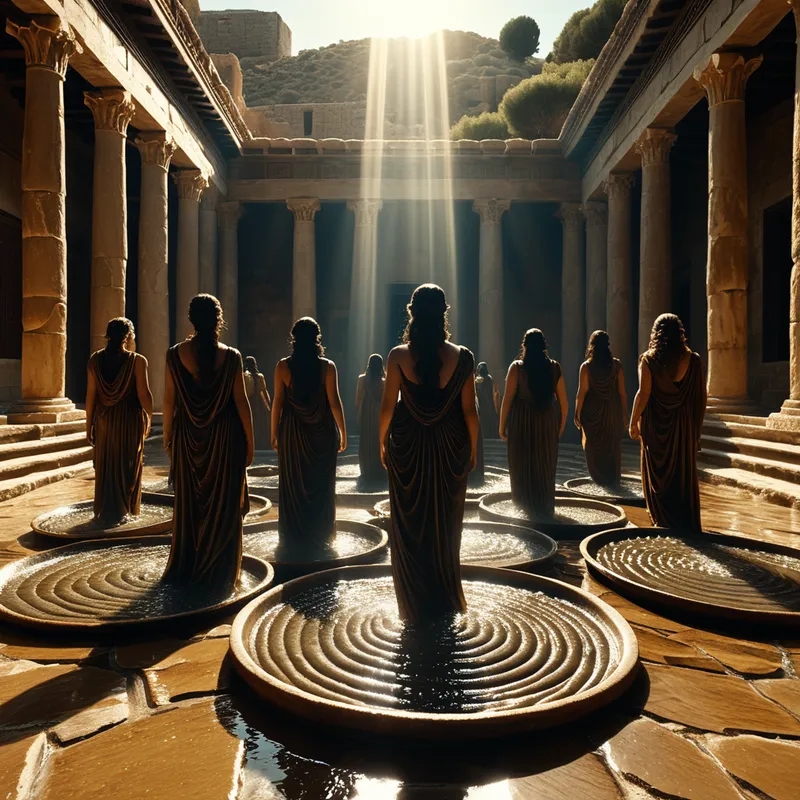
But for the forty-nine, [the Furies](/myths/the-furies “Myth from Greek culture.”/) came. Their father’s crime became their own, a stain no water could cleanse. When their mortal lives ended, they descended to the realm of [Hades](/myths/hades “Myth from Greek culture.”/). There, in a courtyard of eternal twilight, their sentence was pronounced. Their task: to carry water. To fill a great pithos, a vessel as deep as their guilt. But their tools were not jars, but sieves. Vessels riddled with holes, forever leaking, forever empty.
And so they labor, a silent, graceful procession of despair. They descend to a dark, still pool, fill their impossible jars, and climb back to the great pithos, only to watch the life-giving liquid drain away before it can touch the rim. The splash of water, the sigh of [the void](/myths/the-void “Myth from Buddhist culture.”/), the endless, measured steps—this is the music of their eternity. A labor without end, without purpose, without hope of filling what can never be filled.

Cultural Origins & Context
This haunting myth reaches us primarily through the later epitomes of the lost epic, the Danais, and most powerfully through the Roman poet Ovid and the Athenian tragedians. It was a story deeply embedded in the Argive tradition, used to explain local place names and rituals. The Danaids were not mere monsters; they were foundational figures, the purported ancestors of the Danaans, an ancient name for the Greeks themselves.
The myth served multiple societal functions. On one level, it was an aition for certain water-carrying rituals performed by women in Argos, perhaps initiation rites. On another, it explored the profound tensions around marriage, exogamy (marriage outside the group), and female agency. The Danaids’ murderous revolt was a terrifying inversion of the patriarchal order, where daughters obeyed their father to the point of destroying the very system of alliance he ostensibly engaged in. Their punishment thus served as a dire warning about the chaos of transgressing fundamental social laws, while Hypermnestra’s clemency modeled the “correct” outcome that ensures dynastic continuity.
Symbolic Architecture
The Danaids’ [punishment](/symbols/punishment “Symbol: A dream symbol representing consequences for actions, often tied to guilt, societal rules, or internal moral conflicts.”/) is one of the most potent images of futility in the Western imagination. It is the [archetype](/symbols/archetype “Symbol: A universal, primordial pattern or prototype in the collective unconscious that shapes human experience, behavior, and creative expression.”/) of the uncompletable [task](/symbols/task “Symbol: A task represents responsibilities, duties, or challenges one faces.”/).
The sieve is the soul that cannot contain its own experience, forever losing the vital essence it strives to hold.
Psychologically, the leaking [vessel](/symbols/vessel “Symbol: A container or structure that holds, transports, or protects something essential, representing the self, emotions, or life journey.”/) represents a fractured [psyche](/myths/psyche “Myth from Greek culture.”/). The [water](/symbols/water “Symbol: Water symbolizes the subconscious mind, emotions, and the flow of life, representing both cleansing and creation.”/) symbolizes [life](/symbols/life “Symbol: The symbol of ‘Life’ represents a journey of growth, interconnectedness, and existential meaning, encompassing both the joys and challenges that define human experience.”/) force, [emotion](/symbols/emotion “Symbol: Emotion symbolizes our inner feelings and responses to experiences, often guiding our actions and choices.”/), meaning, or libido. The act of carrying it is [the ego](/myths/the-ego “Myth from Jungian culture.”/)’s [effort](/symbols/effort “Symbol: Effort signifies the physical, mental, and emotional energy invested toward achieving goals and personal growth.”/) to integrate experience, to achieve wholeness. But the holes—the traumas, the repressed memories, the unexamined patterns—ensure this effort is perpetually sabotaged. The Danaids are not just punished with labor; they are punished as the labor itself. They embody a state of being: the one who tries, but cannot integrate.
Their [crime](/symbols/crime “Symbol: Crime in dreams often symbolizes guilt, inner conflict, or societal rules that are being challenged or broken.”/), the murder of their bridegrooms, is equally rich. It represents the violent [rejection](/symbols/rejection “Symbol: The experience of being refused, excluded, or dismissed by others, often representing fears of inadequacy or social belonging.”/) of the “other,” the masculine principle ([animus](/symbols/animus “Symbol: In Jungian psychology, the masculine inner personality in a woman’s unconscious, representing logic, action, and spiritual guidance.”/)), the new, and the foreign. It is a retreat into a deadly, exclusive sisterhood under a tyrannical [father](/symbols/father “Symbol: The father figure in dreams often symbolizes authority, protection, guidance, and the quest for approval or validation.”/) (the patriarchy of the conscious ego). They choose the known [horror](/symbols/horror “Symbol: Horror in dreams often symbolizes deep-seated fears, anxieties, and unresolved conflicts that the dreamer faces in waking life.”/) of the [father](/symbols/father “Symbol: The father figure in dreams often symbolizes authority, protection, guidance, and the quest for approval or validation.”/)’s command over the unknown potential of the [husband](/symbols/husband “Symbol: In dreams, the symbol of a husband often represents commitment, partnership, and the dynamics of intimate relationships.”/)’s bed, a [choice](/symbols/choice “Symbol: The concept of choice often embodies decision-making, freedom, and the multitude of paths available in life.”/) that ultimately annihilates their own [futures](/symbols/futures “Symbol: Dreams of futures represent potential paths, unknown outcomes, and the psychological tension between destiny and free will.”/).

The Dreamer’s Resonance
When this myth stirs in the modern unconscious, it rarely appears as fifty women in chitons. Instead, the dreamer becomes the Danaid. You dream of trying to fill a bathtub with a colander. You are late for an exam you can never find. You run on a treadmill towards a receding horizon. The somatic feeling is one of profound exhaustion, anxiety, and emptiness—a burning effort that yields no sustenance.
This dream pattern signals a psyche engaged in a futile loop. The dreamer is likely caught in a life pattern where immense energy is expended—in work, in a relationship, in a pursuit—but there is no sense of accumulation, fulfillment, or progress. The “vessel” of their life has a leak. This could be an unrecognized addiction, a commitment to a path that violates one’s true nature, or the endless repetition of a childhood survival strategy that no longer serves. The dream is the psyche’s stark illustration of the cost: You are pouring your life into a sieve.

Alchemical Translation
The alchemical journey for the Danaid-soul is not to find a better bucket, but to mend the sieve. The first, harrowing step is to stop. To cease the automatic, frantic carrying and to truly look at [the vessel](/myths/the-vessel “Myth from Alchemical culture.”/) itself. This is the moment of despair that precedes insight: staring at the leaking essence of one’s life.
Redemption begins not with a full vessel, but with the conscious acknowledgment of the hole.
Hypermnestra provides the key. She broke the pattern. She saw the individual (Lynceus) beyond the archetypal role (“the enemy husband”). In psychological terms, she allowed for relationship instead of [projection](/myths/projection “Myth from Alchemical culture.”/). For the modern individual, this translates to engaging with the contents of one’s life—the emotions, the tasks, the people—not as abstract burdens or threats, but as specific, relatable realities. It means examining the “holes”: What trauma, fear, or belief causes my life-energy to drain away? What am I refusing to face or feel?
The alchemical goal is the transmutation of the sieve itself. In a profound paradox, when one stops trying to use the sieve as a solid jar and understands its true, permeable nature, it can become something else. A filter. A strainer that separates the essential from the dross. The eternal labor of carrying water becomes the conscious process of discernment. The punished daughters of the past can become the discerning priestesses of the present, who no longer seek to possess the infinite, but to interact with its flow, understanding that wholeness is not a state of being full, but a state of being in right relationship with both the source and the leak. The task remains, but its meaning is utterly transformed.
Associated Symbols
Explore related symbols from the CaleaDream lexicon: