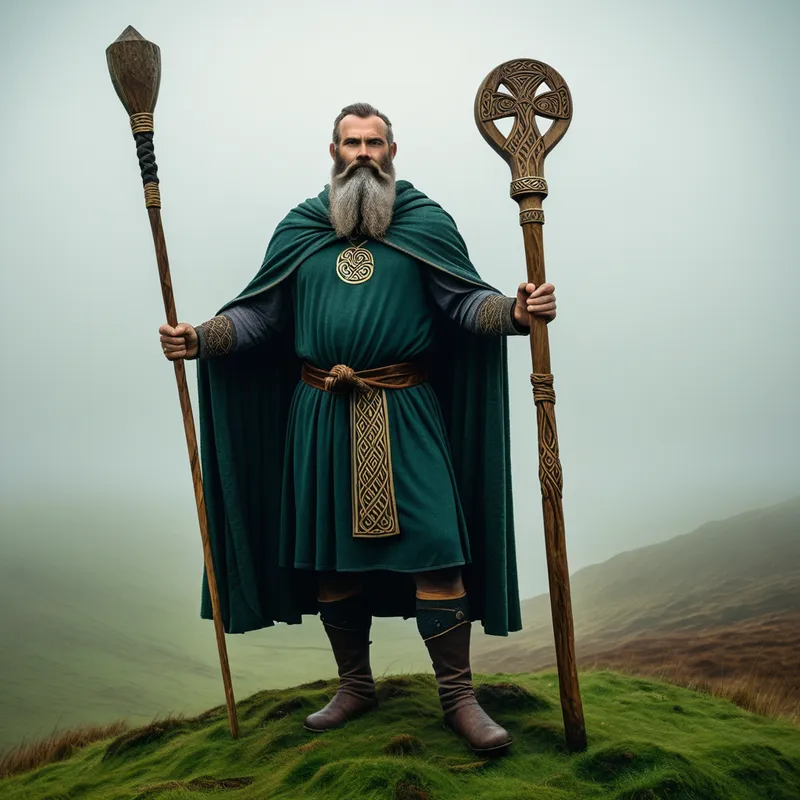
The Dagda's Club Myth Meaning & Symbolism
The tale of the Dagda, the Good God, whose mighty club could slay nine men with one end and restore them to life with the other.
The Tale of The Dagda’s Club
Listen now, and let the fire’s crackle become the rustle of oak leaves in a forgotten forest. Let the smoke carry you to the time of the Tuatha Dé Danann, when the world was raw with magic and the borders between realms were thin as mist.
In that time, there was a king among the gods, a father to the people. He was called the Dagda. He was not slender or swift, but vast as a hill, with a belly that shook like a bowl of jelly when he laughed—and he laughed often. His strength was the strength of the rooted earth, his wisdom the deep, slow knowledge of the turning seasons. And in his great, calloused hand, he carried his club.
It was no mere stick of wood. It was a tree itself, felled from the heart of the oldest forest. So massive was it that it rested on eight wheels, dragged behind him not by horses, but by the very weight of its purpose. Look upon it: one end was broad, gnarled, and terrible, studded with iron and carved with the grimacing face of finality. With this end, he could strike down nine warriors where they stood, felling them like ripe grain before the scythe. It was the end of argument, the close of conflict, the undeniable force of necessity.
But turn the club. The other end was smooth, worn by the grip of a caring hand, and it glowed with a gentle, persistent light. With this end, he could touch those same nine fallen men and breathe the warmth of life back into their still forms. They would rise, blinking, whole and unharmed, remembering only a deep sleep. This was the end of mercy, the return of the sun, the second chance granted by a generous sovereign.
The Dagda did not wield this power with arrogance, but with the solemn duty of one who tends a great hearth. He was the provider, the protector. His club was his tool, as was his great cauldron, the Coire Ansic, which never emptied, and his living harp, Uaithne, which played the music of the seasons themselves. He used the club’s deadly end to defend the Fír Flathemon, the sovereign’s truth, against the chaos of the Fomorians. He used its living end to restore balance, to heal the land and its people after the storm had passed.
He was a god who contained the whole cycle within his grasp: the necessary fall and the essential return, the winter’s death and the spring’s relentless rebirth. And as he rolled his club across the green hills of Ériu, the very earth knew it was in the hands of a good father, who could both discipline and mend with the same unwavering love.
Cultural Origins & Context
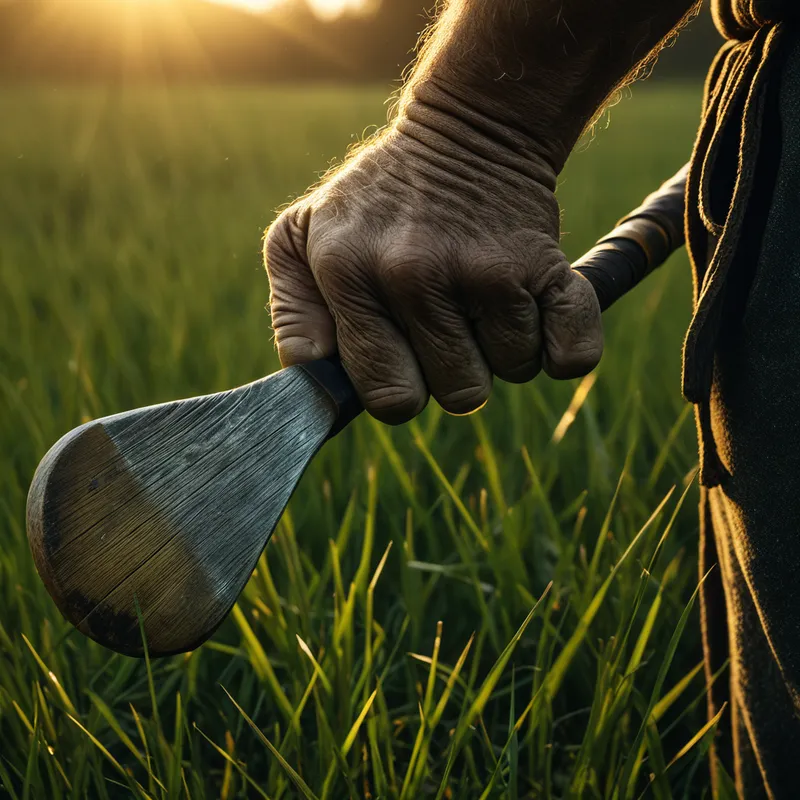
This myth of the Dagda and his club comes to us from the medieval Irish manuscripts, primarily the Lebor na hUidre and the Lebor Laignech. These texts are Christian transcriptions of a far older, pre-Christian oral tradition. The stories were preserved by the fili, the poet-seers, who were the inheritors of the druidic tradition.
The Dagda is a central figure of the Mythological Cycle. His club is not merely a weapon; it is an emblem of his sovereignty. In early Celtic society, the ideal king was not just a warrior but a sacred figure responsible for the fertility of the land and the well-being of the tribe. The Dagda, as a divine archetype of this king, embodies this dual responsibility through his club: he must be fierce enough to defend the tribe’s order (the deadly end) and nurturing enough to ensure its prosperity and continuity (the life-giving end). The myth served to model the awesome, paradoxical burden of true leadership and the deep, magical connection between a rightful ruler and the land itself.
Symbolic Architecture
At its core, the Dagda’s club is a supreme symbol of paradoxical unity. It represents the inseparable pairing of opposites that constitute reality and functional power.
The club is the axis where destruction and creation meet, the staff of a sovereignty that understands death is in service to life.
The deadly end symbolizes necessary force, boundaries, decisive action, and the ending of cycles. It is the “no” that makes a “yes” meaningful, the limit that defines a shape, the winter that makes spring possible. Psychologically, it represents the ego’s capacity for discernment, judgment, and the often-painful act of cutting away what no longer serves life—be it a toxic habit, a defunct belief, or an unhealthy relationship.
The life-giving end symbolizes restoration, healing, forgiveness, and the renewal of cycles. It is compassion, nurture, the healing word, the second chance. Psychologically, it is the function of the Self that integrates and mends, that brings warmth and vitality back to parts of the psyche that have been “struck down” by trauma or neglect.
The Dagda himself, holding both ends, is the symbol of the integrated psyche—the Self. He is not conflicted by his dual nature; he is complete because of it. His great size and appetite speak to an archetype of immense capacity and abundance, one that can hold and manage these tremendous opposing forces without being torn apart.
The Dreamer’s Resonance
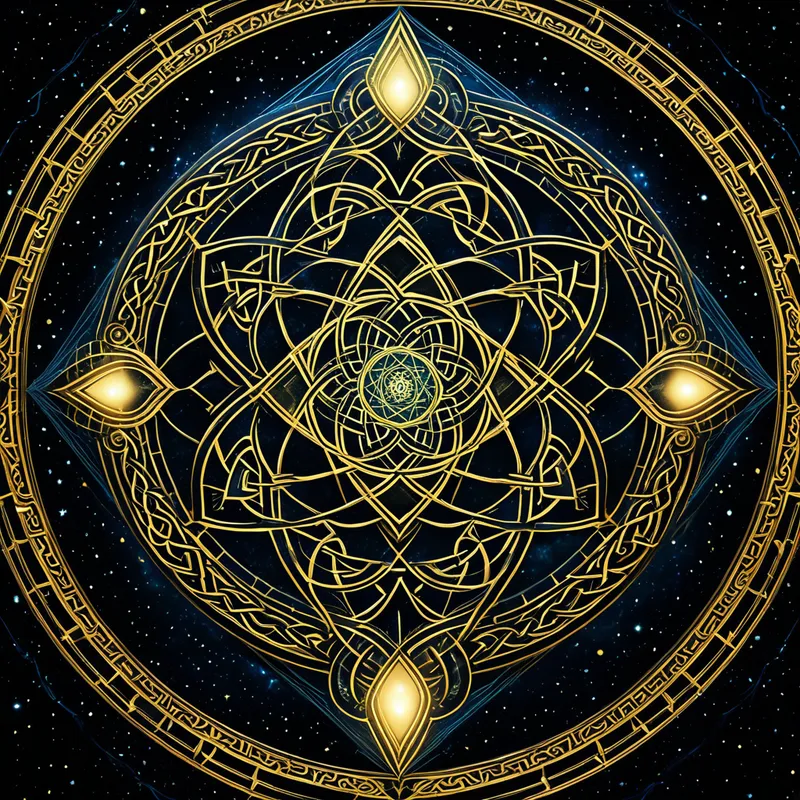
When this myth stirs in the modern unconscious, it often manifests in dreams of powerful, ambiguous tools or weapons. One might dream of a tool that is both a weapon and a healing instrument—a surgeon’s scalpel that glows, a pen that writes in both blood and light, a key that both locks and unlocks.
Somatically, this can correlate with a felt sense of holding tremendous tension—the tension of making a hard decision that will cause short-term pain for long-term health (the deadly end in action), or the tension of patiently nurturing a recovery or a new project (the life-giving end at work). The dreamer may be grappling with their own authority and capacity in a life situation, sensing the need to access both fierce protection and gentle restoration. The club in a dream asks: Where in your life must you learn to wield decisive force, and where must you learn to apply restorative touch? Are you able to hold both powers in the same hand, or do you fear one side of your own nature?
Alchemical Translation
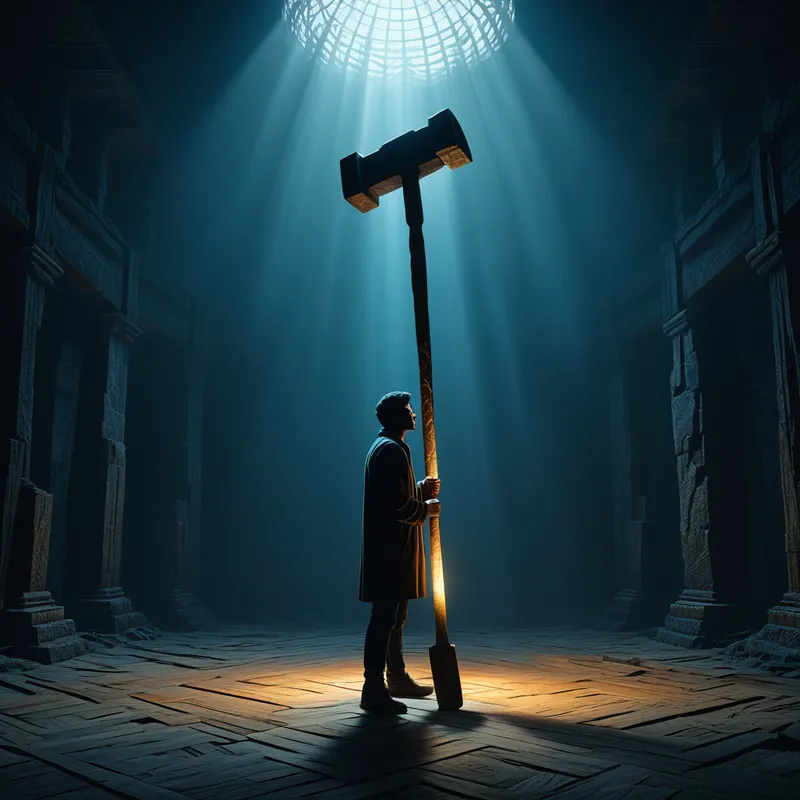
The individuation process, the journey toward psychological wholeness, is precisely the process of forging one’s own “club.” It is the development of a central, guiding principle (the shaft) that can consciously hold and employ our opposites.
Initially, we are identified with one end. We may be overly nurturing, unable to set boundaries (only the life-giving end), or overly critical and destructive, unable to foster growth (only the deadly end). The work of alchemy is to reclaim the denied opposite and unite it with its counterpart in a higher synthesis.
To become sovereign of one’s own inner kingdom is to earn the right to wield the Dagda’s club—to accept the solemn responsibility for both the endings and the beginnings you must author.
This involves the mortificatio—the necessary “killing” of infantile fantasies, outdated identities, and compulsive behaviors (the deadly end’s work). But it is always followed by the albedo and rubedo—the washing clean and the bringing forth of new, more authentic life (the life-giving end’s grace). The modern individual undergoing this process is learning to be their own Good Parent—the Dagda within—who can discipline with love and heal with strength. The ultimate goal is not to choose between power and compassion, but to integrate them into a sovereign wholeness that can roll forward on the wheels of one’s destiny, leaving a trail of both necessary endings and resilient new growth in its wake.
Associated Symbols
Explore related symbols from the CaleaDream lexicon: