The Dagda Myth Meaning & Symbolism
The tale of the all-father god of Ireland, whose cauldron, club, and harp embody the paradoxical power of life, death, and the music that reconciles them.
The Tale of The Dagda
Hear now the tale of the Dagda, the All-Father, he whose breath is the wind in the oak and whose heartbeat is the drum of the land. In the time of the Tuatha Dé Danann, when magic was thick as morning mist, he was their pillar, their provider, their unshakeable heart.
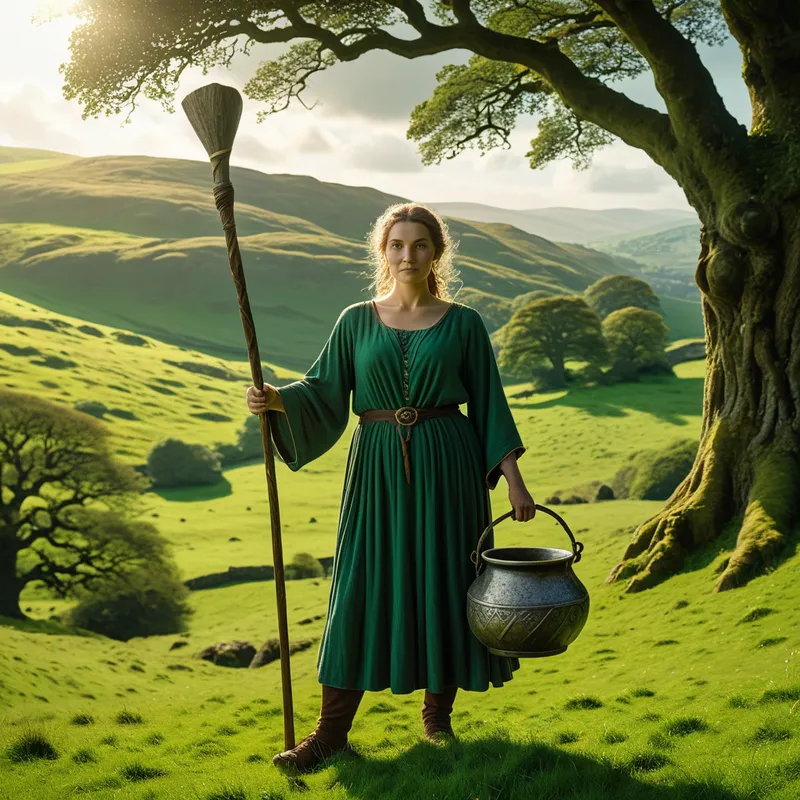
He was a giant of a being, not with the sleek muscles of a warrior, but with the formidable girth of a well-stocked hillfort. His belly was a mound of prosperity, his eyes held the deep, patient knowing of the earth itself. He wore but a simple, rough tunic that barely covered his great form, and his tools were the wonders of the world. From his shoulder hung the Lorg Mór, the Great Club, so massive it needed wheels, its head carved with knots of terrible power. In his great hand he carried the Coire Ansic, the Undry Cauldron, from which an endless feast could be drawn.
But the great conflict was upon them. The People of Danu faced the monstrous Fomorians, a shadow rising from the cold sea. On the eve of the great battle, the Dagda was sent to the Fomorian camp to parley—a ruse to spy and to delay. There, the Fomorian king, Bres, seeking to mock and humiliate this “good god,” commanded him to eat a vast porridge of prophecy, made in a pit with eighty measures of milk, meal, and fat, topped with whole goats, sheep, and swine.
The Dagda did not refuse. He took the great ladle, so large a man and woman could lie in it, and he ate. He consumed every last morsel from the pit, scraping the sides with his fingers, until his belly swelled to the size of a giant’s cauldron. So stuffed he could barely move, he was then mocked and sent stumbling from the camp, his tunic dragging on the ground behind him. The Fomorians laughed, thinking him a gluttonous fool.
Yet this was his cunning. Sated with their food and their secrets, he waddled not to a bed, but to a tryst with the Mórrígan herself, who waited for him at a river ford. There, with the river singing around his ankles, they united, and she promised to stand against the Fomorian king and drain his strength in the coming fight.
The next day, the battle raged. The Dagda, still swollen, moved through the fray like a force of nature. His great club swung, its deadly end felling nine men with a single blow, while its other end could call the slain back to life. But the tide turned not on brute force alone. For the Fomorians had stolen his other great treasure: the Uaithne.
He found it in their banqueting hall. He stretched out his hand and called to it. The harp flew to him, killing nine Fomorians on its path. He laid his fingers upon the oak and bronze. He played the three sacred strains: the Goltraí, which made the warriors weep until their cheeks were salt-streaked; the Geantraí, which lifted them into helpless, healing laughter; and finally, the Suantraí, which laid every soul in the hall into a deep, dreamless slumber. With the music of the world itself, he stilled his enemies and reclaimed the harmony of the land.

Cultural Origins & Context
The Dagda emerges from the rich, fragmented tapestry of early Irish literature, primarily preserved by Christian monks in manuscripts like the Lebor na hUidre and the Lebor Laignech. These texts codify an older, oral tradition that belonged to the filid, the poet-seers who were the memory-keepers of the culture. The Dagda is a central figure in the Mythological Cycle.
He was not a distant, omnipotent sky father, but a god intimately tied to the land, its fertility, and its sovereignty. His myths functioned as foundational narratives, explaining the origin of tribal kingship (his union with the Mórrígan), the moral and physical sustenance of the people (his cauldron and his feast), and the ultimate triumph of order (the Tuatha Dé) over chaos (the Fomorians). He embodies the ideal of the good king: generous, potent, cunning, and a master of both the practical arts of provision and the magical arts of harmony. His sometimes comical, grotesque appearance in the tales—the dragging tunic, the enormous appetite—serves not to diminish him, but to ground his divinity in a tangible, earthy, and paradoxically relatable reality.
Symbolic Architecture
The Dagda is the archetype of the Pater Familias taken to a cosmic scale. He is not a refined ruler, but a primordial provider. His symbols form a trinity of profound, paradoxical power:
- The Club (Lorg Mór): The instrument of raw, dualistic force. It represents the unavoidable polarities of existence: destruction and restoration, death and life, the decisive blow and the healing touch. It is power in its most fundamental, unadorned state.
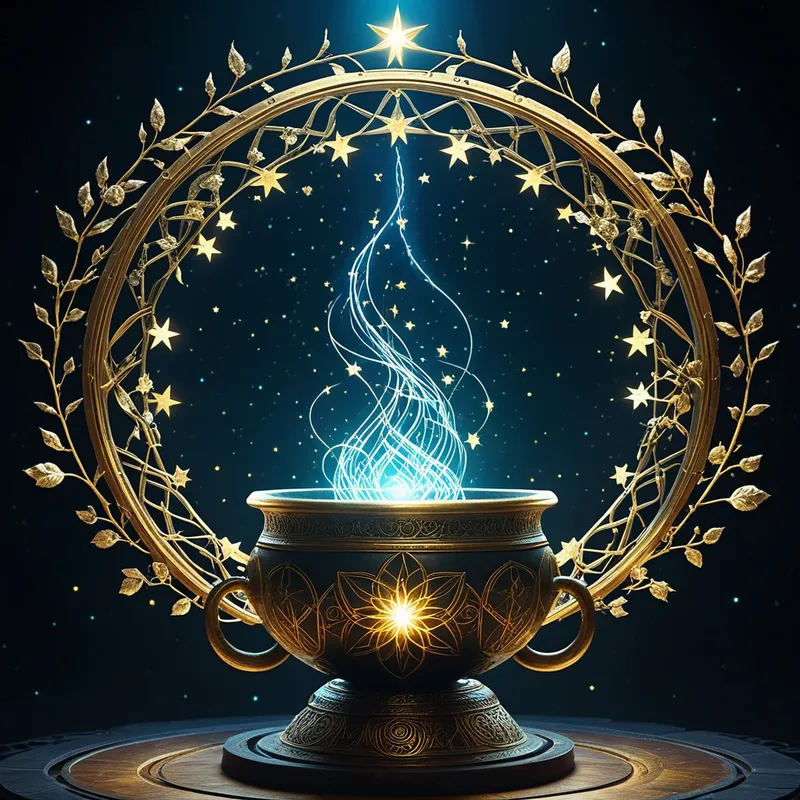
- The Cauldron (Coire Ansic): The womb of endless regeneration. It symbolizes inexhaustible abundance, the deep nourishment that comes from the underworld (the realm of the divine), and the transformative process of cooking, brewing, and making whole. It is the promise that no one who comes to him in genuine need will be turned away unsatisfied.
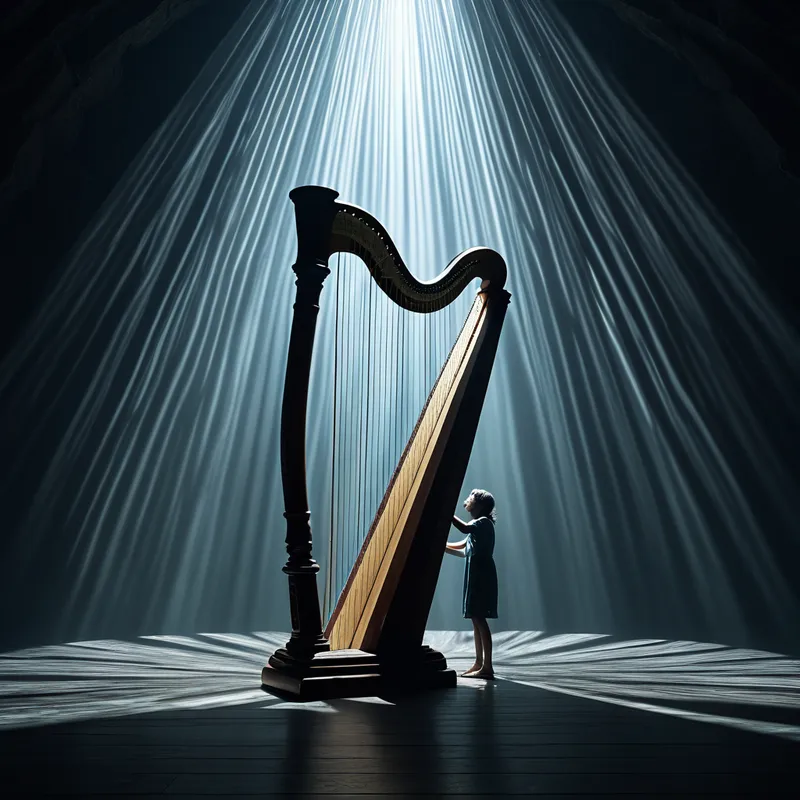
- The Harp (Uaithne): The harmonizing principle. It is the force that orders chaos, that calls the seasons, and that governs the inner weather of the human heart—sorrow, joy, and rest. It represents the art that transcends brute force, the music that reconciles opposites.
The Dagda does not choose between power and gentleness, between gluttony and generosity, between war and music. He holds them all in the vast container of his being, demonstrating that true sovereignty is the capacity to encompass the whole.
Psychologically, he represents the ego’s relationship to the immense, often contradictory, energies of the unconscious. He is the Self that can digest the “porridge” of our shadow material—the shameful, greedy, excessive parts we wish to hide—and, through that very act of unashamed consumption, gain strength and insight from it.
The Dreamer’s Resonance
To dream of the Dagda is to encounter the psyche’s own principle of abundant, unrefined sustenance. Such dreams often arise during periods of intense hunger—not merely physical, but emotional, creative, or spiritual. The dreamer may find themselves at a grotesquely large feast they feel compelled to finish, or struggling to carry a tremendously heavy yet precious object.
Somatically, this can manifest as sensations of overwhelming fullness or bloating, or a deep, grounding heaviness in the limbs. Psychologically, the process is one of incorporation. The psyche is attempting to integrate something massive: a new responsibility, a forgotten appetite, a grief or a joy too large for everyday consciousness. The Dagda’s appearance suggests the dreamer is being called to develop a greater capacity—to “stretch their tunic”—to hold more of life’s complexity without splitting it into acceptable and unacceptable parts. The humor and slight revulsion in the myth translate into dreams as a confrontation with one’s own “uncool” or excessive nature, challenging the dreamer to find strength in what they have been taught to see as weakness or mess.
Alchemical Translation
The Dagda’s journey is a masterclass in the alchemy of individuation, the process of becoming the undivided, sovereign self. His myth models a non-linear path of psychic transmutation:
- The Nigredo of the Feast: The humiliating consumption of the porridge is the initial descent, the confrontation with the shadow. The ego is forced to ingest and be visibly altered by the gross, undifferentiated matter of the unconscious (our primal needs, our gluttony, our cunning). This is the necessary darkening, the swelling with unprocessed content.
- The Coniunctio at the Ford: The union with the Mórrígan represents the sacred marriage (hieros gamos) of the conscious principle (the Dagda as provider-king) with the unconscious, fateful, transformative feminine principle. This occurs not in a palace but at a liminal boundary (the river ford), symbolizing that integration happens at the edges of our awareness, through engagement with our own deep, often fearsome, creative and fate-shaping energies.
- The Albedo of the Harp: The reclamation and playing of the harp is the illumination. After the incorporation and the sacred union comes the ability to bring order and harmony. The three strains—tears, laughter, sleep—represent the mastery over one’s own emotional and instinctual life. One can consciously move through sorrow to joy to rest, no longer a victim of these states but a musician who can call them forth when needed.
The alchemical goal is not to become spiritually slender, but to become a capable container. The Dagda shows us that the transformed Self is not a purified spirit, but a being who has made a pact with abundance, who carries the tools of force, nurture, and art, and who is not afraid to be seen as too much.
For the modern individual, the Dagda’s path asks: What porridge of experience are you refusing to eat? What appetite are you starving? Can you bear to be seen as excessive, to carry the weight of your own full potential? His triumph is not in becoming light, but in becoming so grounded, so replete with all that he is, that he can finally play the music that puts the chaotic fragments of the self and the world to rest.
Associated Symbols
Explore related symbols from the CaleaDream lexicon: