
The Cynics Myth Meaning & Symbolism
A story of radical freedom, where a philosopher rejects all convention to live like a dog, finding divine truth in poverty and mocking hollow power.
The Tale of The Cynics
Listen. The story does not begin on Olympus, nor in the labyrinthine courts of kings. It begins in the gutter, in the marketplace dust, in the space between what is said and what is. It begins with a man who looked upon the polished marble of the world and saw only a cage of lies.
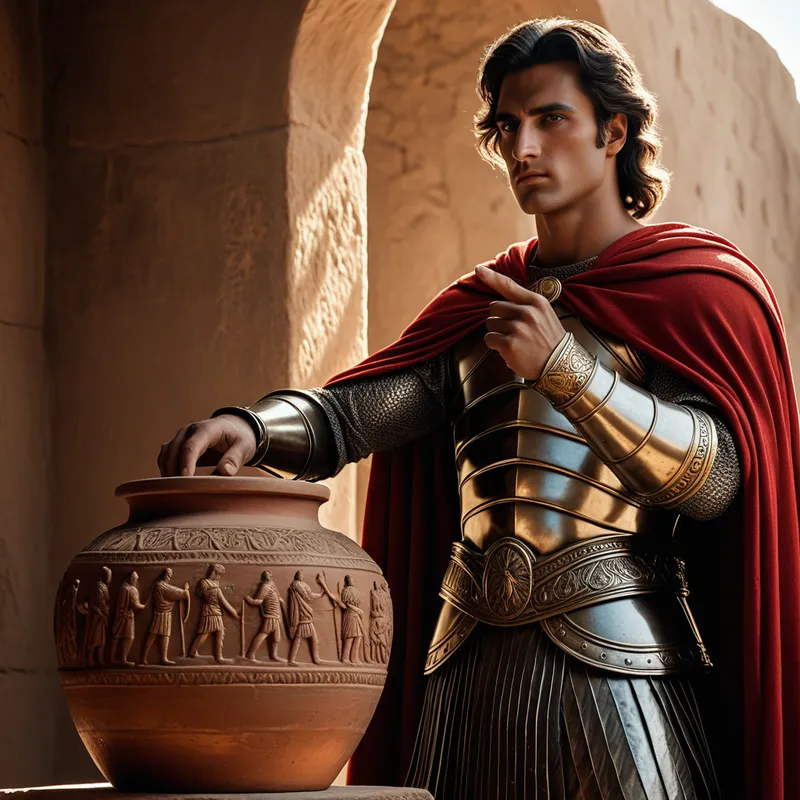
His name was Diogenes of Sinope. He arrived in Athens not with a retinue, but with nothing. He owned a cloak, a staff, a leather pouch for scraps, and later, a large ceramic jar that became his home. He declared himself a citizen of the world, a kosmopolites, and took as his teacher not a sage, but a dog. He watched the stray animals—how they ate when hungry, slept where they lay, and felt no shame for their natural functions. In their freedom from opinion, he saw a philosophy. He called it Kynikos—of the dog. The Cynic.
The city was a theater of masks. Men argued over shadows in Plato’s Academy, politicians orated for empty applause, and merchants traded in vanity. Diogenes walked onto this stage and performed a relentless, living satire. He ate in the marketplace, defecated in the theater, and masturbated in public. When shocked citizens cried, “Diogenes!”, he would sigh and say, “It is a pity you must call me by name to remind yourself I am a man.”
His most famous performance was his search. In the full light of day, he would walk through the agora holding a lit lantern, peering into the faces of the rich, the generals, the philosophers. “What are you doing?” they would ask. “I am looking for an honest man,” he would reply, his voice flat, the flame flickering against their averted eyes. He found none.
The climax of his tale came not from a god, but from a god-king. Alexander the Great, who had conquered the known world, came to see the famous philosopher. He found Diogenes sunning himself on the bank of the Kranion. Standing over the man in the dirt, his armor gleaming, Alexander said, “I am Alexander the Great. Ask of me any boon, and it shall be yours.”
Diogenes, barely opening his eyes, replied, “Stand aside. You are blocking my sunlight.”
A hushed awe fell upon Alexander’s retinue. The king merely smiled, a strange light in his own eyes. “If I were not Alexander,” he said, “I would wish to be Diogenes.”
To which the Cynic, with finality, muttered, “If I were not Diogenes, I would also wish to be Diogenes.”
He died as he lived. Some say he held his breath. Others, that he was bitten by a fever. But the story they tell is that he left instructions for his body to be thrown over the wall for the beasts, for in death he wished to be of use. When asked how he wished to be buried, he said, “Face down. For soon everything will be turned upside down.” They placed a statue of a dog atop his tomb.
Cultural Origins & Context
The Cynics were not a myth in the traditional sense of gods and heroes, but a philosophical and cultural movement that arose in the 4th century BCE, beginning with Antisthenes and reaching its apotheosis in Diogenes. They were the performance artists and punk rockers of the Hellenic world, their “myth” transmitted not through epic poetry but through shocking anecdotes (chreiai) and public acts. These stories were collected and passed down by later writers like Diogenes Laërtius.
Their societal function was that of the gadfly, the living critique. In a culture deeply invested in honor (timē), public reputation, and civic participation, the Cynic stood as a walking repudiation. They exposed the nomos—human convention, law, custom—as arbitrary and often absurd, contrasting it with physis—nature, the true, uncorrupted state of being. They operated in the heart of the polis, the very entity that defined Greek identity, to demonstrate that its values were a sickness of the soul. They were the embodied shadow of Athenian glory.
Symbolic Architecture
The Cynic is the archetype of the Shadow made conscious and wielded as a weapon of truth. He represents the part of the psyche that refuses to wear the persona, the social mask. His jar, cloak, and staff are not symbols of poverty, but of radical sufficiency.
The lantern is not for finding an honest man outside, but for illuminating the dishonesty within. The search is the teaching.
The dog (kyon) is the central symbol. It embodies shamelessness, fidelity to instinct, living in the present, and barking at falsehood. To call someone a dog was a supreme insult in Greek society; the Cynic reclaimed it as the highest praise. This is the ultimate act of psychic alchemy: taking the rejected, projected filth of the culture and wearing it as a crown.
Alexander represents the ultimate expression of the worldly ego—power, conquest, glory. Diogenes’s dismissal, “Stand aside, you block my sun,” is perhaps the most potent symbolic act in philosophical history. It asserts that the simple, immediate experience of nature (the sunlight) is of greater value than all the achievements of the ego. The boon the king cannot give is the one thing the Cynic already possesses: self-sovereignty.

The Dreamer’s Resonance
When this myth stirs in the modern unconscious, it often manifests as dreams of profound, sometimes embarrassing, exposure. The dreamer may find themselves naked in a boardroom or speaking a devastating, simple truth at a family dinner, causing social rupture. There may be dreams of dogs—not pets, but intelligent, feral observers who witness the dreamer’s inauthentic postures.
Somatically, this process feels like a cracking of a shell. There is a tightness in the chest (the constrained persona) giving way to a flush of heat or a loosening in the gut (the seat of instinct in many somatic models). Psychologically, it is the “shameless” reclamation of a denied appetite, an unpopular opinion, or a “crude” need. The dream-ego is being confronted by its own inner Cynic, who barks at its compromises and licks the wounds of its forsaken instincts. The process is one of de-armoring, of shedding layers of “should” to touch the raw “is.”

Alchemical Translation
The Cynic’s path is the alchemy of solve et coagula—dissolve and coagulate—applied to the psyche. First, the solve: the relentless dissolution of all identifications. Career, status, political affiliation, even philosophical beliefs are exposed as costumes. Diogenes in his jar is the ego reduced to its barest, most irreducible core. This is not nihilism, but the fierce clearing of a space for something authentic to stand.
The goal is not to own nothing, but to be owned by nothing. Freedom is the coagulated essence left after all conventions have been dissolved.
The new substance that coagulates is autarkeia—self-sufficiency. This is the philosopher’s stone of the Cynic. It is an internal state of sovereignty so complete that external circumstances—praise, blame, wealth, poverty—become weather, noticed but not determinative. The modern individuation journey modeled here is not about building a better, shinier persona (a more successful Alexander), but about the much more terrifying and liberating work of dis-identifying from the persona altogether.
The final transmutation is seeing the divine in the rejected. When Crates, a later Cynic, called his life “a kingly thing,” he pointed to this truth. The Cynic finds his kingdom in the gutter, his wealth in a bowl of lentils, his power in a word that topples pretense. For the modern seeker, the alchemical translation is this: your freedom does not lie in achieving the world’s goals, but in developing the unassailable inner fortitude to see those goals as the amusing, tragic, and ultimately blocking of the sun. The task is not to conquer the world, but to stop letting the world’s definitions conquer you.
Associated Symbols
Explore related symbols from the CaleaDream lexicon: