The Cup of Gethsemane Myth Meaning & Symbolism
A story of ultimate human anguish and divine surrender, where a man prays alone in a moonlit garden to accept a cup of suffering he desperately wishes to pass.
The Tale of The Cup of Gethsemane
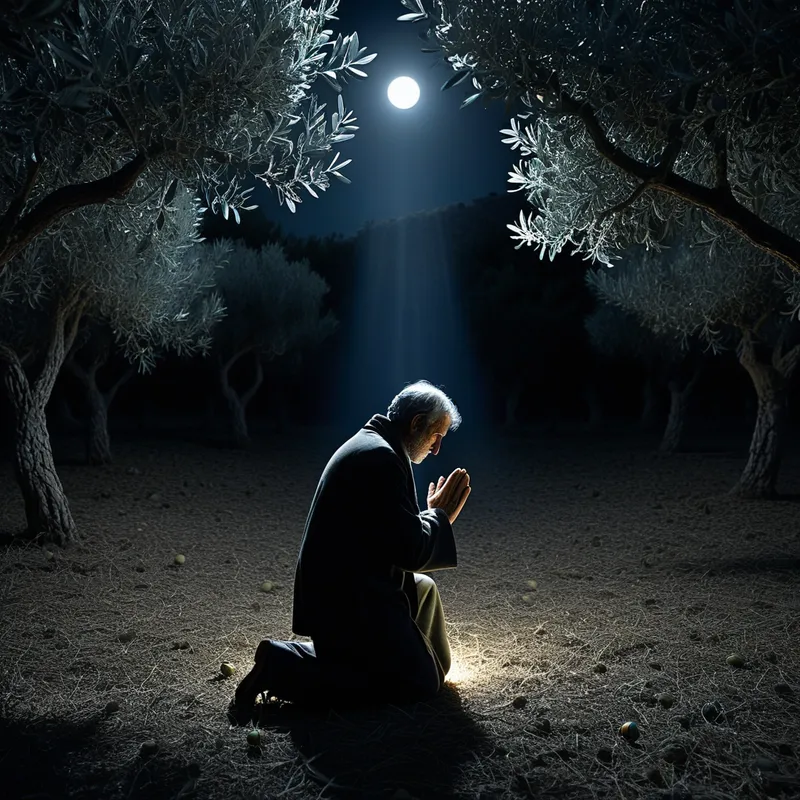
The night was a cloak of cold silk, and [the moon](/myths/the-moon “Myth from Tarot culture.”/) a sliver of bone in a bruised sky. Beyond the city’s sleeping walls, in a place of ancient, twisted trees, a man walked with his friends. The air in the [Gethsemane](/myths/gethsemane “Myth from Christian culture.”/) was thick with the scent of crushed olives and coming rain. His name was [Jesus](/myths/jesus “Myth from Christian culture.”/), and a weight was upon him, a gravity that pulled his spirit toward the dark earth.
He left his companions with a plea: “Stay here, and watch.” Taking with him only his closest three—[Peter](/myths/peter “Myth from Biblical culture.”/), and the brothers James and John—he went a little farther. The gnarled roots of the olive trees seemed to clutch at the stony ground like the hands of the damned. Here, he fell to his knees, then onto his face. The soil was cool against his skin.
“Abba, Father,” he whispered, then cried out, his voice tearing the stillness. “All things are possible for you. Remove this cup from me.” His breath came in ragged gasps. The cup was not of clay or silver, but of a future so dense with agony it had taken solid form in his soul—a draught of betrayal, of scourging, of abandonment, of a torturous death. He could taste its bitterness on his tongue, a metallic tang of fear and grief.
He prayed until his sweat fell like great drops of blood, staining the dust. He returned to his friends and found them sleeping, their spirits willing but their flesh weak with sorrow. Twice more he left them, returning to the same spot, to the same prayer, the words evolving, deepening. “Yet not what I will, but what you will.” The conflict was a storm within him: the human terror of annihilation wrestling with a terrifying, boundless love that demanded its completion.
The third time he rose, his face was changed. The anguish was not gone, but it had been forged into a terrible calm. The internal war was over. The cup was no longer a [thing](/myths/thing “Myth from Norse culture.”/) to be refused, but a sacred vessel to be received. In the distance, the flicker of torches appeared between the trees, and the clink of armor sounded. The kiss of a friend approached in the gloom. The resolution was not escape, but embrace. He had drunk, and was ready.
Cultural Origins & Context
This story is anchored in the Gospel narratives of Matthew and Luke, with a more succinct parallel in Mark. It emerges from the heart of first-century Messianic expectation, yet subverts it utterly. The anticipated hero-king who would take up the sword is here portrayed in his most devastatingly human moment, taking up only a prayer of surrender.
Passed down orally before being codified in text, this was not a tale for public spectacle but for intimate community instruction. It served a critical sociological and theological function for early Christians facing persecution: it redefined strength. True power was not demonstrated in avoiding suffering, but in consciously accepting a purpose that necessarily passed through it. The myth provided a template for understanding their own trials, framing agony not as a sign of divine abandonment, but as a mysterious, integral part of a sacred narrative.
Symbolic Architecture
At its core, the myth presents the Cup as the ultimate [symbol](/symbols/symbol “Symbol: A symbol can represent an idea, concept, or belief, serving as a powerful tool for communication and understanding.”/) of destined, conscious suffering. It is not a [punishment](/symbols/punishment “Symbol: A dream symbol representing consequences for actions, often tied to guilt, societal rules, or internal moral conflicts.”/), but a vocation.
The Cup is the shape of the soul’s most difficult truth, the container of the fate we did not choose but must, somehow, claim as our own.
The Gethsemane (literally “oil press”) itself is the archetypal container for this transformation—a place where the individual is pressed between the [weight](/symbols/weight “Symbol: Weight symbolizes burdens, responsibilities, and emotional loads one carries in life.”/) of divine will and the fragility of [human](/symbols/human “Symbol: The symbol of a human represents individuality, complexity of emotions, and social relationships.”/) flesh to yield the oil of anointment. The sleeping disciples represent the parts of [the self](/myths/the-self “Myth from Jungian culture.”/) and the [community](/symbols/community “Symbol: Community in dreams symbolizes connection, support, and the need for belonging.”/) that cannot, or will not, stay awake to the [magnitude](/symbols/magnitude “Symbol: A measure of scale, intensity, or importance, often reflecting one’s perception of significance, impact, or overwhelming force in life.”/) of the [crisis](/symbols/crisis “Symbol: A crisis symbolizes turmoil, urgent challenges, and the need for immediate resolution or change.”/). The real [drama](/symbols/drama “Symbol: Drama signifies narratives, emotional expression, and the exploration of human experiences.”/) is utterly [interior](/symbols/interior “Symbol: The interior symbolizes one’s inner self, thoughts, and emotions, often reflecting personal growth, vulnerabilities, and secrets.”/), a solitary confrontation between [the ego](/myths/the-ego “Myth from Jungian culture.”/)’s will to live and [the Self](/myths/the-self “Myth from Jungian culture.”/)’s call to a [death](/symbols/death “Symbol: Symbolizes transformation, endings, and new beginnings; often associated with fear of the unknown.”/) that precedes [rebirth](/symbols/rebirth “Symbol: A profound transformation where old aspects of self or life die, making way for new beginnings, growth, and renewal.”/).
Psychologically, The Praying Figure embodies the heroic ego at its most profound [crossroads](/symbols/crossroads “Symbol: A powerful spiritual symbol representing a critical decision point where paths diverge, often associated with fate, transformation, and life-altering choices.”/). The [hero](/symbols/hero “Symbol: A hero embodies strength, courage, and the ability to overcome significant challenges.”/)’s [task](/symbols/task “Symbol: A task represents responsibilities, duties, or challenges one faces.”/) here is not to slay a [monster](/symbols/monster “Symbol: Monsters in dreams often symbolize fears, anxieties, or challenges that feel overwhelming.”/), but to surrender to a process that will slay him. He represents the part of the [psyche](/myths/psyche “Myth from Greek culture.”/) that must consent to its own dismantling for the sake of a greater, unknown wholeness.
The Dreamer’s Resonance
When this myth stirs in the modern dreaming mind, it rarely appears with biblical literalism. The dreamer may find themselves in a stark, lonely place—an empty office at night, a featureless plain, their childhood home devoid of people. There is a task, a document to sign, a door to open, a medicine to drink, that fills them with pure dread. This is the somatic signature of the Cup.
The psychological process is one of confronting an unavoidable life requirement: accepting a difficult diagnosis, ending a foundational relationship, leaving a secure career for an uncertain calling, or facing a profound moral dilemma. The agony in the dream is the ego’s protest against the death of a current identity. The dream is not presenting a solution, but staging the necessary crisis of consent. The trembling, the sweat, the feeling of being utterly alone in the decision—these are the signs that the psyche is in its own Gethsemane, pressing the dreamer toward an acceptance that the waking self may still be resisting.
Alchemical Translation
The alchemical journey is one of transmutation: lead into gold, base consciousness into enlightened Self. The myth of the Cup models the critical stage of [nigredo](/myths/nigredo “Myth from Alchemical culture.”/), the descent into darkness and despair that is the prerequisite for renewal.
The prayer, “Remove this cup… yet not my will,” is the precise incantation of the alchemical process. The ego names its terror, then voluntarily subordinates itself to the transformative fire.
First, the recognition of the Cup: seeing the bitter medicine of one’s own growth. Then, the refusal: the ego’s legitimate, passionate fight for its own existence. Finally, the surrender: not a passive defeat, but an active, conscious handing over of the ego’s agenda to the larger intelligence of the Self. This is the moment the lead begins to shimmer with the potential of gold.
For the modern individual, the alchemical translation is the movement from being a victim of circumstance (“Why is this happening to me?”) to becoming a participant in a sacred ordeal (“This is the difficult thing that is mine to do.”). The Cup is our unique burden of consciousness—the anxiety, the depression, the creative block, the family curse, the historical trauma we carry. We cannot pour it out. The path to wholeness demands we drink it to the dregs, discovering that within its bitterness lies the strange, liberating wine of our own completed truth. The garden is always with us; it is the interior space where we finally stop running and turn to face what we are meant to become.
Associated Symbols
Explore related symbols from the CaleaDream lexicon: