The Culture Hero Myth Meaning & Symbolism
A primordial being journeys from the sky or underworld to bring humanity the gifts of civilization, enduring trials to transform chaos into order.
The Tale of The Culture Hero
In the time before time, when [the world](/myths/the-world “Myth from Tarot culture.”/) was a raw and whispering [thing](/myths/thing “Myth from Norse culture.”/), humanity lived in the long shadow. They huddled in the cold dark, their bellies empty of all but hunger, their minds filled only with the immediate terror of tooth and claw. They had no words for tomorrow, no shape for hope. [The earth](/myths/the-earth “Myth from Hindu culture.”/) was a mother who did not know her children, and [the sky](/myths/the-sky “Myth from Persian culture.”/), a distant, silent father.
Then, a fracture appeared. It was not in the earth, but in the fabric between the worlds. From the Upper World, or perhaps from the [Underworld](/myths/underworld “Myth from Greek culture.”/), a being stepped through. They were not like the gods who shaped mountains in their leisure, nor like the spirits that chattered in the leaves. This one carried a different fire in their eyes—a fire of intent. Some tales say they were cast out for their compassion. Others whisper they stole the secret of their own purpose. They are called by many names, but we know them as the Bringer, the Giver, the One Who Walked Between.
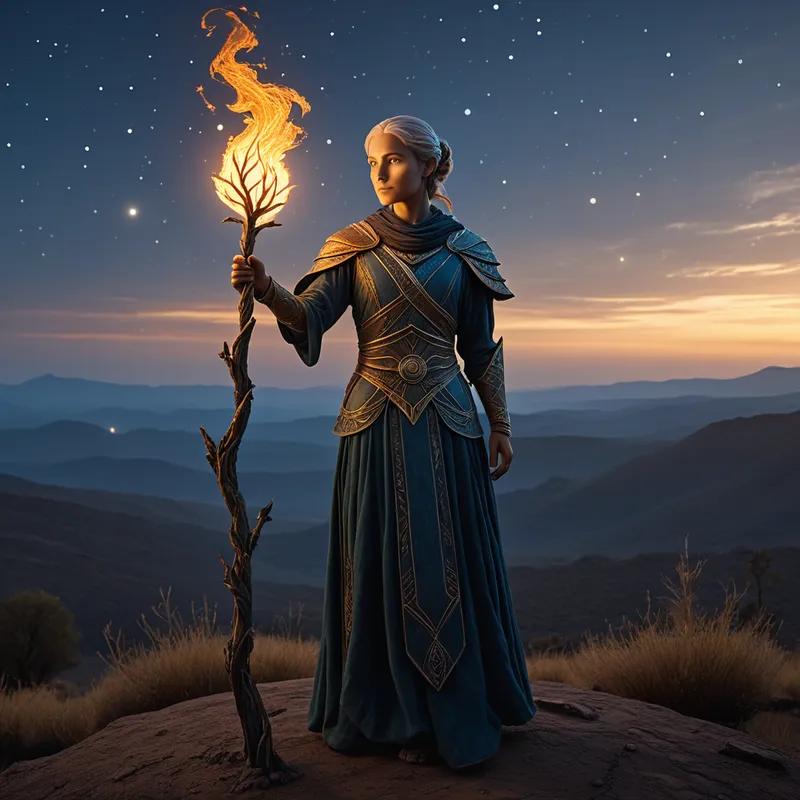
Their journey was not a conquest, but a descent into need. They saw the people eating raw flesh, shivering under skins still dripping with rain, communicating in grunts of fear. The hero’s heart, a drum of a different rhythm, broke open. The first gift was not the grandest, but the most essential: Fire. It did not fall from the sky. It was won. Perhaps it was stolen from a jealous sun-bird’s nest at the peak of a glass mountain, or tricked from the guarded hearth of a volcanic giant. The hero returned, hands blistered and spirit scarred, and knelt to strike the first spark against flint, or to blow upon the ember carried in a hollow reed. The people watched the flame dance—a living, hungry, warming star—and in its light, they saw each other’s faces for the first time.
But light revealed deeper darkness. Without law, the strong preyed upon the weak. Without craft, life was a relentless scramble. So the hero continued. They trapped the wild river and taught its flow to nourish seeds, giving the gift of the Plow. They listened to [the wind](/myths/the-wind “Myth from Various culture.”/)’s howl and the bird’s song and shaped it into the first melody, the gift of Music. They took the chaos of conflict and drew a line in the earth, proclaiming the gift of Law.
Each gift was a theft from the realm of the gods or a bargain with the raw world, each one costing the hero a piece of their primordial innocence. They were pursued by guardians of the old, wild order. They were wounded by the very ignorance they sought to cure. Yet, they persisted until the final gift was given. Then, their work complete, the Culture Hero departed. Not in a blaze of apotheosis, but often in a quiet mystery—turning into a mountain to watch over the land, ascending a [rainbow bridge](/myths/rainbow-bridge “Myth from Universal culture.”/), or simply walking into the forest, leaving behind a world forever altered, humming with the new rhythms of civilization.
Cultural Origins & Context
This is not one story, but the underlying melody of a thousand. The pattern of the Culture Hero resonates from the [Prometheus](/myths/prometheus “Myth from Greek culture.”/) of Greece to the Máii of the Navajo, from the [Shennong](/myths/shennong “Myth from Chinese culture.”/) of China to the Gu of Dahomey. It is a foundational narrative, told not in royal courts first, but around communal fires, by elders to the young, by shamans during rites of passage.
Its function was ontological—it explained how we became us. It answered the profound child’s question: “Who gave us the things we depend on?” The myth served as the psychic bedrock for societal values, framing law, art, and technology not as human inventions, but as sacred gifts with a divine or heroic cost. It established a cosmology where humanity’s current state is the result of a pivotal, transformative intervention, creating a cultural memory of a time before order and the heroic struggle that ended it. The storyteller was not merely an entertainer but a keeper of identity, using the hero’s tale to weave the threads of individual survival into the tapestry of collective civilization.
Symbolic Architecture
At its core, the Culture [Hero](/symbols/hero “Symbol: A hero embodies strength, courage, and the ability to overcome significant challenges.”/) myth is a grand [metaphor](/symbols/metaphor “Symbol: A figure of speech where one thing represents another, often revealing hidden connections and deeper truths through symbolic comparison.”/) for the [dawn](/symbols/dawn “Symbol: The first light of day, symbolizing new beginnings, hope, and the transition from darkness to illumination.”/) of [consciousness](/symbols/consciousness “Symbol: Consciousness represents the state of awareness and perception, encompassing thoughts, feelings, and experiences.”/) itself. The [hero](/symbols/hero “Symbol: A hero embodies strength, courage, and the ability to overcome significant challenges.”/) represents the emerging ego, the first spark of deliberate, purposeful self-[awareness](/symbols/awareness “Symbol: Conscious perception of self, surroundings, or internal states. Often signifies awakening, insight, or heightened sensitivity.”/) separating from the undifferentiated Uroboros of instinctual, purely survival-driven existence.
The hero does not conquer a monster to save a princess; they conquer chaos to save possibility.
The raw, cold, dark world is the [psyche](/myths/psyche “Myth from Greek culture.”/) in a state of [nature](/symbols/nature “Symbol: Nature symbolizes growth, connectivity, and the primal forces of existence.”/)—all potential, but no form. Fire is the ultimate [symbol](/symbols/symbol “Symbol: A symbol can represent an idea, concept, or belief, serving as a powerful tool for communication and understanding.”/) of this psychic [transmutation](/symbols/transmutation “Symbol: A profound, alchemical process of fundamental change where one substance or state transforms into another, often representing spiritual evolution or personal metamorphosis.”/). It is destructive and creative, dangerous and essential. It is the light of consciousness that allows us to see our own inner [landscape](/symbols/landscape “Symbol: Landscapes in dreams are powerful symbols representing the dreamer’s emotional state, personal journey, and the broader context of life situations.”/), to “[cook](/symbols/cook “Symbol: The act of cooking symbolizes nurturing, transformation, and the creation of sustenance, reflecting both the physical and emotional nourishment of oneself and others.”/)” raw experience into digestible understanding, and to transform the base materials of [life](/symbols/life “Symbol: The symbol of ‘Life’ represents a journey of growth, interconnectedness, and existential meaning, encompassing both the joys and challenges that define human experience.”/). The other gifts—agriculture, [music](/symbols/music “Symbol: Music in dreams often symbolizes the harmony between the conscious and unconscious mind, illustrating emotional expression and communication.”/), law—are the subsequent structures built by this new light: the cultivation of inner values, the [expression](/symbols/expression “Symbol: Expression represents the act of conveying thoughts, emotions, and individuality, emphasizing personal communication and creativity.”/) of complex [emotion](/symbols/emotion “Symbol: Emotion symbolizes our inner feelings and responses to experiences, often guiding our actions and choices.”/), the internal governance between competing drives (the inner “strong” and “weak”).
The hero’s inevitable suffering—the theft, the [pursuit](/symbols/pursuit “Symbol: A chase or being chased in dreams often reflects unresolved anxieties, unfulfilled desires, or internal conflicts demanding attention.”/), the wounding—symbolizes the inherent pain of consciousness. To know is to be separate. To bring order is to incur the [wrath](/symbols/wrath “Symbol: Intense, often destructive anger representing repressed emotions, moral outrage, or survival instincts.”/) of the unconscious (the gods, the guardians) which resists organization. The hero’s [departure](/symbols/departure “Symbol: A transition from one state to another, often representing change, growth, or leaving behind the familiar.”/) signifies that this transformative [energy](/symbols/energy “Symbol: Energy symbolizes vitality, motivation, and the drive that fuels actions and ambitions.”/) is not a permanent resident but a catalytic force. Once the inner [framework](/symbols/framework “Symbol: Represents the underlying structure of one’s identity, emotions, or life. It signifies the mental or emotional scaffolding that supports or confines the self.”/) is established, the conscious ego must learn to maintain it; the revolutionary becomes a [memory](/symbols/memory “Symbol: Memory symbolizes the past, lessons learned, and the narratives we construct about our identities.”/), a foundational myth of [the self](/myths/the-self “Myth from Jungian culture.”/).
The Dreamer’s Resonance
When this myth stirs in the modern dreamer, it announces a profound developmental threshold. To dream of stealing a sacred flame, of finding a forgotten tool that changes everything, or of being tasked with delivering a vital message to a lost tribe, is to feel the psyche’s call to bring a new form of order to one’s inner or outer life.
Somatically, this may manifest as a burning restlessness, a sense of charged potential in the hands or chest—the “spark” seeking its tinder. Psychologically, it is the process of differentiation. The dreamer may be struggling with a chaotic life situation, an undefined creative urge, or a moral ambiguity. The Culture Hero archetype activates to confront this inner “primordial chaos.” The figure in the dream who brings the solution—whether it’s a new skill, a courageous truth, or a creative act—is an aspect of the dreamer’s own potential ego strength, emerging to perform a necessary, civilizing function. It is the psyche building a new capability, often at the cost of a familiar, perhaps simpler, but more limited way of being.

Alchemical Translation
The alchemical journey of the Culture Hero is the blueprint for Individuation. It models the process of psychic transmutation from massa confusa (the confused mass) to the [lapis philosophorum](/myths/lapis-philosophorum “Myth from Alchemical culture.”/) (the philosopher’s stone of integrated self).
[The first stage](/myths/the-first-stage “Myth from Alchemical culture.”/), [Nigredo](/myths/nigredo “Myth from Alchemical culture.”/), is the dark, cold, primitive world—a period of depression, confusion, or feeling lost in instinctual reactions. The hero’s decision to act is the spark of [the ego](/myths/the-ego “Myth from Jungian culture.”/) asserting itself against this darkness (Calcinatio—heating by fire). The quest for the gifts represents [Separatio](/myths/separatio “Myth from Alchemical culture.”/) and Coagulatio: distinguishing what is valuable (fire, law, art) from the undifferentiated whole and giving it solid, usable form within the personality.
The theft is the necessary rebellion of the conscious mind against the tyranny of the unconscious status quo. The wound is the receipt for the gift.
The hero’s suffering is the Mortificatio, the necessary death of a former, more unconscious state. One cannot have the light of conscious responsibility without sacrificing the bliss of ignorant innocence. Finally, the hero’s departure signifies Sublimatio: the transformative energy itself becomes internalized. The gift remains, now part of the permanent structure of the self. The modern individual undergoing this process is not bringing fire to a tribe, but perhaps bringing disciplined practice to a talent, ethical clarity to a relationship, or creative structure to a business. They are doing the civilizing work on their own inner kingdom, transforming personal chaos into lived order, and in doing so, re-enacting the most ancient and essential human story of all.
Associated Symbols
Explore related symbols from the CaleaDream lexicon: