The Cultural Mosaic Myth Meaning & Symbolism
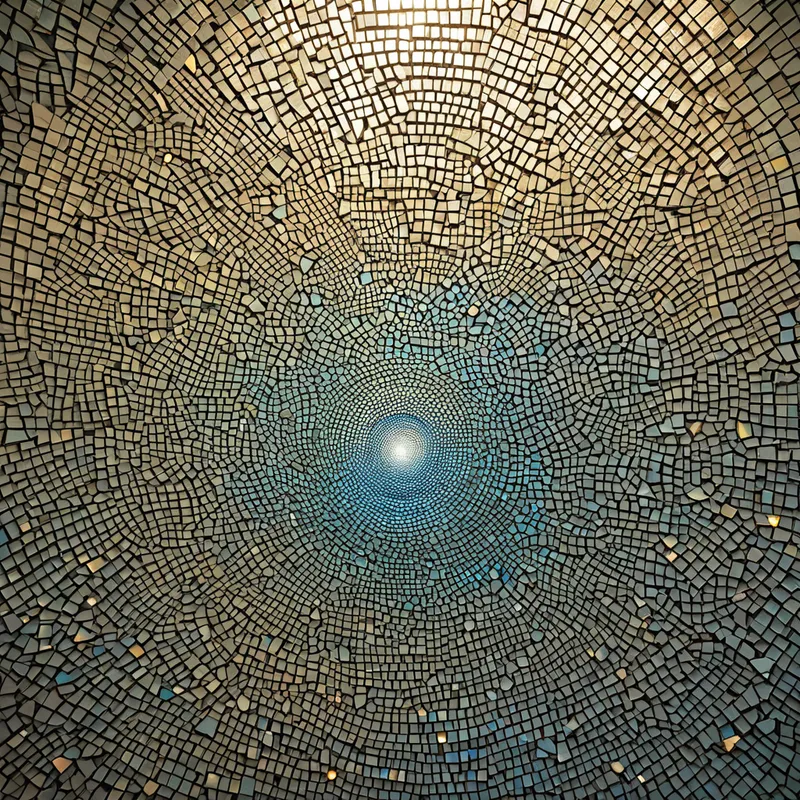
A myth of a shattered vessel whose fragments become the diverse cultures of the world, awaiting a future act of conscious reintegration.
The Tale of The Cultural Mosaic
In the time before time, when the world was a single, silent note held in the throat of the void, there existed the Artisan. The Artisan was not a being of flesh, but of pure intent—a longing to give form to the formless. From the clay of potential, the Artisan began to craft a vessel. This was not a pot for water or a bowl for grain, but a Vessel of Becoming, designed to hold the entire spectrum of human experience: every joy, every sorrow, every story yet untold.
For eons, the Artisan worked. Into the vessel’s surface, they pressed the memory of the first sunrise, the chill of the first winter, the warmth of the first hearth. They inlaid threads of silver for rivers, flecks of obsidian for the night sky, and pigments from a thousand unnamed flowers. The vessel grew, a perfect, luminous orb humming with contained life. It was the ultimate creation, a totality of culture and consciousness in one sacred object.
But totality is a weight few can bear. The lesser spirits, the Daemons of Division, watched with envy and dread. They could not comprehend such wholeness; to them, it was a blinding, terrifying unity. In a crescendo of fear, they assailed the workshop of the cosmos. Not with weapons of fire, but with the cold whisper of a single, corrosive question: “What if the parts are greater than the whole?”
The question struck the Vessel of Becoming like a physical blow. A hairline fracture appeared, then another, racing across its glorious surface like lightning. The Artisan reached out, but it was too late. With a sound like a universe sighing, the vessel shattered. It did not explode into dust, but broke into a billion perfect fragments, each a unique, glittering shard.
Each shard held a piece of the whole. One contained the rhythm of a specific drum, another the recipe for a particular bread, a third the shape of a sacred letter. They flew outwards on the breath of the breaking, scattering across the void. Where they landed, they took root. A shard that held a song became a people who defined themselves by that melody. A shard that held a law became a civilization built upon that code. The world was born from this fragmentation—a breathtaking, heartbreaking tapestry of isolated beauties.
The Artisan did not destroy the Daemons. Instead, they gathered the dust of the clay that had fallen during the breaking—the unused potential. From this dust, they fashioned a new, humble tool: a Trowel of Memory. Their work was no longer creation from nothing, but re-membering. The myth ends not with an ending, but with a whispered promise: the vessel is not lost, only waiting. It waits for the day when the bearers of the shards, in their fullness and diversity, will look not just at their own piece, but at the pattern they are all a part of, and begin the slow, sacred work of fitting them back together.
Cultural Origins & Context
The myth of the Cultural Mosaic finds its roots not in ancient temples, but in the bustling, fragmented landscape of late 20th and early 21st-century globalized society. It arose as a counter-narrative and a poetic framework to understand the tension between national identity and multicultural reality. It was passed down not by bards, but by sociologists, poets, and public policymakers, becoming a foundational metaphor in nations like Canada, where it was adopted as official policy terminology.
Its societal function is dual. On one level, it is a myth of validation, celebrating diversity and suggesting that each cultural group retains its unique integrity within a larger societal framework. On a deeper, more unconscious level, it serves as a container for the profound anxiety of that same condition: the fear that the whole is irrevocably broken, that the shards are fundamentally separate, and that the original, unifying vessel is lost to history. It is a myth born of both idealism and profound loss, told in university seminars, political speeches, and the quiet confusion of the immigrant experience, seeking to name a new, complex kind of belonging.
Symbolic Architecture
At its core, the myth is a profound map of the modern psyche. The Artisan represents the unifying, creative principle of the Self—the Jungian archetype of wholeness that seeks to organize experience into a coherent totality. The pristine Vessel of Becoming symbolizes this state of original, unconscious wholeness, a paradise of undifferentiated being that precedes the necessary crisis of individuation.
The original fracture is not a fall from grace, but the birth of consciousness. We are not punished with diversity; we are born into it.
The shattering is the central, traumatic event. It represents the inevitable fragmentation of the psyche as it encounters the world—the separation into complexes, personas, and cultural conditioning. Each Shard of Specificity is a complex: a cluster of thoughts, feelings, and cultural memories that claims to be a whole identity in itself (“I am my ethnicity,” “I am my profession,” “I am my trauma”). The Daemons of Division are the psychological forces of fear, shadow, and the ego’s resistance to surrendering its partial identity to a greater whole.
The Trowel of Memory is the most crucial symbol. It represents the conscious ego’s tool for individuation. It is not the Artisan’s original creative power, but the humble, patient faculty of reflection, dialogue, and integration. It works not with pure clay, but with the “dust”—the forgotten connections, the shared human experiences, the glue of empathy and understanding.

The Dreamer’s Resonance
When this myth activates in the modern dreamscape, it often manifests as dreams of fragmentation and searching. The dreamer may find themselves in a vast, beautiful library where every book is written in a different language they only partially understand. They may dream of trying to assemble a priceless, fractured vase, but the pieces keep changing shape. They might see their own reflection in a broken mirror, each shard showing a different version of themselves—a child, a professional, a member of a family, all feeling strangely separate.
Somatically, this can feel like a literal ache of disconnection, a sense of being pulled in multiple directions, or a deep nostalgia for a wholeness never personally experienced. Psychologically, it signals a confrontation with the Tower of Personas. The psyche is struggling to hold its multiple identities—cultural, professional, familial—and is yearning for an integrative principle. The dream is not a sign of breakdown, but of the psyche preparing the ground for a more conscious synthesis. The anxiety in the dream is the friction of the shards against one another, the necessary discomfort that precedes a new pattern.

Alchemical Translation
The alchemical journey modeled by this myth is the opus contra naturam—the work against nature—where “nature” is the accepted state of fragmentation. The goal is not to return to the unbroken vessel, which represents a pre-conscious, paradisiacal state. That is impossible and undesirable, for it would mean the annihilation of hard-won consciousness and diversity. Instead, the goal is the creation of the Mosaic Self.
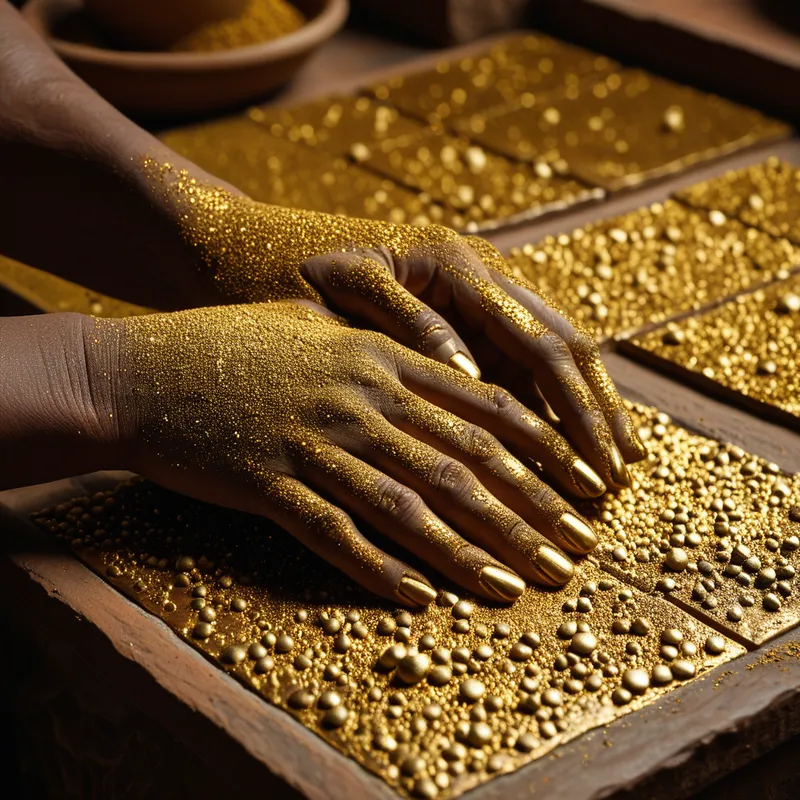
The gold is not in the shard, but in the seam. Individuation is the art of gilding the cracks with the light of awareness.
The first stage (nigredo) is the acknowledgment of the break. This is the dark night where one feels the pain of cultural dislocation, internal conflict, or the sheer overwhelm of a multifaceted identity. The second stage (albedo) is the washing and examination of the individual shards—the deep, non-judgmental exploration of one’s own cultural heritage, personal traumas, and adopted personas. One must truly see and value each piece.
The crucial third stage (citrinitas) is the application of the Trowel of Memory. This is the conscious work of finding the points of connection. It is the act of seeing how one’s personal grief echoes a universal human experience, or how a specific cultural joy resonates with a joy from an apparently foreign tradition. The final stage (rubedo) is the revelation of the new pattern. The integrated self is not a smooth, featureless orb. It is a magnificent, complex mosaic. The fractures are still visible, but they are now filled with the gold of conscious understanding—the psychological equivalent of kintsugi. The individual becomes a living node in the larger, slowly re-forming Cultural Mosaic, carrying both the integrity of their specific shard and the conscious responsibility to seek connection with the whole.
Associated Symbols
Explore related symbols from the CaleaDream lexicon: