The Cube of Earth Myth Meaning & Symbolism
A myth of a primordial cube, a divine artisan, and the human soul's struggle to contain the boundless within the perfect, stable form of the earth.
The Tale of The Cube of Earth
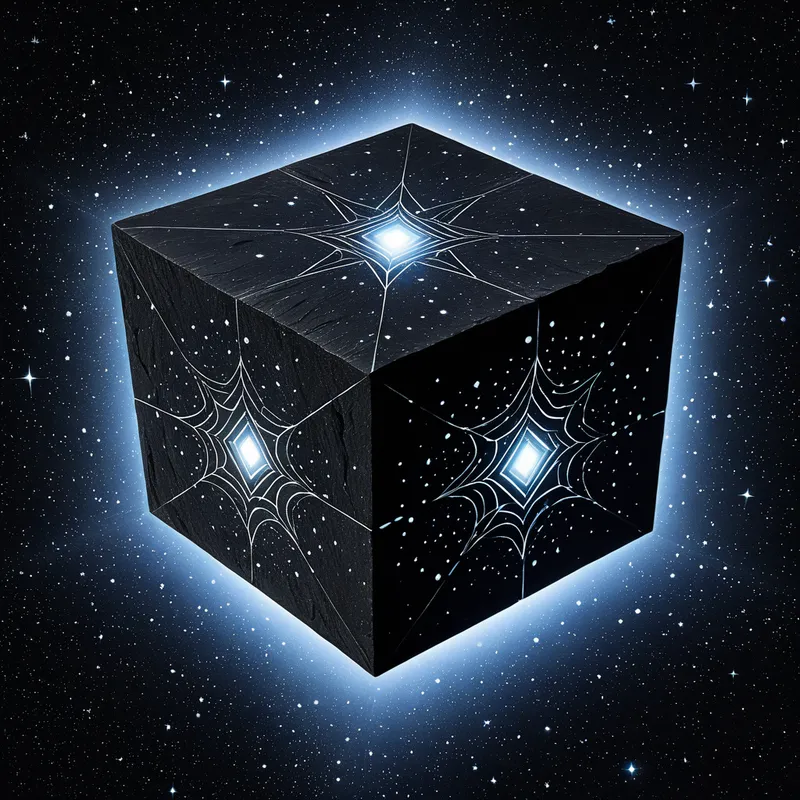
Listen, and hear the tale from before time was measured. In the age of first forms, when the Demiurge gazed upon the churning, boundless Khora, a great longing arose. The Demiurge desired not to destroy the wild potential, but to grant it a home, a vessel worthy of its chaotic beauty. From the geometric principles of the eternal realm, the artisan drew forth the most steadfast of shapes: the hexahedron. The Cube.
With a thought that was also a deed, the Demiurge fashioned the Cube of Earth. It was not built, but persuaded into being, its six faces becoming the absolute boundaries of stability. Into this perfect vessel, the artisan began to pour the essence of the Khora—the swirling mist of possibility, the fiery breath of becoming, the liquid dreams of formlessness. The Cube hummed, a deep, resonant tone that was the first note of a cosmic hymn. It held the chaos, but it strained. Geometric light, pure and cold, flared along its edges, containing the seething, colorful tumult within.
Yet, a fragment of the Khora, a spark of the original unboundedness, refused to be fully contained. This spark fled the shaping, slipping into the spaces between worlds. And in time, this spark took root in the hearts of the creatures who would walk the earth-born world. It became the human soul—a glorious, terrifying fragment of the infinite, now housed in a body of flesh and bone, a smaller, softer cube.
Thus began the eternal tension. The human soul, remembering its origin in the boundless, feels the walls of its earthly existence. It dreams of stars and yearns for dissolution back into the great All. It rages against the limits of the Cube—against morality, against death, against the very facts of the physical world. This rage manifests as a psychic tremor, a longing to shatter the vessel.
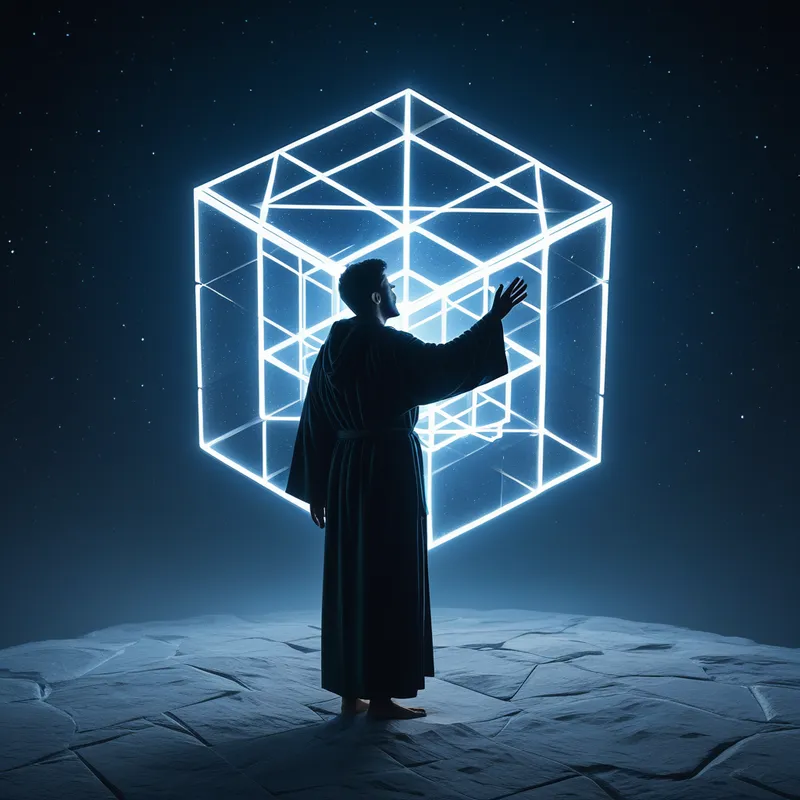
But the Cube of Earth does not break. It endures. Its lesson is not one of imprisonment, but of sacred definition. The myth tells that when a human soul turns its gaze not outward to the lost infinity, but inward to the geometry of its own being, it feels the resonance. The same perfect angles, the same steadfast proportions that structure the cosmic Cube, are etched into the essence of the soul. To accept the Cube is not to surrender freedom, but to discover the divine architecture within. The conflict finds its resolution not in escape, but in a profound alignment. The soul stops straining against its own walls and instead begins to polish them, until the vessel no longer obscures the light within, but reflects it, stable and whole, a microcosm of the cosmic order.
Cultural Origins & Context
This myth finds its roots not in popular folklore, but in the esoteric teachings of the Platonic academies and mystery schools. It was an “initiate’s myth,” passed orally from philosopher to student during advanced studies of the Theory of Forms and the Timaeus. The storyteller was typically a Didaskalos, who would recite the tale not as a history, but as a meditative exercise prior to dialogues on geometry, ethics, and cosmology.
Its societal function was deeply psychological and civic. In a culture that idealized the city-state (polis) as the manifestation of order (Kosmos) over chaos, the myth of the Cube provided a metaphysical foundation. It explained why human nature is torn between anarchic passion and the desire for law, between poetic frenzy and logical proof. The myth taught that the stability of the polis itself was a reflection of the cosmic Cube, and that the citizen’s duty was to internalize this geometry, becoming a stable, virtuous “cube” within the greater social structure. It was a narrative justification for education (Paideia) as the process of “squaring the soul.”
Symbolic Architecture
At its core, the Cube is the symbol of manifestation. It represents the necessary imposition of limit upon the unlimited, the moment potential becomes actual. It is the principle of Earth not merely as dirt, but as the element of definition, solidity, and truth.
The Cube does not cage the spirit; it gives the spirit a face, a direction, and a place from which to shine.
The Khora represents the unconscious in its raw, pre-personal state—all potential, no identity. The Demiurge is the ordering principle of consciousness, the ego’s first, heroic act of saying “I am,” which inevitably creates a boundary between self and world. The human soul’s struggle is the lifelong psychic conflict between the regressive pull of the unconscious (the longing to return to formless Khora) and the progressive work of consciousness (building a stable, well-defined Self).
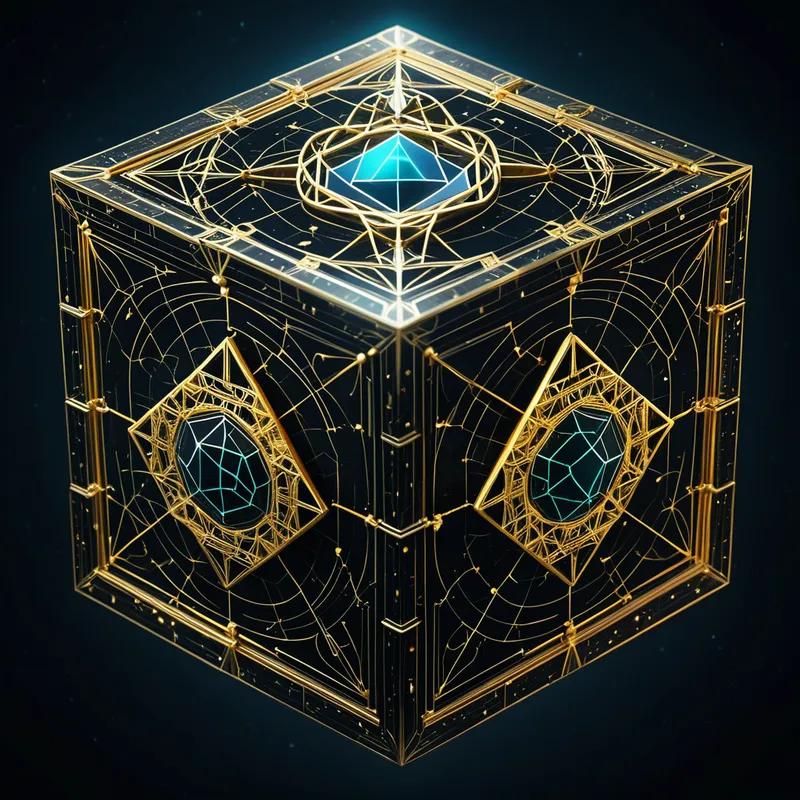
The six faces correspond to the foundational aspects of a realized psyche: the four cardinal virtues of Wisdom, Courage, Moderation, and Justice, plus the “faces” of upward aspiration (the Divine) and downward grounding (the Earth). To be “cubic” is to have integrated these facets into a coherent whole.
The Dreamer’s Resonance
When the Cube of Earth appears in modern dreams, it rarely manifests as a simple geometric shape. It may be a perfectly square room, a sealed vault, a monolithic building, or even a feeling of being “boxed in” by circumstances of immense, impersonal solidity. The somatic experience is key: there is often a feeling of profound pressure, a weight of responsibility, or a claustrophobic anxiety that accompanies it.
This dream signals a critical phase in what psychology calls containment. The dreamer is likely grappling with a surge of unformed emotional material—a chaos of grief, rage, creative potential, or spiritual yearning—that threatens to overwhelm the ego. The Cube represents the psyche’s own attempt to provide a structure strong enough to hold this content without being shattered. The conflict in the dream mirrors the myth: a part of the dreamer wants to destroy the box (the limiting job, the relationship, the moral code) to free the feeling, while another, deeper part knows that without the box, the feeling would dissipate into meaningless chaos. The dream is an enactment of the soul building its own capacity.
Alchemical Translation
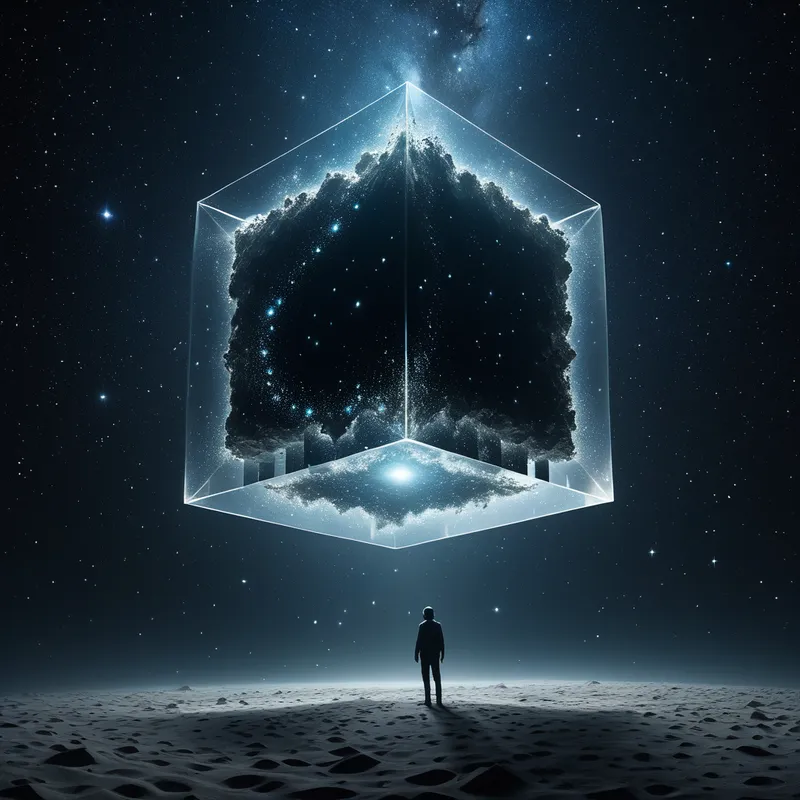
The alchemical journey mirrored in this myth is the opus contra naturam—the work against nature, which here means against the nature of the primal, scattered psyche. The initial nigredo, or blackening, is the soul’s experience of being trapped in the Cube, feeling the agony of limitation and the mourning for lost boundlessness.
The alchemy occurs not when we escape the vessel, but when we realize we are the artisans of its dimensions.
The albedo, or whitening, is the turn inward, the polishing of the Cube’s faces through self-knowledge, discipline, and the integration of shadow (the unruly Khora-spark within). As one clarifies the nature of one’s own boundaries—ethical, emotional, intellectual—they become translucent. The final stage, the rubedo or reddening, is the moment of resonance. The individual Cube of the Self vibrates in harmony with the cosmic Cube of Earth. The contained light within—the individual’s unique spirit—now shines through the defined form, stable and brilliant. The individual is no longer in conflict with their own structure. They have achieved the philosopher’s stone of the psyche: a Self that is perfectly defined, yet perfectly transparent to its own transcendent source. They have become, in earthly form, a true vessel of the infinite.
Associated Symbols
Explore related symbols from the CaleaDream lexicon: