
The Crystal Palace of Apollo Myth Meaning & Symbolism
A myth of Apollo's perfect, silent palace of crystal, shattered by a mortal's cry, revealing that divine truth requires the flawed, resonant human voice.
The Tale of The Crystal Palace of Apollo
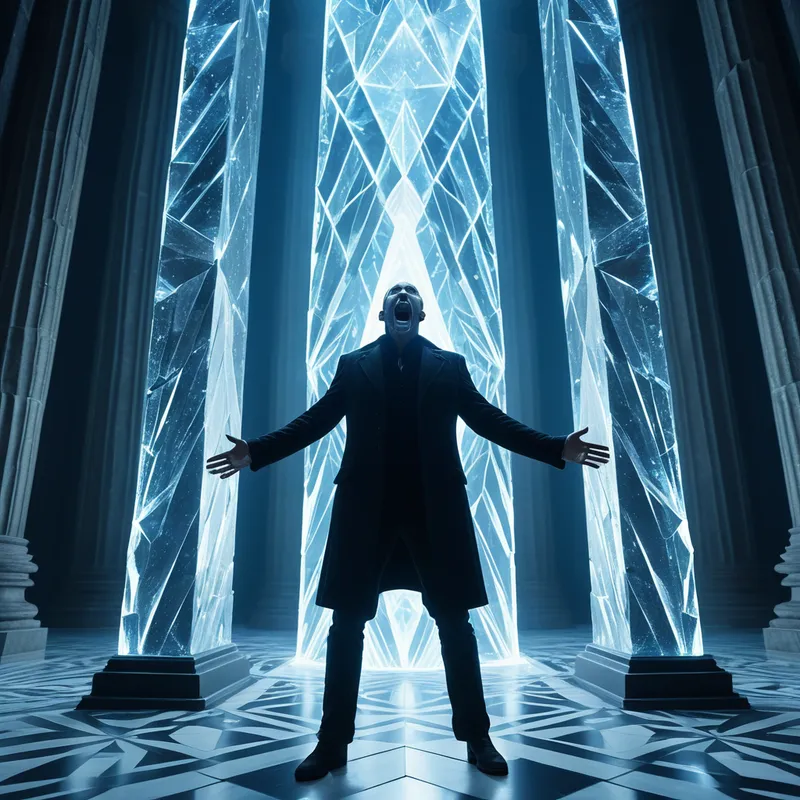
Hear now a tale not of stone or marble, but of light made solid, of silence given form. High upon the sun-scorched peaks where the air grows thin and the gaze of Apollo is most direct, there stood his greatest secret and his folly: the Crystal Palace.
It was not built, but grown—a sublime geometry coaxed from the heart of the earth by solar will. Every column was a frozen ray of noon. Every arch was the perfect curve of a harmonic not yet sounded. The floors were planes of stilled water, the ceilings constellations of fixed, gem-like stars. Within its boundless halls, there was no echo, for sound was an impurity, a chaos. There was only the pure, silent resonance of absolute order, a monument to the god’s own ideals of clarity, prophecy, and untouched truth. Here, Apollo would walk, and in the flawless reflections of a thousand facets, see only his own perfect, unchanging aspect. It was the citadel of the unblemished mind.
But a palace that admits no shadow becomes a prison for light. The very perfection that defined it made it sterile, a closed system. The muses would not sing there, for their songs required breath and imperfection. The oracle’s vapors could not rise, for they required murky, earthly depths. The palace stood in majestic, silent isolation.
Until the day of the poet.
He was not a hero of the spear, but of the word, a mortal granted an audience for the beauty of his hymns. Led by impassive daimones, he passed into the crystalline realm. His breath caught not in awe, but in terror. The silence was a pressure, a weight upon his soul. He saw his reflection repeated to infinity—a thousand tiny, fragile men surrounded by immortal, geometric grandeur. The clarity was unbearable; it showed him every flaw, every tremor, every mortal fear multiplied.
A profound loneliness, deeper than any he had known in the bustling world below, seized him. It was the loneliness of perfection itself, which admits no companion. Overwhelmed, his carefully prepared hymn died in his throat. What emerged instead was a raw, unadorned, mortal cry—a sound of pure human limitation, of awe and terror intertwined.
The silent air had never known such a vibration.
The cry struck a crystal pillar. For a heartbeat, nothing. Then, a sound like the sky cracking. A hairline fracture, glowing as if with captured lightning, shot up the flawless surface. Then another. And another. The cry echoed now, not as an echo, but as a catalyst, racing through the palace’s resonant lattice. A symphony of shattering erupted. Facades cascaded down in glittering waterfalls. Prisms broke free, spinning light into chaotic rainbows. The perfect order dissolved into a dazzling, chaotic kaleidoscope.
Apollo, drawn by the cacophony, stood amidst the raining light. His face showed not rage, but a stunned revelation. He looked from his shattered palace to the weeping poet, cowering amid the beauty of the wreckage. The god’s hand, which had risen perhaps to smite, slowly lowered. He listened. He heard it now: the wind singing through the broken spires, the light playing a chromatic scale across the fallen shards, the poet’s sobs weaving into a new, complex melody. The silence was gone. In its place was resonance, texture, music born of fracture.
He did not restore the palace. He left it shining in its broken state, a new kind of temple. And the poet, they say, never sang a polished hymn again. He sang only the truth of the fracture, and the light that pours through the break.
Cultural Origins & Context
This myth exists in the liminal space of the Greek poetic tradition, more a fragment of metaphysical speculation than a standard mythos recorded by Hesiod or Homer. It is a “philosopher’s myth,” likely emerging from the Orphic or later Neoplatonic circles that pondered the nature of the divine mind, creation, and the role of the soul. It is told not around public fires but in symposia and philosophical schools, a narrative tool to explore a paradox: the conflict between Apollonian ideals of order, clarity, and pure form, and the necessary, chaotic Dionysian element of embodied life, sound, and emotion.
Its societal function was not to explain natural phenomena or validate political orders, but to model a psychological and aesthetic crisis. It served as a warning to the intellectual and artistic elite: that a pursuit of perfection untempered by the mortal, the emotional, the human, results in a beautiful void. The myth validates the artist’s—and the prophet’s—necessary imperfection. True prophecy (Apollo’s domain) requires the chaotic Pythian vapors; true music requires the breath and breakable heart of the mortal musician. The myth argues that wholeness is not found in purity, but in the resonant integration of the break.
Symbolic Architecture
The Crystal Palace is the ultimate symbol of the persona elevated to a divine principle. It is the idealized self-image, constructed with impeccable logic and aesthetic brilliance, designed to reflect only perfection and keep all chaos, shadow, and “noise” at bay.
The prison of perfection is built from the fear of one’s own echo.
The poet represents the embodied human soul—the psyche—with all its fragile, emotional, and unconscious depths. His unprepared cry is not rational speech, but the voice of the shadow and the anima/animus, the parts of the self excluded from the perfect palace. It is raw affect, vulnerability, and ultimately, truth.
The shattering, therefore, is not a destruction but a necessary initiation. It is the catastrophic, yet liberating, failure of the perfect persona to contain the full Self. The resulting landscape of broken crystal is a powerful symbol of the integrated psyche.
Wholeness is not a flawless surface, but a constellation of fragments held in a meaningful pattern. The light that reveals the soul must first break the mirror of the ego.
The transformed palace, singing in the wind, symbolizes the individuated Self—no longer a sterile monument to an ideal, but a living, resonant system where order and chaos, light and sound, divine aspiration and mortal limitation, coexist in creative tension.
The Dreamer’s Resonance
To dream of the Crystal Palace is to encounter one’s own inner citadel of perfectionism, intellectual rigidity, or spiritual bypassing. The dreamer may wander its halls feeling awe mixed with profound isolation. The somatic experience is often one of coldness, constriction in the chest, or a feeling of being watched by one’s own multiplied, judgmental reflections.
The moment of shattering in the dream can be terrifying—a career failure, a relationship ending, a public mistake—but it is frequently followed by a surprising sense of relief, even awe at the beauty of the broken light. This dream pattern signals a critical psychological process: the collapse of an outdated, overly rigid self-structure that has become a prison. The psyche is forcing a confrontation with excluded emotions (the poet’s cry) to initiate a more authentic, resonant, and whole state of being. The dream is an invitation to stop rebuilding the old palace and to learn to sing among the shards.

Alchemical Translation
The myth maps perfectly onto the alchemical nigredo and albedo, with a direct path to the coniunctio.
The pristine Palace is the albedo state mistaken for the goal—a spiritual ego purified of all dross, white, sterile, and alone. The poet’s entry represents the unavoidable return of the repressed, the contents of the nigredo (the black, chaotic, emotional base matter) demanding entry into the purified realm. The shattering is the hieros gamos achieved through rupture: the marriage of solar consciousness (Apollo) with mortal, resonant soul (the poet’s voice).
The alchemical gold is not the perfect crystal, but the prismatic play of light through the crystal once it has been broken.
For the modern individual, the process demands a cessation of the project of building a perfect, impermeable self. Individuation requires the courageous admission of one’s own “cry”—the broken, emotional, irrational, and vulnerable aspects. The triumph is not in withstanding the shattering, but in perceiving, as Apollo did, the more profound music and more complex beauty it makes possible. One must learn to be the poet and the god: to voice the breaking truth, and to have the wisdom not to restore the old order, but to preside over the new, resonant creation born from its fragments. The goal is not a static perfection, but a dynamic, ever-resonating wholeness.
Associated Symbols
Explore related symbols from the CaleaDream lexicon: