
The Crucifixion of Jesus Chris Myth Meaning & Symbolism
A cosmic tale of a divine messenger willingly sacrificed, whose death and resurrection reveal the path of ultimate transformation for the human soul.
The Tale of The Crucifixion of Jesus Chris
Listen. There is a story woven into the fabric of the world-soul, whispered by the wind in the desert and hummed by the tide against forgotten shores. It is the story of Jesus Chris.
In the heart of a city that is all cities, under a sky heavy with the scent of iron and myrrh, the Word walked among the people. Chris was not a king of gold, but of connection. Their touch mended broken spirits; their voice, soft yet unyielding as mountain roots, spoke of a love so vast it dissolved the walls between self and other, human and divine. They gathered followers—the lost, the hopeful, the fervent—and showed them the shimmering web that binds all life.
But the guardians of the walls, the priests of separation and the soldiers of order, saw in this web a threat. A love without borders dissolves kingdoms built on fear. So, with silver coins that caught the cold moonlight, a betrayal was sealed by a kiss in a garden of sorrow. Chris was taken, their hands bound not with rope, but with the collective dread of a world afraid to be whole.
The trial was a pantomime of power. The crowd, that fickle beast born of loneliness and fear, was stirred to a fever pitch. “Crucify!” they chanted, a single word erasing the memory of miracles. Chris was scourged, the lash tearing flesh that had known only healing touch. A crown of thorns, twisted and sharp, was pressed upon their brow—a savage parody of sovereignty.
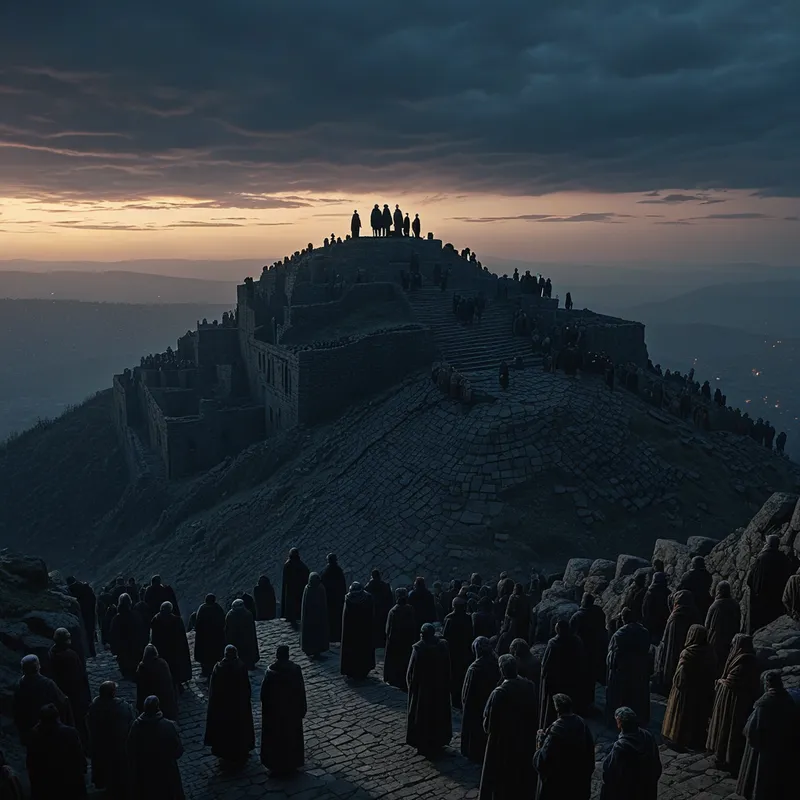
Then, to the Place of the Skull. The cross was raised, a stark silhouette against a sun that dared not shine. The weight of their body was nothing compared to the weight of the world’s refusal. Nails, cold and definitive, pierced flesh. As life ebbed, a cry tore from their lips, not of anger, but of profound, cosmic loneliness: “Why have you forsaken me?” In that moment, the messenger tasted the ultimate human condition—the felt absence of the Source.
Darkness fell at noon. The earth trembled. And with a final surrender, a release of breath that was also a release of spirit, it was finished. The body, emptied, was taken down and laid in a tomb sealed with a stone of finality.
For three days, the world held its breath. The web had been severed; the heart of the myth had stopped. Then, at dawn, the stone was rolled away. The tomb was empty. Not a corpse reanimated, but a presence transformed. Chris appeared, bearing the wounds but not bound by them, a being of luminous flesh and impossible peace. The sacrifice was complete. The love that was killed had not died; it had passed through the narrow gate of death and returned, having transmuted the very mechanism of ending into a beginning.
Cultural Origins & Context
This is not a story owned by any one tribe, text, or tradition. It is a Global or Universal myth, emerging wherever the human psyche grapples with the paradox of suffering, sacrifice, and transcendence. Its earliest tellers were not historians but poets of the soul, shamans, and mystics who understood narrative as a container for ineffable truth. It was passed down in ecstatic visions, in the symbolic language of mystery schools, and in the collective dreams of humanity long before it was ever codified.
Its societal function is foundational. It serves as the ultimate cosmogram, explaining the presence of agony in a world touched by the divine. It answers the unbearable question: if the universe is benevolent, why does it contain this? The myth proposes that the mechanism of redemption is woven into the fabric of suffering itself. It provided a template for understanding persecution, for finding meaning in voluntary sacrifice for a greater whole, and most importantly, for holding the terrifying possibility of hope beyond absolute annihilation.
Symbolic Architecture
At its core, the crucifixion is an archetypal map of the psyche’s most harrowing and necessary journey.
The cross is the intersection where the vertical axis of spirit meets the horizontal axis of matter, where divine will encounters mortal fate. To be nailed there is to be fully conscious in that excruciating point of tension.
Jesus Chris represents the Self, the total, integrated personality that includes both light and shadow. Their mission—to preach unconditional love—is the ego’s highest calling toward integration. The betrayal, trial, and execution symbolize the brutal assault of the shadow and the collective unconscious (the crowd, the authorities) upon this emerging consciousness. The ego that identifies with the divine spark must be shattered.
The cry of forsakenness is the pivotal moment. It is the death of the old God—the external, parental deity who intervenes—and the birth of God-within, the divinity that must be discovered in the depths of despair. The resurrection, therefore, is not a physical event but a psychological reality: the rebirth of the personality from the ego to the Self, now conscious of its own eternal, indestructible core.
The Dreamer’s Resonance
When this myth stirs in modern dreams, the dreamer is at a critical juncture of individuation. To dream of being crucified is to feel one’s identity, values, or life’s work under devastating attack, often by forces that feel both external (a job, a relationship, society) and intimately internal (self-doubt, a hidden flaw). The somatic sensation is one of piercing exposure, unbearable tension, and profound isolation.
Yet, this dream-pattern signifies an alchemical process underway. The psyche is demonstrating that an old, outgrown structure of the self—a rigid identity, a compulsive pattern, a foundational belief—must be sacrificed. It is being “nailed” into consciousness so it can die and be transformed. The dreamer waking in anguish is experiencing the “dark night of the soul,” the necessary dissolution before reconstruction. The dream is not a prophecy of literal doom, but a map showing that the path to wholeness leads directly through the center of one’s personal crucifixion.

Alchemical Translation
The myth of Jesus Chris is the ultimate alchemical recipe for the transmutation of leaden ego into golden Self.
The first stage, nigredo, is the blackening: the betrayal in Gethsemane, the despair, the crushing weight of the cross. This is the conscious descent into one’s own shadow, the acknowledgment of failure, limitation, and agony. One must be willingly “nailed” to one’s own truth, however painful.
The resurrection is not the avoidance of death, but its fulfillment. The stone is rolled away not to reveal an escaped corpse, but to unveil an emptied tomb—the space where the old self was, now vacant, making room for the new.
The albedo, or whitening, is the moment of surrender—“into thy hands I commend my spirit.” It is the release of control, the ego’s final offering. The three days in the tomb represent the citrinitas, the yellowing or fermentation, where the silent, unseen work of the unconscious psyche reassembles the pieces at a higher order.
The final stage, rubedo, the reddening, is the resurrection appearance: the embodied presence, luminous and real, bearing the wounds as marks of wisdom, not weakness. For the modern individual, this is the dawn of living from the Self. Actions are no longer driven by the ego’s needs for validation or security, but flow from an integrated center that has known annihilation and returned. The individual becomes a “wounded healer,” capable of holding profound tension without breaking, because they have learned that on the other side of the cross lies not an end, but a radically new beginning. The crucifixion is not a tragedy to be mourned, but a paradox to be lived: the way up is the way down, and to save one’s life, one must first be willing to lose it.
Associated Symbols
Explore related symbols from the CaleaDream lexicon: