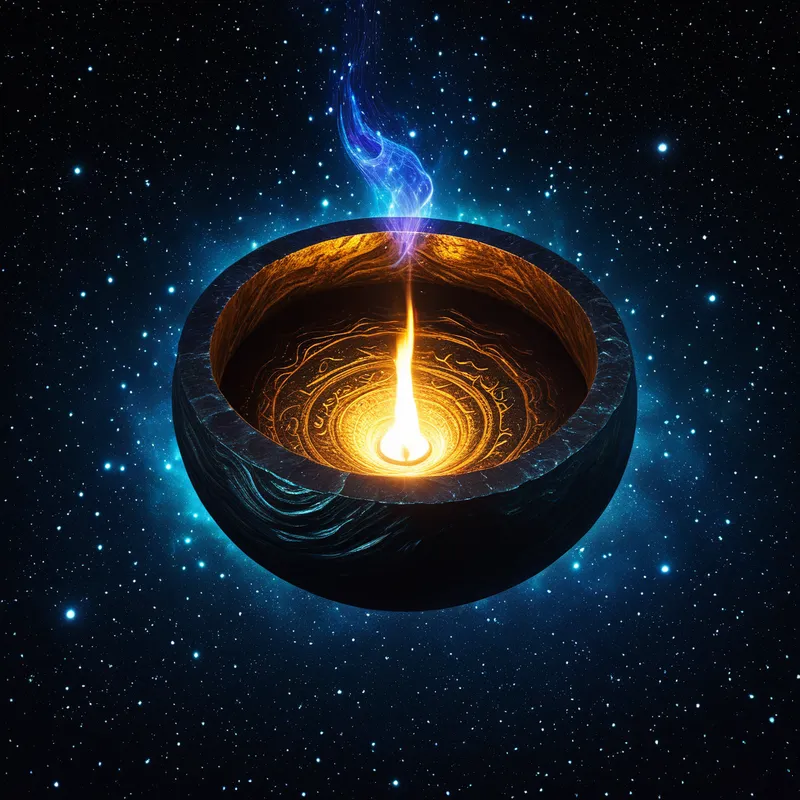
The Crucible Myth Meaning & Symbolism
The tale of the primordial vessel that holds chaos, endures the elemental fires, and births the Philosopher's Stone through sacred dissolution.
The Tale of The Crucible
Before the world was world, there was only the Churn—a seething, formless potential of heat and cold, weight and flight, bitterness and sweetness, all at once. From this roiling non-place, the First Dreamer stirred. Not a god with a face, but a presence of pure intent: the desire for a Vessel.
And so, from the dreaming, the Crucible was born. It was not forged by hammer or hand. It condensed, as frost gathers on a void-dark pane. Its substance was the memory of boundary, the first whisper of “inside” and “outside.” It was a womb of black iron and shining copper, etched with the sigils of what-could-be, cold and silent in the endless Churn.
But a vessel empty is a longing unanswered. The Churn, sensing this new hollow, this invitation, began to pour itself in. Not a gentle stream, but a screaming cataract of contradictions. The fire that burns and the water that drowns entered as one. The earth that buries and the air that scatters became a whirling dust-devil within the Crucible’s heart. The Crucible did not choose this; it was its nature to receive. It held the screaming chaos, its metal groaning with the strain of containing opposites that sought to annihilate each other.
Then came the Fire. Not the fire of the Churn, but the Fire from Below—the conscious, purposing flame of the Dreamer’s will. It did not warm the Crucible’s exterior. It ignited within the substance of the Vessel itself. The Crucible became its own furnace. Its metal glowed first cherry-red, then white-hot, then a searing, transcendent gold. The chaos within did not calm; it raged fiercer, amplified by the heat, a storm of elements fighting for supremacy.
This was the Long Suffering. The Crucible held. It did not melt, though it flowed like liquid stone. It did not crack, though its sigils blazed with painful light. It contained the uncontainable. It endured the marriage of hostile forces within its own body. The sound was not of thunder, but of a single, sustained note—the hum of transformation itself.
And in that endless moment of supreme tension, a change occurred not to the chaos, but within the relationship between the vessel and the contained. The fighting elements, compressed and catalyzed by the steadfastness of the Crucible, began to recognize each other. Fire saw its dryness in earth, its heat in air’s passion. Water saw its flow in air’s currents, its reflection in metal’s sheen. They did not become one, but they entered a dance—a sacred, revolving concord.
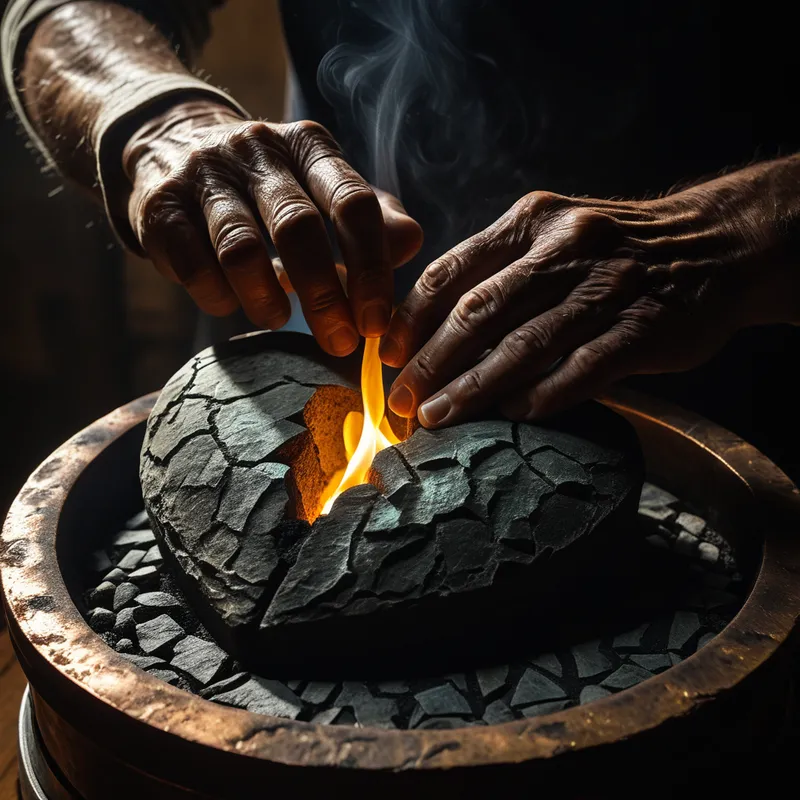
The Fire from Below ceased. The glow faded from gold, to silver, to a cool, deep black. Silence. Within the Crucible’s bowl, where terror had raged, lay a small, perfect stone. It was not a gem, but a seed; not a mineral, but a condensed possibility. It pulsed with a soft, inner light, containing all colors and none. This was the First Stone, the child of chaos and boundary, of suffering and steadfastness. The Crucible, its task complete, did not vanish. It remained, forever changed, its form a testament to the ordeal, now a silent guardian of the process it had borne.
Cultural Origins & Context
The myth of the Crucible is the foundational narrative of the Alchemical tradition. It was never a single text, but an oral teaching, passed from master to apprentice in the sealed laboratories, scriptoria, and ateliers where the Great Work was pursued. It was considered the “secret history of matter,” explaining not how the cosmos was made by a deity, but how order emerges from inherent chaos through a principle of voluntary containment.
Its tellers were the practicing alchemists, who saw themselves not as inventors, but as participants in this primordial drama. The story was recited during the long, vigilant nights of tending the furnace, a mantra to align the operator’s spirit with the process unfolding in the flask. Its societal function was initiatory and psychological. It provided a sacred map for the inner transformation required to handle the dangerous, often disillusioning work with physical substances. To understand the Crucible was to understand one’s own soul as the vessel for psychic chaos, and the disciplined fire of attention as the transformative agent.
Symbolic Architecture
The Crucible is the archetypal Vas. It represents the total human psyche—the ego, the body, the entire field of consciousness—that agrees to contain the unconscious, chaotic contents welling up from within (the Churn). It is not a hero who goes out to slay a dragon, but the ground upon which the battle occurs.
The true alchemist does not fight the dragon; they provide the sealed arena in which the dragon can transform itself.
The Prima Materia (the Churn) symbolizes the raw, often contradictory and painful material of the psyche: repressed memories, conflicting desires, shadow aspects, and unlived potentials. It is not “evil,” but unformed and potent. The Fire from Below is the heat of conscious suffering, the focused application of self-observation, ethical conflict, and enduring the tension of opposites without resorting to easy answers or repression. The Crucible’s endurance is the ego’s capacity to hold, to not fragment or dissociate in the face of inner turmoil.
The ultimate product, the Philosopher’s Stone, is not a trophy won, but a state of being that emerges from the relationship between the container and the contained. It symbolizes the integrated Self, where previously warring aspects of the personality achieve a dynamic, cooperative equilibrium.
The Dreamer’s Resonance
When the myth of the Crucible activates in the modern dreamscape, it signals a profound somatic and psychological process of contained dissolution. The dreamer may not see a literal crucible, but its motifs are unmistakable.
One may dream of being in a room that is also a furnace, feeling intense heat yet remaining unharmed. Or of holding a box or a bowl that shakes violently with something alive and dangerous inside, with the imperative to not let go. There are dreams of melting metal, of withstanding immense pressure, or of tending a fire in a hearth that must not go out. These are somatic metaphors for the psyche’s ordeal of holding intense affect—grief, rage, passion, or creative chaos—without acting it out or being destroyed by it.
The process is one of ego death and reconstitution. The dream-ego is not the active hero, but the passive, enduring vessel. The psychological work happening is the strengthening of the “container function” of the psyche, building the capacity to process core complexes and archetypal energies that were previously too overwhelming to confront.
Alchemical Translation
For the modern individual, the myth models the non-glamorous, essential core of individuation: the opus contra naturam, the work against one’s own habitual nature. Our instinct is to expel what is painful and to identify only with what is comfortable. The Crucible’s path is the opposite.
Individuation begins not with finding your true self, but with agreeing to host the chaos you have spent a lifetime excluding.
The “Churn” we must admit into our personal crucible is our shadow—the inferior, embarrassing, aggressive, or needy parts we disown. It is the unresolved trauma, the stalled grief, the secret envy. The “Fire from Below” is the courageous, sustained act of turning toward this material with honest attention. This is the heat of therapy, of journaling, of difficult conversations, of sitting silently with one’s own anxiety instead of numbing it.
The ordeal is the period of depression, confusion, and existential disorientation that often accompanies deep psychological work. Things feel worse before they feel better because the chaos is now in the vessel, reacting. The myth assures us that this suffering is not failure, but the necessary heat of the process. Steadfastness—commitment to the process itself—is the key.
The “Stone” that results is not a state of perfect, conflict-free happiness. It is the emergent property of a psyche that has developed a resilient container. It is the capacity for inner complexity, for holding ambiguity, for accessing creativity from the very wounds that once caused fragmentation. One becomes, like the Crucible, a vessel capable of transforming base experience into the gold of meaning. The Work is never truly finished, for the Vessel remains, ready to receive the next iteration of the Churn, in the eternal cycle of death and rebirth that is a life consciously lived.
Associated Symbols
Explore related symbols from the CaleaDream lexicon: