The Crown of Thorns Myth Meaning & Symbolism
A brutal circlet of thorns placed on a divine king, transforming agony into an eternal emblem of paradoxical power and ultimate sacrifice.
The Tale of The Crown of Thorns
Listen. In the hour when [the world](/myths/the-world “Myth from Tarot culture.”/) holds its breath between the darkness and the dawn, a story is woven not from silk, but from briar and blood.
In the heart of a conquered city, under [the shadow](/myths/the-shadow “Myth from Jungian culture.”/) of eagles and the weight of empire, walked a man who spoke of a kingdom not of this world. His name was Yeshua, called by some the Messiah, by others a rabble-rouser. He was brought before the Roman governor, [Pontius Pilate](/myths/pontius-pilate “Myth from Biblical culture.”/), accused of claiming a kingship that challenged Caesar himself. The air in the praetorium was thick with dust, fear, and the metallic scent of power.
Pilate, a man whose soul was a ledger of political calculations, found no crime in him. Yet, the crowd, a beast with one voice, roared for blood. Seeking to appease its hunger, the governor ordered a scourging—a ritual of flesh-rending humiliation. Afterwards, the soldiers of the cohort, bored and brutal, saw a chance for sport. “Hail, King of the Jews!” they mocked.
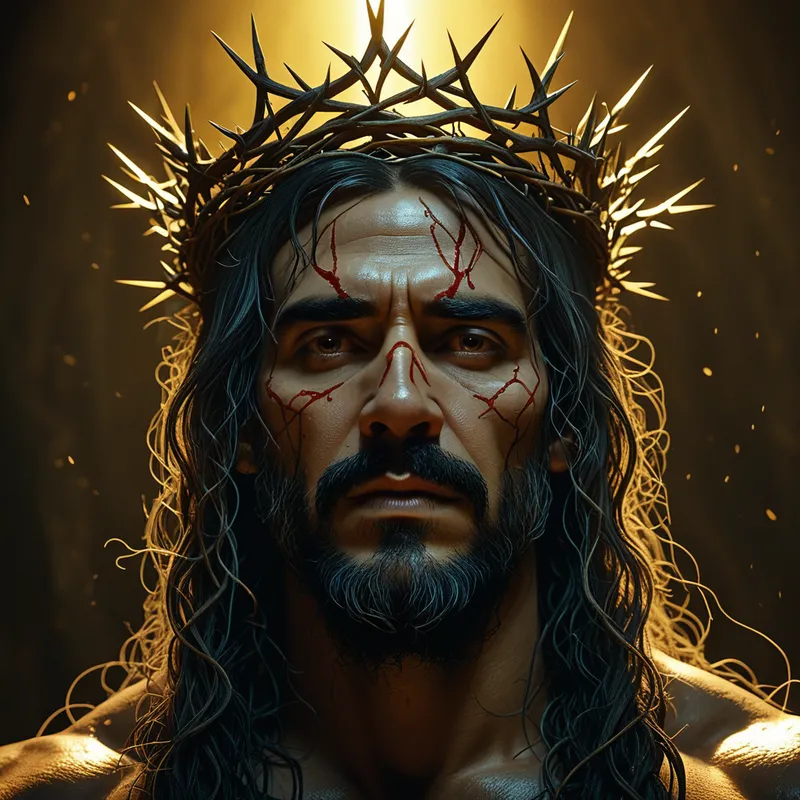
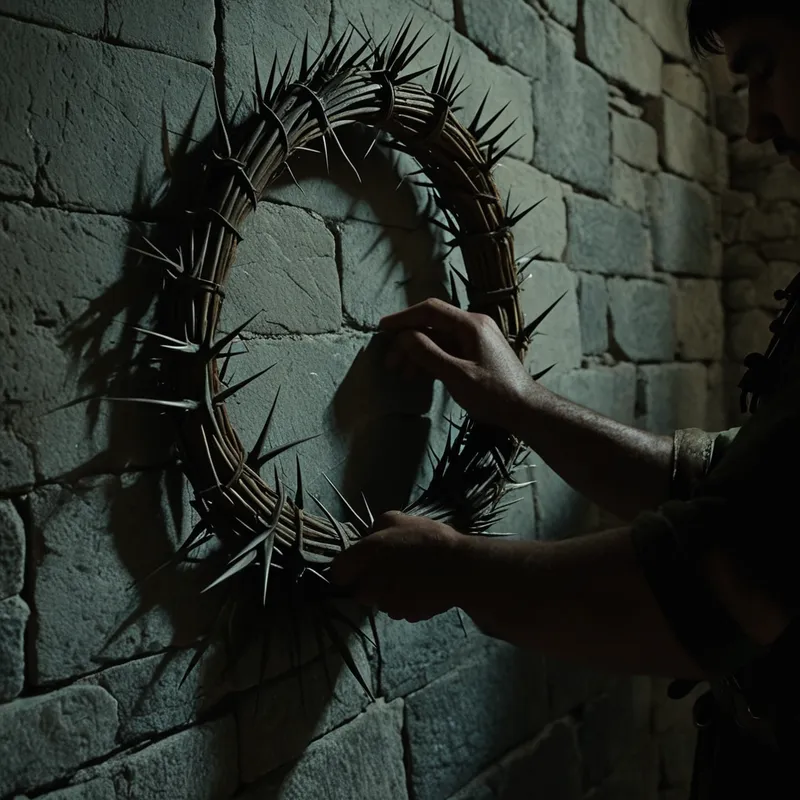
They found a plant of [the desert](/myths/the-desert “Myth from Biblical culture.”/), the thorny burnet, its branches a tangle of cruel, hardened spikes. With calloused hands, indifferent to its bite, they wove a rough circlet. This was no laurel wreath of victory, no golden diadem of empire. This was a crown of agony, a parody of sovereignty. They pressed it down upon his brow. The world did not pause. No thunder clapped. Only the quiet, intimate sound of thorn piercing skin, the slow, warm trickle of blood mingling with sweat, tracing paths through the dust on his face.
They clothed him in a purple rag, thrust a reed into his bound hands for a scepter, and knelt in false homage, spitting their contempt. He was then led out, wearing this crown, this brutal halo, for all to see—a king enthroned in suffering, his regalia pain, his procession a walk to execution. [The crown](/myths/the-crown “Myth from Various culture.”/) remained as he bore the weight of the cruciform timber up the hill of the skull, [Golgotha](/myths/golgotha “Myth from Christian culture.”/). It was the final, twisted jewel in [the passion](/myths/the-passion “Myth from Christian culture.”/) of a god who had emptied himself, taking the form of a slave. There, at the zenith of his humiliation, [the crown](/myths/the-crown “Myth from Various culture.”/) of thorns became the ultimate emblem of a kingdom built not on domination, but on a love that endures all things.
Cultural Origins & Context
The story emerges from the Gospel narratives of Matthew, Mark, John, and with less detail in Luke. It is a pivotal moment in the Passion narrative, the climax of the Christian mythos. Historically, it exists at the fraught intersection of Jewish apocalyptic hope and Roman imperial reality. The act of mockery by Roman soldiers is culturally precise: it was a brutal piece of political theater, designed to crush any notion of kingship outside Caesar’s purview. A crown symbolized authority; to make one from thorns was to declare that all other authority was painful, false, and worthless.
The myth was passed down orally by early communities before being codified in scripture. Its function was multifaceted: for persecuted early Christians, it validated the experience of suffering for their faith. It transformed an instrument of torture into a symbol of their Lord’s unique, paradoxical kingship. Throughout the centuries, veneration of supposed relics of the crown, such as those in Notre-Dame de Paris, and its depiction in countless icons, paintings, and hymns, have kept the symbol potent. It serves as a visceral, tangible anchor for contemplating the central Christian mystery of a suffering God.
Symbolic Architecture
The [Crown](/symbols/crown “Symbol: A crown symbolizes authority, power, and achievement, often representing an individual’s aspirations, leadership, or societal role.”/) of Thorns is an unparalleled [symbol](/symbols/symbol “Symbol: A symbol can represent an idea, concept, or belief, serving as a powerful tool for communication and understanding.”/) of sacred [paradox](/symbols/paradox “Symbol: A contradictory yet true concept that challenges logic and perception, often representing unresolved tensions or profound truths.”/). It represents the ultimate inversion of worldly power. Where crowns collect light, this one draws [blood](/symbols/blood “Symbol: Blood often symbolizes life force, vitality, and deep emotional connections, but it can also evoke themes of sacrifice, trauma, and mortality.”/). Where they signify dominion over others, this one signifies a [king](/symbols/king “Symbol: A symbol of ultimate authority, leadership, and societal order, often representing the dreamer’s inner power or external control figures.”/)’s dominion over his own suffering, offering it up.
The most profound sovereignty is not claimed from the world, but forged within the self, in the willing acceptance of a fate that transforms agony into meaning.
Psychologically, the crown represents the [integration](/symbols/integration “Symbol: The process of unifying disparate parts of the self or experience into a cohesive whole, often representing psychological wholeness or resolution of internal conflict.”/) of the [shadow](/symbols/shadow “Symbol: The ‘shadow’ embodies the unconscious, repressed aspects of the self and often represents fears or hidden emotions.”/). The thorns are the painful, rejected, and brutal aspects of existence—sin, suffering, [mortality](/symbols/mortality “Symbol: The awareness of life’s finitude, often representing transitions, impermanence, or existential reflection in dreams.”/), humiliation. To consciously wear them, to integrate them into one’s [identity](/symbols/identity “Symbol: Identity represents the sense of self, encompassing personal beliefs, cultural background, and social roles.”/) instead of fleeing from them, is a act of immense psychological courage. The figure of the Christ does not transcend suffering by avoiding it, but by moving through it, thereby transmuting its essence. The crown also symbolizes the burden of [consciousness](/symbols/consciousness “Symbol: Consciousness represents the state of awareness and perception, encompassing thoughts, feelings, and experiences.”/) itself—the painful [awareness](/symbols/awareness “Symbol: Conscious perception of self, surroundings, or internal states. Often signifies awakening, insight, or heightened sensitivity.”/) of one’s own [condition](/symbols/condition “Symbol: Condition reflects the state of being, often focusing on physical, emotional, or situational aspects of life.”/), of existential [loneliness](/symbols/loneliness “Symbol: A profound emotional state of perceived isolation, often signaling a need for connection or self-reflection.”/), and of a [responsibility](/symbols/responsibility “Symbol: Responsibility in dreams often signifies the weight of duties and the expectations placed upon the dreamer.”/) that feels like a [wreath](/symbols/wreath “Symbol: A wreath commonly symbolizes completion, cyclical nature, and the binding of different life phases, often associated with celebration or remembrance.”/) of sharp points upon the mind.
The Dreamer’s Resonance
When this myth surfaces in modern dreams, the dreamer is likely encountering a profound initiation into a state of sacred suffering or paradoxical empowerment. To dream of wearing a crown of thorns suggests a moment where one’s authority, wisdom, or leadership (the crown) is being tested or born through intense difficulty, criticism, or inner conflict (the thorns). It is not a symbol of victimhood, but of a painful coronation.
Somatically, one might feel pressure around the head, a sense of constriction, or the sting of shame. Psychologically, this dream pattern indicates a process of embracing a difficult truth or accepting a responsibility that one knows will bring pain. It is [the ego](/myths/the-ego “Myth from Jungian culture.”/)’s recognition that its next stage of growth requires it to endure a humiliation, to bear the weight of a truth that isolates it, or to accept love’s demands even when they feel like piercing barbs. The dream asks: What painful wisdom are you being crowned with? What authority are you claiming that the world mocks, but your soul knows is true?
Alchemical Translation
The alchemical journey modeled here is the transmutation of humiliation into humility, and agony into agency. The [prima materia](/myths/prima-materia “Myth from Alchemical culture.”/) is the raw, painful experience of being mocked, defeated, and broken—the lead of the soul. The soldier’s mocking act is the forcible application of the [nigredo](/myths/nigredo “Myth from Alchemical culture.”/), the blackening, where all light and hope seem extinguished.
The conscious wearing of the crown is the beginning of the albedo, the whitening. It is the conscious choice to contain the contradiction: to hold the identity of “king” and “suffering servant” simultaneously without rejecting either. This is the essence of individuation—holding the tension of opposites until a third, transcendent [thing](/myths/thing “Myth from Norse culture.”/) emerges.
The goal of this alchemy is not to remove the crown, but to discover the divine light that shines through its terrible latticework, transforming it from a instrument of torture into a lens of revelation.
For the modern individual, this translates to those moments when our deepest wounds—our failures, our shames, our anxieties—become the very source of our unique authority and compassion. We do not heal by making the thorns disappear; we heal by discovering that our crown, however painfully fashioned, is ours alone, and within its confines lies our true, unassailable sovereignty. The process culminates when we realize the crown was never imposed by an external enemy, but was the necessary, brutal shape of our own becoming.
Associated Symbols
Explore related symbols from the CaleaDream lexicon: