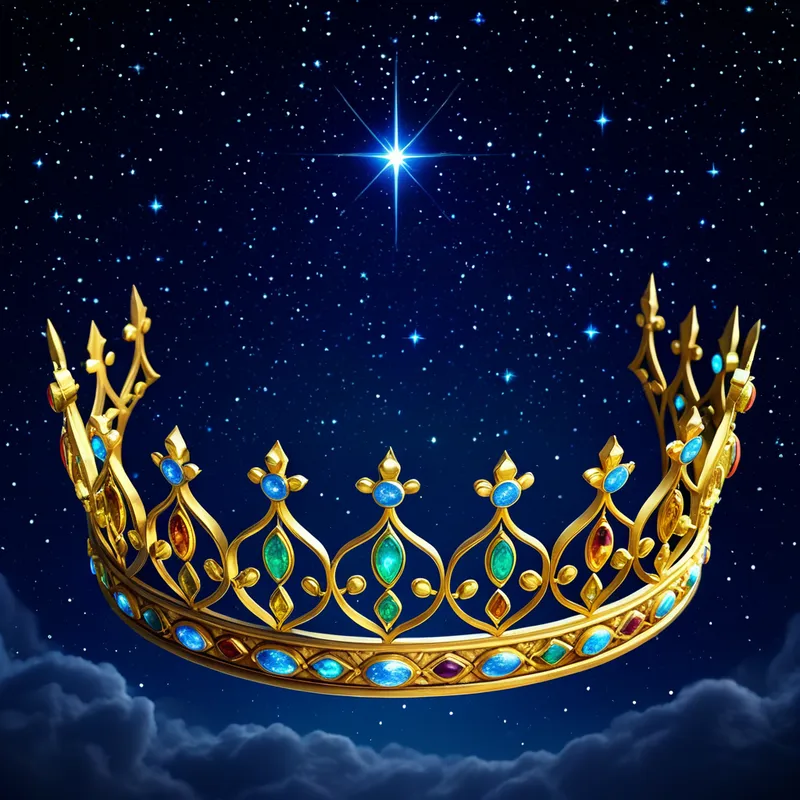
The Crown of Ariadne Myth Meaning & Symbolism
A mortal princess's crown, cast into the heavens by a god, becomes a constellation—a testament to love, loss, and immortal recognition.
The Tale of The Crown of Ariadne
Hear now a tale not of a hero’s sword, but of a lover’s crown. It begins in the deep, echoing belly of [the earth](/myths/the-earth “Myth from Hindu culture.”/), in the [Labyrinth](/myths/labyrinth “Myth from Various culture.”/) of [Minos](/myths/minos “Myth from Greek culture.”/). Here, the beast [Minotaur](/myths/minotaur “Myth from Greek culture.”/) breathed in the dark, and the stones drank the blood of Athenian youths. To this place of coiled shadows came [Theseus](/myths/theseus “Myth from Greek culture.”/), a prince with a borrowed destiny. But his path was lit not by his own courage alone, but by a thread of compassion spun in a princess’s chamber.
Her name was Ariadne. Daughter of a tyrant, sister to a monster, her heart was a chamber untouched by the stone logic of her father’s court. When she saw Theseus, marked for death, she saw a way out—not just for him, but for her own caged spirit. In the dead of night, she came to him. Not with weapons, but with cunning. She gave him a ball of gleaming thread and a sword. “Tie this to the entrance,” she whispered, her voice the only soft [thing](/myths/thing “Myth from Norse culture.”/) in that hard palace. “Unwind it as you go. It will be your memory in stone, your path back to the light.” She exacted a promise: take her with him when he fled.
Theseus descended. The thread, a slender, pulsating lifeline, led him through the madness of the maze. He found the beast and did the bloody work. Then, hand over hand, he followed the thread back, pulling himself from [the underworld](/myths/the-underworld “Myth from Greek culture.”/) into Ariadne’s waiting arms. Together, under a sky salted with stars, they fled Crete, stealing away on a ship with black sails. Ariadne, tasting freedom for the first time, believed her labyrinth was behind her.
The gods, however, weave stories with finer, crueler thread. Exhausted, they made landfall on the serene isle of Naxos. As Ariadne slept on the sun-warmed sand, wrapped in dreams of a new life in Athens, Theseus walked to the shore. We are told he was commanded by the gods to leave her. Perhaps he was. Or perhaps the hero, his deed done, saw the princess who saved him as a reminder of a monstrous past, a thread still tying him to [the labyrinth](/myths/the-labyrinth “Myth from Greek culture.”/). He gave the order. The sails were raised. And as Ariadne awoke to the empty beach, the sound of [the sea](/myths/the-sea “Myth from Greek culture.”/) was broken by the sight of her love’s ship shrinking to a speck on [the horizon](/myths/the-horizon “Myth from Various culture.”/), then to nothing.
She stood alone, the vast, indifferent sky her only roof. The betrayal was a colder maze than any her father built. But the story does not end in mortal despair. For the Dionysus had been watching. The wild god, the breaker of chains, approached not as a conqueror but as a witness. He saw not a abandoned woman, but a soul who had dared to love beyond her walls, who had traded a crown of stone for a thread of hope and been shattered for it. In her raw, unfiltered grief, he saw a divinity akin to his own.
With a tenderness rarely ascribed to him, Dionysus came to Ariadne. He took from her brow the simple circlet she wore, a last relic of her royal life. Then, in a gesture of cosmic recompense, he cast it high into the heavens. The gold flared, the jewels ignited. It soared past [the moon](/myths/the-moon “Myth from Tarot culture.”/), past the paths of wandering planets, and fixed itself in the northern sky. There it blazed into the constellation we call Corona Borealis, a circle of stars—a crown of eternal, undimming light. Ariadne herself was made immortal, her mortal tears transmuted into the wine of divine union. She was seen, recognized, and crowned not by a mortal king, but by the cosmos itself.

Cultural Origins & Context
The myth of Ariadne and her crown is a complex tapestry woven from multiple threads of Greek tradition. Its earliest full telling comes from the Homeric epics, but it finds richer, more contradictory detail in later poets like Hesiod and the tragedians. It was a story told not in one voice, but many: a cautionary tale about the fickleness of heroes (Theseus), a etiological myth for the constellation Corona Borealis, and a foundational narrative for the ecstatic cult of Dionysus.
In the societal function of ancient Greece, Ariadne’s story served multiple purposes. For women, it was a potent narrative of vulnerability and unexpected exaltation, a fantasy of divine rescue from the betrayals of the mortal world. For the followers of Dionysus, it was a [sacred marriage](/myths/sacred-marriage “Myth from Alchemy culture.”/) myth (Hieros Gamos), legitimizing the god’s connection to ecstatic release and the transcendence of suffering. [The crown](/myths/the-crown “Myth from Various culture.”/) itself, becoming a constellation, reinforced the Greek worldview where the actions of gods and heroes were literally written in the stars, providing a divine map and a sense of cosmic order to human chaos.
Symbolic Architecture
At its [heart](/symbols/heart “Symbol: The heart symbolizes love, emotion, and the core of one’s existence, representing deep connections with others and self.”/), the [Crown](/symbols/crown “Symbol: A crown symbolizes authority, power, and achievement, often representing an individual’s aspirations, leadership, or societal role.”/) of Ariadne is a [symbol](/symbols/symbol “Symbol: A symbol can represent an idea, concept, or belief, serving as a powerful tool for communication and understanding.”/) of recognition. It represents the [moment](/symbols/moment “Symbol: The symbol of a ‘moment’ embodies the significance of transient experiences that encapsulate emotional depth or pivotal transformations in life.”/) when raw, personal experience—especially the experience of [betrayal](/symbols/betrayal “Symbol: A profound violation of trust in artistic or musical contexts, often representing broken creative partnerships or artistic integrity compromised.”/), [abandonment](/symbols/abandonment “Symbol: A dream symbol representing feelings of being left behind, isolated, or emotionally deserted, often tied to primal fears of separation and loss of support.”/), and profound [grief](/symbols/grief “Symbol: A profound emotional response to loss, often manifesting as deep sorrow, yearning, and a sense of emptiness.”/)—is witnessed and validated by a transpersonal force. Ariadne’s thread was her agency in the [labyrinth](/symbols/labyrinth “Symbol: The labyrinth represents a complex journey, symbolizing the intricate path toward self-discovery and understanding one’s life’s direction.”/) of [the personal unconscious](/myths/the-personal-unconscious “Myth from Jungian Psychology culture.”/), navigating the monstrous aspects of her [family](/symbols/family “Symbol: The symbol of ‘family’ represents foundational relationships and emotional connections that shape an individual’s identity and personal development.”/) [legacy](/symbols/legacy “Symbol: What one leaves behind for future generations, encompassing values, achievements, possessions, and memory.”/) (the [Minotaur](/symbols/minotaur “Symbol: The Minotaur, a creature from Greek mythology, is often interpreted as a symbol of inner turmoil and the struggle between human and beast.”/)). Her abandonment on Naxos is the ultimate [crisis](/symbols/crisis “Symbol: A crisis symbolizes turmoil, urgent challenges, and the need for immediate resolution or change.”/) of meaning: [the ego](/myths/the-ego “Myth from Jungian culture.”/)’s plan (Theseus/Athens) fails utterly.
The labyrinth is the problem we can solve with cunning. The empty beach is the despair we must be transformed by.
The crown is the key symbol. As a mortal object, it signifies her old [identity](/symbols/identity “Symbol: Identity represents the sense of self, encompassing personal beliefs, cultural background, and social roles.”/), her [role](/symbols/role “Symbol: The concept of ‘role’ in dreams often reflects one’s identity or how individuals perceive their place within various social structures.”/) as Cretan [princess](/symbols/princess “Symbol: The symbol of a princess embodies themes of power, privilege, and feminine grace, often entailing a journey of self-discovery.”/)—a [role](/symbols/role “Symbol: The concept of ‘role’ in dreams often reflects one’s identity or how individuals perceive their place within various social structures.”/) she willingly abandoned. Cast into [the sky](/myths/the-sky “Myth from Persian culture.”/) by Dionysus, it is alchemized. It becomes a symbol of a new, cosmic [identity](/symbols/identity “Symbol: Identity represents the sense of self, encompassing personal beliefs, cultural background, and social roles.”/) earned not through birthright, but through the ordeal of the heart. Dionysus, as the [archetype](/symbols/archetype “Symbol: A universal, primordial pattern or prototype in the collective unconscious that shapes human experience, behavior, and creative expression.”/) of the irrational, instinctual, and transformative [spirit](/symbols/spirit “Symbol: Spirit symbolizes the essence of life, vitality, and the spiritual journey of the individual.”/), does not offer a logical [solution](/symbols/solution “Symbol: A solution symbolizes resolution, clarity, and the overcoming of obstacles, often representing a sense of accomplishment.”/). He offers a symbolic one: your value is not determined by the one who left you; it is inherent and celestial. The crown is no longer a sign of earthly [station](/symbols/station “Symbol: Signifies a temporary stop, transition point, or a place of waiting in life’s journey.”/), but a [mandala](/symbols/mandala “Symbol: A sacred geometric circle representing wholeness, the cosmos, and the journey toward spiritual integration.”/) of wholeness—a circle of stars representing the integrated Self, visible to all, yet untouchable.
The Dreamer’s Resonance
When the pattern of Ariadne’s Crown surfaces in modern dreams, it often signals a profound process of re-orientation following a devastating betrayal or loss of life direction. The dreamer may not see a literal crown or constellation, but will feel the myth’s architecture.
Somatically, one might dream of being literally left behind: on a station platform as a train departs, in an empty house, or on a shoreline. There is a piercing feeling of clarity mixed with desolation—the “Naxos moment.” This is the [psyche](/myths/psyche “Myth from Greek culture.”/)’s depiction of the ego’s project collapsing. The thread (the plan, the relationship, the career path) has led you out of one labyrinth, only to strand you in a void.
Psychologically, this dream state is a necessary death. It is the dissolution of an identity built around an other (the Theseus figure—a partner, a parent, a societal ideal). The dreamer is in the liminal space between identities, where the old crown has been taken off, but the new, celestial one has not yet been bestowed. The work here is not to “get over it” or find a new Theseus, but to lie fallow on that symbolic beach, to fully feel the abandonment without rushing to escape it. It is in this state of utter vulnerability that the Dionysian energy of the deep Self can approach—not as a savior, but as a witness who sees [the divine spark](/myths/the-divine-spark “Myth from Gnostic culture.”/) in the shattered pieces.
Alchemical Translation
The alchemical journey modeled by this myth is not one of heroic conquest, but of transmutation through heartbreak. The [prima materia](/myths/prima-materia “Myth from Alchemical culture.”/) is not lead, but a broken promise. The process follows the classic stages: [Nigredo](/myths/nigredo “Myth from Alchemical culture.”/), Albedo, [Rubedo](/myths/rubedo “Myth from Alchemical culture.”/).
The Nigredo is the Labyrinth and the abandonment. It is the confrontation with the personal Minotaur (one’s own inherited complexes, fears) and the subsequent, deeper blackness of betrayal. The ego’s solution (the thread) gets you out of the first darkness, but cannot prevent the second.
The Albedo is the empty beach of Naxos. This is the crucial, purifying stage often avoided. It is the lunar, reflective state of solitude and grief. Here, all color is washed out; only the stark facts of loss remain. In psychological terms, this is the ego’s inflation dying, allowing for a connection to the unconscious. Ariadne does not do anything here; she is. This passive, receptive state is essential.
The alchemical fire is not in the hero’s sword, but in the tears on the shore. They dissolve the mortal alloy to reveal the gold beneath.
Finally, the Rubedo is the arrival of Dionysus and the casting of the crown. This is the synthesis. The god represents the instinctual, life-affirming force of the psyche that recognizes worth beyond ego-achievements. The crown’s ascent is the integration of the experience into the very fabric of the personality—it becomes a permanent, guiding constellation in one’s inner sky. The individual is no longer Ariadne the abandoned princess, nor Ariadne the hero’s helper. She is Ariadne the crowned one, whose worth is self-contained and celestial. The process teaches that our deepest wounds, when fully endured and witnessed by [the Self](/myths/the-self “Myth from Jungian culture.”/), can become the very points of light that orient our entire being.
Associated Symbols
Explore related symbols from the CaleaDream lexicon: