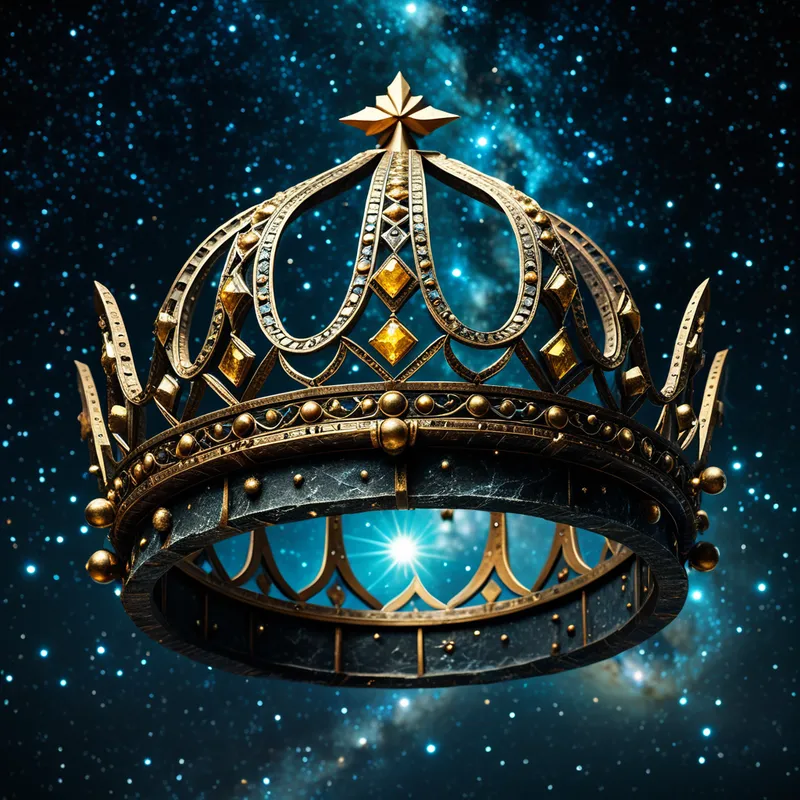
The Crown Myth Meaning & Symbolism
A universal tale of a sacred object conferring ultimate authority, which reveals itself as both glorious prize and a weight that forges or destroys the soul.
The Tale of The Crown
Listen. Before kings built thrones of marble, before empires drew borders on maps, the Crown existed. It did not rest in a treasury or a tomb. It waited.
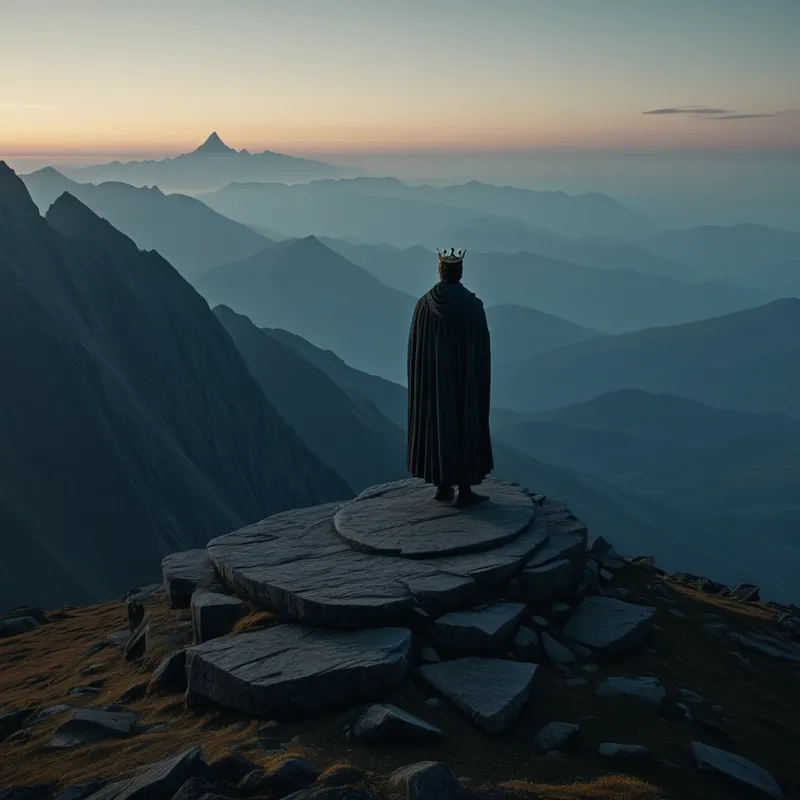
It waited in the high, silent places where [the earth](/myths/the-earth “Myth from Hindu culture.”/) touches [the sky](/myths/the-sky “Myth from Persian culture.”/)—on [the summit](/myths/the-summit “Myth from Taoist culture.”/) of the Mount of [the World](/myths/the-world “Myth from Tarot culture.”/), cradled in the roots of the Cosmic Tree, or sleeping in the heart of a [labyrinth](/myths/labyrinth “Myth from Various culture.”/) where [the Minotaur](/myths/the-minotaur “Myth from Greek culture.”/) was but a guardian of a deeper secret. It was not merely an object, but a presence. Some said it was forged in the first fire of creation, when order was wrestled from chaos. Others whispered it was the crystallized tear of a god who saw the burden of ruling what they had made.
Many sought it. The warrior-king came with an army that faded like mist on the mountain slopes, leaving him alone, his strength meaningless. The cunning sorcerer came with spells that unraveled in the Crown’s silent aura, leaving him a babbling child. The pure-hearted shepherd came, guided by innocence, but fled when he felt the weight of the ages pressing down from the simple circlet of twisted thorn and star-metal.
The one who finally took it was never the one who intended to. It was the exile, carrying the shame of a past failure. It was the second son, with no birthright but a keen sense of [justice](/myths/justice “Myth from Tarot culture.”/). It was the widow, ruling a broken household with fierce compassion. Their journey was not a conquest, but an unraveling. Every virtue they clung to was tested; every flaw was laid bare. The final approach was never a battle, but a choice made in profound solitude.
And when their hand closed around it—or when they simply bowed their head and accepted its descent—the transformation was not of glittering glory, but of terrifying gravity. The sky did not cheer; it deepened. The light did not shine on them, but from within them, a cool, clear light that cast long, demanding shadows. They did not feel powerful. They felt responsible. For every blade of grass, every whispered secret, every beating heart in the realm they never knew they belonged to. The Crown was not won. It was wedded. And the marriage was to destiny itself.
Cultural Origins & Context
The myth of the Crown is a polygenetic myth, appearing in the foundational lore of countless cultures, from the Pschent of the Egyptians to the Reichskrone, from the Kiani Crown to the symbolic coronets in African oral traditions and Mesoamerican regalia. Its transmission is the work of bards, shamans, and elders—not merely to record lineage, but to encode the philosophy of power.
Its primary societal function was psycho-political. It answered the dangerous question: “Why does that person rule?” The myth moved the answer from mere heredity or brute force to the realm of the sacred and the psychological. It taught that legitimacy is not taken, but received; that authority is a covenant with the people and the cosmos. The coronation ritual, often a re-enactment of the myth, was a collective spell, binding the ruler to a standard so high that tyranny became a sacrilege. The myth was a check on power, embedded in the very story that seemed to glorify it.
Symbolic Architecture
The [Crown](/symbols/crown “Symbol: A crown symbolizes authority, power, and achievement, often representing an individual’s aspirations, leadership, or societal role.”/) is the ultimate [symbol](/symbols/symbol “Symbol: A symbol can represent an idea, concept, or belief, serving as a powerful tool for communication and understanding.”/) of the Self in its sovereign [aspect](/symbols/aspect “Symbol: A distinct feature, quality, or perspective of something, often representing a partial view of a larger whole.”/). It represents the achieved [integration](/symbols/integration “Symbol: The process of unifying disparate parts of the self or experience into a cohesive whole, often representing psychological wholeness or resolution of internal conflict.”/) of the [personality](/symbols/personality “Symbol: Personality in dreams often symbolizes the traits and characteristics of the dreamer, reflecting how they perceive themselves and how they believe they are perceived by others.”/) where [the ego](/myths/the-ego “Myth from Jungian culture.”/) is no longer a tyrant or a servant, but a conscious steward of the whole [psyche](/myths/psyche “Myth from Greek culture.”/).
The true crown is not worn on the brow, but experienced as the circumference that contains the totality of one’s being—light and shadow, strength and vulnerability.
The [quest](/symbols/quest “Symbol: A quest symbolizes a journey or search for purpose, fulfillment, or knowledge, often representing life’s challenges and adventures.”/) for it is the ego’s ambition. The failure of the [warrior](/symbols/warrior “Symbol: A spiritual archetype representing inner strength, discipline, and the struggle for higher purpose or self-mastery.”/) and sorcerer represents the [bankruptcy](/symbols/bankruptcy “Symbol: A state of financial insolvency representing loss, failure, and the collapse of material security or personal foundations.”/) of pure might and pure intellect in the face of [the Self](/myths/the-self “Myth from Jungian culture.”/)‘s demands. The [journey](/symbols/journey “Symbol: A journey in dreams typically signifies adventure, growth, or a significant life transition.”/)‘s solitude signifies the nigdredo, the darkening, where one is stripped of all external validation. The Crown itself is dual: jeweled light and crushing [weight](/symbols/weight “Symbol: Weight symbolizes burdens, responsibilities, and emotional loads one carries in life.”/). The jewels are the crystallized virtues, insights, and talents of the individual. The weight is the unbearable [responsibility](/symbols/responsibility “Symbol: Responsibility in dreams often signifies the weight of duties and the expectations placed upon the dreamer.”/) of [consciousness](/symbols/consciousness “Symbol: Consciousness represents the state of awareness and perception, encompassing thoughts, feelings, and experiences.”/)—[the duty](/symbols/the-duty “Symbol: A moral or social obligation that one is expected to fulfill, often tied to roles, responsibilities, or societal expectations.”/) to know, to choose, and to bear the consequences.
The [moment](/symbols/moment “Symbol: The symbol of a ‘moment’ embodies the significance of transient experiences that encapsulate emotional depth or pivotal transformations in life.”/) of acquisition is not victory, but the hieros gamos between the conscious mind and the numinous, transpersonal Self. To rule a [kingdom](/symbols/kingdom “Symbol: A kingdom symbolizes authority, belonging, and a sense of identity within a larger context or community.”/) is, symbolically, to bring order to the inner [chaos](/symbols/chaos “Symbol: In Arts & Music, chaos represents raw creative potential, uncontrolled expression, and the breakdown of order to forge new artistic forms.”/) of the unconscious [realm](/symbols/realm “Symbol: The symbol of ‘Realm’ often signifies the boundaries of one’s consciousness, experiences, or emotional states, suggesting aspects of reality that are either explored or ignored.”/).
The Dreamer’s Resonance
When the Crown appears in modern dreams, it rarely manifests as a clean, royal diadem. It may be a ring of fire, a halo of tangled wires, a circlet of thorns, or a heavy, ornate helmet. Dreaming of seeking a crown points to a deep, often unconscious, drive for self-realization, recognition, or the integration of one’s authority in waking life—perhaps in a career, a family role, or a creative pursuit.
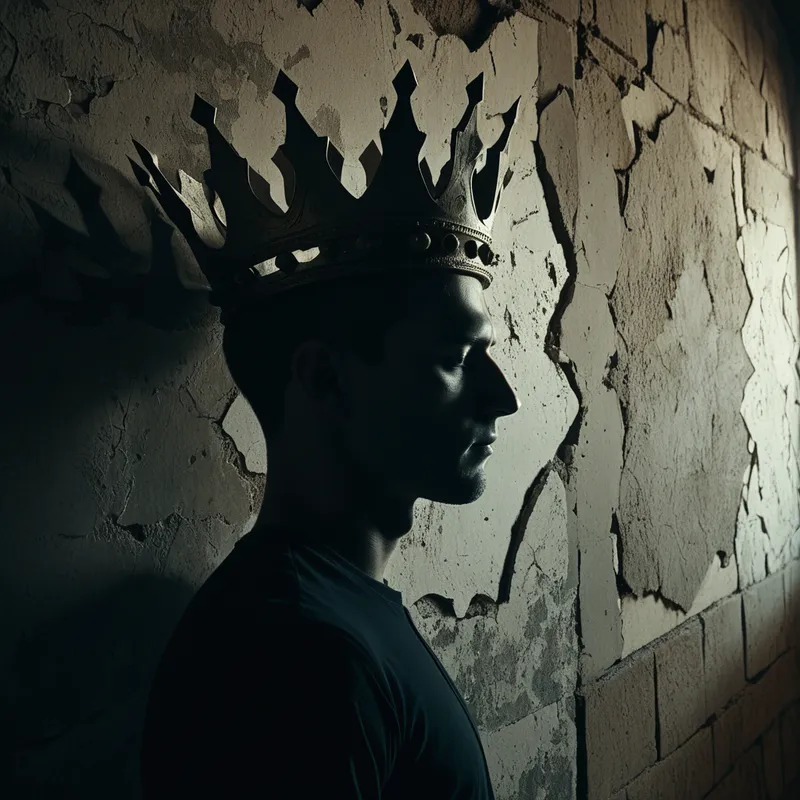
Dreaming of wearing a crown that is too heavy, or that burns, or that attracts attacks, signals what Jung called “the inflation.” The ego has prematurely identified with the Self. The dreamer may be taking on too much responsibility, suffering the burdens of leadership without the integrated wisdom to bear it, or experiencing a grandiose self-image that is out of touch with reality. The somatic sensation is often one of pressure, a literal headache, or a stiff neck—the body bearing the symbolic weight.
Conversely, dreaming of a crown that fits perfectly, emitting a gentle light, indicates a moment of profound self-acceptance and authentic personal authority. The individual is, however briefly, in alignment with their true purpose and capability.
Alchemical Translation
The alchemical journey is the transformation of base lead (the unconscious, fragmented personality) into spiritual gold (the integrated Self). The myth of the Crown is a perfect map for this individuation process.
The initial [nigredo](/myths/nigredo “Myth from Alchemical culture.”/) is the long, arduous quest, the failure of old identities (warrior, scholar, innocent). The seeker is dissolved in the acid of their own inadequacy. The albedo is the moment of humble acceptance on the mountaintop, the clarity that comes with surrender. The citrinitas is the first glow of understanding, the dawning of a new consciousness.
The alchemical gold is not the metal, but the creation of the Lapis Philosophorum—which is often depicted as a crowned king. To forge the Self is to become sovereign.
The final [rubedo](/myths/rubedo “Myth from Alchemical culture.”/) is the permanent assumption of the Crown’s burden and brilliance. This is not a state of bliss, but of sober, active engagement. The modern individual undergoes this when they stop seeking external validation for their worth (the search for the crown out there) and instead undertake the brutal, interior work of owning their whole story—their talents (jewels) and their flaws (the weighty metal). They become the ruler of their own inner kingdom, imposing compassionate order on their impulses, nurturing their creativity, and taking full responsibility for their life. They realize the crown was never an external reward, but the shape of their own completed spirit.
Associated Symbols
Explore related symbols from the CaleaDream lexicon: