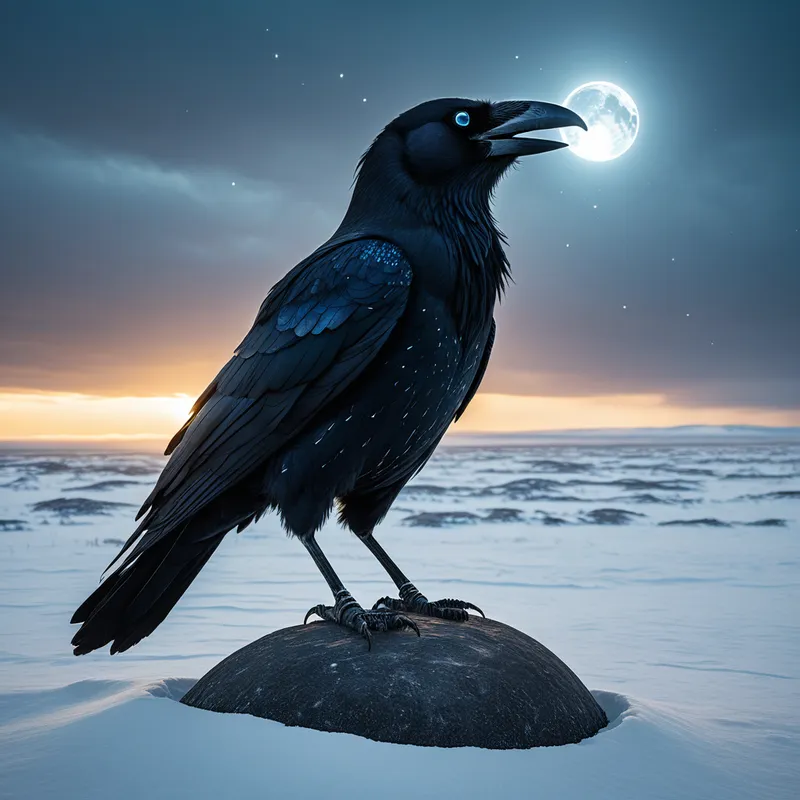
The Crow Creator Koryak Myth Meaning & Symbolism
A myth of the trickster-creator who steals the sun from a selfish spirit, bringing light, order, and life to a world shrouded in primal darkness.
The Tale of The Crow Creator Koryak
In the time before time, when the world was soft and unformed, there was only darkness. Not a gentle night, but a thick, swallowing gloom where the earth and sky were one murky substance. Spirits moved in that gloom, formless and hungry. There was no sun, no moon, no stars to cast a shadow or reveal a shape. Life was a blind, groping thing.
In this eternal twilight lived Kutkh, the Great Raven. But to the people who would later tell his tale, he was simply the Crow, the One Who Walks and Flies. He was not yet a creator, but a restless intelligence in the dark. He could feel the potential of the world—the mountains waiting to be ridges, the rivers waiting for courses, the people waiting for breath—but it was all trapped in the murk.
His sharp eyes, adapted to the dark, perceived a faint, teasing glow far above, in the realm of the Spirit of the Upper World. This spirit had all the light, hoarding it for himself in his celestial dwelling, caring nothing for the struggle below. The Crow felt a great injustice coil within his breast. The world needed light. It needed shape. It needed time—the rhythm of day and night, of seasons and cycles.
So, the Crow began the great ascent. He flew through layers of clinging shadow, past murmuring, jealous spirits, until he reached the borders of the Upper World. There it was: a blinding, beautiful, terrifying sphere of pure radiance, the Sun, resting in the spirit’s lodge. The spirit, vast and possessive, slept beside his treasure.
The Crow knew he could not simply take it. He was cunning. He transformed himself, shrinking, becoming a speck of dust, a mote floating on a sunbeam. He drifted into the lodge, right up to the blazing orb. Then, in one swift and silent motion, he resumed his form, seized the sun in his strong beak, and burst from the dwelling.
A roar of fury shattered the silence of the realms. The Spirit of the Upper World awoke, his light stolen! The Crow flew with desperate speed, the sun burning in his mouth, a comet streaking through the void. The spirit gave chase, his wrath manifesting as storms and thunder.
What followed was the first great drama of the cosmos. The Crow dove, twisted, and soared, the furious spirit close behind. As he flew, the light he carried did not just illuminate his path; it created his path. Where the sun’s rays touched the formless murk, mountains rose up, hard and definite. Valleys were carved by the trailing light. Rivers sparked into being, reflecting the new brilliance.
Exhausted, pursued, the Crow knew he could not keep the sun whole. With a cry that was both a lament and a strategy, he struck the sun against the sharp peak of a newly formed mountain. It shattered into countless pieces.
The largest piece remained the sun, which he hurled into the sky to begin its journey. Other fragments became the moon and the stars, scattered across the celestial blanket. The smallest, glowing embers fell to earth and became the first fires in the hearths of the first people, whom the Crow, with the last of his strength, now shaped from clay and animated with his breath.
The Spirit of the Upper World, seeing the light now irrevocably dispersed, woven into the very fabric of the world, ceased his chase. His monopoly was broken. Order—beautiful, harsh, life-giving order—was established from the chaos of his selfish hoard. The Crow, now truly Koryak, looked upon a world of contrast, of day and night, of land and sky, and he rested. The theft was complete. Creation had begun.
Cultural Origins & Context
This myth belongs to the Koryak people, with close relatives among the Itelmen and Chukchi. It is a cornerstone of their oral tradition, a narrative held not in books but in the memory and voice of the community. It was traditionally told by elders and shamans, especially during the long, dark winter nights, when the absence of the sun was a palpable, living reality. The telling was an act of remembrance and of power—re-enacting the primordial theft to ensure the sun’s return would continue.
Its societal function was multifaceted. It was a cosmogony, explaining the origin of the world’s fundamental structures. It was an ethical lesson about the distribution of resources, critiquing hoarding and championing the cunning intelligence required to secure communal survival. Most importantly, it established the paradoxical nature of the sacred: the creator is a trickster; order is born from an act of transgression; the greatest gift is something stolen. This imbued the Koryak worldview with a profound pragmatism and resilience, where humor, adaptability, and cleverness were sacred virtues, not mere survival skills.
Symbolic Architecture
At its [heart](/symbols/heart “Symbol: The heart symbolizes love, emotion, and the core of one’s existence, representing deep connections with others and self.”/), this is a myth about the [emergence](/symbols/emergence “Symbol: A process of coming into being, rising from obscurity, or breaking through a barrier, often representing birth, transformation, or revelation.”/) of [consciousness](/symbols/consciousness “Symbol: Consciousness represents the state of awareness and perception, encompassing thoughts, feelings, and experiences.”/) from the undifferentiated unconscious. The primal darkness is the state of psychic unity with no [separation](/symbols/separation “Symbol: A spiritual or mythic division between realms, states of being, or consciousness, often marking a transition or loss of connection.”/), no ego, no distinction between self and other. It is potential, but it is also stagnation.
The light is not invented; it is discovered, coveted, and wrested from a realm that refuses to share it. Consciousness begins with a theft from the gods.
The [Spirit](/symbols/spirit “Symbol: Spirit symbolizes the essence of life, vitality, and the spiritual journey of the individual.”/) of the Upper World represents a psychic complex of [inflation](/symbols/inflation “Symbol: A dream symbol representing feelings of diminishing value, loss of control, or expansion beyond sustainable limits in one’s life or psyche.”/) or selfish containment—the archetypal [energy](/symbols/energy “Symbol: Energy symbolizes vitality, motivation, and the drive that fuels actions and ambitions.”/) that hoards its potential, refusing to engage with the “lower” world of matter, instinct, and [human](/symbols/human “Symbol: The symbol of a human represents individuality, complexity of emotions, and social relationships.”/) [life](/symbols/life “Symbol: The symbol of ‘Life’ represents a journey of growth, interconnectedness, and existential meaning, encompassing both the joys and challenges that define human experience.”/). The Crow [Creator](/symbols/creator “Symbol: A figure representing ultimate origin, divine power, or profound authorship. Often embodies the source of existence, innovation, or personal destiny.”/) is the archetypal [Trickster](/symbols/trickster “Symbol: A boundary-crossing archetype representing chaos, transformation, and the subversion of norms through cunning and humor.”/) who initiates the necessary [rupture](/symbols/rupture “Symbol: A sudden break or tear in continuity, often representing abrupt change, separation, or the shattering of established patterns.”/). His theft is the primal act of ego-formation: seizing a [piece](/symbols/piece “Symbol: A ‘piece’ in dreams often symbolizes a fragment of the self or a situation that requires integration, reflection, or understanding.”/) of the transcendental Self (the light) to illuminate the personal [realm](/symbols/realm “Symbol: The symbol of ‘Realm’ often signifies the boundaries of one’s consciousness, experiences, or emotional states, suggesting aspects of reality that are either explored or ignored.”/). The shattering of the sun symbolizes the [fragmentation](/symbols/fragmentation “Symbol: The experience of breaking apart, losing cohesion, or being separated into pieces. Often represents disintegration of self, relationships, or reality.”/) of this pure consciousness into the manifold phenomena of the experienced world—thoughts, feelings, perceptions, and the cycles of time that define mortal [life](/symbols/life “Symbol: The symbol of ‘Life’ represents a journey of growth, interconnectedness, and existential meaning, encompassing both the joys and challenges that define human experience.”/).
The Dreamer’s Resonance
When this mythic pattern stirs in the modern dreamer, it often signals a profound inner rebellion against a state of psychic “hoarding.” One may dream of stealing a precious jewel from a fortified castle, finding a hidden light source in a childhood basement, or being pursued after taking a forbidden book.
Somatically, this can feel like a tightness in the chest or jaw—the holding of the stolen light. Psychologically, it is the process of claiming one’s own authority, one’s own “light” of insight, talent, or vitality, from an internalized “Upper World.” This internal authority might be a parental complex, a rigid dogma, or a perfectionistic ideal that has kept one’s essential energy locked away. The dreamer is the Crow, engaging in a necessary, terrifying, and ultimately creative act of self-liberation. The ensuing “chase” in the dream mirrors the inner critic’s or superego’s wrath at this act of individuation.
Alchemical Translation
The alchemical journey mirrored here is the opus contra naturam—the work against nature, or more precisely, against the current nature. The initial state (the prima materia) is the dark, undifferentiated psyche. The Crow’s flight is the arduous, perilous work of distillation and separation (separatio).
The goal is not to become the hoarder of light, but to become the agent of its distribution, shattering one’s brilliant, isolated insight into the practical, warming fires of daily life and relationship.
First, one must recognize the “light” held captive—often a disowned power or a numinous potential perceived as belonging to an “other” (a parent, a mentor, an ideal). The “theft” is the courageous, perhaps guilt-inducing, act of internalizing it: “This insight is mine. This voice is mine. This authority is mine.” The pursuit and the shattering are crucial. They represent the confrontation with the consequences of this act and the necessary sacrifice of wholeness for multiplicity. The pure, singular “sun” of potential must be broken into the “moon” of reflection, the “stars” of guiding ideas, and the “hearth fires” of embodied, grounded action. The final stage is coniunctio, not a return to unity, but a new synthesis where the once-stolen light now illuminates and structures the entire landscape of the self, creating a world where consciousness and instinct, spirit and matter, exist in a dynamic, creative tension.
Associated Symbols
Explore related symbols from the CaleaDream lexicon:
- Bird — The Crow as the avian messenger and thief, representing the ability to traverse realms (conscious/unconscious) and the aerial perspective of the trickster-intellect.
- Creator — The ultimate identity Koryak earns, transforming from a simple bird into the shaper of worlds through a definitive, transgressive act.
- Theft — The central, sacred crime that initiates all creation, symbolizing the necessary appropriation of power or consciousness from a higher, withholding authority.
- Light — The primordial object of desire, representing consciousness, enlightenment, order, and the fundamental principle that structures chaos.
- Darkness — The original, formless state of potential and unity, but also of stagnation and blindness, from which all distinct things must emerge.
- Sky — The realm of the hoarding spirit, representing distant ideals, spiritual inflation, and that which is perceived as above and separate from earthly concerns.
- Mountain — The tool and the result; the sharp peak shatters the sun, and mountains are formed by the light’s passage, symbolizing the enduring, structural consequences of the creative act.
- Fire — The fragmented, earthly form of the stolen light, representing domesticated spirit, warmth, hearth, and the practical application of divine energy in human community.
- Journey — The Crow’s desperate flight, which is itself the act of creation, modeling the psychic journey where the process is the transformation.
- Trickster — The essential archetype embodied by Koryak, the amoral, cunning agent of change who breaks stagnant systems to allow for new life.
- Shadow — Represented both by the primal darkness and the Crow himself as a dark figure who brings light, integrating the idea that illumination often comes from a rejected or “shadowy” part of the psyche.
- Spirit — The hoarding entity of the Upper World, representing a complex or archetype that possesses but does not share life-giving energy, requiring confrontation and integration.