The Crossroads Myth Meaning & Symbolism
A tale of a mortal at a sacred intersection, facing a threefold goddess who offers a choice that will define their soul's journey.
The Tale of The Crossroads
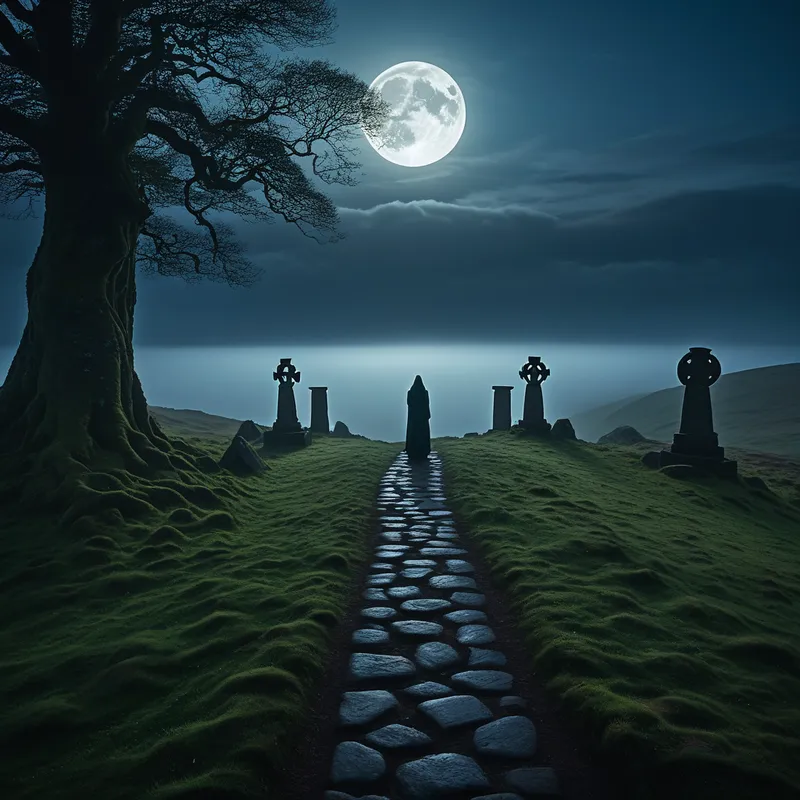
Listen. The road is long, and the day is failing. The light bleeds from [the sky](/myths/the-sky “Myth from Persian culture.”/) into the purple hills, and [the wind](/myths/the-wind “Myth from Various culture.”/) carries the scent of damp earth and distant hearth-fires. You have walked until your bones ache with the memory of stone, guided by stars now hidden behind a veil of cloud. Your purpose is a fading ember in your chest. And then, you see it.
Not a fork, not a mere parting of ways. A true place of meeting. Three roads converge in a clearing where the [hawthorn](/myths/hawthorn “Myth from Celtic culture.”/) grows thick and twisted. The air here is still, charged, older than the oaks. This is no place built by mortal hands. This is a [limen](/myths/limen “Myth from Roman culture.”/), a seam in [the world](/myths/the-world “Myth from Tarot culture.”/). You feel watched by the very stones.
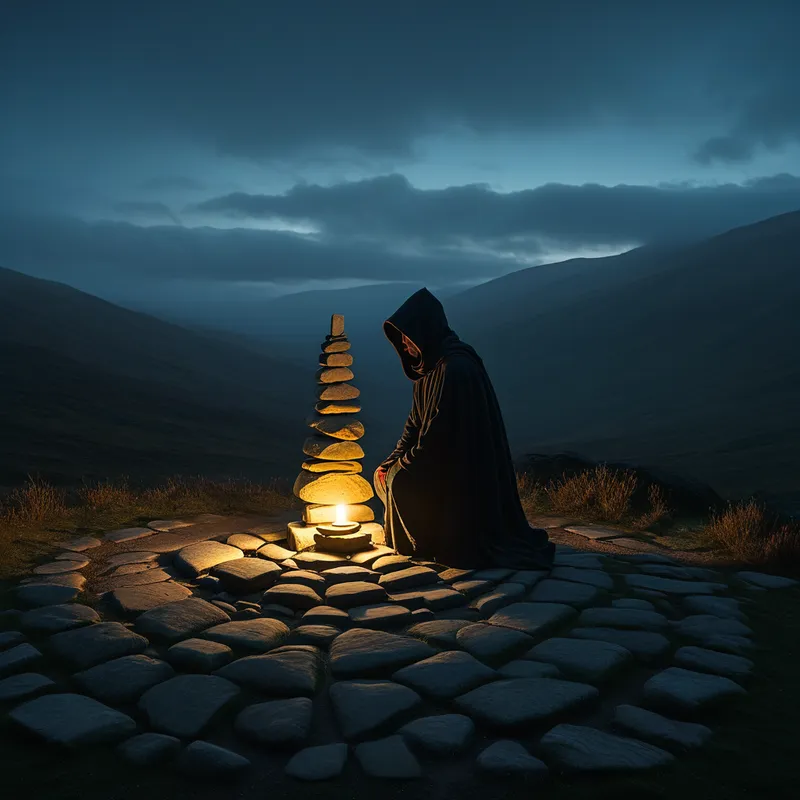
You make your offering—a crust of bread, a worn coin, a strand of hair—and place it on the cairn that rises like a silent sentinel at the center. The last light vanishes. Darkness pools. And then, a soft glow emanates from the cairn itself, not fire, but a cold, phosphorescent light.
From [the mist](/myths/the-mist “Myth from Celtic culture.”/) of the eastern path, a figure steps forth. She is young, her face unlined, her eyes bright with the promise of dawn. She holds a spindle, the wool unspun. “This way,” her voice is the sound of a spring brook. “Here lies beginning. Untested potential. The first breath of a song. Come, and all will be new.”
From the southern path, the mist parts for a woman in her full strength. Her gaze is steady, her hands capable. She holds a cup, brimming with what looks like dark wine or deep [water](/myths/water “Myth from Chinese culture.”/). “This way,” her voice is the warmth of a well-tended hearth. “Here lies substance. The weaving of the thread. Love, labor, the full weight of life. Come, and know meaning.”
From the western path, the mist coalesces into a form bent with age, yet radiating a terrible, serene power. Her eyes are pools of starless night. She holds a pair of shears, their blades gleaming. “This way,” her voice is the rustle of dry leaves, the whisper of a closing door. “Here lies release. The cutting of the thread. Wisdom earned, burdens laid down. Come, and find rest.”
They are three, yet they are one. The Morrígna in her terrible sovereignty. They do not command. They simply are. They present the roads, the raw materials of destiny. The choice—the terrifying, glorious burden of the choice—is yours alone. The wind holds its breath. Your heart is the only drum in the silence. To choose a path is to choose a self, to step into a story whose ending you cannot see. You look at the maiden’s spindle, the mother’s cup, [the crone](/myths/the-crone “Myth from Celtic culture.”/)’s shears. You take a step.
Cultural Origins & Context
The crossroads myth is not a single, codified story from a Celtic sacred text, but a powerful narrative pattern woven into the fabric of pre-Christian Celtic worldview, later preserved in folklore, place-name lore, and medieval Irish and Welsh literature. It emerges from an animistic landscape where every river, grove, and hill could be numinous. The crossroads was a uniquely potent [nemeton](/myths/nemeton “Myth from Celtic culture.”/).
As a literal intersection of human travel, it was a place of practical meeting and potential danger. Symbolically, it was a point where the ordered world of the tribe (tuath) met the untamed, chaotic potency of the [Otherworld](/myths/otherworld “Myth from Celtic culture.”/). It was a place for leaving offerings to appease spirits, for conducting certain rites (including some later stigmatized), and for burial of outcasts, literally placing them “outside” the community’s linear path.
The telling of such tales was the domain of the fili and later, the seanchaí. Its function was multifaceted: to explain the numinous anxiety felt at such places, to teach about the nature of choice and consequence, and to map the psychological landscape of a people for whom destiny (geis) was a active, weaving force, not a fixed script. The myth served as a cultural container for the profound anxiety and awe of existential choice.
Symbolic Architecture
At its core, the [Crossroads](/symbols/crossroads “Symbol: A powerful spiritual symbol representing a critical decision point where paths diverge, often associated with fate, transformation, and life-altering choices.”/) is the archetypal [symbol](/symbols/symbol “Symbol: A symbol can represent an idea, concept, or belief, serving as a powerful tool for communication and understanding.”/) of the critical [juncture](/symbols/juncture “Symbol: A critical point of decision, transition, or convergence where paths, choices, or timelines meet, demanding action or reflection.”/). It is the embodied [moment](/symbols/moment “Symbol: The symbol of a ‘moment’ embodies the significance of transient experiences that encapsulate emotional depth or pivotal transformations in life.”/) of [crisis](/symbols/crisis “Symbol: A crisis symbolizes turmoil, urgent challenges, and the need for immediate resolution or change.”/), [decision](/symbols/decision “Symbol: A decision in a dream reflects the choices one faces in waking life and can symbolize the pursuit of clarity and resolution.”/), and transformation. The three roads are never mere geographical [options](/symbols/options “Symbol: The presence of multiple potential paths or choices, representing freedom, uncertainty, and the burden or opportunity of decision-making.”/); they represent the tripartite [structure](/symbols/structure “Symbol: Structure in dreams often symbolizes stability, organization, and the framework of one’s life, reflecting how one perceives their environment and personal life.”/) of [reality](/symbols/reality “Symbol: Reality signifies the state of existence and perception, often reflecting one’s understanding of truth and life experiences.”/) and [psyche](/myths/psyche “Myth from Greek culture.”/) so central to Celtic thought.
The Crossroads is not about finding the right path, but about becoming the person capable of choosing any path at all.
The three paths offered by the [goddess](/symbols/goddess “Symbol: The goddess symbolizes feminine power, divinity, and the nurturing aspects of life, embodying creation and wisdom.”/)—often interpreted through the [lens](/symbols/lens “Symbol: A lens in dreams represents focus, perspective, clarity, or distortion in how one perceives reality, art, or self.”/) of the [triple goddess](/myths/triple-goddess “Myth from Celtic culture.”/) as Maiden (potential), [Mother](/symbols/mother “Symbol: The symbol of ‘Mother’ represents nurturing, protection, and the foundational aspect of one’s emotional being, often associated with comfort and unconditional love.”/) (actualization), and Crone ([dissolution](/symbols/dissolution “Symbol: The process of breaking down, dispersing, or losing form, often representing transformation, release, or the end of a state of being.”/))—represent the full cycle of existence. To choose one is to necessarily engage with its counterparts. Choosing the [path](/symbols/path “Symbol: The ‘path’ symbolizes a journey, choices, and the direction one’s life is taking, often representing individual growth and exploration.”/) of the [Mother](/symbols/mother “Symbol: The symbol of ‘Mother’ represents nurturing, protection, and the foundational aspect of one’s emotional being, often associated with comfort and unconditional love.”/) means eventually facing the Crone’s shears. The [hero](/symbols/hero “Symbol: A hero embodies strength, courage, and the ability to overcome significant challenges.”/) at the crossroads is the [human](/symbols/human “Symbol: The symbol of a human represents individuality, complexity of emotions, and social relationships.”/) ego, conscious but limited, confronted by [the Self](/myths/the-self “Myth from Jungian culture.”/) in its totality. The offering is the crucial act of humility and reciprocity, acknowledging that one’s [choice](/symbols/choice “Symbol: The concept of choice often embodies decision-making, freedom, and the multitude of paths available in life.”/) is part of a larger, sacred [dialogue](/symbols/dialogue “Symbol: Conversation or exchange between characters, representing communication, relationships, and narrative flow in games and leisure activities.”/), not an act of solitary will. The figure of the [goddess](/symbols/goddess “Symbol: The goddess symbolizes feminine power, divinity, and the nurturing aspects of life, embodying creation and wisdom.”/), especially in her crone [aspect](/symbols/aspect “Symbol: A distinct feature, quality, or perspective of something, often representing a partial view of a larger whole.”/) as a [fate](/symbols/fate “Symbol: Fate represents the belief in predetermined outcomes, suggesting that some aspects of life are beyond human control.”/)-weaver, embodies the unconscious itself—not as a repository of repressed [trauma](/symbols/trauma “Symbol: A deeply distressing or disturbing experience that overwhelms the psyche, often manifesting in dreams as unresolved emotional wounds or psychological injury.”/), but as the vast, [pattern](/symbols/pattern “Symbol: A ‘Pattern’ in dreams often signifies the underlying structure of experiences and thoughts, representing both order and the repetitiveness of life’s situations.”/)-making intelligence of the psyche that presents us with our destinies in the form of choices.
The Dreamer’s Resonance
When the Crossroads appears in a modern dream, it signals that the dreamer’s psyche is at a critical point of differentiation. This is not about choosing a job or a partner, but about choosing a fundamental orientation of the soul. The somatic experience is often one of paralysis, awe, or a chilling clarity.
The three paths may manifest as three doors, three people offering conflicting advice, or three versions of the dreamer’s own life. The looming, numinous presence—the goddess, a shrouded figure, a silent animal—is the embodiment of the Self, the organizing principle of the totality of the psyche, presenting the dreamer with the archetypal possibilities for growth. To dream of standing frozen, unable to choose, reflects a conscious ego terrified of committing to a direction that will necessitate the death of other potential selves. To dream of choosing a path and feeling a surge of both terror and rightness indicates [the ego](/myths/the-ego “Myth from Jungian culture.”/)’s alignment with a deeper, individuating impulse. The dream crossroads is the psyche’s innate ritual space for enacting the drama of becoming.
Alchemical Translation
The alchemical process mirrored in the Crossroads myth is the [nigredo](/myths/nigredo “Myth from Alchemical culture.”/), the crucial descent into confusion and the confrontation with opposing forces. For the modern individual, the “crossroads” is any life situation where previously held identities, values, or narratives break down, leaving one in a state of disorienting, fertile potential—[the dark night of the soul](/myths/the-dark-night-of-the-soul “Myth from Christian Mysticism culture.”/).
The psychic transmutation begins not with the first step on the new path, but in the agonizing, sacred pause before any step is taken.
The three goddesses represent the psychic complexes and archetypal energies that pull us in different directions: the puer/puella (eternal youth), the responsible ego (the mother/father), and the senex (the wise but death-dealing old one). The alchemical work is to hold this tension of opposites without fleeing into one pole or another. The “offering” is the conscious sacrifice of the ego’s illusion of total control, surrendering to a process larger than itself. The choice that follows is then not a mere selection, but a coniunctio oppositorum—a marriage of opposites within the soul. By consciously engaging with the Crone (accepting limitation, death, and ending) as part of the choice, one integrates shadow and accepts fate, transforming a literal crisis into a symbolic crucible. The individual emerges not just on a new life path, but with a more capacious psyche, having internalized the crossroads itself as an inner faculty for navigating destiny.
Associated Symbols
Explore related symbols from the CaleaDream lexicon: