
The Crone Myth Meaning & Symbolism
The Crone, a Celtic goddess of winter, offers a cup of forgetting and wisdom, testing the hero's courage to face the dark and be reborn.
The Tale of The Crone
Listen. The wind does not just blow; it carries the breath of the Cailleach. In the time when the world was raw bone and the memory of stone, when the sun was a weakling child fleeing the horizon, there was a king whose realm was gripped in the fist of an endless winter. No spring song came. No green shoot dared break the iron earth. His people, their breath frosting in the perpetual gloom, whispered of the one who held the seasons hostage: the Cailleach Bheur.
The king, whose name is lost to all but the ravens, was a man of summer deeds. His valor was for the clash of bright spears, his wisdom for the feasting hall. This silent, grey dying was a foe he could not fight. Desperate, he sought the counsel of the last druid, a man so old he seemed carved from yew root. “You seek the source of the cold,” the druid whispered, his voice like dry leaves. “Journey to the cairn at the mountain’s heart, where the bones of the earth pierce the sky. There you will find her. You will ask for the return of the sun. But know this: she will offer you a drink. To refuse is to be frozen where you stand. To accept… is a journey from which not all return.”
Through landscapes of skeletal trees and over rivers sighing under plates of ice, the king traveled. He forgot the feel of grass. His world narrowed to the crunch of frost and the ache in his bones. At last, he reached the high place—a ring of teeth-like stones crowned with snow. And in the center, by a fire that gave no warmth, only a shifting, blue light, she sat.
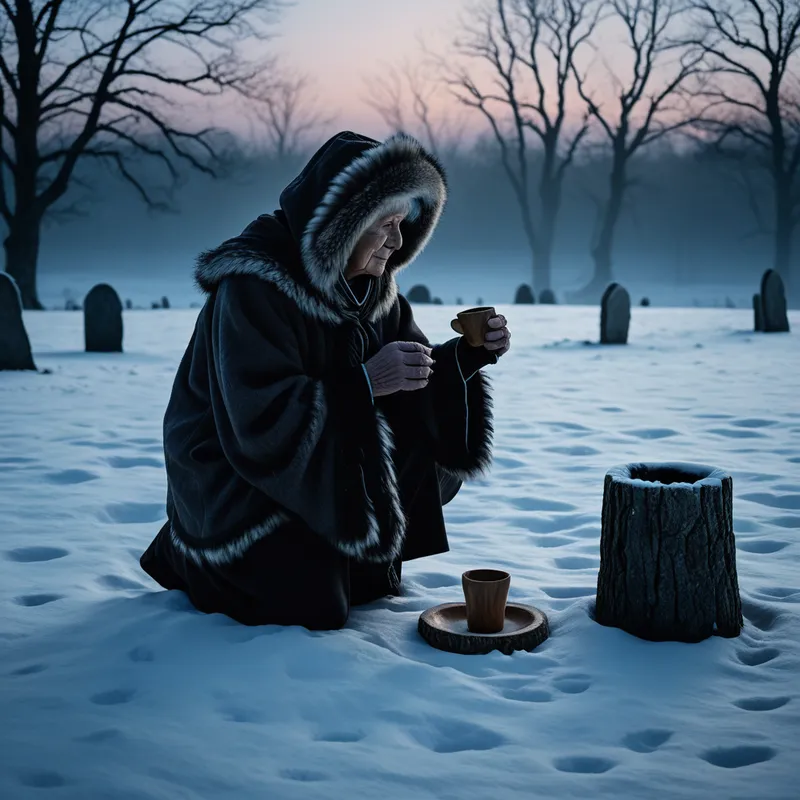
She was not a monster of storybook fright. She was older. Her face was a map of erosion, her hair the color of a snow-laden cloud at twilight. Her eyes were not cruel, but held the terrible, patient clarity of a deep lake that has witnessed epochs sink beneath its surface. In her hands was a cup of plain, dark wood.
“You have come far, little king of the fleeting fires,” she said, and her voice was the crack of glacier ice. “You seek an end to my reign. You seek life. But first, you must drink of my hospitality.”
She extended the cup. A scent rose from it—not of herbs or mead, but of cold stone, of damp earth, of the profound silence under the roots of the world. It was the smell of forgetting: forgetting summer’s sweat, a lover’s warmth, the very sound of one’s own name. This was the test. Not a battle of strength, but of surrender.
The king’s summer heart recoiled. Every instinct screamed to dash the cup aside, to draw his sword against this embodiment of the end. He saw his own death in that dark liquid. But then he saw the faces of his people, grey with cold. He heard the druid’s words. This was the only path.
With hands that trembled not from the cold, but from the dissolution of his very self, he took the cup. He met the Cailleach’s fathomless gaze. And he drank.
The world did not go black. It went through. He felt the sap retreat from the trees, the bear’s heart slow in its den, the mountain’s immense, grinding patience. He felt the necessary death that makes the seed germinate. He was not destroyed; he was unmade into his constituent parts—fear, pride, identity—and scattered like ash on the wind. For a moment that was an age, he was nothing but the cold truth.
And then, from that nothingness, a spark. A memory not of his own life, but of Life itself. A warmth that did not fight the cold, but was born from its very essence. He opened eyes he did not know he had closed. The cup was empty. The Cailleach was gone. The fire was out.
But where blue light had been, the first, fragile gold of dawn now touched the highest stone. And at his feet, where ice had been, a single, defiant snowdrop bowed its white head.
Cultural Origins & Context
The figure of the Cailleach is not a singular character from one tale, but a pervasive archetype woven into the Gaelic landscapes of Scotland, Ireland, and the Isle of Man. She is the divine hag, the personification of winter and the sovereign of the wild, untamed places. These stories were not preserved in a single sacred text but lived in the oral tradition, told by the fireside during the long, dark months she herself ruled. They were topographic myths; many local features—a strangely shaped mountain, a scattering of boulders—were explained as her discarded staff or stones dropped from her apron.
Her societal function was multifaceted. As a weather spirit, she explained the necessary, terrifying power of the seasonal cycle. As a creator figure, she was said to have formed the mountains and lochs. But most profoundly, she served as the ultimate reminder of mortality, decay, and the raw, amoral power of nature that human order must ultimately acknowledge and accommodate. She was the antidote to hubris, the cold water on the fire of human presumption. The stories of encountering her were cautionary and initiatory, teaching that wisdom is not won through dominance, but through a terrifying, respectful engagement with that which is greater and older than oneself.
Symbolic Architecture
The Crone is the embodiment of the anima in its most profound and challenging form: not as a muse or lover, but as the Wise Woman who presides over the dissolution of the ego. She represents the psychic principle of necessary ending.
The cup she offers is not poison, but the bitter draught of truth—the truth of limitation, of mortality, of all that the conscious personality has refused to acknowledge.
The king represents the conscious ego, ruling its “summer” realm of known territories, achievements, and identity. The endless winter is the stagnation that occurs when the ego refuses to engage with the deeper, colder layers of the unconscious. The journey to the mountain cairn is the descent into the self, the approach to the prima materia of the soul. The drink is the voluntary ingestion of shadow—the acceptance of one’s own darkness, fragility, and ultimate powerlessness in the face of nature and time. The transformation is not into something “better,” but into something true: an individual who has internalized the reality of winter and thus can authentically welcome the spring.

The Dreamer’s Resonance
When this myth stirs in the modern dreamer, it often announces a profound psychological winter. Dreams of being lost in a frozen landscape, of meeting a formidable, ancient woman in a barren place, or of being forced to drink something unsettling are somatic signals of a deep, initiatory process.
The psyche is compelling the ego to confront what it has iced over: a long-avoided grief, the death of a life phase (a career, a relationship, a self-image), or the chilling realization of one’s own ignored capacities for coldness or harshness. The somatic feeling is often one of literal coldness upon waking, a sense of dread, or a heavy, mineral stillness. This is not a nightmare to be dismissed, but a sacred summons. The dream is the inner Cailleach calling the dreamer to the high cairn of self-confrontation. The anxiety is the ego’s rightful terror at being asked to drink from the cup of its own dissolution. The process underway is the freezing out of old, outworn attitudes so that a more resilient and authentic structure of being can eventually form.

Alchemical Translation
The alchemy modeled here is the nigredo—the blackening, the descent into the dark night of the soul. In the vessel of one’s own life, the heat of ambition and the light of identity are withdrawn, leaving only the cold, heavy residue of what is real.
The triumph of the myth is not the slaying of the Crone, but the king’s surrender to her rite. The psychic transmutation occurs in the swallowing of the cold truth.
For the modern individual, this translates to the courage to consciously endure a period of depression, stagnation, or loss of meaning without rushing to “fix” it with false optimism. It is the will to sit in the “cairn” of one’s own despair and accept the cup of what is: “My marriage is over.” “My body is failing.” “The dream I pursued is ashes.” This ingestion is the beginning of individuation. By metabolizing the cold fact, its energy is transmuted. The winter within is not conquered, but integrated. The ego, having died to its old form, finds it is not annihilated but paradoxically strengthened by its humility. It gains the Cailleach’s own qualities: the patience of stone, the clarity of frozen air, the deep, unshakeable wisdom that knows death is not the opposite of life, but its most intimate teacher. From this place, any new growth—the snowdrop of a new beginning—is authentic, rooted in the deep, dark earth of accepted reality, and capable of weathering all seasons to come.
Associated Symbols
Explore related symbols from the CaleaDream lexicon: