The Creation of the First Humans Myth Meaning & Symbolism
A trickster Raven, a lonely giant, and a handful of earth become the first humans in a myth of loneliness, creation, and the birth of consciousness.
The Tale of The Creation of the First Humans
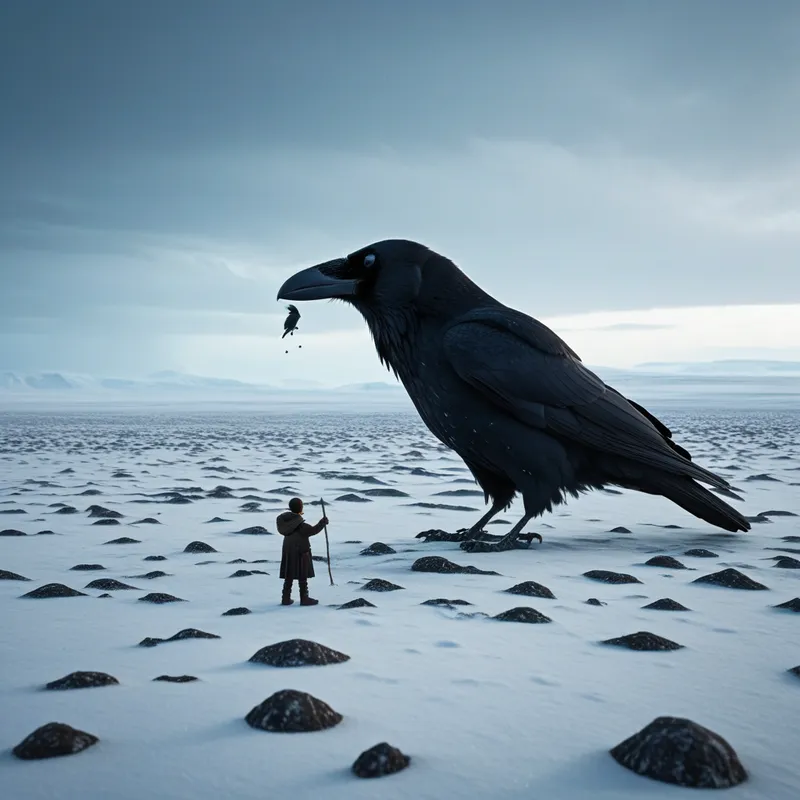
In the time before time, when the world was new and vast and terribly quiet, there lived a giant. He was not a god of thunder or a spirit of the storm, but a being of immense solitude, named Arnaqquasaaq. The world was his alone—endless plains of stone, mountains that scraped a sky empty of birds, and a silence so deep it was a presence itself. He walked the empty earth, and his footsteps were the only sound. He drank from lakes that reflected only his own lonely face. He was the world, and the world was him, and in that unity was an ache without a name.
One day, as he sat by a shore, shaping pebbles for want of anything else to do, a shadow flickered at the corner of his eye. It was Raven. Black as a hole in the world, clever and curious, Raven had been flying across the void, seeking something interesting. He saw the giant’s profound loneliness, not as a pity, but as a puzzle. A problem to be solved. Raven landed, a speck of darkness against the giant’s knee.
“Why do you sit here, so large and so alone?” Raven asked, his voice a clever crackle in the silence.
The giant sighed, a wind that stirred the dust for miles. “There is nothing else. I am all that is. To be alone is simply to be.”
Raven tilted his head. “But what if you were not alone? What if there were others to talk to, to share the seals you catch, to laugh with?”
The concept was so foreign it was like a new color. The giant’s heart, a slow drum in the vast cavern of his chest, beat a little faster. “Others? How could there be others? They are not here.”
“They could be,” Raven said, his eye glinting. “But I will need something from you. A piece of the world itself.”
Intrigued, the giant agreed. Raven instructed him to lie upon the bare earth, upon a great, flat plain of stone and hard-packed soil. The giant did so, his form covering the land like a mountain range settling to sleep. Then Raven, with his sharp beak, began to work. He did not attack or wound. He pecked and scratched at the earth around the giant’s immense body, carefully, deliberately. He loosened the soil from the places where the giant’s sides met the ground, from the curve of his arm, from the space beside his great leg.
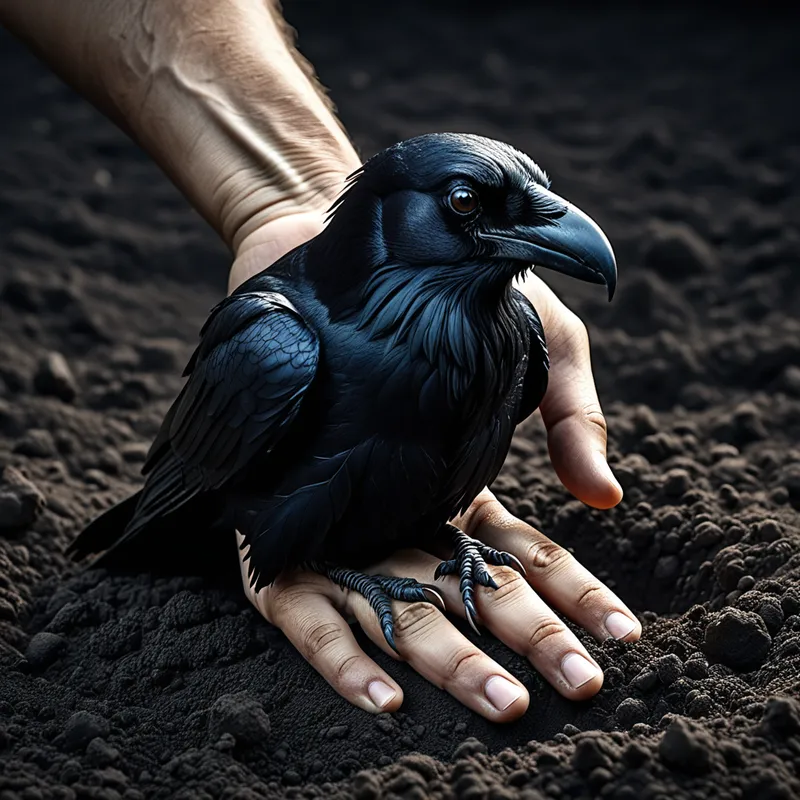
When he had a small pile of dark, rich earth, Raven took it in his beak. He flew to the giant’s upturned palm, which lay open like a barren valley. There, onto the lifeline of that vast hand, Raven placed the handful of earth. He hopped back, watching.
For a long moment, nothing. Then, the earth in the giant’s palm began to stir. It quivered, it shifted. It swelled and formed into shapes—tiny, delicate, intricate shapes. Limbs unfolded, heads lifted. The dark soil became flesh, the granules became eyes that blinked open, looking up in wonder and fear at the colossal face of the giant who held them. They were the first Inung, the first humans. They were born not from a divine breath, but from a union of vast loneliness and clever intervention, from the very ground of being, placed into the hand of their progenitor.
The giant felt a warmth in his palm he had never known. The silence was broken by soft, murmuring voices. The ache had found its name, and its name was not loneliness anymore, but connection. Raven, his work done, gave a satisfied kraa and took to the sky, leaving the giant and his new, small people to discover what it meant to be a world shared.
Cultural Origins & Context
This creation narrative, with variations, is central to the Inuit worldview across the Arctic, from Greenland to Alaska. It was not a scripture, but a living story passed down through generations by elders, often during the long winter nights in the qarmaq or iglu. The storyteller was a vital community figure, using rhythm, repetition, and gesture to weave the tale into the fabric of collective memory.
Its function was multifaceted. Primarily, it established a sacred and intimate relationship between the people and the land (nuna). Humans were not placed upon the earth; they were of the earth, literally formed from its soil. This fostered a profound ethic of respect, reciprocity, and sustainability. Secondly, it explained the human condition—our smallness in a vast, powerful world (the giant), and our inherent cleverness, adaptability, and sometimes troublesome nature (Raven’s influence). It was a myth that grounded a people in their environment while giving a spiritual account of their own psyche.
Symbolic Architecture
The myth presents a profound symbolic [triad](/symbols/triad “Symbol: A grouping of three representing spiritual unity, divine completeness, and cosmic balance across many traditions.”/). The Arnaqquasaaq represents the undifferentiated Self, the primal, unconscious state of being. It is totality, but a totality that is [static](/symbols/static “Symbol: Static represents interference, disruption, and the breakdown of clear communication or signal, often evoking feelings of frustration and disconnection.”/), isolated, and unaware of its own parts. It is the psyche before [consciousness](/symbols/consciousness “Symbol: Consciousness represents the state of awareness and perception, encompassing thoughts, feelings, and experiences.”/), containing all potential but expressing [none](/symbols/none “Symbol: The absence represented by ‘none’ can signify emptiness, potential, or a yearning for substance.”/).
[Raven](/symbols/raven “Symbol: The raven is often seen as a messenger of the divine and a symbol of transformation, wisdom, and the mysteries of life and death.”/) is the archetypal [trickster](/symbols/trickster “Symbol: A boundary-crossing archetype representing chaos, transformation, and the subversion of norms through cunning and humor.”/) and the catalyst for consciousness. He is curiosity, intellect, the disruptive spark. He does not create ex nihilo; he rearranges. He takes the substance of the giant (the unconscious) and transforms it. The trickster’s [role](/symbols/role “Symbol: The concept of ‘role’ in dreams often reflects one’s identity or how individuals perceive their place within various social structures.”/) is not evil, but necessary—it is [the principle](/symbols/the-principle “Symbol: A fundamental truth, law, or doctrine that serves as a foundation for a system of belief, behavior, or reasoning, often representing moral or ethical standards.”/) that disturbs [equilibrium](/symbols/equilibrium “Symbol: A state of balance, stability, or harmony between opposing forces, often representing inner peace or external order.”/) to initiate growth.
Creation is not an act of making from nothing, but of seeing the potential in what is already there and daring to rearrange it.
The [handful](/symbols/handful “Symbol: A handful represents possession, control, or the limited capacity to manage aspects of life.”/) of nuna is the crucial [symbol](/symbols/symbol “Symbol: A symbol can represent an idea, concept, or belief, serving as a powerful tool for communication and understanding.”/) of substance and embodiment. It is the raw [material](/symbols/material “Symbol: Material signifies the tangible aspects of life, often representing physical resources, desires, and the physical world’s influence on our existence.”/) of the psyche given form. The act of placing it in the giant’s hand is critical: consciousness (the humans) is held by the larger Self. We are not separate from the unconscious ground of our being; we are borne by it, resting in its [palm](/symbols/palm “Symbol: The palm tree symbolizes resilience, victory, and peace, often associated with tropical climates.”/), in a [relationship](/symbols/relationship “Symbol: A representation of connections we have with others in our lives, often reflecting our emotional state.”/) of dependency and awe.
The Dreamer’s Resonance
When this myth pattern stirs in the modern dreamer, it often manifests as dreams of profound isolation in vast landscapes, or of discovering small, living things (insects, plants, tiny animals) growing in the palm of one’s hand or from one’s own body. One might dream of a clever, annoying, or guiding black bird that disrupts a stagnant situation.
Somatically, this can feel like a deep, existential loneliness—the “giant’s ache”—coupled with a restless, itching curiosity. Psychologically, it signals the psyche’s readiness to differentiate. The dreamer is the giant, whole but unconscious, and the unconscious itself (in the form of the trickster) is initiating a process of “pecking at the edges” of identity. It is the painful but necessary process of disturbing one’s own foundations to gather the material (memories, traits, potentials) from which a more conscious, articulated self can be formed. The dream is an invitation to hold what emerges, not with fear, but with the giant’s awe.
Alchemical Translation
The alchemical process mirrored here is solve et coagula: dissolve and coagulate. The giant’s static, monolithic state is “dissolved” by Raven’s disruptive work. The earth is loosened, separated from its undifferentiated bed. This is the often-uncomfortable stage of analysis, shadow-work, and deconstruction of old, rigid identities.
The “coagulation” is the formation of the humans in the palm. This is the integration phase, where the insights and parts gathered from the unconscious are reassembled into a new, more conscious structure—the individuated self. The giant does not become the humans; he holds them. This is the key to psychic transmutation.
Individuation is not about becoming someone new, but about the eternal Self learning to consciously hold and relate to the many beings it has always contained.
The modern individual’s journey is from being the lonely giant (identified with one dominant complex or a diffuse, unconscious state) to becoming the giant who is in relationship with the created community within. The “first humans” are our own acknowledged subpersonalities, talents, wounds, and drives—now conscious, now in relationship with each other and with the larger, grounding Self. We are both the creator and the created, the holder and the held, learning to live with the creative, trickster energy (Raven) that forever stirs the soil of our being.
Associated Symbols
Explore related symbols from the CaleaDream lexicon:
- Earth — The primordial substance of creation, representing the raw, unconscious material of the psyche from which conscious life is formed and to which it remains fundamentally connected.
- Raven — The trickster-creator, symbolizing the disruptive, clever, and necessary force of curiosity that disturbs stagnation to initiate the process of differentiation and conscious becoming.
- Human — The final product of the myth, representing embodied consciousness, community, and the articulated self that emerges from the undifferentiated ground of being.
- Giant — The vast, primal Self or unconscious totality, representing a state of potential wholeness that is also one of profound isolation before the dawn of relational consciousness.
- Hand — The vessel and interface of creation, symbolizing the capacity of the larger Self to hold, support, and be in conscious relationship with the differentiated aspects of the psyche.
- Seed — The potential latent within the earth, representing the dormant possibilities within the unconscious that require the catalyst of the trickster to sprout into conscious form.
- Creation — The core act of the myth, representing the psychological process of bringing the contents of the unconscious into the light of conscious awareness and form.
- Loneliness — The initial state of the giant, symbolizing the ache of the undifferentiated psyche, the driving tension that makes the journey toward consciousness and relationship necessary.
- Shadow — Represented by Raven’s dark form and disruptive action, it is the unconscious catalyst that, though often unsettling, is essential for growth and the birth of consciousness.
- Dream — The entire mythic process mirrors the dream function of the psyche, where isolated elements of the self are gathered and reconfigured into new, living forms of awareness.