The Creation Chant Kumulipo Myth Meaning & Symbolism
A sacred Hawaiian chant describing the genesis of the cosmos from deep night, unfolding life from coral to gods, connecting all existence through genealogy.
The Tale of The Creation Chant Kumulipo
In the beginning, there was Po. Not a simple darkness, but a deep, thick, fecund night, a living silence pregnant with all possibilities. It was a darkness that was not empty, but full—a womb of potential. From within this eternal Po, the first stirrings began. Not with a bang, but with a whisper of becoming.
The chant begins: O ke au i kahuli wela ka honua… “At the time when the earth became hot…” But this heat is not of fire; it is the first warmth of life stirring in the cosmic deep. From the deep ocean of night, the first life forms emerge: the koakoa (coral), the loli, the wana. They are not grand, but they are the foundation. The chant names them, blesses them, establishes them. This is the first age, the era of the sea-creatures, each generation named in precise order, a genealogy of slime and shell.
Then life climbs onto the land. The chant turns its voice to the creeping things, the grubs and insects that turn the soil. Then to the plants: the tender shoots, the grasses, the great trees whose roots clutch the newborn earth. Each is named, each is placed in its proper familial line. The <abbr title="The Hawaiian god of the forest">ākua</abbr> of the wild places watch as the green world unfolds from the same ancestral source as the sea urchin.
Now the warm-blooded ones arrive. The rats, the dogs, the bats—the children of the land. The chant does not distinguish between “lowly” and “noble”; the rat has its lineage, its place in the great family. The sea continues its own branching: the great fish, the sharks, the turtles, all are recited, their lines intertwining with the life on shore. The <abbr title="The Hawaiian god of the sea">Kanaloa</abbr> presides over this aqueous genealogy.
Finally, the pinnacle of this immense, patient unfolding: the first humans. But they do not appear as conquerors. They are born from the same ancestral root as the coral and the taro plant. The chant names Wākea (the broad sky) and Papa (the earth foundation), whose union brings forth the islands themselves and, ultimately, the Hawaiian people. The divine and the earthly genealogies merge. The long night of Po gives birth to the day of Ao, and every creature, every rock, every gust of wind is recognized as a cherished relative in the single, unbroken ohana of existence. The chant does not end; it simply reaches the present, leaving the listener suspended in a web of profound kinship, hearing the echo of the coral polyp in their own heartbeat.
Cultural Origins & Context
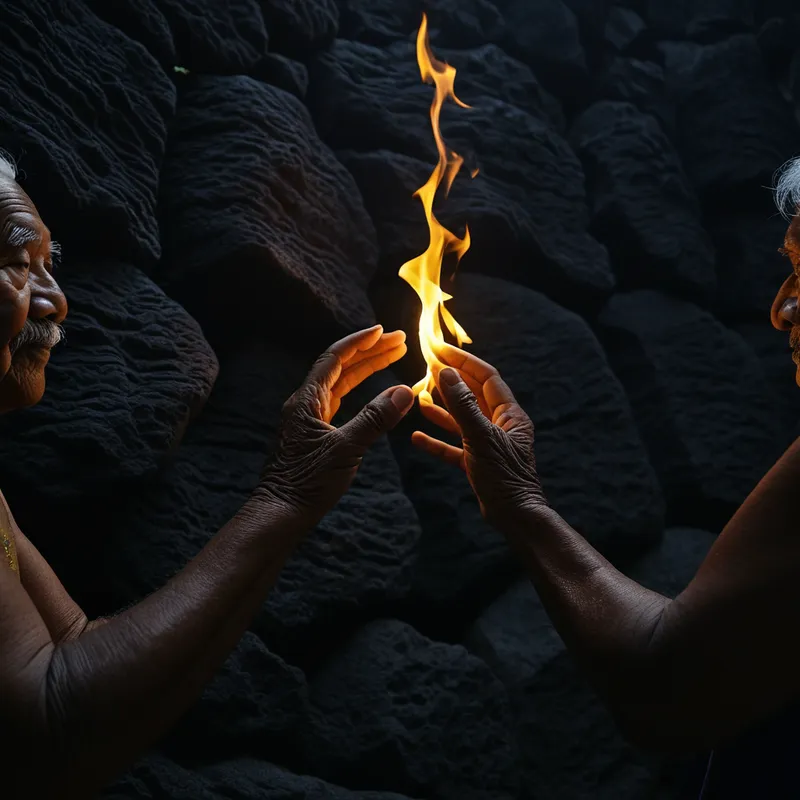
The Kumulipo is not merely a story; it is a sacred genealogy, a mele of the highest order. It is believed to have been composed in the 18th century for the birth of the high chief Kalaninuiʻīamamao, linking him directly back to the very origins of the cosmos, thereby legitimizing his divine right to rule (<abbr title="Sacred power, divine authority">mana</abbr>). Its preservation is a testament to the formidable power of oral tradition. Chanted by trained kahuna, its over 2,000 lines were memorized with exacting precision, for to alter a word was to break the ancestral chain.
Its function was multifaceted: it was a political document, a cosmological map, a religious scripture, and a scientific taxonomy. It provided a framework for understanding humanity’s place within—not above—the natural world. Every aspect of the environment, from the smallest insect to the governing chief, was interconnected through pilina (relationship). To chant the Kumulipo was to perform that connection, to vibrate the threads that bind the universe into a conscious, familial whole.
Symbolic Architecture
The Kumulipo presents a radical symbolic [architecture](/symbols/architecture “Symbol: Architecture in dreams often signifies structure, stability, and the framing of personal identity or life’s journey.”/) centered on genealogy (<abbr title="Genealogy, lineage, backbone">moʻokūʻauhau</abbr>) as the fundamental structuring principle of [reality](/symbols/reality “Symbol: Reality signifies the state of existence and perception, often reflecting one’s understanding of truth and life experiences.”/). The [cosmos](/symbols/cosmos “Symbol: The entire universe as an ordered, harmonious system, often representing the totality of existence, spiritual connection, and the unknown.”/) is not built by a distant architect, but birthed through an unbroken [lineage](/symbols/lineage “Symbol: Represents ancestral heritage, family connections, and the transmission of traits, values, and responsibilities across generations.”/).
The deepest darkness is not void, but the pregnant potential of the unformed self. All consciousness emerges from this inner Po.
The [progression](/symbols/progression “Symbol: Symbolizes forward movement, development, or advancement through stages toward a goal or state of being.”/) from simple sea [life](/symbols/life “Symbol: The symbol of ‘Life’ represents a journey of growth, interconnectedness, and existential meaning, encompassing both the joys and challenges that define human experience.”/) to complex humans is not a [hierarchy](/symbols/hierarchy “Symbol: A structured system of ranking or authority, often representing social order, power dynamics, and one’s position within groups or institutions.”/) of value, but a map of psychic development. The [coral](/symbols/coral “Symbol: A representation of transformation, resilience, and beauty emerging from seemingly harsh environments.”/) represents the most basic, foundational [layer](/symbols/layer “Symbol: Layers often symbolize complexity, depth, and protection in dreams, representing the various aspects of the self or situations.”/) of the unconscious—the instinctual, structural bedrock of the psyche. The plants symbolize the vegetative, feeling [life](/symbols/life “Symbol: The symbol of ‘Life’ represents a journey of growth, interconnectedness, and existential meaning, encompassing both the joys and challenges that define human experience.”/) beginning to reach for light ([consciousness](/symbols/consciousness “Symbol: Consciousness represents the state of awareness and perception, encompassing thoughts, feelings, and experiences.”/)). Animals embody the drives and emotions, and humans represent the [arrival](/symbols/arrival “Symbol: The act of reaching a destination, marking the end of a journey and the beginning of a new phase or state.”/) of self-reflective [awareness](/symbols/awareness “Symbol: Conscious perception of self, surroundings, or internal states. Often signifies awakening, insight, or heightened sensitivity.”/). Yet, crucially, the later stages contain the earlier; our conscious mind is built upon and contains the [coral](/symbols/coral “Symbol: A representation of transformation, resilience, and beauty emerging from seemingly harsh environments.”/), the [grub](/symbols/grub “Symbol: A larval insect symbolizing potential, transformation, and the raw, hidden aspects of life before emergence.”/), the rat.
The [night](/symbols/night “Symbol: Night often symbolizes the unconscious, mystery, and the unknown, representing the realm of dreams and intuition.”/) of <abbr title="The profound, generative night, the source of all existence">Po</abbr> symbolizes the unconscious itself, the [source](/symbols/source “Symbol: The origin point of something, often representing beginnings, nourishment, or the fundamental cause behind phenomena.”/) of all creativity and being. The coming into <abbr title="The world of light, consciousness, and the living">Ao</abbr>, the day, is the [dawn](/symbols/dawn “Symbol: The first light of day, symbolizing new beginnings, hope, and the transition from darkness to illumination.”/) of ego-consciousness. The myth teaches that to be whole, consciousness must acknowledge its [birth](/symbols/birth “Symbol: Birth symbolizes new beginnings, transformation, and the potential for growth and development.”/) from and ongoing kinship with the dark, instinctual, “primitive” layers of the self.
The Dreamer’s Resonance
When the pattern of the Kumulipo stirs in modern dreams, it often signals a profound process of psychic re-origination. The dreamer may experience sequences of evolutionary imagery: floating in dark water, seeing amorphous shapes coalesce, or witnessing a parade of ancient creatures. They may dream of tracing their family tree only to find it includes animals or plants.
Somatically, this can feel like a deep, cellular remembering—a sense of roots growing, of the spine becoming a trunk, of the breath becoming tidal. Psychologically, it is the process of the ego reconnecting to its ancestral layers within the personal and collective unconscious. It is a healing of the modern fracture between the human self and the natural world inside. The dream is performing the chant, naming and integrating the forgotten “relatives” within: the primitive instincts (the coral), the raw emotions (the animals), the deep biological wisdom (the plants). The conflict in such dreams is often the resistance of the conscious mind to this humble but vast genealogy.
Alchemical Translation
The individuation process modeled by the Kumulipo is one of remembering and incorporating one’s entire lineage. The modern psyche, often orphaned and isolated, must undertake the alchemical work of chanting its own moʻokūʻauhau.
Individuation is not about becoming someone new, but about fully remembering who you have always been, all the way back to the source.
The first operation is a descent into one’s personal and collective <abbr title="The profound, generative night, the source of all existence">Po</abbr>—the darkness of the unconscious, not to fight it, but to listen. This is the nigredo, the blackening. Here, one encounters the “coral” of one’s being: the ancient, automatic patterns and survival structures.
The second operation is the patient unfolding, the albedo. One must name and honor each stage of one’s psychic development: the clinging wounds (the sea urchin), the creeping anxieties (the insects), the flowering potentials (the plants), the passionate drives (the animals). This is not an intellectual exercise, but a ritual of recognition, granting each aspect its rightful place in the internal family.
The final transmutation, the rubedo, is the realization of kinship. The conscious ego, born last in this psychic genealogy, understands it is not the ruler, but the current flowering of a deep, ancient tree. It assumes responsibility not through domination, but through stewardship of its vast internal ecosystem. The psyche becomes a harmonious ahupuaa` (a land division from mountain to sea), where every layer, from deepest instinct to spiritual aspiration, is recognized as interdependent and sacred. The self is no longer a solitary point, but a living chant connecting the deep night to the breaking dawn.
Associated Symbols
Explore related symbols from the CaleaDream lexicon:
- Ocean — The primordial Po itself, the dark, watery unconscious from which all life and consciousness first emerges and is forever nourished.
- Night — Represents the fecund, generative darkness that precedes form, the realm of potential and the origin point of all creation.
- Genealogy — The core structural principle of the Kumulipo, symbolizing that existence is not a hierarchy but an interconnected web of familial relationships stretching back to the source.
- Root — The foundational, anchoring connection to the deepest layers of the past, both biological and psychic, from which all growth extends.
- Seed — The latent potential within the night of Po, containing the complete blueprint for the unfolding complexity of life and psyche.
- Fish — The early, instinctual life forms that first differentiate from the oceanic unconscious, representing primal drives and the foundations of being.
- Tree — The branching structure of genealogy and life itself, with its roots in the dark earth (Po) and its crown reaching into the light (Ao).
- Chant — The vibrational act of creation and remembrance, the spoken word that weaves reality into being and maintains the bonds of kinship.
- Dream — The personal experience of the inner Po, where the archaic layers of the psyche present themselves for recognition and integration.
- Spirit — The animating force that moves through all generations and forms in the chant, connecting the coral to the chief in one breath.
- Earth — The body of Papa, the manifested, tangible world born from the union of sky and earth, the realm of Ao where the genealogy is lived.
- Star — The distant, guiding lights that may appear as the chant progresses into the era of humans, symbolizing destiny, navigation, and the higher consciousness emerging from the dark.