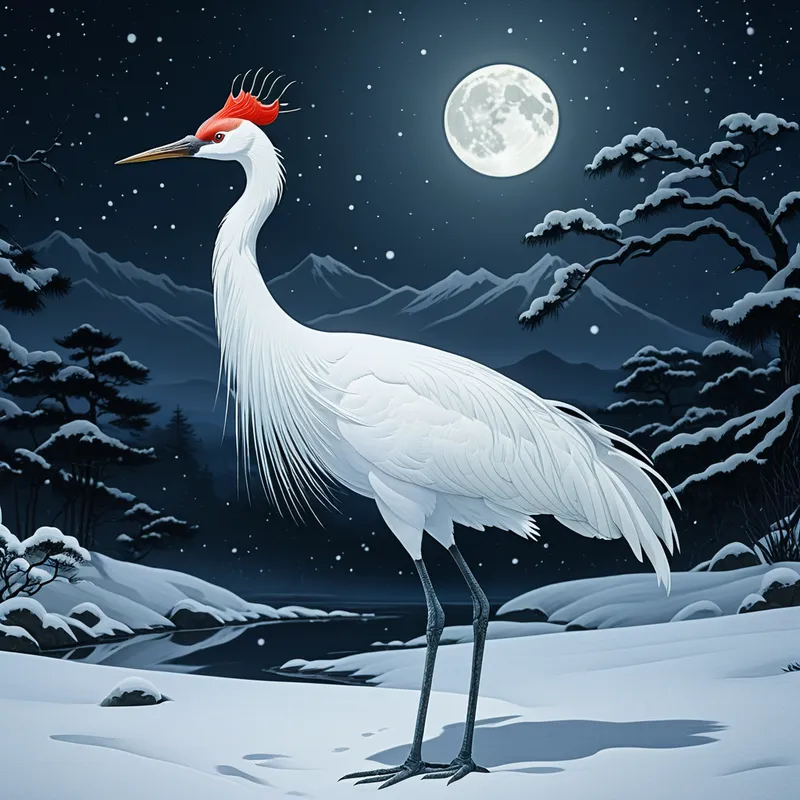
The Crane Myth Meaning & Symbolism
A wounded crane transforms into a woman who weaves a miraculous cloth from her own feathers, revealing the sacred cost of beauty and truth.
The Tale of The Crane
Listen now, and let the snows of a distant winter settle in your heart. In a time when the mountains were sharper and the silence deeper, there lived a poor but kind-hearted young woodcutter. His name was Yohei. One evening, as [the world](/myths/the-world “Myth from Tarot culture.”/) turned to indigo and the first stars pricked [the sky](/myths/the-sky “Myth from Persian culture.”/), he heard a desperate, keening cry from the frozen river. Rushing through the drifts, he found a magnificent crane, its wing pierced by a hunter’s arrow, struggling in the icy [water](/myths/water “Myth from Chinese culture.”/). Its white feathers were stained with crimson, a stark and sorrowful sight.
Without a thought for the cold, Yohei waded in. He spoke soft words, gentled the trembling bird, and carefully drew out the arrow. Tearing a strip from his own thin robe, he bound the wound. “Fly,” he whispered, lifting the crane toward the darkening sky. “Fly and be free.” The great bird looked at him once with a deep, knowing eye, then beat its powerful wings and vanished into the gathering night.
The next evening, as a blizzard howled around his lonely hut, there came a soft knock at the door. There stood a woman of breathtaking beauty, her skin as pale as new snow, her eyes holding the same profound depth as the crane’s. She said her name was O-[Tsuru](/myths/tsuru “Myth from Japanese culture.”/), and she was lost. Yohei, ever compassionate, invited her in from the storm, offering her his meager food and the warmth of his hearth.
Days turned to weeks. O-Tsuru stayed, and a tender love grew between them. They were married simply, under the bare branches of an ancient pine. Yet, poverty pressed upon them. Seeing her husband’s worry, O-Tsuru made a solemn request. “Husband,” she said, “I will weave a special cloth. It will be of great value. But you must promise me one [thing](/myths/thing “Myth from Norse culture.”/): you must never, under any circumstance, look upon me while I weave.”
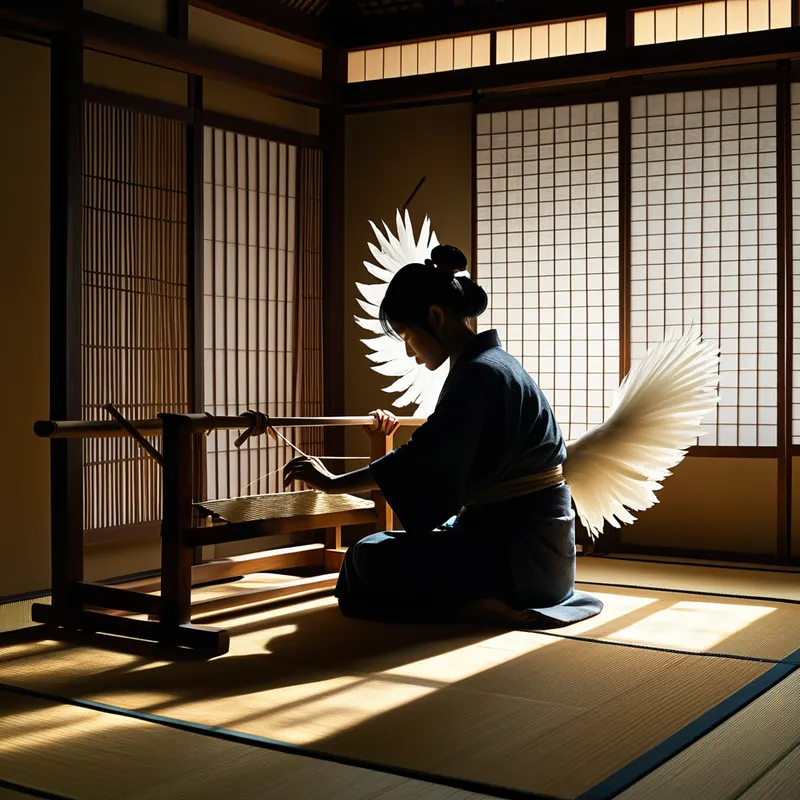
Yohei, bewildered but trusting, agreed. O-Tsuru entered a small, enclosed room with a loom. For three days and three nights, Yohei heard only the rhythmic clack-clack-clack of the shuttle. No food, no drink, no rest. When she emerged, she was pale and weak, but in her hands, she held a bolt of cloth more magnificent than anything Yohei had ever seen. It shimmered with a light of its own, the weave so fine it seemed made of moonlight and cloud. He sold it in the town for a fortune.
Life became easier, but greed, that subtle poison, began to whisper. The merchant demanded more cloth, offering a king’s ransom. Yohei, forgetting his simple heart, begged his wife to weave again. Reluctantly, sorrowfully, she agreed, repeating her one condition.
Again, the rhythmic sound from the sealed room. But this time, the silence between the beats felt heavy with suffering. A terrible doubt gnawed at Yohei. What magic was this? What cost was being paid? On the third night, driven by fear and a burning curiosity, he crept to the door and slid the [shoji](/myths/shoji “Myth from Japanese culture.”/) screen open just a crack.
What he saw shattered his world. There was no woman at the loom. Instead, a great, gaunt crane stood there, plucking its own feathers with its beak. One by one, it wove the long, white plumes into the cloth on the loom. Its body was growing thin and bare. The sacred act was a brutal self-sacrifice.
With a cry of anguish, Yohei revealed himself. The crane turned its head. In its eyes, he saw not anger, but an infinite sadness—the sadness of a broken vow and a revealed truth. “Husband,” the crane spoke with O-Tsuru’s voice, now faint as a breeze, “I am the crane you saved. I came to repay your kindness. But the magic is broken when the secret is seen. I can no longer stay.”
Before he could speak, the crane-woman began to transform. She stepped out onto the snowy path, her human form dissolving into the pure, white shape of the bird. With one last, longing look, she spread her wings—now fully feathered once more—and lifted into the gray dawn sky. Yohei was left alone, forever holding the miraculous cloth and the unbearable weight of his transgression, as the crane disappeared into the realm from whence she came.
Cultural Origins & Context
This tale, known widely as Tsuru no Ongaeshi (The Crane’s Return of a Favor), is a classic example of the kami musume or irui kon’in tan folklore tradition. It was not a myth of the imperial Kojiki but a story born from the oral traditions of the common people, passed down through generations by village storytellers, often around [the hearth](/myths/the-hearth “Myth from Norse culture.”/) during the long winter months. Its function was multifaceted: it was a moral lesson about gratitude, promises, and the dangers of greed; a poetic explanation for the crane’s revered status in Japan; and a profound exploration of the permeable boundary between the human world (kenkai) and the spirit world (yūkai). The crane itself was a symbol of fidelity, good fortune, and longevity, making its sacrifice all the more potent. The story served as a cultural container for the complex emotions surrounding indebtedness, the sacred nature of hospitality (motenasu), and the tragic consequences of violating a sacred trust.
Symbolic Architecture
At its core, the myth is an alchemical [drama](/symbols/drama “Symbol: Drama signifies narratives, emotional expression, and the exploration of human experiences.”/) of [spirit](/symbols/spirit “Symbol: Spirit symbolizes the essence of life, vitality, and the spiritual journey of the individual.”/) made manifest, and the [human](/symbols/human “Symbol: The symbol of a human represents individuality, complexity of emotions, and social relationships.”/) [condition](/symbols/condition “Symbol: Condition reflects the state of being, often focusing on physical, emotional, or situational aspects of life.”/) that cannot fully bear that manifestation. The [crane](/symbols/crane “Symbol: A majestic bird symbolizing longevity, wisdom, and spiritual ascension across many cultures, often seen as a messenger between earthly and divine realms.”/) is a kami in animal form, a [numinous presence](/symbols/numinous-presence “Symbol: A powerful, awe-inspiring spiritual or divine presence that evokes profound reverence and transcendence beyond ordinary experience.”/) from the yūkai that crosses into the kenkai out of a deep, instinctual drive for reciprocity. Its transformation into O-Tsuru represents the descent of the sacred into the [vessel](/symbols/vessel “Symbol: A container or structure that holds, transports, or protects something essential, representing the self, emotions, or life journey.”/) of the mundane, the [spirit](/symbols/spirit “Symbol: Spirit symbolizes the essence of life, vitality, and the spiritual journey of the individual.”/) taking on flesh to enact a [relationship](/symbols/relationship “Symbol: A representation of connections we have with others in our lives, often reflecting our emotional state.”/).
The miraculous cloth is not merely wealth; it is spirit made tangible, the sublime woven from the very substance of the soul.
Yohei’s initial act of [compassion](/symbols/compassion “Symbol: A deep feeling of empathy and concern for others’ suffering, often involving a desire to help or alleviate their pain.”/) is the innocent, selfless [gesture](/symbols/gesture “Symbol: A non-verbal bodily movement conveying meaning, emotion, or intention, often symbolic in communication and artistic expression.”/) that invites the numinous into one’s [life](/symbols/life “Symbol: The symbol of ‘Life’ represents a journey of growth, interconnectedness, and existential meaning, encompassing both the joys and challenges that define human experience.”/). His later transgression—peering into the [secret room](/symbols/secret-room “Symbol: The Secret Room symbolizes hidden aspects of the self, unexplored territories of the mind, and the mysteries one seeks to uncover.”/)—symbolizes [the ego](/myths/the-ego “Myth from Jungian culture.”/)’s insistence on possessing the [mystery](/symbols/mystery “Symbol: An enigmatic, unresolved element that invites curiosity and exploration, often representing the unknown or hidden aspects of existence.”/), on demanding to know the [source](/symbols/source “Symbol: The origin point of something, often representing beginnings, nourishment, or the fundamental cause behind phenomena.”/) of the gift rather than simply receiving it with grace. It is the shift from relationship to ownership, from gratitude to entitlement. The crane’s plucking of its own feathers is the ultimate [image](/symbols/image “Symbol: An image represents perception, memories, and the visual narratives we create in our minds.”/) of creative or spiritual generation: true [beauty](/symbols/beauty “Symbol: This symbol embodies aesthetics, harmony, and the appreciation of life’s finer qualities.”/), true art, true love often comes from a place of profound self-sacrifice, a rending of one’s own essence. The violated taboo reveals that this process cannot survive the harsh light of literal-minded scrutiny; it requires the protective darkness of the [temenos](/myths/temenos “Myth from Greek culture.”/), the sacred [enclosure](/symbols/enclosure “Symbol: A bounded space representing psychological containment, social boundaries, or existential limitations. It can symbolize both safety and restriction.”/).
The Dreamer’s Resonance
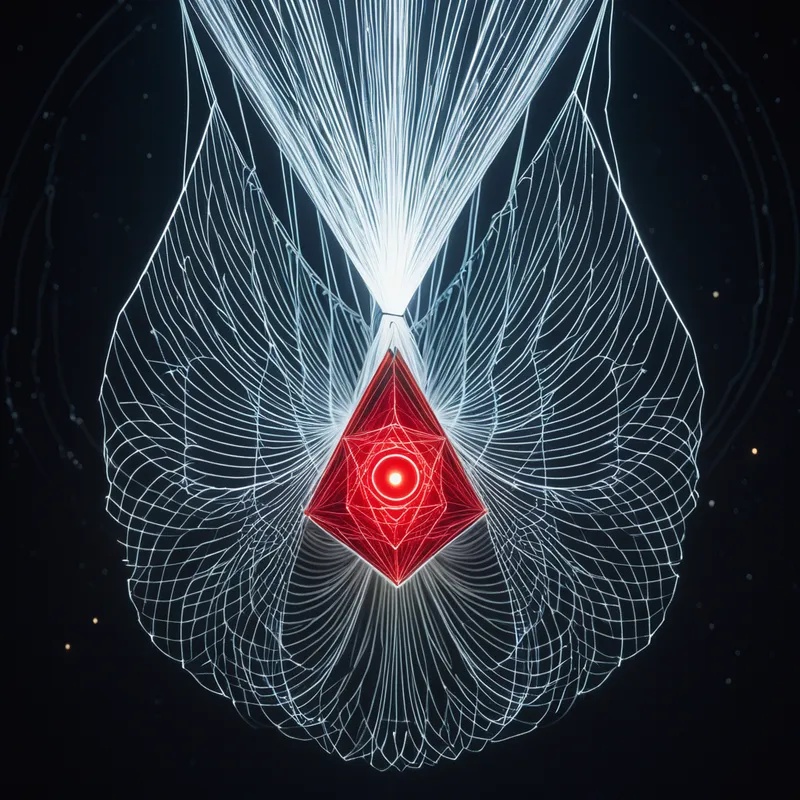
When this myth pattern stirs in the modern dreamer, it often signals a profound psychological process related to the sacred contract of a relationship or a creative endeavor. Dreaming of a wounded bird one must heal may point to an encounter with one’s own neglected spirit or a call to care for a vulnerable part of the [psyche](/myths/psyche “Myth from Greek culture.”/). The arrival of a mysterious, beautiful partner often coincides with the beginning of a deeply meaningful but fragile new phase—a creative project, a spiritual practice, or a relationship that feels “otherworldly” in its depth.
The critical dream sequence is the act of looking into [the forbidden room](/myths/the-forbidden-room “Myth from Various culture.”/). Somatically, this may be experienced as a tightening in the chest, a mix of anxiety and irresistible compulsion. Psychologically, it represents the moment the dreamer’s ego, driven by doubt, insecurity, or a need for control, attempts to deconstruct the magic. It is the demand for guarantees in love, the over-analysis of inspiration, the insistence on seeing the “how” instead of trusting the “what.” The subsequent flight of the crane in the dream leaves a resonant feeling of loss, emptiness, and the haunting beauty of what was sacrificed. It is the psyche’s way of illustrating that some connections are covenants, not contracts, and are maintained only by respect for their inherent mystery.
Alchemical Translation
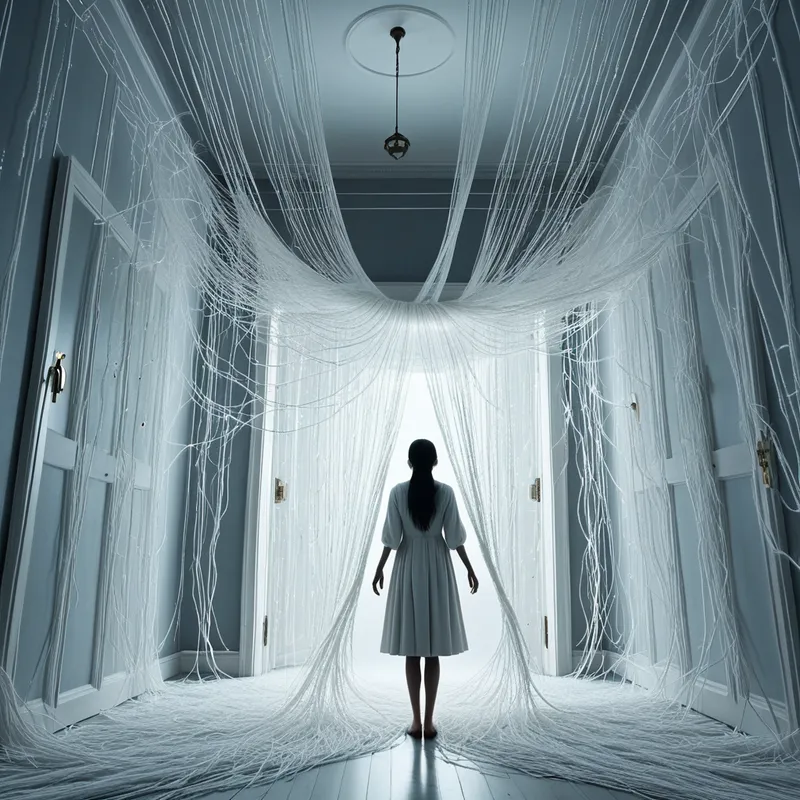
For the modern individual on the path of individuation, the crane’s journey is a masterful map of psychic transmutation. [The first stage](/myths/the-first-stage “Myth from Alchemical culture.”/) is the Recognized Wound: the conscious ego (Yohei) encounters the wounded, transcendent function (the crane)—the part of [the Self](/myths/the-self “Myth from Jungian culture.”/) that connects us to the numinous, lying injured in the frozen waters of neglect or trauma. The compassionate act of binding the wound is the initial, often painful, act of acknowledging and attending to this spiritual injury.
The second stage is the [Sacred Marriage](/myths/sacred-marriage “Myth from Alchemy culture.”/): the wounded spirit integrates, taking form within the personal psyche as a new attitude, a new creative energy (O-Tsuru). This brings a period of enrichment and “miraculous” inner production—the cloth. Here, the ego must learn to hold space without possession, to receive the gifts of the unconscious without demanding to own its processes.
The ultimate alchemy is not in creating the gold, but in learning to be the vessel that can contain its radiance without shattering.
The crisis is the Violation of [the Temenos](/myths/the-temenos “Myth from Greek culture.”/): the ego, fearful of the very mystery that sustains it, breaches the boundary. This is a necessary, if painful, stage in the alchemical [nigredo](/myths/nigredo “Myth from Alchemical culture.”/). The raw, sacrificial mechanics of the Self are revealed. The crane, plucking its own feathers, shows that what feeds our highest self comes from a deep, often painful, interior sacrifice.
The final stage is the Return and Integration: The crane does not die; it returns to its native element, the sky/unconscious. The relationship is forever changed, but not annihilated. For the individuating psyche, this means the numinous energy is no longer projected onto an outer relationship or contained in a fragile human form. It is recognized as an eternal, interior reality. Yohei is left with the cloth—the lasting, tangible wisdom and beauty forged in the encounter. He is poorer for the loss of the daily presence, but immeasurably richer in soul, forever aware of the crane’s flight path across the border of his own being. The myth teaches that some truths, once fully seen, cannot be unlived with, but must be lived from. The crane’s gift was not the cloth, but the indelible knowledge of the sacred cost from which all true beauty is woven.
Associated Symbols
Explore related symbols from the CaleaDream lexicon: