The Cowherd and Weaver Girl Myth Meaning & Symbolism
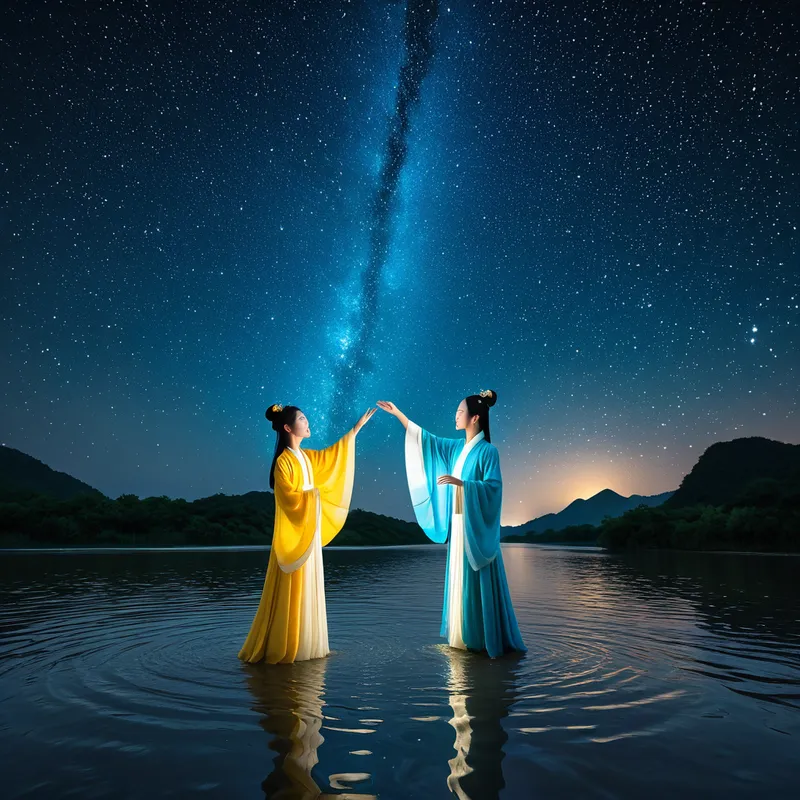
A celestial weaver and a mortal cowherd fall in love, are separated by the Milky Way, and are permitted to reunite only once a year.
The Tale of The Cowherd and Weaver Girl
Listen, and hear a tale woven from starlight and sorrow, a story older than the oldest dynasty, sung by the wind in the reeds and written in the path of the heavens.
In the time before time, when the Jade Emperor’s court shone with immortal splendor, there lived his granddaughter, Zhinü, the Weaver Girl. Her fingers danced with threads of sunset and dawn, weaving the clouds and robes for the gods. Yet, for all her skill, her life was one of endless, lonely duty, her loom set upon the banks of the Silver River. Her heart yearned for a world beyond the cold, perfect stars.
Far below, on the green earth fragrant with loam and life, lived a poor orphaned cowherd named Niulang. His only companions were an old, wise ox and a herd of loyal cattle. He was kind and diligent, but his days were marked by a quiet solitude, his gaze often lifting from the pastures to the glittering river in the night sky.
One day, the old ox spoke in a voice like grinding stones. “Master, today the celestial maidens will descend to a hidden pool in the forest to bathe. Among them is Zhinü. Seize her robe of feathers and clouds, and she cannot return to heaven.”
Trembling with a fate he did not fully understand, Niulang hid among the ferns. He saw them—beings of light stepping onto mossy stones, their laughter like silver bells. He saw her. As they slipped into the water, he took only her robe, its fabric cool and humming with power.
When the others fled skyward at the sun’s first touch, Zhinü remained, stranded. Niulang emerged, not as a captor, but as a supplicant, holding her garment with reverence. In his eyes, she saw not theft, but a profound, human loneliness that mirrored her own. From that moment, a bond was forged not of trickery, but of mutual recognition. They married. He tended the fields; she wove cloth of such beauty it seemed to hold captured sunlight. They built a simple home, and two children filled it with laughter. For a time, heaven and earth were reconciled in their humble hearth.
But the cosmos cannot tolerate such bliss for long. The Jade Emperor, enraged by his granddaughter’s desertion and union with a mortal, commanded her immediate return. Heavenly guards descended like a thunderclap. As Niulang and the children cried out, Zhinü was torn from their embrace, carried back across the vast, starry gulf of the Silver River.
Despair threatened to swallow the cowherd whole. But the old ox, with its last breath, spoke again. “Take my hide. It will carry you.” Grieving, Niulang did so. Donning the magical hide, he placed his children in baskets and pursued his love into the very heavens, the ox’s final gift granting him flight.
He soared, the earth shrinking below, the river of stars swelling before him. He could see Zhinü on the far bank, her face a mask of tear-stained joy. He was almost there…
With a wave of his hand, the Jade Emperor slashed the sky. The Silver River widened into an impassable, raging torrent of light, forever dividing the lovers. Their cries echoed in the void. Yet, even the heart of a celestial emperor can be moved. Perhaps it was the weeping of the grandchildren, or the unyielding devotion shining from both banks. He decreed a mercy: on the seventh day of the seventh lunar month, all the magpies in the world would gather, linking wing to wing, to form a living bridge across the celestial flood. For one night, the Cowherd and the Weaver Girl may cross, hold each other, and remember.
And so it is. Each year, if you listen on that quiet night, you might hear their whispers on the breeze. And if it rains, those are Zhinü’s tears of joy and parting, watering the earth once more.
Cultural Origins & Context
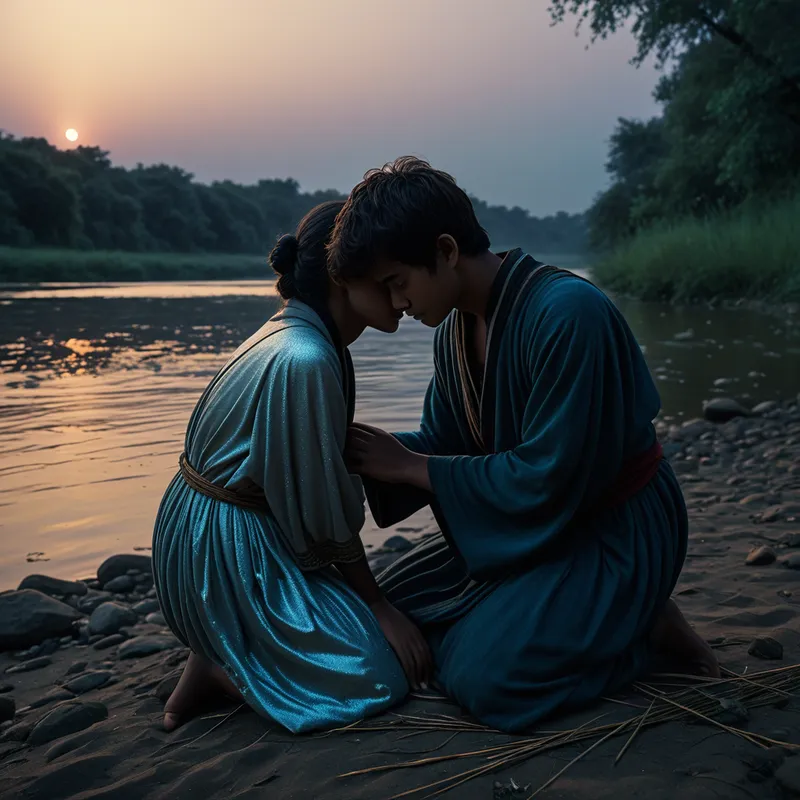
This is not merely a fairy tale, but a foundational cultural codex. Its earliest known references appear in the Shijing (Book of Songs), and it was solidified during the Han Dynasty. The myth is intrinsically tied to the stars Vega and Altair, which flank the bright band of the Milky Way. Their celestial dance provided an ancient calendar, with the “meeting” on the seventh night of the seventh month marking the Qixi Festival, often called Chinese Valentine’s Day.
The story was told by grandmothers to grandchildren, by poets to courts, and by farmers looking up at the summer sky. Its societal function was multifaceted: it explained astronomical phenomena, provided a narrative for seasonal change, and, most importantly, it gave a sacred shape to universal human experiences—love, loss, duty, and the hope for reunion against impossible odds. It validated the longing of separated lovers, soldiers, and families, offering a cosmic mirror for earthly sorrow and a promise of cyclical return.
Symbolic Architecture
Beneath the poignant narrative lies a profound symbolic architecture. The myth maps the fundamental tensions of existence.
Zhinü represents the anima, the soul-image, the realm of spirit, creativity, and divine order. She is the part of us that weaves meaning, beauty, and connection. Niulang embodies the grounded animus, the earthly self, the caretaker of instinct and the simple, sustaining rhythms of nature. Their union is the sacred marriage of heaven and earth, spirit and matter, the transcendent and the immanent within the individual psyche.
The greatest creativity and wholeness are born when the celestial weaver of spirit descends to meet the earthly herdsman of the soul.
The Silver River is the ultimate symbol of separation—not just physical distance, but the chasms of circumstance, social decree, time, and the inherent divisions within the self. The old ox is the guiding instinct, the deep, animal wisdom of the unconscious that provides the means for the ego (Niulang) to pursue its wholeness. Its hide as a vehicle signifies that true aspiration must be clothed in the substance of our embodied, instinctual nature.
The magpies’ bridge is the most potent symbol of all: it represents the miraculous, collective, and temporary forces—love, art, memory, ritual—that can momentarily bridge our deepest divides. It is not a permanent solution, but a sacred, recurring moment of connection.
The Dreamer’s Resonance
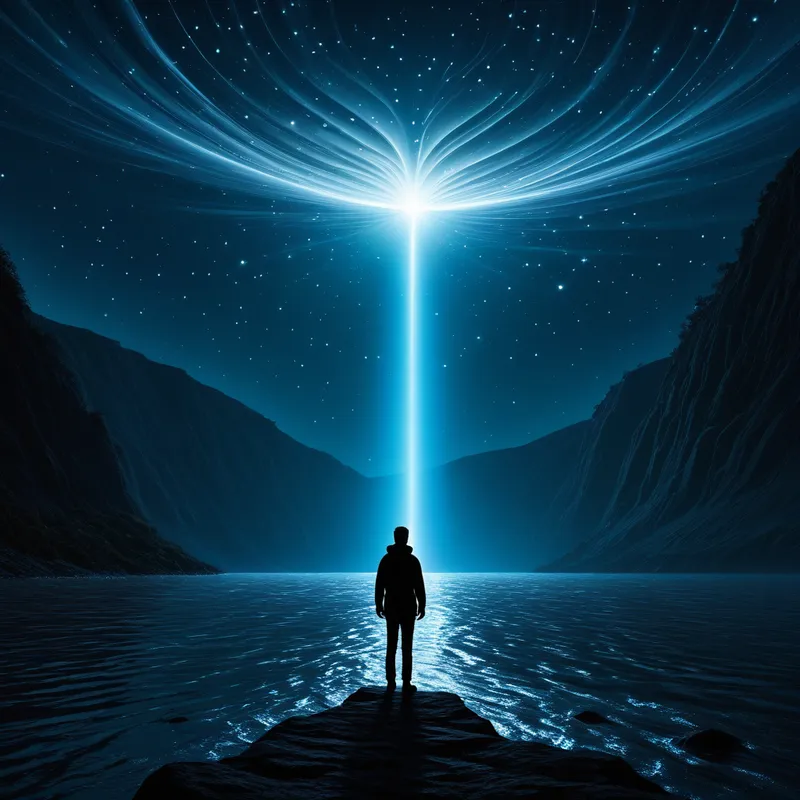
When this myth stirs in the modern dreamer, it signals a profound somatic and psychological process. To dream of a beloved figure separated by a vast, un-crossable river or canyon is to feel the ache of the Cowherd and Weaver Girl in one’s own bones. This is not necessarily about a romantic partner. It can manifest as:
- Dreaming of a lost part of oneself (an old passion, a creative spark, a sense of innocence) visible on a distant shore.
- Recurring dreams of trying to reach someone or something, only for a barrier to appear or widen.
- Somatic sensations of a literal “heartache,” a tightness in the chest, when contemplating a deep separation or unfulfilled longing in waking life.
The psyche is processing a fundamental experience of division. The dream is the psyche’s way of honoring that split, of giving the longing a mythic container. It asks the dreamer: What in your life feels eternally separated? What heavenly aspiration feels cut off from your earthly reality? The tears in the dream are the beginning of the alchemy.
Alchemical Translation
The myth does not offer a happy ending, but something more real and thus more sacred: a model for psychic transmutation in the face of eternal tension. The individuation process it outlines is not about final, permanent union, but about learning to live in creative relationship with the divide.
First, there is the Recognition and Descent (the meeting at the pool). The spiritual principle (Zhinü) must descend and engage with the earthly, animal, and emotional life (Niulang). For us, this is the courage to let our high ideals and creativity touch our messy, human reality.
Then, the Enforced Separation (the wrath of the Jade Emperor). This is the inevitable crisis. The conscious ego’s attempt to hold the union permanently is “punished” by the greater Self (the Emperor), which maintains the cosmic order of tension. In life, this is the painful realization that certain unities—perhaps between work and family, solitude and relationship, perfect ideals and imperfect reality—cannot be permanently sustained in a static way.
The goal is not to live on the bridge, but to learn the sacred ritual of crossing.
Finally, the Ritual of Return (the magpie bridge). This is the alchemical gold. The psyche learns to create, through conscious ritual (the Qixi Festival), art, active imagination, or dedicated reflection, those “magpie moments.” It is the scheduled date night for busy partners, the sacred hours for a neglected creative practice, the intentional memory that bridges time and loss. The myth teaches that wholeness is not a state achieved, but a relationship honored in its cyclical, fleeting, and profoundly beautiful moments of connection. We become alchemists not by dissolving the Silver River, but by learning, year after year, how to build a bridge across it.
Associated Symbols
Explore related symbols from the CaleaDream lexicon: