The Court Jester Myth Meaning & Symbolism
A myth of the sacred Fool who, through disruptive laughter and impossible riddles, shatters the King's rigid order to restore the kingdom's soul.
The Tale of The Court Jester
Listen, and let the tale settle in your bones.
In the heart of a kingdom of perfect geometry, where the sun traced the same arc on a sky of polished lapis every day, there ruled a King of Absolute Order. His laws were etched in diamond, his schedules ran with the precision of celestial mechanics, and silence, a heavy, velvet silence, was the highest virtue. The kingdom was a masterpiece of stillness, a beautiful, breathless tomb. The people moved as clockwork, their hearts beating in metronomic time, their dreams forgotten dust in attics.
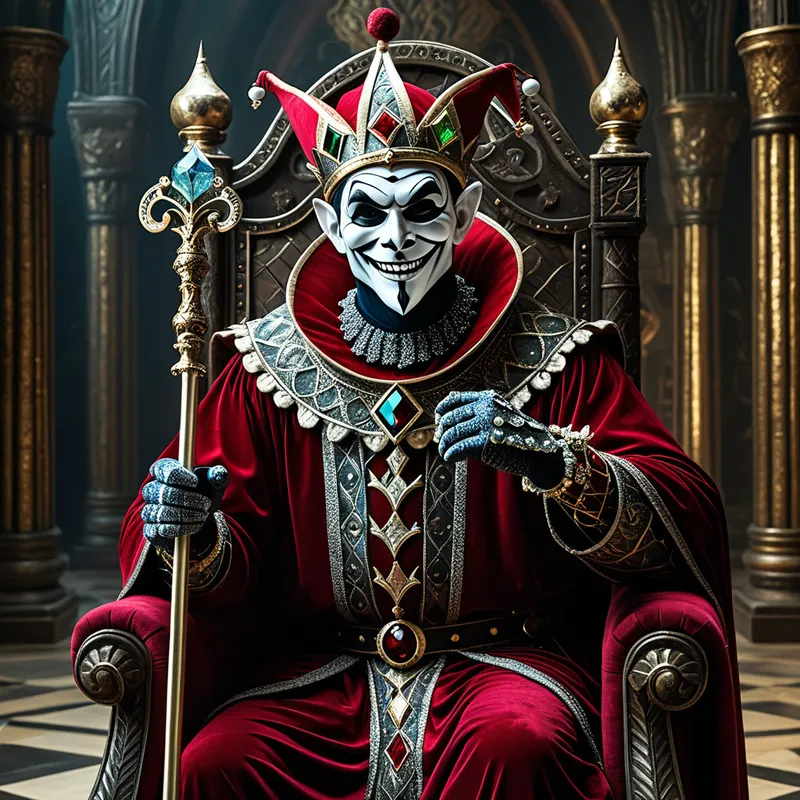
Into this calcified splendor came a figure with the sound of broken bells. He was the Court Jester. His motley was not the bright rags of a clown, but the deep hues of a twilight forest—crimson like heart’s blood, silver like a knife’s edge, and patches of a black so deep it seemed to swallow the light. He carried no weapon but a scepter topped with a crystal skull that grinned with a thousand facets.
His first act was not a jig, but a question. He stood before the throne, in that cavernous hall of echoing quiet, and asked the King, “Your Majesty, if the law commands the river to run straight, who will teach the fish to fly?” The courtiers gasped. The King, frowning, declared it nonsense. The Jester bowed, and from his sleeve, he produced a single, live minnow that swam in the air before the throne, glistening.
Thus began the unraveling. The Jester did not tell jokes; he told truths that wore the masks of jokes. He would point to the Chancellor, a man of immense gravity, and mimic not his walk, but the creaking of the immense, invisible burden he carried. The sound was that of a ship breaking on rocks. The Chancellor would then weep, not from humiliation, but from a sudden, shocking recognition of his own exhaustion.
He presented the King with a mirror that did not show one’s face, but one’s most tightly held fear given form. To the General, it showed not enemies, but the ghosts of the soldiers he had spent like coin. To the Queen, it showed not age, but the cage of gold that her compassion had become. The King saw his own reflection as a magnificent, intricate clock, its gears frozen solid.
The conflict rose to a crescendo. The King, feeling the very stones of his palace begin to tremble with a strange, organic pulse, decreed the Jester a demon of chaos. “You break every law!” the King thundered. “You turn wisdom to folly and folly to wisdom! You must name your crime!”
The Jester knelt, not in submission, but as a gardener kneels before a stubborn root. “My crime, Your Majesty, is life,” he said, his voice soft yet carrying to the farthest pillar. “You have built a temple to the concept of the flower, but you have outlawed the seed, the soil, and the rain. You worship the map and call the territory heresy.”
Enraged, the King commanded, “Then you shall be the final lesson! You will perform one last act. You will make the stone of this dais weep tears of true sorrow. If you cannot, you will be unmade, and order will be eternal.”
The Jester smiled his sad, knowing smile. He did not chant or conjure. He simply sat upon the cold marble step, placed his crystal-skull scepter in his lap, and began to hum a lullaby—the one the King’s own mother had sung to him, a melody lost to decades of statecraft. He hummed of soft blankets, of night fears soothed, of a love that asked for no tribute.
And the King, the Absolute Monarch, the living embodiment of Law, felt a crack deep within his chest. A memory, warm and helpless, flooded him. A single, perfect tear, hot and human, escaped his eye. It traced a path down his cheek and fell. It struck the dais with a sound like a tiny bell. Where it landed, a single, impossible violet pushed through the seamless stone and bloomed.
The rigid silence shattered, not into noise, but into sound—the sound of a hundred courtiers taking their first deep breath in years. The Jester looked at the flower, then at the King, whose face was now a battlefield of awe and grief. Without a word, the Jester placed his scepter at the King’s feet, turned, and walked from the hall. The kingdom did not descend into chaos. It began, haltingly, to breathe. The river was allowed its bends, and the people remembered how to dream.
Cultural Origins & Context
The myth of the Court Jester did not originate as popular folklore, but as a core teaching myth of the Fool Archetype culture, recited during the Feast of Unknitting. This was not a festival of mere revelry, but a profound societal safety valve and a ceremony of psychic hygiene.
The tellers were not bards, but the Custodians of the Motley, a priestly class trained in the art of sacred disruption. They passed the myth down through rigorous oral tradition, ensuring each recitation contained specific tonal cadences and pauses designed to induce a state of receptive unease in the listener. Its societal function was prophylactic; it was a story told to kings and councils as a warning against the idolatry of pure order. It served as the cultural immune system, identifying and metaphorically "infecting" the body politic with the germ of necessary chaos before rigidity could cause a fatal fracture.
Symbolic Architecture
The myth is a perfect symbolic engine for the process by which the unconscious corrects the conscious ego’s inflation.
The King of Absolute Order represents the tyrannical, hyper-rational conscious mind—the ego that has successfully organized the inner world into a sterile, efficient system, repressing instinct, emotion, and the unpredictable waters of the soul. His kingdom is the psyche under this dictatorship, where everything is known, controlled, and lifeless.
The Jester is the embodied voice of the Self, the total, integrating center of the psyche, which often must use trickery and shock to communicate with a deafened ego.
The Court Jester is the archetypal emissary of the unconscious, specifically the trickster. He is not the shadow (which is personal), but the personified function of the unconscious itself—its disruptive, truth-telling, rebalancing power. His motley represents the unity of opposites (crimson passion/silver intellect, black void/starlight patches). His crystal-skull scepter is the tool of reflection and memento mori; it forces confrontation with mortality and the brittle nature of purely intellectual constructs.
The central action—making the stone dais weep and bloom—is the ultimate symbol of psychic alchemy: the transmutation of petrified structure (complexes, dogmas, frozen trauma) back into living, feeling, growing substance. The tear is the redeemed affect, the feeling that has been allowed back into the system. The violet is the new psychic possibility that can only emerge from that liquefaction.

The Dreamer's Resonance
When this myth pattern activates in the modern dreamer, it signals a critical phase of individuation where the psyche’s Self is intervening against a pathological stability. To dream of a Jester figure in a context of rigid order—a corporate boardroom, a sterile lab, a perfectly arranged home—is to experience the somatic prelude to a necessary breakdown.
Psychologically, the dreamer is often in a state of "successful stagnation." Life may look orderly on the surface, but there is a deep, somatic deadness: a tightness in the chest, a sense of emotional anesthesia, a feeling of being trapped in a gilded cage of their own making. The Jester’s appearance is the unconscious declaring that the cost of this order is the soul itself. The dreams may be unsettling, filled with absurdities that provoke not fear, but a profound, disorienting curiosity or even laughter upon waking. The process underway is the ego’s gradual, often reluctant, surrender to a wisdom that operates on a logic of paradox and symbol, not linear control.

Alchemical Translation
The myth provides a precise model for psychic transmutation. The modern individual’s "kingdom" is their identified personality—the successful persona, the cherished beliefs, the efficient life structure that has become a prison.
Stage 1: The Invitation of Chaos (The Jester’s Entrance). This is the initial, often unwelcome, intrusion of the irrational: a sudden loss that makes no sense, a "foolish" passion, a debilitating symptom, or a piercing insight that undermines one’s entire worldview. The ego’s first reaction is the King’s: to label it nonsense or demonize it as chaos.
Stage 2: The Mirror of Truth (The Jester’s Performances). The irrational persists, acting as a mirror. It doesn’t argue with the ego; it shows it its own hidden costs. The workaholic sees their neglected heart. The cynic sees their buried hope. This stage is deeply uncomfortable, a psychic humiliation where one’s cherished control is revealed as a defense against life.
The goal is not to dethrone the King, but to teach him how to weep, thereby transforming a ruler of stone into a steward of a living garden.
Stage 3: The Liquefaction (The Weeping Dais). This is the critical, transformative moment where feeling breaks through. It is the breakdown before the breakthrough—the grief, rage, or vulnerability long held at bay by the rigid structure. This is not a failure, but the alchemical solutio, the dissolving of solid forms back into the prima materia of raw experience.
Stage 4: The New Growth (The Blooming Violet). From the liquefied state, a new, organic ordering principle emerges. It is not planned by the ego but grows from the fertilized ground of integrated experience. The individual does not become a Jester; rather, the King (the ego) learns to incorporate the Jester’s function. One develops a capacity for creative doubt, self-reflection, humor about one’s own seriousness, and the wisdom to allow life its messy, fertile bends. The kingdom becomes an ecosystem, not a machine. The individuated Self is not a perfect, static ruler, but the dynamic, breathing relationship between order and the creative chaos that renews it.
Associated Symbols
Explore related symbols from the CaleaDream lexicon: