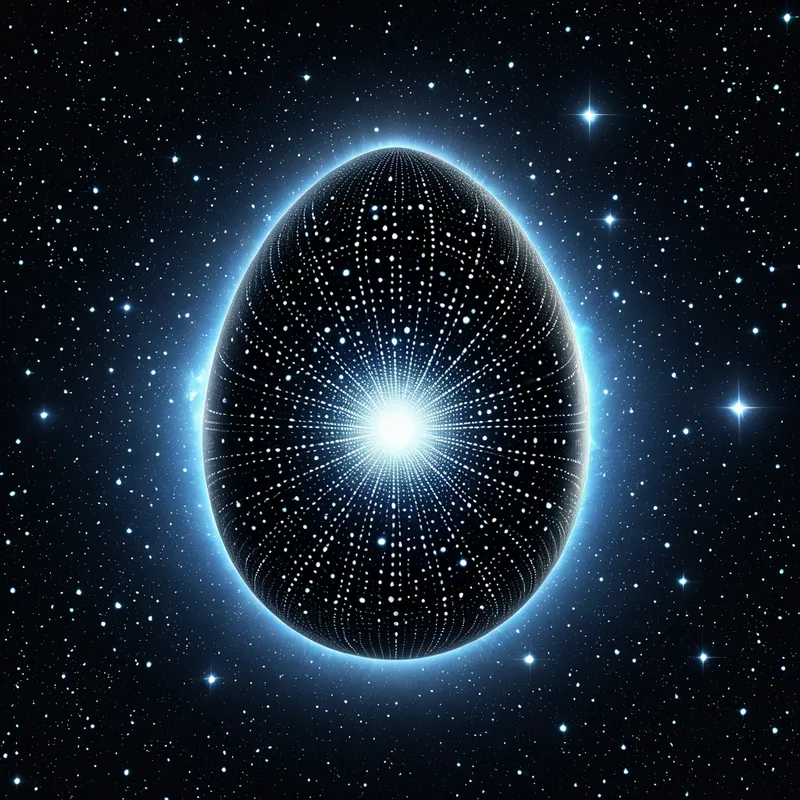
The Cosmic Egg of Orphic tradi Myth Meaning & Symbolism
From primordial Night, a silver Egg cracks, birthing the radiant, bisexual Protogonos, who sets the cosmos in motion from a single point of unity.
The Tale of The Cosmic Egg of Orphic tradi
In the beginning, there was not light, nor earth, nor sea. There was only Chronos, unaging Time, moving in the boundless, breathless dark. And from Chronos came Chaos and Erebus. But before all these, the poets whisper of a more ancient state: Nyx, the ineffable Night, brooded alone in the void. She was the womb and the tomb, the first and final mother, a presence so vast and dark it was not an absence, but a profound, potential-filled presence.
Within the black wings of Nyx, a wind began to stir—not a wind of air, for there was none, but a wind of desire, a spiraling intention. This wind, this breath, coiled upon itself in the limitless dark. From this coiling, from the marriage of Nyx’s depth and the wind’s motion, a mist was gathered. The mist thickened, silvered, and took form. It became an Egg, perfect and self-contained, floating in the eternal embrace of Night. Its shell was not of stone or earth, but of solidified twilight, marbled with the faint, swirling promise of stars yet unborn.
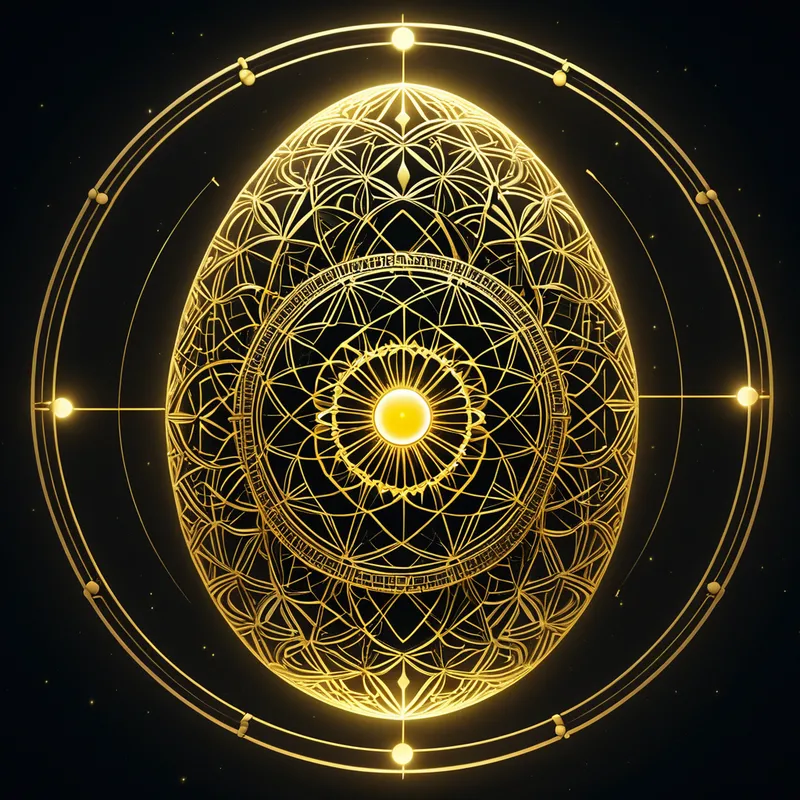
Silence held for an acon. Then, from within, a pulse. A second. A rhythm not of a heart, but of a universe waiting to beat. The silver shell grew warm, then hot, glowing from within with a light that had never before been. The light was not the harsh light of day, but the first, soft, golden light of dawn—of all dawns.
With a sound that was both a crack of thunder and the first note of a cosmic song, the Egg split. Not shattered, but opened, like a sacred vessel yielding its secret. And from within emerged a being of breathtaking and terrifying beauty: Protogonos. They were radiant, with golden wings upon their shoulders and eyes that held the shifting patterns of all things to come. Protogonos was both male and female, containing within their single form the seed of all division, all duality, all life. In one hand, they held the scepter of sovereignty; their very gaze brought order to the swirling mists.
As Protogonos stepped forth onto the curved inner surface of the lower shell—which would become the dome of the sky—and pushed upward with the upper shell—the vault of heaven—they began to dance. This was the first dance, a whirling, weaving motion that spun the chaotic mists into threads of ether, air, and substance. From their breath came the winds; from their voice, the harmonies that would govern the spheres. They set the constellations into the shell of night and gathered the heavier elements beneath their feet. The cosmic Egg was broken, but from its two halves, the structure of the world was made. The One had become the Many, and the song of creation, conducted by the shining, first-born one, had begun its eternal refrain.
Cultural Origins & Context
This profound creation narrative comes from the spiritual tradition known as Orphism</abphism, which flourished in the Greek world from around the 6th century BCE. Unlike the official, state-sanctioned Homeric hymns, Orphic texts were esoteric, used in initiation rites and personal salvation cults. They were recorded on fragile gold leaves buried with devotees, meant as guides for the soul in the afterlife.
The myth of the Cosmic Egg was not a public story for entertainment, but a sacred cosmology recited during rituals. It served a specific societal and psychological function: to provide an alternative, more mystical origin story that placed a divine, bisexual, and radiant creator (Protogonos/Phanes) at the beginning of all things, rather than the violent succession myths of Hesiod (where Ouranos is overthrown by Cronus). For the Orphic initiate, understanding this origin was key to understanding their own divine spark and their journey toward liberation from the cycle of rebirth. The myth was a map of the soul’s origin and potential destiny.
Symbolic Architecture
The symbolism here is not merely decorative; it is the very architecture of a worldview. The Egg is the ultimate symbol of potential, wholeness, and containment. It represents the state of the psyche before consciousness, before the ego differentiates itself from the unconscious. It is the prima materia of the soul, holding all opposites in perfect, latent unity.
The Cosmic Egg is the Self in its pre-conscious, pre-manifest state—the totality of being before the dawn of awareness creates the subject-object split.
Protogonos, the radiant deity born from the Egg, is the archetype of emergent consciousness itself. Their bisexuality symbolizes the transcendence of duality—male and female, light and dark, active and receptive—at the point of origin. They are the first act of perception, the “I am” that bursts forth from the undifferentiated “is.” The cracking of the shell is the necessary trauma of creation: the fragmentation of wholeness to generate a world of distinct forms, a psyche of distinct thoughts and feelings. The act of organizing the cosmos is the psyche’s innate drive to create order from inner chaos.
The Dreamer’s Resonance
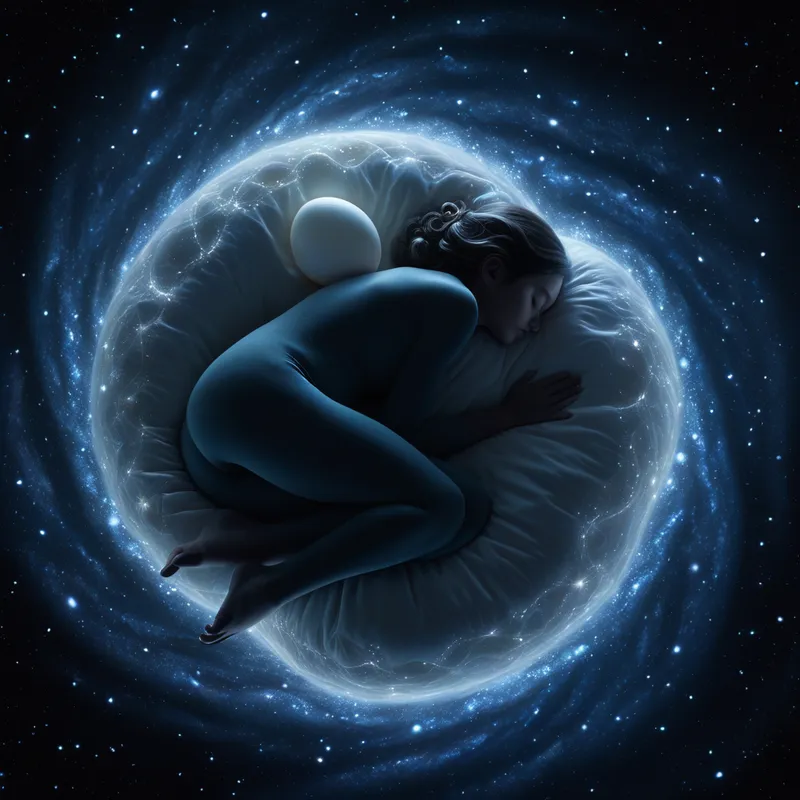
When this myth stirs in the modern dreamer, it often surfaces during profound periods of gestation or rebirth. To dream of an egg—especially one that is cosmic, glowing, or cracking—suggests the psyche is in a potent state of incubation. The dreamer may be on the cusp of a major creative act, a new self-conception, or a spiritual awakening that has been forming in the darkness of the unconscious.
Somatically, this can feel like a pregnant fullness, a pressure, or a gathering of energy with no clear outlet. Psychologically, it is the process of what Carl Jung called the transcendent function—the psyche laboring to produce a new attitude that reconciles conscious and unconscious demands. The cracking in the dream can mirror feelings of vulnerability, a “breaking open,” or the anxiety that precedes a breakthrough. The dream is an assurance: the fragmentation is not a destruction of the self, but the necessary birth of a more complex, radiant, and conscious self-structure.
Alchemical Translation
The Orphic myth is a perfect allegory for the alchemical and Jungian process of individuation—the journey toward psychic wholeness. We all begin in a state of unconscious unity with the world (the Egg in the womb of Nyx). The first stage of the work (nigredo) is this primal, dark incubation, where our latent potentials and conflicts churn unseen.
The cracking of the Egg is the separatio and solutio—the dissolution of old, rigid structures (the shell of our former limited identity) and the differentiation of our complex nature. The emergence of Protogonos represents the birth of the conscious ego, but more importantly, the first appearance of the Self as an organizing principle. This is the albedo, the whitening, the dawning of a new, luminous awareness.
The goal of the opus is not to return to the unbroken Egg, but to become the dancer who, having emerged, consciously creates a cosmos from the fragments.
The final, ongoing work (rubedo and coagulatio) is Protogonos’s dance: actively engaging with the fragmented pieces of our psyche—our talents, shadows, passions, and fears—and weaving them into a cohesive, dynamic, and personal cosmos. We do not regain the original, unconscious wholeness of the Egg. Instead, we strive for a created wholeness, where we consciously hold the position of the radiant creator within our own being, sovereign over the inner universe we are destined to organize and illuminate. The myth tells us that our deepest birthright is not simplicity, but the creative, golden responsibility of bringing light from our own primal night.
Associated Symbols
Explore related symbols from the CaleaDream lexicon: