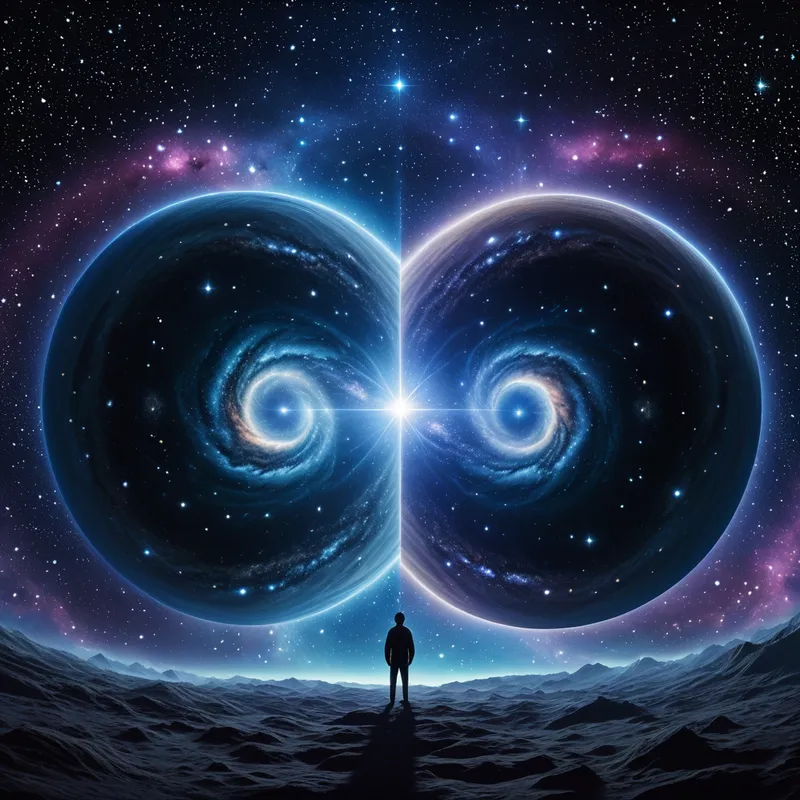
The cosmic ball game of the Ma Myth Meaning & Symbolism
A cosmic game of chance and sacrifice between primordial forces determines the fate of reality, weaving existence from the threads of loss and renewal.
The Tale of The cosmic ball game of the Ma
Before the first note of time was sung, in the great silence that was not empty but full of potential, there existed the Ma. The Ma was not one, but two—the Ma of the Shining Pattern and the Ma of the Deep Well. They were the first tension, the first pair of eyes regarding each other across the abyss of what-could-be.
They did not war, for there was nothing yet to fight over. They did not speak, for there were no words. Instead, they moved in a slow, eternal dance of approach and withdrawal, and from this rhythm, an idea was born. It was the idea of a game. A contest not of strength, but of essence. They would craft a Ball of All-Might-Be, a sphere containing every possible future, every seed of star and whisper of soul. And they would play for it.
The court was laid upon the fabric of the void itself, its boundaries marked by the slow-birth of quasars. The Ball glowed between them, a miniature cosmos of swirling colors and dark, pregnant voids. The rules were inherent, unwritten: to gain possession was to imprint one’s nature upon the nascent all. The Ma of the Shining Pattern moved with crystalline precision, its tactics forming lattices of light and inevitable geometry. The Ma of the Deep Well flowed like a tide of dark mercury, its play unpredictable, a symphony of sudden voids and emergent possibilities.
The game stretched across eons that had not yet been named. The Ball passed between them, and with each pass, a fragment of its potential was crystallized into reality. A streak of light from the Pattern-Ma became a river of galaxies. A splash of shadow from the Well-Ma became the fertile, terrifying dark between them. The universe was not created by a word, but in the volley of this sublime contest.
But a game must have an end. The Pattern-Ma, in a moment of flawless strategic alignment, saw a path to final possession. It moved to claim the Ball, to seal the cosmos in perfect, eternal order. Yet, in that very instant of certain victory, it hesitated. It perceived that to win completely was to extinguish the game forever—to freeze the living cosmos into a single, silent, beautiful statue. In that hesitation, the Deep Well surged.
It did not steal the Ball. It accepted the offered volley, and with a motion that was both surrender and assertion, it allowed the Ball to strike its own core. The impact did not shatter the Well, but the Ball. It fragmented into a billion-billion shining pieces, scattering across the newborn universe like seeds of fire and ice.
The Ma of the Shining Pattern recoiled, not in defeat, but in awe. The Ma of the Deep Well seemed to diminish, its essence spent in that catalytic sacrifice. From the fragments came the cacophony and beauty of the real: stars igniting, planets cooling, the first chaotic dances of matter that would one day become life. The game was over. The playing had just begun.

Cultural Origins & Context
The myth of the Cosmic Ball Game is considered a ur-myth, a story so fundamental it appears in fragments and echoes across disparate human cultures—from the ball courts of Mesoamerica where games were rituals of solar renewal, to the philosophical dialogues of Asia discussing the interplay of yin and yang. It was never the property of a single people, but rather a story told by star-gazers, shamans, and philosophers who pondered the paradox of creation: why is the universe both lawful and chaotic, beautiful and terrifying?
It was passed down not as dogma, but as a sacred riddle, often in the form of poetry or ritual re-enactment. Its societal function was profound. It explained the nature of reality not as a fixed creation, but as a dynamic, ongoing process born from a primordial act of sacrifice and play. It taught that order alone is sterility, and chaos alone is oblivion; existence is the child of their tense, creative game.
Symbolic Architecture
At its heart, the myth maps the psyche’s confrontation with the two fundamental poles of existence. The Ma of the Shining Pattern represents the conscious mind: the drive for order, meaning, control, and identity. It is the architect, the planner, the ego seeking to comprehend and arrange the world. The Ma of the Deep Well is the unconscious: the realm of chaos, potential, instinct, and the unknown. It is the source of creativity, madness, dreams, and everything that erupts unbidden into the light of consciousness.
The Ball of All-Might-Be is the nascent Self, the total potential of an individual—everything they could become, containing both their brilliance and their darkness.
The game itself is the process of life and individuation. We spend our days “volleying” between these poles: imposing order on our chaos (planning our day, building a career), and being disrupted by chaos from within and without (falling in love, suffering loss, experiencing inspiration). The critical moment in the myth is not the victory of one side, but the transformative sacrifice. The Well’s act of allowing the Ball to shatter against itself symbolizes the necessary sacrifice of the ego’s total control. The conscious mind must allow its perfect plan to be broken open by the unconscious for new, unforeseen possibilities to be born.
The Dreamer’s Resonance
When this myth stirs in the modern dreamer, it often manifests as dreams of profound, high-stakes games or tests. You may dream of a chess match against a shadowy opponent where the pieces are planets, or a sporting event where the ball is a glowing, fragile artifact. The somatic feeling is one of intense, focused tension—a sense that everything is on the line.
Psychologically, this signals a critical juncture in the dreamer’s process of individuation. The conscious attitude (the Pattern) has become too rigid, too controlling. The dream is presenting the game as a psychic imperative: you must engage with your own inner chaos (the Well). The anxiety in the dream mirrors the resistance of the ego to this engagement. The resolution, if the dream allows it, often involves a loss, a shattering, or a surprising move that breaks the deadlock, leading to a feeling of release and the scattering of new, confusing, but vital possibilities upon waking.

Alchemical Translation
The alchemical journey mirrored in this myth is the nigredo, the blackening, followed by the albedo. The ego’s perfect, shining plan (the Ball held by the Pattern) must be dissolved in the dark waters of the unconscious (the Well’s sacrifice).
The triumph is not in holding the center, but in having the courage to let the center not hold, trusting that a richer, more complex pattern will emerge from the fragments.
For the modern individual, this translates to those life moments when our identified self—our career path, our worldview, our sense of who we are—is shattered by an eruption from the depths: a creative block that forces a new direction, a grief that dismantles us, a love that rewrites our rules. The myth teaches that this is not a failure, but the essential move in the cosmic game. Our task is not to avoid the shattering, but to participate in it consciously—to volley with our own darkness, to allow our certainty to be broken, and to then gather the scattered fragments of our new, more whole reality. We become, at last, not just players on the court, but the living court itself, where the eternal, creative game between order and chaos continues to generate the story of our becoming.
Associated Symbols
Explore related symbols from the CaleaDream lexicon: