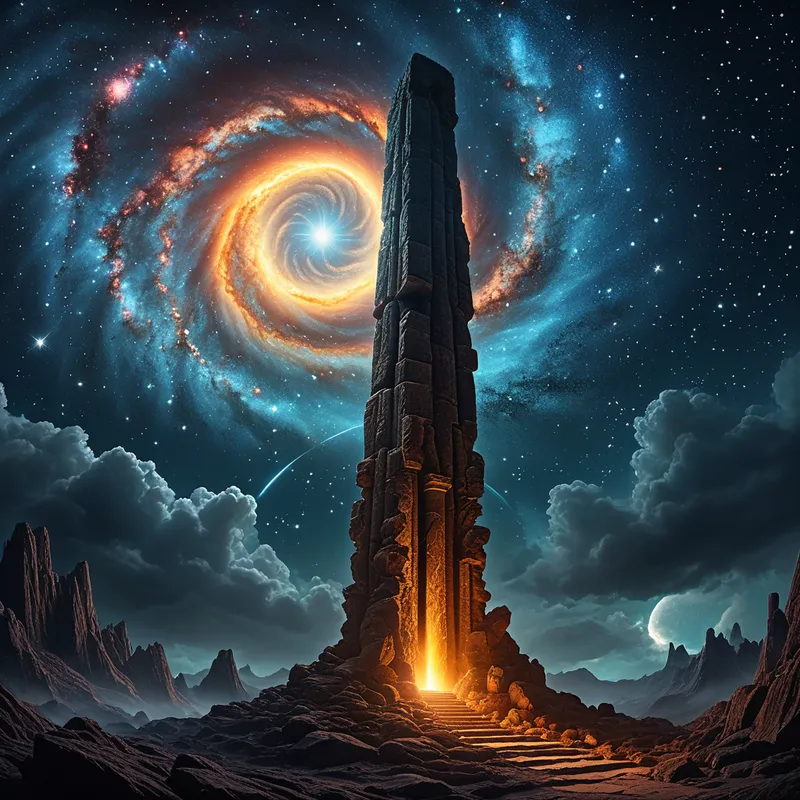
The Cosmic Axis Myth Meaning & Symbolism
A universal myth of the central pillar connecting all realms, representing the human quest for order, meaning, and connection between the conscious and unconscious.
The Tale of The Cosmic Axis
In the time before time, when the world was a formless, churning soup of shadow and potential, there was no up, no down. The heavens, heavy with unborn stars, pressed their weight upon the raw earth, while the deep places beneath groaned, hungry for light. Chaos was king. The gods, the ancestors, the first beings—they walked upon this unsteady ground and looked upon this cramped sky, and a great longing seized them. They longed for space to breathe, for a ladder to climb, for a foundation upon which to build the worlds.
And so, from the collective will of order, they summoned a great sacrifice. They took the essence of the first mountain, the breath of the first storm, and the silence of the first void, and they forged a pillar. Not with hammer and anvil, but with song and intention. They planted its base in the deepest, darkest waters of the abyss, the Tehom. They drove its shaft through the heart of the middle-earth, the world of mud and leaf and fleeting life. And they raised its peak to pierce the very vault of the sky-dome, the Firmament.
With a sound that was both a shattering and a birth-cry, the pillar held. The heavens, relieved of their crushing burden, soared upward into a vast and starry expanse. The earth, now firmly supported, spread out in all directions—forests, rivers, and mountains flowing from its center. And the underworld, the realm of ancestors and forgotten things, settled into its rightful depth. The pillar thrummed with a silent music. It was the first tree, the first mountain, the first ladder. It was the navel of the world, the Omphalos. The gods climbed it to convene in the high places. Shamans descended its hidden pathways to retrieve lost souls from the depths. Its roots drank from the waters of memory; its branches cradled the eggs of future suns. All things found their place in relation to its unwavering, central truth.

Cultural Origins & Context
The myth of the Axis Mundi is not the property of a single culture, but a profound archetypal pattern emerging independently across the globe. It is the ultimate "various" myth, a testament to a shared structure of human consciousness confronting the cosmos. For the Norse, it was the immense ash tree Yggdrasil, its roots in the wells of fate and its branches holding the nine worlds. In Siberian shamanism, it was the World Tree or a central pole, the turu, up which the shaman's soul would travel in ecstatic flight. The ancient Mesopotamians built their towering Ziggurats as artificial mountains linking earth to the domain of the gods. For the Indigenous peoples of the Americas, it was often the sacred central pole of the lodge culture.") or the village, the axis around which the community and the cosmos revolved.
This myth was not merely told; it was enacted, embodied, and built. It was passed down in the chants of shamans, the rituals of kings, and the very architecture of temples and cities. Its societal function was foundational: to establish cosmic order (cosmos) out of chaos, to provide a fixed point of orientation in a vast and often terrifying universe, and to create a conduit for communication—prayers ascending, blessings descending. It answered the most primal human questions: Where is the center? How do we reach the divine? Where do we belong?
Symbolic Architecture
At its core, the Cosmic Axis is a symbol of connection and mediation. It represents the psychic structure that bridges disparate realms of experience.
The Axis is the spine of the world, and by reflection, the backbone of the soul. It is the vertical dimension that interrupts the horizontal sprawl of mundane life.
Psychologically, it maps onto the structure of the Self. The celestial realm symbolizes the superconscious—the realm of ideals, spirit, and transcendent meaning. The earthly realm is the field of ego-consciousness, our daily identity and waking life. The underworld represents the unconscious, the repository of instincts, shadows, forgotten memories, and ancestral patterns. The Axis is the conduit that allows for a dynamic relationship between these levels. It is the pathway of inspiration (descending from above) and the pathway of integration (assimilating what lies below).
It also symbolizes centeredness and stability. In a psychological landscape that can feel fragmented and chaotic, the Axis represents the central, organizing principle of the psyche—what Jung called the Self. It is the inner compass, the unwavering truth around which the tumult of complexes and personas can reorganize.
The Dreamer's Resonance
When the pattern of the Cosmic Axis stirs in the modern dreamer, it often signals a profound process of recentering or a call to connect fragmented parts of the self. One might dream of a tremendous, unclimbable ladder appearing in their backyard, a colossal tree growing through the center of their childhood home, or a elevator that travels not to floors, but to radically different landscapes or eras.
Somatically, this can correspond to sensations in the spinal column—a feeling of alignment, a rush of energy, or conversely, a stiffening or pain, suggesting a blockage in this inner verticality. Psychologically, the dreamer is likely navigating a transition where old orientations have failed. The ego feels unmoored, caught between competing pressures (the "heavens" of ambition or spirit and the "underworld" of depression or unresolved past). The appearance of the Axis is the psyche's innate blueprint for re-establishing order. It is an invitation to find one's own center, to build an internal pillar of values and awareness that can hold the tension between the heights one aspires to and the depths one must acknowledge.
Alchemical Translation
The myth of the Cosmic Axis models the alchemical process of individuation—the journey toward psychic wholeness. The initial state is chaos: the inner world feels compressed, conflicted, without hierarchy or meaning (the unseparated heavens and earth). The first, crucial operation is the establishment of the axis: the conscious decision to seek order, to commit to self-knowledge, to "plant one's stake" in the center of one's being. This is an act of will and sacrifice, requiring one to hold a steady intention amidst inner turmoil.
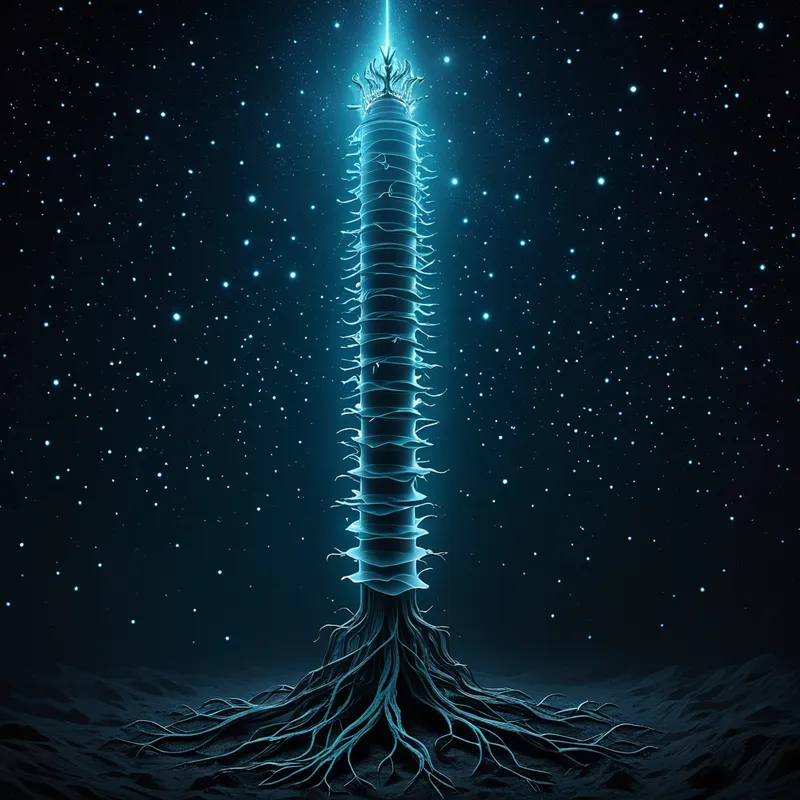
Individuation is not a horizontal journey outward, but a vertical excavation and ascent. One must sink roots into the personal and collective shadow to support a crown that touches the transpersonal light.
The subsequent work is the ascent and descent along this inner axis. The "ascent" involves integrating insights, ideals, and spiritual awareness (the celestial) into one's conscious attitude, lifting the ego's perspective. The "descent" involves the courageous exploration of the unconscious—facing repressed memories, complexes, and instinctual drives (the underworld), bringing them into the light of consciousness to be integrated. This creates a circulating energy, a circumambulatio around the center. The Axis itself, the embodied Self, becomes the stable witness that is no longer identified solely with the heights of spirit, the struggles of the ego, or the depths of the shadow, but contains and connects them all. The triumph is not in reaching a final destination, but in becoming the living pillar—a connected, grounded, and transcendent being, oriented in the vastness of one's own soul.
Associated Symbols
Explore related symbols from the CaleaDream lexicon: